
A watch is more than a timekeeping device—it’s a tool. For decades, mechanical and dive watches have featured one of the most functional yet underutilized components: the rotating bezel. Whether you own a classic dive watch, a pilot’s chronometer, or a modern field timepiece, understanding how to use the bezel transforms your watch from a passive accessory into an active instrument. Despite its presence on countless models, many wearers never engage with the bezel beyond admiring its design. This guide demystifies the rotating bezel, explaining its types, functions, and real-world applications so you can use it with precision and confidence.
Understanding the Rotating Bezel: Types and Functions
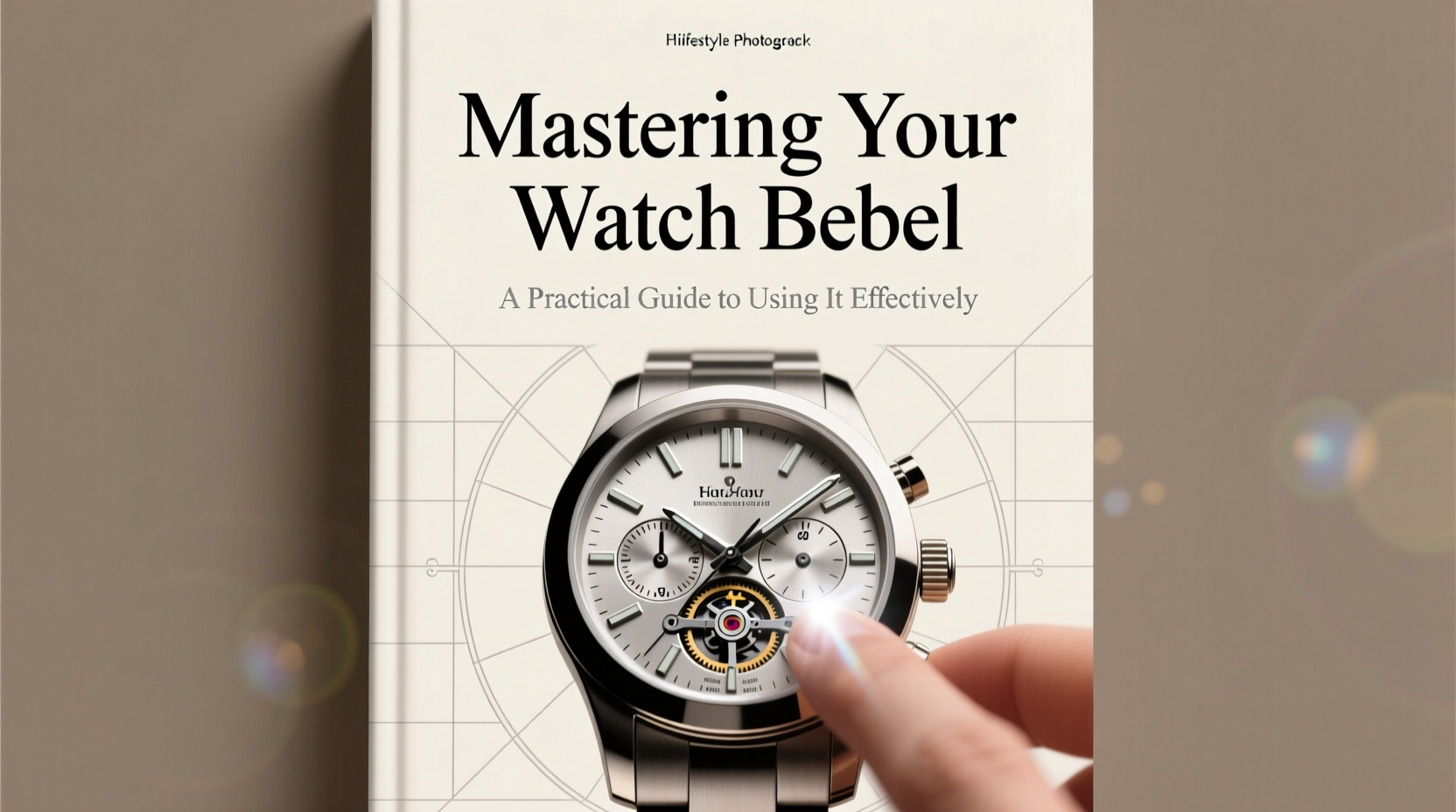
The rotating bezel is a ring around the watch crystal that turns either unidirectionally (most commonly counterclockwise) or bidirectionally. Its primary purpose is to track elapsed time or assist in specialized calculations. While often associated with dive watches, bezels serve roles across aviation, military operations, and everyday time management.
There are several common types:
- Dive Bezel (Unidirectional): Found on dive watches, it rotates only counterclockwise to prevent accidental over-rotation during dives. Used to monitor bottom time.
- Elapsed Time Bezel (Bidirectional): Allows free rotation in both directions. Ideal for general timing tasks like cooking, meetings, or workouts.
- GMT Bezel: Paired with a 24-hour hand, it helps track a second time zone—common on traveler’s watches.
- Tachymeter Bezel: Marked with non-linear scales, it calculates speed based on travel time over a fixed distance.
- Slide Rule Bezel (Pilot’s Bezel): Found on flight watches like the Breitling Navitimer, it performs multiplication, division, fuel consumption, and airspeed calculations.
How to Use a Dive Bezel: A Step-by-Step Guide
The dive bezel is perhaps the most critical safety feature on a dive watch. It allows divers to track their remaining no-decompression time without relying on electronics.
- Before entering the water, align the zero marker (luminous pip) on the bezel with the current minute hand.
- As you descend, the minute hand moves forward, and the bezel remains fixed, showing elapsed time via the scale.
- To read elapsed time, note where the minute hand sits relative to the bezel’s minute markings (typically up to 60 minutes).
- For example, if the minute hand points to the “20” mark on the bezel, 20 minutes have passed since descent.
- Plan your ascent accordingly, ensuring you stay within safe limits based on depth and dive tables.
This system works even if the watch stops underwater—the last known position still indicates elapsed time. Because the bezel only turns counterclockwise, any accidental bump will make the timer indicate *more* elapsed time than actual, promoting conservative, safer behavior.
Practical Applications Beyond Diving
While designed for divers, the bezel’s utility extends far beyond underwater exploration. With a bit of practice, it becomes a silent assistant in daily life.
Timing Daily Tasks
Use the bidirectional bezel to time anything from coffee brewing to meeting durations. Rotate the bezel so the “0” aligns with the current minute hand. When the minute hand reaches a specific number on the bezel, that amount of time has passed.
Navigating with a 24-Hour Bezel
On GMT watches, the 24-hour bezel can represent home time or a destination zone. If your second hand tracks UTC, rotate the bezel so “00” aligns with the hand. Then, each hour mark corresponds to local time in 24-hour format—useful for pilots or frequent travelers.
Measuring Speed with a Tachymeter
A tachymeter scale calculates average speed over a known distance (e.g., one mile or kilometer). Start the chronograph as you pass a starting point. Stop it when you reach the next mile marker. The chronograph seconds hand will point to a value on the tachymeter scale indicating speed in units per hour.
“Timekeeping tools like the bezel were born from necessity—divers, pilots, and soldiers needed reliable, mechanical solutions. Today, they offer us a tactile connection to precision.” — Daniel Reeves, Horological Historian & Curator at the Geneva Watch Museum
Bezel Use Checklist: Master Your Timing Tool
- Identify your bezel type (dive, elapsed, tachymeter, etc.)
- Ensure the crown is secure before rotating
- Align the zero marker with the current minute hand to start timing
- Read elapsed time by checking the minute hand’s position against the bezel scale
- Practice in low-risk scenarios (cooking, walking, driving) before relying on it in critical situations
- Clean the bezel regularly to prevent grit buildup that affects smooth rotation
Real-World Example: Using the Bezel During a Trail Run
Consider Sarah, an avid trail runner who wears a field watch with a bidirectional elapsed time bezel. She begins her run at 7:15 a.m. Before setting off, she rotates the bezel so the “0” lines up with the minute hand. Her goal is to complete each mile in under 9 minutes. After the first mile, she glances at her watch: the minute hand rests at the “8” mark on the bezel. She’s on pace. At mile three, the hand hits “25”—just under her target of 27 minutes. No buttons pressed, no digital interface. Just intuitive, mechanical feedback.
In another scenario, a sailor uses his dive bezel not for diving but to time tacking intervals during a coastal race. Every 12 minutes, he adjusts course. By pre-setting the bezel at the start of each leg, he maintains rhythm without distraction.
Common Mistakes and How to Avoid Them
| Mistake | Consequence | Solution |
|---|---|---|
| Using a unidirectional bezel bidirectionally | Impossible on most models; attempting force can damage mechanism | Respect the rotation direction—especially on dive watches |
| Forgetting to reset the bezel | Next timing session starts with incorrect baseline | Always return the zero marker to the minute hand after use |
| Confusing tachymeter readings with elapsed time | Incorrect speed calculation | Remember: tachymeter only works with chronograph and fixed distances |
| Operating bezel with crown pulled out | Potential misalignment or water ingress | Ensure crown is fully seated before turning the bezel |
Frequently Asked Questions
Can I use the bezel on a non-dive watch for diving?
No. While some watches have cosmetic bezels that look like dive bezels, only ISO 6425-certified dive watches guarantee proper functionality and safety. These include unidirectional rotation, luminous markers, and minimum water resistance of 100 meters. Never rely on a fashion watch for actual diving.
Why does my dive bezel only turn counterclockwise?
This is a critical safety feature. If the bezel is accidentally bumped during a dive, it will only move in a direction that increases the displayed elapsed time. This conservative error ensures you don’t mistakenly believe you have more no-decompression time left than you actually do.
Do all rotating bezels click into place?
Most do. High-quality dive and pilot watches feature ratcheted bezels with distinct clicks (usually every minute or five minutes) for precise adjustments. Some luxury models offer smoother, friction-based rotation, but these are less common in tool watches due to reduced accuracy under gloves or wet conditions.
Conclusion: Make the Bezel Part of Your Routine
The watch bezel is a marvel of analog engineering—a simple, durable solution to complex timing challenges. Whether you’re underwater, in the cockpit, or simply boiling eggs, it offers a silent, immediate way to measure time without distractions. Mastery doesn’t require technical expertise, only awareness and repetition. Begin by using it for small, everyday tasks. Over time, it becomes instinctive. You’ll find yourself reaching for your watch instead of your phone, appreciating the elegance of mechanical precision in a digital world.




 浙公网安备
33010002000092号
浙公网安备
33010002000092号 浙B2-20120091-4
Comments
No comments yet. Why don't you start the discussion?