
The S78 speaker has earned a reputation for delivering crisp, dynamic audio in compact form—ideal for mobile DJs, podcasters, outdoor event hosts, and audiophiles on the move. But raw hardware potential means little without proper integration into your system. Whether you're setting up in a park, café, or at a small venue, how you use these speakers directly impacts clarity, depth, and overall listening experience. This guide breaks down the real-world practices that unlock the full sonic capability of the S78 in portable environments.
Understanding the S78 Speaker’s Strengths
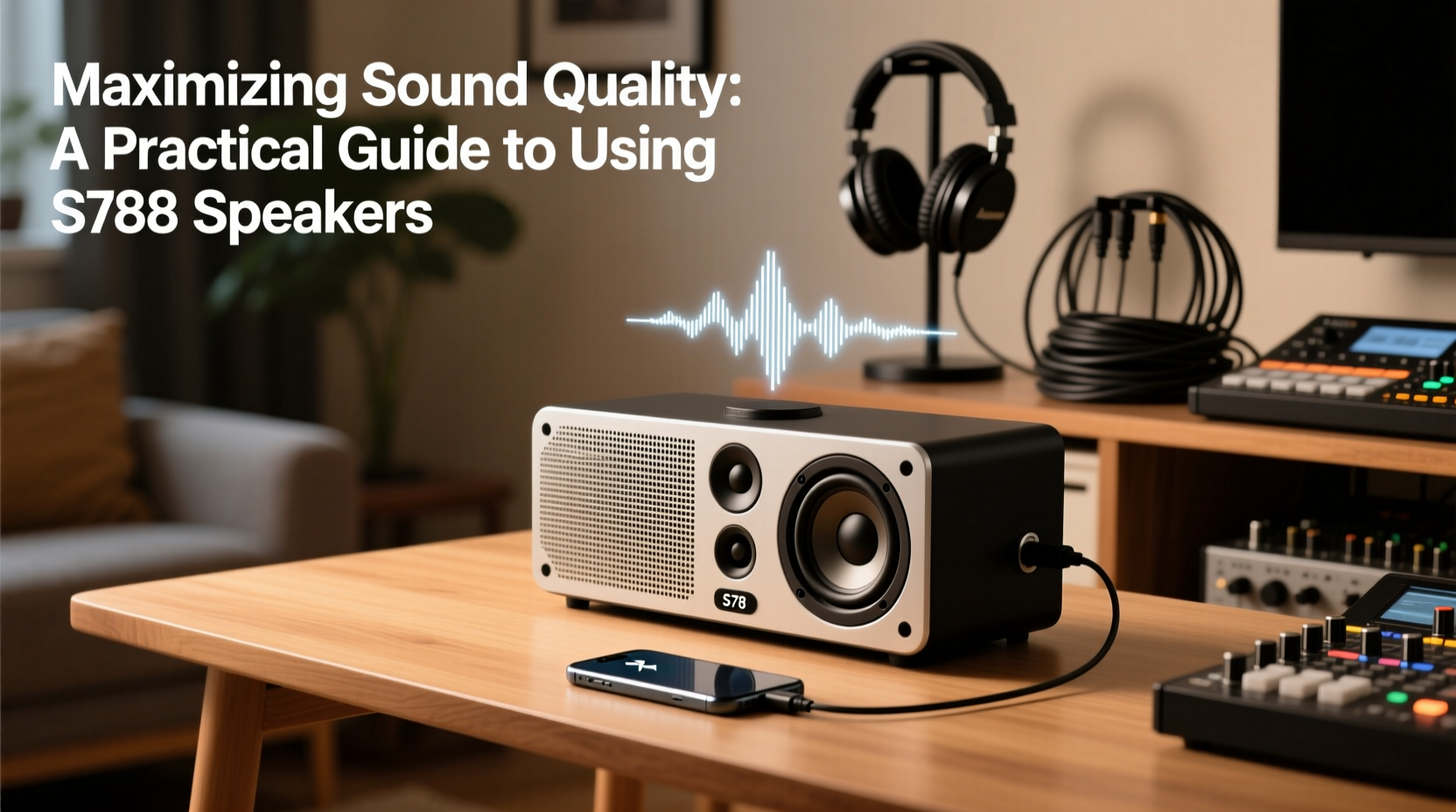
The S78 is engineered for balanced output across frequencies, featuring a 6.5-inch woofer, 1-inch tweeter, and a built-in passive crossover. With a frequency response range of 55 Hz to 20 kHz and a peak output of 120 dB, it handles both bass-heavy tracks and vocal-centric content with precision. Its portability—lightweight design and durable ABS plastic housing—makes it ideal for transport, but performance hinges on more than just specs.
What sets the S78 apart in field applications is its sensitivity rating of 90 dB (1W/1m), meaning it efficiently converts amplifier power into volume. This efficiency becomes critical when operating off limited battery sources or lower-powered mixers in remote setups.
“Portable doesn’t have to mean compromised. The S78 delivers studio monitor-level accuracy when paired correctly and positioned with intent.” — Rafael Mendez, Live Sound Engineer & Audio Consultant
Optimal Pairing: Matching Sources and Amplification
No speaker performs beyond the limits of its signal chain. To maximize fidelity, ensure your source and amplification components are aligned with the S78’s capabilities.
The S78 is a passive speaker, requiring an external amplifier. For portable use, this typically means a powered mixer or a lightweight Class D amp. Choose an amplifier that provides 150–300 watts per channel at 8 ohms—the sweet spot for clean headroom without risk of clipping or underpowering.
Digital sources like smartphones, laptops, or audio interfaces should connect via balanced XLR or TRS outputs whenever possible. If using unbalanced RCA or 3.5mm connections, keep cable runs short (under 10 feet) to minimize noise interference.
Signal Chain Checklist
- Source device with line-level output (mixer, interface, media player)
- Balanced cables (XLR or TRS) from source to amp
- Speaker wire (14–16 gauge) from amp to S78
- Power supply or battery pack rated for continuous amp draw
- Optional: DSP unit for EQ and limiting in high-volume scenarios
Strategic Placement for Clarity and Coverage
In portable setups, speaker placement often takes a backseat to convenience. Yet, where you position the S78 dramatically affects perceived sound quality.
For even coverage, place each S78 at ear level when audiences are standing—ideally on stands between 5 and 6 feet tall. Angling the speakers inward at a 30-degree angle creates a focused stereo image at the center listening position. Avoid placing them face-up on tables or the ground; this causes bass buildup and muffled highs due to floor reflections.
When outdoors, face the speakers away from large reflective surfaces like walls or vehicles. These can cause comb filtering—where delayed reflections cancel out certain frequencies—resulting in hollow or thin sound.
| Placement Condition | Recommended Practice | Risk if Ignored |
|---|---|---|
| Indoors (small room) | Position 3 ft from wall, angled toward audience | Bass resonance and feedback |
| Outdoors (open space) | Elevate on stands, avoid ground placement | Lack of clarity, volume loss |
| Near reflective surfaces | Angle away or reposition | Phase cancellation, muddy sound |
| Asymmetric environment | Aim center speaker cluster at main audience zone | Uneven sound distribution |
Step-by-Step Setup for Field Deployment
Follow this sequence to ensure optimal performance every time you deploy your S78s in a portable configuration:
- Park and assess: Arrive early to evaluate the space. Note audience size, surface types, and available power sources.
- Position speaker stands: Set up stands where listeners will gather, ideally forming an equilateral triangle between the two speakers and the primary listening point.
- Connect in order: Link source → amplifier → speakers. Power on in reverse order: amp last, off first.
- Set initial gain: Start with all gains at minimum. Play reference track (e.g., well-mixed song with vocals and drums). Gradually increase until output is clear and distortion-free.
- Adjust EQ sparingly: If the room feels boomy, reduce low-mid frequencies (around 250 Hz). If harsh, cut slightly at 3–4 kHz.
- Test at volume: Run sound check at expected performance level to catch feedback or driver strain.
- Monitor during use: Watch for thermal shutdown signs—distortion, dropouts—which suggest amp overload.
Real-World Example: Mobile Podcast Tour
Jess Lin, host of the travel podcast *Open Road Dialogues*, uses a pair of S78s to play live audience segments during her cross-country tour. At each stop, she sets up in cafes, libraries, and community centers with variable acoustics.
Initially, she placed the speakers on tables near the host table. Attendees complained about uneven volume and “tinny” vocals. After consulting a sound technician, Jess elevated the S78s on stands behind the stage area, angled toward the center of the room. She also added a compact digital mixer with a high-pass filter to eliminate subsonic rumble from HVAC systems.
The result? Clearer dialogue reproduction, consistent volume across rows, and no feedback—even in echo-prone spaces. “I didn’t change my content,” Jess said. “But suddenly, people said, ‘Your show sounds so professional now.’ It was all about the speakers’ placement and signal chain hygiene.”
Common Pitfalls and How to Avoid Them
Even experienced users make mistakes that degrade sound quality. Here are frequent errors and their solutions:
- Underpowering the speakers: Running an amp below 150W increases clipping risk as users crank volume. Use an amp within the recommended wattage range.
- Using long, thin speaker cables: Thin gauge wires over 25 feet cause power loss. Stick to 14-gauge cable for runs over 15 feet.
- Ignoring ambient noise: In windy or loud environments, boosting volume masks clarity. Instead, improve directionality by focusing speaker angles and raising height.
- Daisy-chaining multiple speakers: Connecting two S78s in series can double impedance load and reduce output. Use parallel wiring or a multi-channel amp for independent control.
Frequently Asked Questions
Can I use the S78 with a Bluetooth mixer?
Yes, provided the mixer has balanced outputs and sufficient power. Bluetooth itself doesn’t degrade sound if the source is high-quality and the mixer processes the signal cleanly before amplification.
Do I need a subwoofer with the S78?
For music with deep bass (e.g., electronic, hip-hop), adding a powered subwoofer enhances low-end response. The S78 reaches 55 Hz, but a sub extends performance below 50 Hz and reduces strain on the main drivers.
How do I protect the S78 during transport?
Use custom foam-lined cases or padded gig bags. Always remove cables and store them separately. Avoid temperature extremes—leaving speakers in a hot car can warp enclosures and degrade adhesives.
Final Thoughts: Quality Is in the Details
The S78 speaker is not just a tool—it’s a platform for high-fidelity sound in motion. Its true potential emerges not from isolated specs, but from thoughtful integration: correct amplification, intelligent placement, and disciplined signal management. Portable audio doesn’t have to mean compromise. By treating each deployment as an acoustic environment to be shaped, rather than merely filled with sound, you elevate the listener’s experience from adequate to exceptional.




 浙公网安备
33010002000092号
浙公网安备
33010002000092号 浙B2-20120091-4
Comments
No comments yet. Why don't you start the discussion?