
In the world of formal attire, accessories are more than just complements—they're silent communicators of taste, status, and intention. Among these, the wristwatch stands out as one of the most personal and expressive pieces a man or woman can wear. But today, a critical question arises: in the context of black-tie galas, boardroom meetings, or high-society weddings, does a mechanical watch still reign supreme over its digital counterpart—the smartwatch?
The answer isn’t simply about function or fashion. It’s about symbolism, tradition, and the subtle language of presence. A well-chosen timepiece at a formal event doesn’t just tell time—it tells a story about who you are, what you value, and how seriously you take the occasion.
The Language of Formality: What Your Watch Says About You
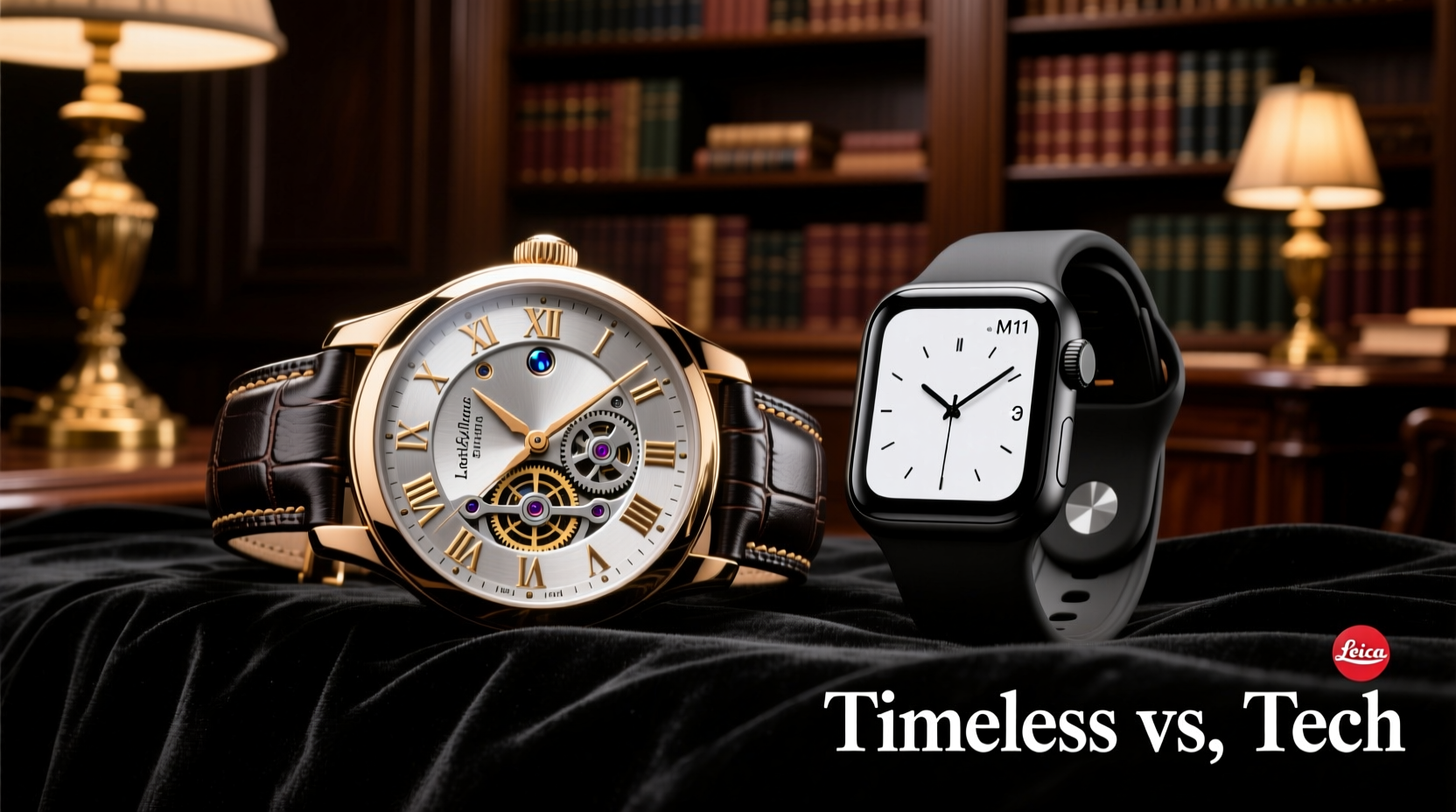
Formal events operate under an unspoken code. While dress codes may specify “black tie” or “cocktail attire,” they rarely mention watches. Yet, the choice of timepiece speaks volumes before a word is even spoken. A mechanical watch—crafted from stainless steel, gold, or platinum, with a sapphire crystal face and a hand-stitched leather strap—carries connotations of heritage, craftsmanship, and permanence. It suggests patience, appreciation for detail, and respect for tradition.
In contrast, a smartwatch, no matter how sleek or premium its design, broadcasts connectivity, immediacy, and modernity. Its glowing screen pulses with notifications, reminders, and biometric data—a constant reminder of the outside world. At a dinner where conversation flows and phones are tucked away, a vibrating wrist can feel like a breach of decorum.
“Wearing a mechanical watch to a formal event is akin to choosing a fountain pen over a smartphone for signing a contract. It’s not about efficiency—it’s about intention.” — Julian Hartwell, Horology Curator at The British Watch Museum
Functional Differences That Shape Perception
To understand why one watch might make a stronger statement than the other, it helps to examine their core differences—not just in mechanics, but in social optics.
| Feature | Mechanical Watch | Smartwatch |
|---|---|---|
| Power Source | Manual winding or automatic rotor | Battery (recharged daily/weekly) |
| Display | Analog hands, minimalist dial | Digital screen, customizable faces |
| Notification Handling | None | Vibrations, sounds, pop-ups |
| Lifespan | Decades with maintenance | 3–5 years average |
| Social Signal | Prestige, tradition, focus | Connectivity, efficiency, accessibility |
| Formality Fit | High (especially dress watches) | Low to moderate (even in luxury models) |
The table illustrates a fundamental divide: mechanical watches are designed to blend into elegance, while smartwatches are built to stand out with utility. This distinction becomes crucial when entering environments where subtlety is prized.
When a Mechanical Watch Makes the Stronger Statement
A mechanical watch shines brightest in settings where time seems to slow down and presence matters more than productivity. Think of a charity ball, a diplomatic reception, or a wedding in a historic venue. In these moments, wearing a mechanical timepiece signals that you are fully engaged, unhurried, and respectful of the ritual.
High-end mechanical watches—such as those from Patek Philippe, Jaeger LeCoultre, or A. Lange & Söhne—are often heirloom pieces, passed down through generations. Their very existence implies continuity and legacy. Wearing one to a formal event subtly aligns you with those values.
Moreover, the craftsmanship involved in creating a mechanical movement—sometimes requiring hundreds of tiny components assembled by hand—is a testament to human ingenuity. This artistry is lost on a device whose primary purpose is to sync with your smartphone.
Real Example: The Boardroom Meeting
Consider Daniel Reyes, a 42-year-old investment banker based in London. Invited to pitch to a conservative German client known for valuing discretion and tradition, Daniel opted for his vintage 1968 Omega Seamaster over his Apple Watch Series 9. During the meeting, the client—a man in his late 60s—briefly glanced at Daniel’s wrist, nodded slightly, and later commented, “I appreciate when someone takes the time to get the details right.”
The watch didn’t win the deal alone, but it contributed to an impression of reliability and cultural sensitivity. In contrast, had Daniel worn a smartwatch lighting up with Slack messages, it might have signaled distraction or impatience.
Where Smartwatches Can Still Make a Statement—Carefully
It would be shortsighted to dismiss smartwatches entirely in formal contexts. For certain professionals—doctors on call, executives managing global teams, or speakers monitoring their presentation timer—a smartwatch offers discreet functionality that a mechanical piece cannot match.
Luxury hybrid models like the TAG Heuer Connected or the Montblanc Summit 3 blur the line between analog aesthetics and digital capability. These watches feature refined designs with polished cases, leather straps, and minimalistic watch faces that mimic traditional dials. When set to a classic analog display and silenced, they can pass as elegant accessories—even if their soul remains digital.
The key lies in restraint. A smartwatch makes a positive statement not through its technology, but through how quietly it operates. The message shifts from “I’m always online” to “I’m prepared, but present.”
“The future of formal wear isn’t about rejecting technology—it’s about mastering its subtlety.” — Dr. Lila Nguyen, Fashion Tech Ethnographer at MIT Media Lab
Checklist: Choosing the Right Watch for a Formal Event
- ✅ Assess the event’s tone: Is it ceremonial, business-formal, or semi-social?
- ✅ Consider your role: Are you a guest, speaker, host, or professional attendee?
- ✅ Evaluate necessity: Do you genuinely need real-time notifications?
- ✅ Opt for minimalism: If wearing a smartwatch, choose a neutral band and analog face.
- ✅ Silence all alerts: Disable vibrations and sounds to avoid disruptions.
- ✅ Prioritize materials: Stainless steel, leather, or ceramic looks more formal than silicone or aluminum.
- ❌ Avoid bright screens, animated faces, or fitness tracking displays during dinners or speeches.
Step-by-Step Guide: Transitioning from Smart to Formal Timekeeping
If you’re accustomed to relying on a smartwatch daily but want to elevate your presence at formal occasions, follow this transition plan:
- Week 1: Acquire a dress watch – Start with an affordable yet elegant model (e.g., Tissot, Hamilton, or Nomos). Look for slim profiles, white or black dials, and leather straps.
- Week 2: Practice time-checking etiquette – Instead of glancing frequently, train yourself to check the time less often. Use ambient clocks or subtle wrist tilts.
- Week 3: Leave the smartwatch at home during evenings – Replace it with your mechanical watch during dinners, dates, or social gatherings.
- Week 4: Observe reactions – Note compliments, questions, or changes in how people engage with you. Many report being perceived as more attentive or composed.
- Ongoing: Rotate based on context – Use your smartwatch for workouts, travel, and workdays; reserve the mechanical piece for formal or meaningful events.
Frequently Asked Questions
Can I wear an Apple Watch Ultra to a wedding?
While technically possible, the Apple Watch Ultra—with its rugged titanium case, orange rubber band, and dive bezel—is designed for outdoor adventure, not formal elegance. It risks appearing out of place unless the wedding is casual or outdoors. If you must wear it, switch to a black leather band and a classic watch face, and silence all notifications.
Is a smartwatch disrespectful at a funeral?
Yes, in most cultural contexts, wearing an active smartwatch to a funeral can be seen as disrespectful. Vibrations, screen glows, or visible notifications during eulogies or prayers disrupt solemnity. If you need health monitoring (e.g., heart rate), ensure the device is in silent mode and kept out of sight. A simple analog watch is a more appropriate choice.
Do younger professionals still value mechanical watches?
Surprisingly, yes—and increasingly so. A 2023 survey by Hodinkee found that 68% of professionals under 35 view a mechanical watch as a symbol of achievement. While they may own smartwatches for daily use, many save for or receive a mechanical timepiece as a milestone gift—graduation, promotion, or engagement.
The Final Word: Making a Statement Beyond Timekeeping
At its core, the choice between a mechanical watch and a smartwatch at a formal event is not about accuracy or features. It’s about alignment—with the moment, the company, and your own values. A mechanical watch says, “I am here, and I honor this occasion.” A smartwatch, even in stealth mode, whispers, “I am here, but part of me is elsewhere.”
This doesn’t mean rejecting technology. It means choosing when to be connected and when to be present. In a world saturated with digital noise, the quiet tick of a mechanical movement can be the most powerful statement of all: one of focus, refinement, and timeless confidence.




 浙公网安备
33010002000092号
浙公网安备
33010002000092号 浙B2-20120091-4
Comments
No comments yet. Why don't you start the discussion?