
In an era where technology evolves at breakneck speed, the debate between tradition and innovation extends to the wrist. Mechanical watches and smartwatches represent two ends of a spectrum—one rooted in craftsmanship, the other in connectivity. But when it comes to long-term value retention, one clearly outperforms the other. While both serve as personal accessories and status symbols, their financial trajectories diverge sharply after purchase.
A new $500 smartwatch may lose half its resale value within a year. Meanwhile, a well-maintained mechanical timepiece—even one priced similarly—can appreciate or at least maintain its worth over decades. This article examines the factors that influence value retention in each category, explores real-world examples, and provides actionable insights for those considering a long-term investment in horology.
The Depreciation Curve: Smartwatches vs Mechanical Watches
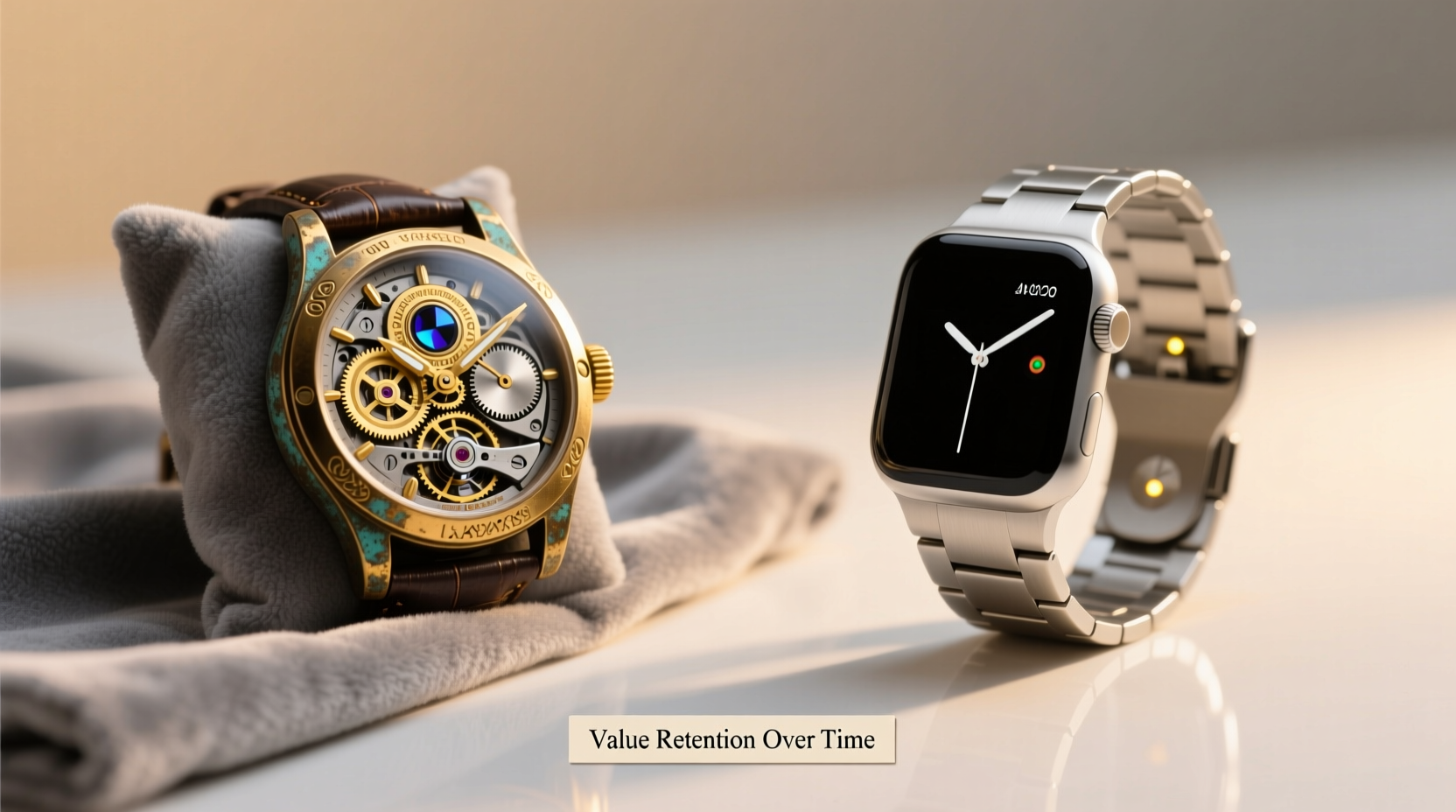
From the moment a smartwatch leaves the store, its value begins to decline rapidly. Most models follow a steep depreciation curve due to technological obsolescence, software limitations, and battery degradation. In contrast, mechanical watches often experience minimal depreciation if they are from reputable brands, kept in good condition, and serviced regularly.
Consider this: Apple Watch Series 9, retailing at around $400–$700 depending on configuration, typically sells for 40–60% less just one year later on secondary markets. By comparison, a Rolex Oyster Perpetual, introduced at approximately $6,000, frequently trades above retail price due to demand and limited availability.
Why Mechanical Watches Hold Value Better
Mechanical watches are not merely tools for telling time; they are miniature works of engineering art. Their ability to hold—or even increase—value stems from several interrelated factors:
- Limited production runs: Brands like Patek Philippe, Audemars Piguet, and Vacheron Constantin produce only a few thousand pieces annually, creating scarcity.
- Hand craftsmanship: Many high-end mechanical movements are assembled by master watchmakers using techniques unchanged for centuries.
- Brand heritage: A legacy spanning generations enhances desirability and perceived prestige.
- Timeless design: Unlike digital interfaces that age quickly, classic watch dials remain stylish across decades.
- Serviceability: With proper maintenance every 5–7 years, a mechanical watch can last generations.
“Unlike consumer electronics, fine watches are built to transcend trends. They’re heirlooms, not gadgets.” — James Kimball, Independent Horological Appraiser
This enduring nature allows certain models to become collectibles. For example, the Rolex Submariner ref. 16610, discontinued in 2010, now commands prices upwards of $15,000 despite originally retailing under $5,000.
Why Smartwatches Lose Value So Quickly
Smartwatches operate under the constraints of modern tech economics: rapid iteration, planned obsolescence, and reliance on external ecosystems. These factors make them poor candidates for long-term value retention.
New models are released almost annually, each boasting faster processors, improved sensors, longer battery life, or updated operating systems. As soon as a newer version launches, older models become less desirable—even if functionally adequate.
Beyond hardware, software support plays a critical role. Most manufacturers provide OS updates for only 3–5 years. Once a smartwatch stops receiving security patches or app compatibility, its utility diminishes significantly.
Battery degradation is another unavoidable issue. Lithium-ion cells degrade over time, and replacing them often costs more than the device’s residual value. Combine this with fragile OLED screens and proprietary charging systems, and you have a product designed for replacement rather than preservation.
Case Study: Two Watches, Ten Years Apart
Imagine two individuals purchasing watches in 2014:
- John buys a Samsung Gear S ($399), attracted by its curved AMOLED display and standalone LTE capability. By 2016, it's outdated. By 2018, no longer supported. Today, it has no resale market beyond niche collectors of obsolete tech.
- Sarah buys a Jaeger LeCoultre Master Control ($8,500), appreciating its understated elegance and in-house Caliber 899 movement. She services it every six years. In 2024, her watch remains fully functional, sought after, and valued between $7,000 and $9,000 depending on condition and provenance.
The divergence in value trajectory couldn’t be starker. One became electronic waste; the other, a family heirloom.
Comparative Analysis: Key Factors Side-by-Side
| Factor | Mechanical Watch | Smartwatch |
|---|---|---|
| Initial Depreciation (Year 1) | 10–20% (luxury), up to 40% (entry-level) | 50–70% |
| Long-Term Resale Potential | High (for premium/limited editions) | Negligible after 3–5 years |
| Service Life | Decades with maintenance | 3–7 years (battery/software limits) |
| Repair Accessibility | Global network of watchmakers | Manufacturer-dependent; often uneconomical |
| Emotional & Cultural Value | Strong (gifts, milestones, legacy) | Moderate (convenience, fitness tracking) |
| Technological Obsolescence Risk | None | Very High |
Exceptions and Nuances
Not all mechanical watches gain value, nor are all smartwatches doomed to zero worth. There are nuances worth noting.
While luxury Swiss brands dominate the appreciation market, many mid-tier mechanical watches also depreciate initially before stabilizing. A Tissot or Hamilton might retain 50–60% of its value after five years—better than most smartwatches but far below Rolex or Patek levels.
On the flip side, rare or first-edition smartwatches occasionally develop cult followings. The original Pebble Time, discontinued in 2016, sometimes sells for $100+ among retro-tech enthusiasts. However, these cases are exceptions driven by nostalgia, not intrinsic quality or longevity.
Additionally, hybrid smartwatches—devices like the Withings ScanWatch—that blend analog aesthetics with basic digital functionality—tend to age better than full-touchscreen models. Their simpler electronics and traditional appearance help them stay relevant longer.
How to Maximize Value Retention (Regardless of Type)
Whether you own a mechanical masterpiece or a cutting-edge smartwatch, certain practices can slow depreciation and preserve usability.
Step-by-Step Guide to Preserving Watch Value
- Purchase from Reputable Brands: Stick to manufacturers known for build quality and service networks—e.g., Rolex, Omega, Garmin, Apple.
- Keep Original Packaging: Boxes, papers, warranty cards, and manuals significantly boost resale value, especially for mechanical watches.
- Maintain Service Records: Document every cleaning, oil change, or battery replacement. Full service history increases buyer confidence.
- Limit Wear and Exposure: Avoid extreme temperatures, moisture (beyond rated resistance), and impacts. Rotate watches to reduce wear.
- Store Properly: Use a soft pouch or watch box. For automatics, consider a winder if not worn weekly.
- Upgrade Thoughtfully: With smartwatches, delay upgrades until necessary. Frequent trading accelerates loss.
“Provenance matters. A watch with documented ownership history and care logs sells faster and for more.” — Clara Nguyen, Auction Specialist at Hodinkee Timepiece Auctions
Checklist: Is Your Watch a Good Long-Term Investment?
Use this checklist to evaluate potential value retention before buying:
- ☐ Is the brand recognized for quality and heritage?
- ☐ Does it have a strong secondary market presence?
- ☐ Are spare parts and servicing widely available?
- ☐ Is the design timeless rather than trendy?
- ☐ For smartwatches: Does the manufacturer commit to long-term software support?
- ☐ Can the battery be replaced affordably?
- ☐ Is it water-resistant and durable enough for daily use?
Frequently Asked Questions
Can any smartwatch hold value like a mechanical watch?
No current smartwatch matches the long-term value retention of even entry-level mechanical watches. While some limited editions (like the Hermès x Apple Watch) may command slight premiums briefly, none sustain value over decades. Technological decay ensures eventual obsolescence.
Do expensive smartwatches depreciate faster than cheaper ones?
Generally, higher-priced smartwatches lose more absolute value, but the rate of depreciation is similar across tiers. A $799 Apple Watch Ultra will lose proportionally as much value as a $249 Fitbit, though the former starts with a higher resale floor. Ultimately, price doesn’t protect against tech turnover.
Are vintage smartwatches collectible?
Only marginally. Devices like the Seiko Ruputer (1998) or Timex Datalink (1994) have niche appeal among tech historians, but they lack broad collector interest. Unlike vintage mechanical watches—which improve in value with age—vintage smartwatches are curiosities, not investments.
Conclusion: Choosing for the Future
When evaluating which type of watch holds value better over time, the answer is unequivocal: mechanical watches win decisively. Built to endure, crafted to inspire, and designed to outlive their owners, they represent a rare fusion of art and engineering. Smartwatches, while powerful tools for health, communication, and productivity, are inherently temporary—consumables in a cycle of constant renewal.
This doesn’t mean smartwatches are worthless. For functionality, convenience, and integration with modern life, they are unmatched. But if your priority is legacy, emotional resonance, or financial prudence over time, the mechanical watch remains peerless.




 浙公网安备
33010002000092号
浙公网安备
33010002000092号 浙B2-20120091-4
Comments
No comments yet. Why don't you start the discussion?