
In today’s fast-paced world, mental clarity and emotional balance are more valuable than ever. As interest in inner well-being grows, two terms consistently surface: meditation and mindfulness. Though often used interchangeably, they represent distinct practices with unique purposes, techniques, and outcomes. Understanding the nuances between them isn’t just academic—it can deepen your personal practice and help you choose the right tool for your goals.
Meditation is a structured discipline, typically practiced in dedicated sessions, aimed at training attention and awareness. Mindfulness, by contrast, is a quality of attention that can be applied throughout the day—during conversation, eating, walking, or even working. One is a formal exercise; the other is a way of being. Recognizing this distinction empowers individuals to integrate both into their lives with intention and precision.
Defining Meditation: A Structured Path to Inner Stillness
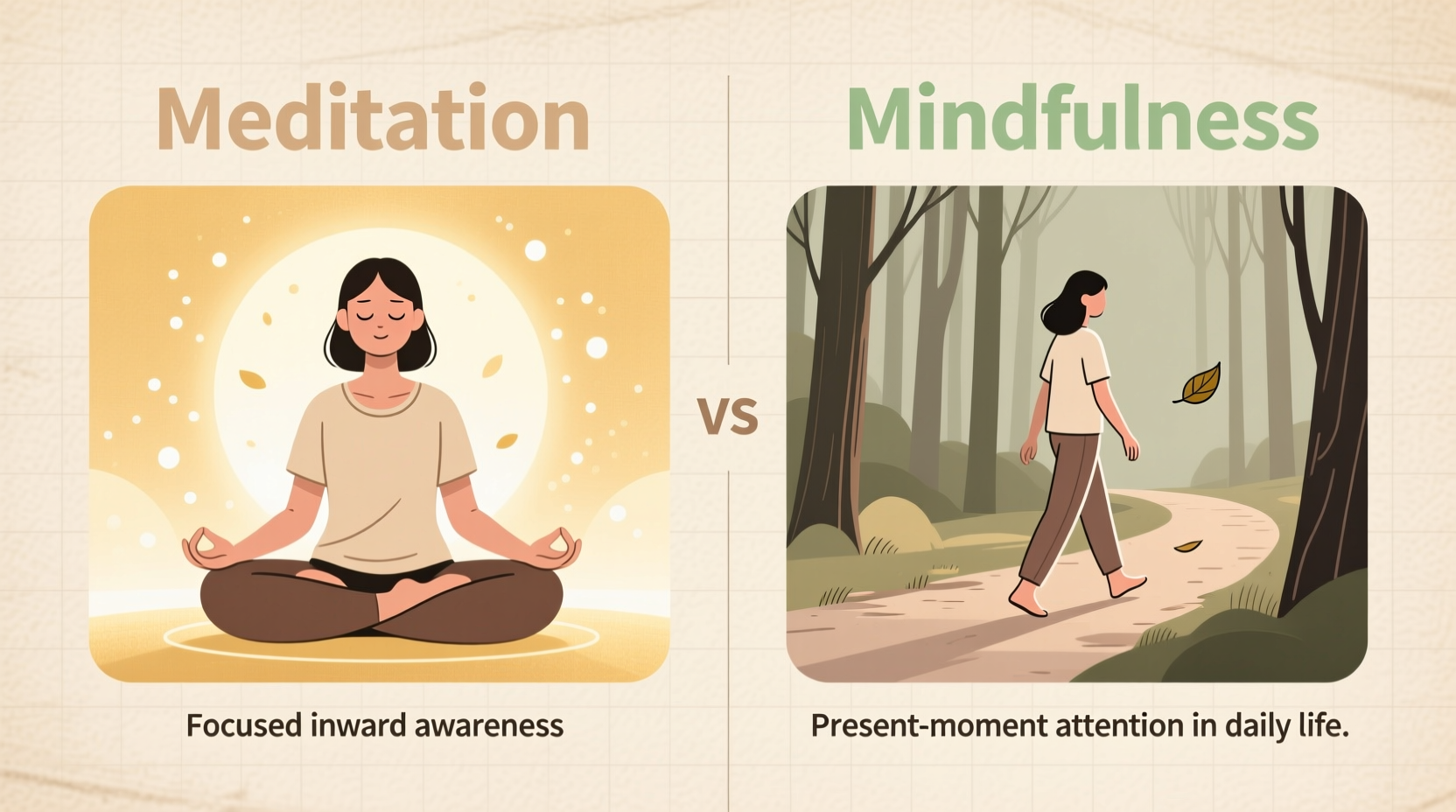
Meditation refers to a family of practices designed to cultivate mental focus, emotional regulation, and deeper self-awareness. It usually involves setting aside time—anywhere from five minutes to an hour—to sit quietly, often with eyes closed, and engage in a specific technique. These techniques vary widely across traditions but generally fall into categories such as concentration, visualization, mantra repetition, or breath awareness.
One of the most common forms is focused-attention meditation, where practitioners anchor their awareness on a single object—most often the breath. When the mind wanders (as it inevitably does), the meditator gently returns focus to the chosen anchor. This process strengthens cognitive control and reduces reactivity over time.
Other styles include loving-kindness (metta) meditation, which cultivates compassion through silent repetition of phrases like “May I be happy, may I be safe,” and transcendental meditation, which uses personalized mantras to settle the mind into a state of restful alertness.
The Science Behind Meditation
Neuroscientific research has shown that regular meditation leads to measurable changes in brain structure and function. Studies using fMRI scans reveal increased gray matter density in areas associated with memory, emotional regulation, and self-awareness—particularly in the hippocampus and prefrontal cortex. Long-term practitioners also show reduced activity in the default mode network, the brain system linked to mind-wandering and self-referential thoughts, often correlated with anxiety and depression.
“Meditation is not about stopping thoughts, but recognizing that we are more than our thoughts.” — Dan Harris, journalist and author of *10% Happier*
What Is Mindfulness? Awareness Woven Into Daily Life
Mindfulness is the psychological process of bringing full attention to experiences occurring in the present moment without judgment. Unlike meditation, which is typically practiced in isolation, mindfulness is meant to be lived. It’s about noticing the warmth of water on your hands while washing dishes, feeling each footstep during a walk, or listening deeply in a conversation without planning your response.
Jon Kabat-Zinn, who founded the Mindfulness-Based Stress Reduction (MBSR) program at the University of Massachusetts Medical School, defines mindfulness as “paying attention in a particular way: on purpose, in the present moment, and non-judgmentally.” This definition underscores intentionality and acceptance—two pillars of mindful living.
Practicing mindfulness doesn’t require sitting still or closing your eyes. Instead, it invites you to become an observer of your experience as it unfolds. For example, when stress arises at work, a mindful response would involve acknowledging the tension in your shoulders, noticing rapid breathing, and observing anxious thoughts—all without reacting impulsively.
How Mindfulness Differs from Meditation
While all mindfulness practices involve some form of meditation, not all meditation is mindfulness-based. Vipassana (insight) meditation, for instance, is explicitly designed to develop mindfulness through sustained observation of bodily sensations and mental phenomena. However, other forms like chanting, guided imagery, or chakra-focused meditations aim at different outcomes and don’t necessarily emphasize present-moment awareness.
Think of it this way: meditation is the gym session for your mind; mindfulness is how you carry that strength into everyday life. You might train focus during a 20-minute breath meditation, then apply that sharpened awareness when navigating a difficult conversation with a colleague.
Key Differences in Practice and Purpose
| Aspect | Meditation | Mindfulness |
|---|---|---|
| Setting | Formal, quiet space; often seated | Anytime, anywhere—integrated into activities |
| Duration | Structured sessions (5–60+ minutes) | Spontaneous moments or extended periods of awareness |
| Primary Goal | Cultivate focus, insight, or relaxation | Develop non-reactive awareness in the present |
| Techniques | Breath focus, mantras, body scans, visualization | Noticing sensations, thoughts, emotions as they arise |
| Outcome Focus | Inner transformation, spiritual growth, mental clarity | Improved attention, emotional regulation, reduced stress |
A Practical Guide to Building Both Practices
Integrating meditation and mindfulness into your routine doesn’t require drastic lifestyle changes. With small, consistent actions, you can build resilience, focus, and presence over time.
Step-by-Step: Starting a Combined Practice
- Begin with short meditation sessions – Choose a time each day (morning or evening works best for most) and commit to 5–10 minutes of breath-focused meditation. Use a timer and sit comfortably with a straight spine.
- Select a mindfulness trigger – Pick one daily activity (e.g., brushing teeth, drinking coffee, walking to the mailbox) to practice mindful awareness. During that activity, engage all your senses and notice what’s happening in real time.
- Label your experiences – As thoughts or emotions arise during meditation or daily life, silently note them: “thinking,” “worrying,” “hearing,” “aching.” This builds meta-awareness without getting caught in the content.
- Pause before reacting – When stressed, take three conscious breaths before responding. This creates space between stimulus and reaction—a hallmark of mindfulness.
- Reflect weekly – Journal briefly about what you noticed in meditation and where mindfulness showed up (or didn’t) during the week. Reflection deepens integration.
Real-Life Example: From Burnout to Balance
Sarah, a project manager in her mid-30s, was struggling with chronic stress and insomnia. She attended a weekend workshop on mindfulness and learned basic breath meditation. At first, she tried meditating for 20 minutes each night but found herself falling asleep or frustrated by distractions.
Her instructor suggested scaling back to five minutes in the morning and focusing on one mindful activity per day. Sarah chose her morning commute—instead of scrolling through emails, she paid attention to the sensation of driving: the grip of the steering wheel, the rhythm of traffic lights, the sounds around her.
Within three weeks, she noticed she was less reactive in meetings. When a team member missed a deadline, instead of snapping, she paused, recognized her rising frustration, and responded calmly. Her nightly meditation gradually extended to 15 minutes, and her sleep improved. What began as a formal practice had quietly transformed her entire approach to work and life.
Expert Insights on Integration
Dr. Amishi Jha, neuroscientist and author of *Peak Mind*, emphasizes that both meditation and mindfulness strengthen attention—the foundation of mental performance.
“Attention is like a flashlight. Meditation trains you to keep it steady. Mindfulness ensures you’re shining it where you need to, especially under pressure.” — Dr. Amishi Jha, University of Miami
This synergy explains why elite performers—from athletes to military personnel—are increasingly trained in both. Meditation builds the underlying capacity; mindfulness applies it in real-world conditions.
Common Misconceptions Clarified
- Misconception: “Mindfulness means always being calm.” Reality: Mindfulness includes noticing discomfort, anger, or sadness without suppressing them. It’s about awareness, not enforced positivity.
- Misconception: “Meditation requires emptying the mind.” Reality: Thoughts will come. The practice lies in noticing them and returning to your focus point—not achieving thoughtlessness.
- Misconception: “You need to meditate for hours to benefit.” Reality: Even brief, consistent practice yields measurable improvements in focus and emotional regulation within weeks.
Frequently Asked Questions
Can I practice mindfulness without meditating?
Yes. While meditation supports mindfulness, you can cultivate present-moment awareness through informal practices like mindful eating, walking, or listening. However, many find that formal meditation accelerates progress.
Is meditation religious?
While rooted in Buddhist, Hindu, and other contemplative traditions, modern meditation is largely secular and evidence-based. Techniques like mindfulness meditation are taught in hospitals, schools, and corporations without religious context.
How long before I see results?
Some people notice improved focus and reduced reactivity within a week of daily practice. Research suggests that meaningful structural brain changes occur after eight weeks of consistent practice (e.g., MBSR programs). Patience and regularity are key.
Checklist: Building a Sustainable Practice
- ✅ Dedicate a consistent time and quiet space for meditation
- ✅ Start small—5 minutes daily is better than 30 minutes once a week
- ✅ Choose one daily activity to practice mindfulness
- ✅ Use reminders (phone alerts, sticky notes) to prompt awareness
- ✅ Be kind to yourself when your mind wanders—it’s part of the process
- ✅ Track your practice in a journal or app for accountability
- ✅ Seek guidance through apps, classes, or books if needed
Conclusion: Cultivating Presence in a Distracted World
Meditation and mindfulness are not quick fixes or mystical escapes. They are practical disciplines that train the mind to be more focused, resilient, and compassionate. Understanding their differences allows you to use each intentionally—meditation to deepen inner resources, mindfulness to navigate daily challenges with greater clarity.
The beauty of these practices lies in their accessibility. No special equipment, expensive retreats, or perfect conditions are required. Just a willingness to pay attention, again and again, with kindness and curiosity.




 浙公网安备
33010002000092号
浙公网安备
33010002000092号 浙B2-20120091-4
Comments
No comments yet. Why don't you start the discussion?