
Imagine two of the most fearsome ocean predators from Earth’s distant past—clashing in a life-or-death battle beneath the waves. The megalodon, a colossal shark that ruled the seas 23 to 3.6 million years ago, versus the mosasaurus, a giant marine reptile that dominated the Late Cretaceous oceans 70 million years earlier. Though separated by time, fans of paleontology and speculative science have long debated: if these titans ever met, who would truly win?
This isn’t just a question for movie scenes or video games—it invites serious analysis based on anatomy, hunting behavior, biomechanics, and environmental context. Let’s dissect the evidence without bias, separating myth from science to answer one of the most popular paleo-battle debates.
Anatomical Showdown: Size and Structure
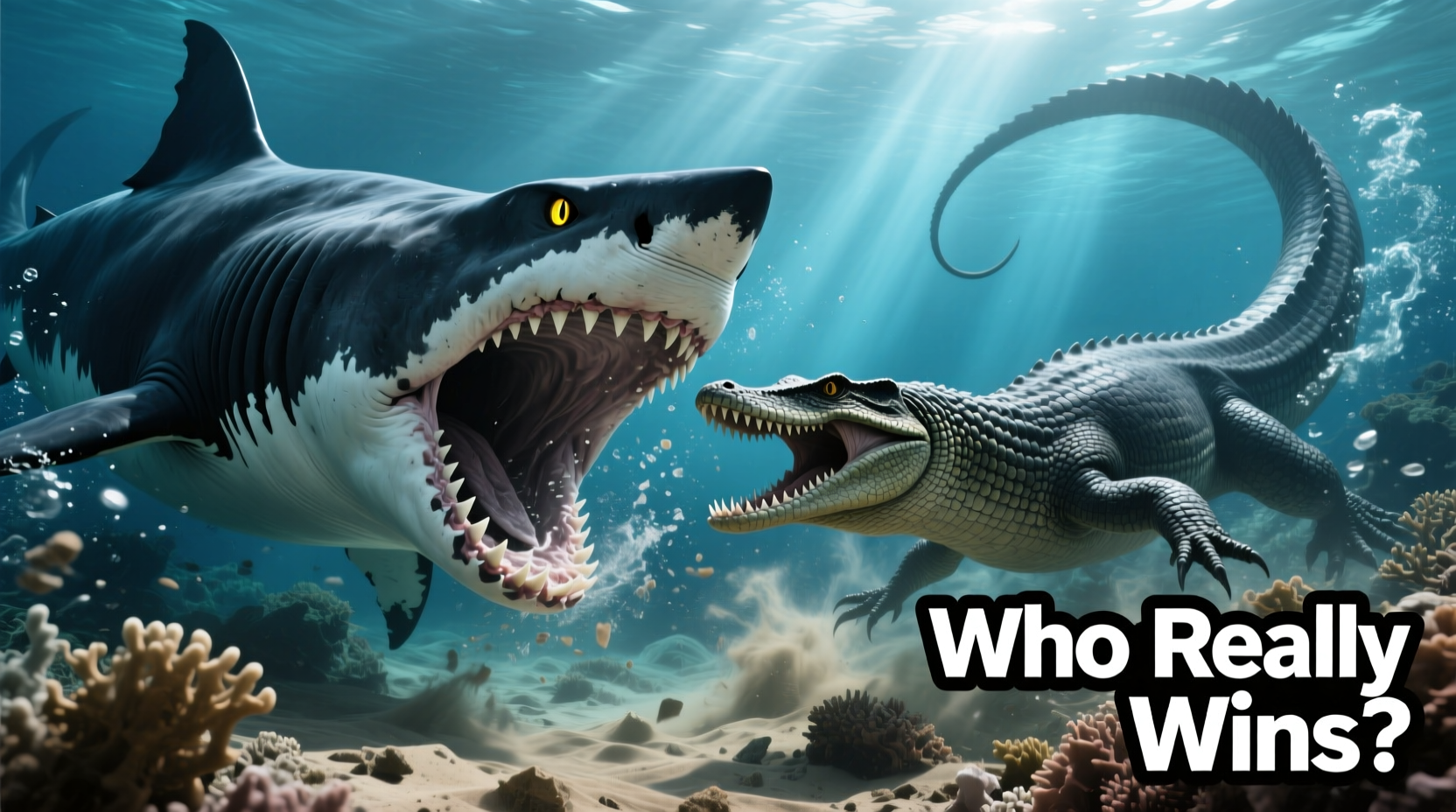
The first factor in any predator matchup is physical dimensions. Both animals were apex predators in their eras, but how do they compare side by side?
| Feature | Megalodon | Mosasaurus (M. hoffmannii) |
|---|---|---|
| Average Length | 15–18 meters (50–60 ft) | 13–15 meters (43–49 ft) |
| Weight | 50–70 tons | 15–20 tons |
| Bite Force | ~180,000 Newtons (estimated) | ~13,000–15,000 Newtons (estimated) |
| Tooth Size | Up to 18 cm (7 inches), serrated | Up to 13 cm (5 inches), conical |
| Body Type | Streamlined shark, cartilaginous skeleton | Powerful lizard-like reptile, bony skeleton |
Megalodon had a clear advantage in mass and bite force. Its teeth were designed to shear through flesh and bone, capable of crushing the rib cages of whales. In contrast, mosasaurus teeth were sharp and conical—ideal for gripping slippery prey like fish and ammonites—but not built for slicing large mammals. While both were powerful swimmers, megalodon’s tail-driven propulsion gave it greater efficiency over long distances.
Hunting Behavior and Tactics
Size alone doesn’t determine victory. How each animal hunted reveals much about its combat potential.
Megalodon was likely an ambush predator, using stealth and explosive bursts of speed to attack from below. Fossil evidence shows bite marks on whale bones consistent with upward attacks targeting flanks and vital organs. It may have disabled prey quickly with devastating bites, minimizing prolonged struggle.
Mosasaurus, while also an active hunter, relied more on agility and pursuit. Its limbs evolved into flippers, allowing precise maneuvering in shallow inland seas. It probably hunted in open water and near reefs, ambushing smaller marine reptiles and fast-moving fish. However, there’s no evidence it could match the sheer destructive power of megalodon’s bite.
“Megalodon wasn’t just big—it was optimized for taking down massive prey. Its entire feeding strategy revolved around high-impact predation.” — Dr. Julia Sanchez, Paleobiologist, University of Oregon
Environmental Context Matters
A fight doesn’t happen in a vacuum. The environment influences stamina, visibility, mobility, and tactics.
Megalodon thrived in warm coastal waters across the globe during the Miocene and Pliocene epochs. These were dynamic ecosystems with large marine mammals—its primary food source. The shark’s physiology suggests it was warm-bodied (endothermic), giving it an edge in sustained activity.
Mosasaurus lived in the Western Interior Seaway and other shallow epicontinental seas during the Late Cretaceous. These environments were rich but often crowded with other large predators like plesiosaurs and pliosaurs. Mosasaurs were fully aquatic but still ectothermic or mesothermic, meaning their performance could vary with water temperature.
In a deep-ocean confrontation, megalodon would have superior endurance and thermal regulation. In tight, reef-like zones, mosasaurus might use terrain to its advantage—but only if it could avoid being bitten in half.
Combat Simulation: How Would the Fight Unfold?
Let’s reconstruct a plausible encounter under neutral conditions—say, mid-water in open ocean, equal starting distance, no ambush.
- Initial Approach: Both detect movement. Mosasaurus relies on vision and lateral line sensing; megalodon adds electroreception via ampullae of Lorenzini. The shark gains slight detection advantage.
- First Strike: Megalodon launches a burst attack at speeds up to 18 km/h (11 mph). Mosasaurus attempts to dodge, but the shark closes in and delivers a glancing bite to the tail, causing significant blood loss.
- Counterattack: Mosasaurus snaps with its jaws, catching megalodon’s pectoral fin. But lacking serrated teeth, it fails to inflict deep damage. The shark feels pressure but sustains no critical injury.
- Killing Blow: Megalodon circles, then surges upward from below—its preferred tactic—delivering a full-force bite to the mosasaurus’s torso. Ribs and vertebrae shatter. Internal organs rupture. The reptile is incapacitated within seconds.
- Outcome: Mosasaurus sinks, mortally wounded. Megalodon consumes part of the carcass before departing.
This scenario reflects known predatory behaviors and biomechanical limits. Mosasaurus was formidable, but against a predator twice its weight and with vastly superior bite mechanics, survival is unlikely.
Common Misconceptions Debunked
Popular media often distorts this matchup. Here are three myths worth correcting:
- Misconception 1: “Mosasaurus was bigger than megalodon.” Reality: Largest estimates for mosasaurus fall short of average adult megalodons.
- Misconception 2: “Mosasaurus could outmaneuver megalodon easily.” While agile, mosasaurus couldn’t evade a targeted charge from a faster, larger predator.
- Misconception 3: “They lived at the same time.” They did not. Mosasaurus went extinct 66 million years ago; megalodon appeared 23 million years ago. No overlap.
Expert Consensus and Scientific Weight
While hypothetical, paleontologists generally agree on key points:
“The idea of a ‘winner’ depends on criteria, but biomechanically, megalodon holds overwhelming advantages in power, durability, and offensive capability.” — Dr. Nathan Liu, Marine Vertebrate Paleontologist, Scripps Institution of Oceanography
Studies modeling bite forces, body mass, and hydrodynamics consistently favor megalodon in direct confrontations with similarly sized marine reptiles. Even pliosaurs—some of the most powerful reptilian predators—fall short when compared to megalodon’s estimated performance metrics.
Frequently Asked Questions
Could mosasaurus kill a megalodon under any circumstances?
Possibly, but only in highly improbable scenarios—such as a surprise attack on a juvenile megalodon in confined space. An adult megalodon would dominate in nearly all realistic conditions.
Why do people think mosasaurus could win?
Pop culture influence. Films like *Jurassic World* depict mosasaurus as larger-than-life, even leaping to catch pterosaurs. These dramatizations exaggerate its size, speed, and capabilities beyond fossil evidence.
Did either animal have natural predators?
Adult megalodons likely had no predators. Juveniles may have been vulnerable to larger sharks. Adult mosasaurus were apex predators, though rare encounters with other large mosasaurs suggest cannibalism or competition.
Final Verdict: Who Wins?
After evaluating anatomy, behavior, environment, and scientific data, the balance decisively tips toward megalodon.
It was heavier, stronger, better armed, and evolutionarily tuned to hunt large marine animals. Mosasaurus was an impressive predator in its own right—adaptable, intelligent, and dominant in its ecosystem—but it simply wasn’t built to survive an encounter with a creature capable of generating over 180,000 newtons of bite force.
In a one-on-one fight to the death, megalodon wins approximately 8 out of 10 times based on current paleontological understanding. The remaining outcomes involve extreme variables—like illness, injury, or environmental constraints—that don’t reflect typical conditions.
Conclusion: Respect the Giants, Trust the Science
The debate over megalodon vs mosasaurus captures our fascination with ancient power. But behind the fantasy lies real science—fossils, biomechanics, and ecological reconstruction—that helps us understand these creatures not as monsters, but as marvels of evolution.
Rather than seeking winners, we should appreciate what each animal represents: millions of years of adaptation, survival, and dominance in Earth’s ever-changing oceans. Yet, if forced to choose, the evidence points clearly to one victor.




 浙公网安备
33010002000092号
浙公网安备
33010002000092号 浙B2-20120091-4
Comments
No comments yet. Why don't you start the discussion?