
For side sleepers, the right mattress isn’t just about comfort—it’s about long-term spinal health. When you sleep on your side, your hips and shoulders bear the brunt of your body weight. Without proper support, these pressure points can sink too deeply, misaligning your spine and leading to chronic pain. The debate between memory foam and hybrid mattresses centers on this critical balance: cushioning for soft tissue relief versus firmness for structural stability. Understanding how each type performs under real-world conditions helps you make a smarter investment in restful, pain-free sleep.
The Side Sleeper’s Dilemma: Support vs. Sink
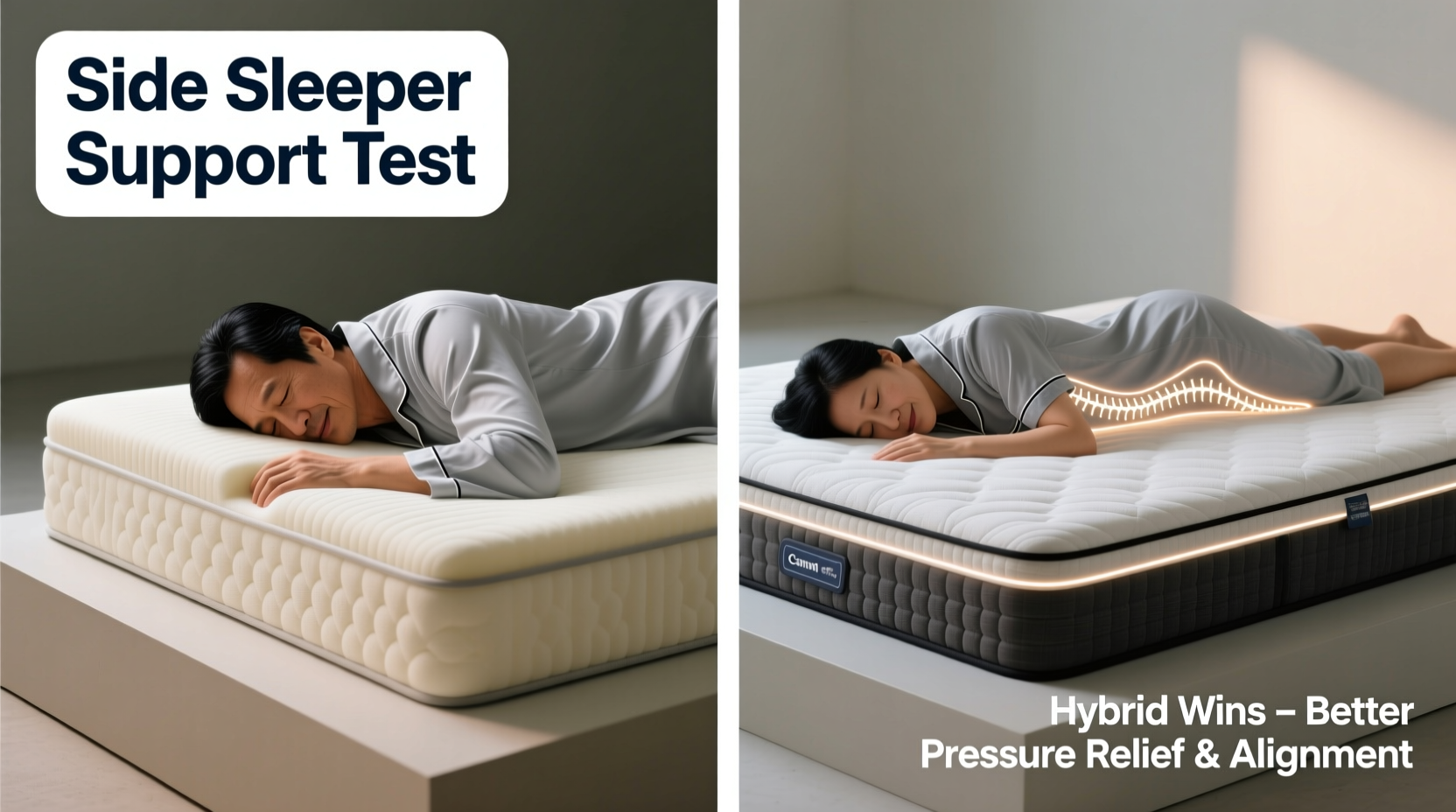
Side sleeping is the most common sleep position, favored by over 60% of adults. It reduces snoring and acid reflux but places unique demands on a mattress. The ideal surface must be soft enough to cradle the shoulders and hips, preventing pressure buildup, yet supportive enough to keep the spine in a neutral line from neck to lower back.
Too much sink—especially around the midsection—can cause the torso to drop below the level of the hips and shoulders. This creates an unnatural curve in the spine, straining muscles and joints. Over time, this leads to stiffness, numbness, and even nerve compression. Conversely, a mattress that’s too firm won’t allow enough contouring, leaving pressure points unrelieved and disrupting deep sleep cycles.
This delicate equilibrium is where memory foam and hybrid mattresses diverge in design philosophy and performance.
How Memory Foam Mattresses Perform for Side Sleepers
Memory foam was originally developed by NASA to improve crash protection. Its viscoelastic structure responds to heat and pressure, molding precisely to the body’s shape. For side sleepers, this means exceptional pressure relief at the shoulders and hips—the two areas most vulnerable to discomfort.
High-density memory foam conforms closely, distributing weight evenly and reducing point pressure. This is particularly beneficial for individuals with joint pain or arthritis. However, traditional all-foam models often suffer from excessive sinkage, especially in the center third of the bed where the heaviest load accumulates over time.
Modern advancements have addressed some of these concerns. Zoned memory foam layers use variable firmness—softer at the hip zone, firmer under the lumbar—to promote better alignment. Cooling gel infusions and open-cell structures also mitigate the heat retention historically associated with foam.
The Risk of Over-Conforming
The very feature that makes memory foam appealing—its deep hugging sensation—can become a liability. Sleepers report difficulty repositioning during the night because the material resists movement. Lighter individuals (under 130 lbs) may feel adequately supported, but heavier side sleepers (over 180 lbs) often sink too far, losing spinal neutrality.
A study published in the *Journal of Chiropractic Medicine* found that while low-to-medium density memory foam improved subjective comfort scores, it failed to maintain optimal spinal alignment in over half of tested participants who were side sleepers. The conclusion? Conformity without counter-support increases the risk of morning back pain.
Hybrid Mattresses: Balancing Spring and Surface
Hybrid mattresses combine the contouring benefits of foam or latex with the responsive support of innerspring coils. Typically, they feature 2–4 inches of comfort layer atop a pocketed coil system. This dual-material approach aims to deliver the best of both worlds: cushioning where you need it, lift where you don’t want to sink.
Pocketed coils move independently, adjusting to localized pressure. When a side sleeper lies down, the coils beneath the hips compress slightly more than those under the legs or upper back, maintaining horizontal spinal alignment. Unlike traditional Bonnell coils, which transfer motion and lack precision, modern pocket springs are engineered for targeted responsiveness.
The top foam layer still provides that initial softness crucial for shoulder accommodation. But because the underlying coils provide active pushback, the overall feel remains buoyant rather than engulfing.
“Hybrids offer dynamic support—especially important for side sleepers over 150 pounds. The coil system prevents bottoming out while allowing surface-level pressure relief.” — Dr. Lena Torres, Sleep Posture Specialist
Edge Support and Mobility Advantages
One underrated benefit of hybrids is edge reinforcement. Many models include denser perimeter coils or reinforced foam borders, making it easier to sit on the edge of the bed or sleep near the border without rolling off. This is particularly useful for couples sharing space or those using adjustable bases.
Motion isolation has improved dramatically in recent hybrid designs. While early versions transmitted partner movement due to interconnected springs, today’s individually wrapped coils minimize disturbance—rivaling all-foam beds in this regard.
Comparative Analysis: Memory Foam vs Hybrid for Side Sleepers
| Feature | Memory Foam | Hybrid |
|---|---|---|
| Pressure Relief | Excellent – conforms closely to curves | Very Good – balanced with support |
| Spinal Alignment | Fair to Good – depends on density and zoning | Excellent – coil system promotes neutrality |
| Sinkage Risk | Higher – especially in softer models | Lower – responsive coils resist deep collapse |
| Cooling Performance | Poor to Moderate – retains heat unless ventilated | Good – airflow through coils enhances breathability |
| Motion Isolation | Excellent – minimal transfer | Very Good – slight vibration possible |
| Durability | Good – high-density lasts 7–8 years | Very Good – coils extend lifespan to 8–10 years |
| Ideal for Weight Range | Under 180 lbs (light to medium) | All weights, especially 130–250 lbs |
The data suggests hybrids generally outperform all-foam options when it comes to preventing excessive sinkage while still offering sufficient cushioning. For heavier side sleepers, the structural integrity of a coil system becomes non-negotiable.
Real-World Example: Choosing the Right Bed After Chronic Pain
Karen, a 42-year-old physical therapist and lifelong side sleeper, struggled with persistent lower back pain for years. She initially chose a plush memory foam mattress believing it would ease her shoulder discomfort. While she loved the “hugged” feeling at first, within six months she began waking up stiff and sore.
After consulting a sleep specialist, she realized her spine was dipping below neutral alignment. Her hips sank deeper than her shoulders, creating a diagonal tilt across her torso. Switching to a medium-firm hybrid with zoned support transformed her sleep quality. Within three weeks, her morning pain diminished significantly. She noted improved mobility and no longer needed stretching routines upon waking.
Her experience underscores a key insight: personal preference must be tempered with biomechanical reality. What feels soft and inviting at first may not serve long-term wellness.
Actionable Checklist: How to Choose the Right Mattress as a Side Sleeper
- Evaluate your body weight: If you weigh over 180 lbs, prioritize hybrids or high-density foams with strong core support.
- Test firmness levels: Aim for medium to medium-firm (5–7 on a 10-point scale). Avoid ultra-plush surfaces unless paired with reinforced support layers.
- Look for zoned construction: Lumbar reinforcement or differential zoning helps maintain spinal alignment.
- Check coil count (for hybrids): Opt for at least 800–1,000 individually wrapped coils in queen size for precise support.
- Assess cooling features: Gel infusions, graphite additives, breathable covers, and coil ventilation reduce heat buildup.
- Read trial policies: Choose brands offering at least 100-night sleep trials and free returns.
- Consider your sleep environment: Hot sleepers benefit more from hybrids; those sensitive to motion may prefer full memory foam.
Step-by-Step Guide to Testing Mattress Suitability at Home
- Set up the mattress properly: Use a solid foundation or slatted base with gaps no wider than 3 inches to prevent sagging.
- Sleep in your natural position: Spend at least 20 minutes lying on your side, ideally later in the evening when muscles are relaxed.
- Check spinal alignment: Ask a partner to take a photo from behind, or use a mirror. Your ear, shoulder, hip, and ankle should form a straight line.
- Assess pressure points: Note any pinching in the shoulder or hip. Mild cushioning is good; sharp pain or numbness indicates poor fit.
- Try movement and repositioning: Roll over several times. Does the mattress respond quickly, or do you feel stuck?
- Monitor morning symptoms: Track back, neck, or joint pain over 7–14 nights. Consistent discomfort signals inadequate support.
- Compare alternatives: If possible, test a different model side-by-side during the trial period.
Frequently Asked Questions
Can a memory foam mattress work for heavy side sleepers?
Yes, but only if it uses high-density foams (5+ pounds per cubic foot) and includes a firm support core. Many standard memory foam beds will compress too much under heavier loads, leading to misalignment. Look for models specifically labeled “for heavier individuals” or “dual-layer support.”
Do hybrid mattresses last longer than memory foam?
Generally, yes. The inclusion of durable pocketed coils extends the functional lifespan. While a quality memory foam may last 7–8 years, hybrids often remain supportive for 8–10 years, especially when made with tempered steel coils and resilient transition layers.
Is there a hybrid that feels like memory foam?
Absolutely. Many hybrids now use thick comfort layers of gel-infused memory foam or responsive latex, giving that signature contouring feel without the slow response time. These combine the hugging sensation with the bounce-back support of coils—ideal for side sleepers wanting both cushion and structure.
Final Recommendation: Match Material to Your Needs
There is no universal winner between memory foam and hybrid mattresses—only what works best for your body and sleep habits. Pure memory foam excels in pressure relief and motion isolation, making it a solid choice for lightweight side sleepers or those with chronic joint pain. However, its tendency to sink excessively—particularly over time—makes it less reliable for maintaining long-term spinal alignment.
Hybrid mattresses, by contrast, offer a more balanced solution. They provide enough surface softness to accommodate shoulder and hip drop while leveraging coil systems to prevent total collapse. Their superior breathability, edge support, and longevity make them the preferred option for most side sleepers, especially those in the average to heavy weight range.
The key is not to fall for marketing claims about “cloud-like comfort” without considering structural support. A mattress should not merely feel good in the showroom—it should actively contribute to healthier posture and deeper recovery overnight.




 浙公网安备
33010002000092号
浙公网安备
33010002000092号 浙B2-20120091-4
Comments
No comments yet. Why don't you start the discussion?