
Festivals are exhilarating—music, art, movement, and community. But between sunscreen, water bottles, phone chargers, and personal items, staying light while carrying what you need is a real challenge. The wrong bag can leave your shoulders aching or your essentials scattered. Two of the most popular choices among festival-goers are the mini backpack and the crossbody bag. Both promise portability and style, but when it comes to holding capacity without adding weight, one may clearly outperform the other in certain situations.
This guide breaks down the strengths and limitations of each option, backed by ergonomic insights, real-world use cases, and expert recommendations. Whether you're heading to Coachella, Glastonbury, or a local outdoor concert, choosing the right carryall can make or break your experience.
Capacity and Practical Storage: What Fits Where?
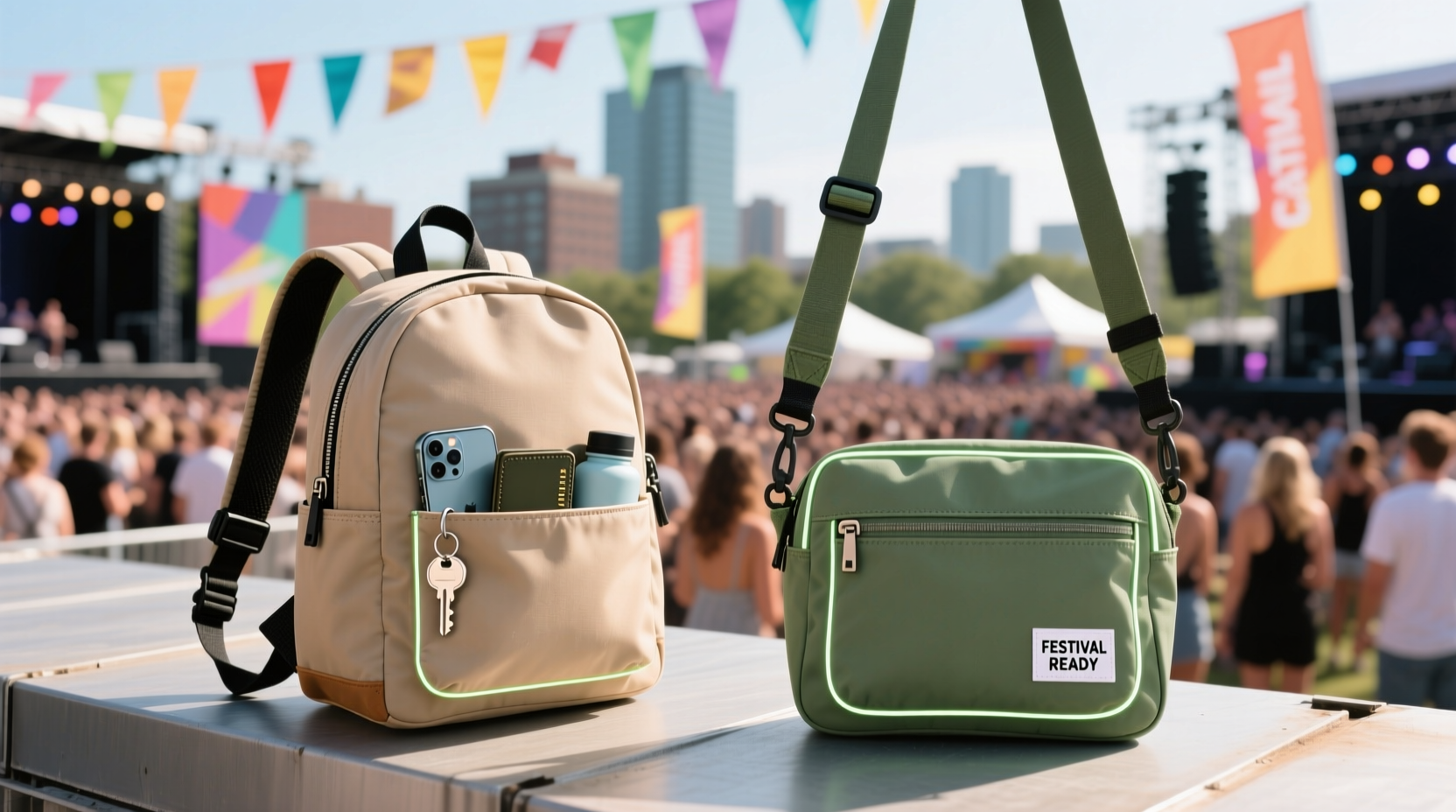
The core question isn’t just about volume—it’s about usable space. A bag might claim 5 liters of capacity, but if it lacks organization, half of that becomes wasted room. Let’s compare what typically fits in each type under realistic festival conditions.
| Item | Mini Backpack (Typical 7–10L) | Crossbody Bag (Typical 3–5L) |
|---|---|---|
| Smartphone + Power Bank | ✅ Easily accommodated with room to spare | ✅ Fits, but tight; power bank may bulge |
| Water Bottle (500ml) | ✅ Side pockets or main compartment | ❌ Rarely fits unless collapsible |
| Sunscreen & Bug Spray | ✅ Multiple compartments available | ⚠️ One product max, often awkward to access |
| Light Jacket or Hoodie | ✅ Can be rolled and stowed | ❌ No space; must be carried |
| Ticket/Wallet/Keys | ✅ Secure interior pockets | ✅ Easily accessible zippered section |
| Camera or Vape Pen | ✅ Dedicated small pockets | ⚠️ Possible, but risks overstuffing |
From this comparison, the mini backpack clearly wins on total storage. Its dual compartments, external pockets, and structured design allow for better categorization and load distribution. Crossbodies, while sleek, are limited by their flat profile and single primary chamber, making them ideal only for minimalist packing.
Weight Distribution and Comfort Over Long Hours
Comfort matters more than people expect. Standing for hours, dancing, walking across large fields—your bag should feel like an extension of your body, not a burden.
Mini backpacks distribute weight evenly across both shoulders and rest against the back, reducing strain on any single point. This balanced load helps prevent shoulder fatigue, especially when carrying heavier items like water or extra layers. High-quality models feature padded straps and breathable mesh backing, further enhancing comfort.
Crossbody bags, on the other hand, concentrate all weight on one shoulder and hip. While initially comfortable, prolonged wear often leads to postural imbalance. Users naturally lean away from the loaded side, causing muscle tension over time. According to Dr. Lena Torres, a sports ergonomist at Boulder Movement Clinic:
“Single-strap carriers disrupt natural posture and increase spinal asymmetry. For extended physical activity, even lightweight loads become problematic after 3–4 hours.” — Dr. Lena Torres, Sports Ergonomist
That said, crossbodies offer faster access. You can swing the bag to the front instantly without removing it—ideal for quick ID checks or grabbing cash. Their low-profile silhouette also reduces snagging in crowds, a common issue with protruding backpacks.
Real Festival Scenario: Lollapalooza Weekend
Consider Maya, attending her first three-day festival in Chicago. On day one, she brought a stylish vegan-leather crossbody. It held her phone, wallet, lip balm, and earplugs—nothing more. By midday, temperatures soared. She hadn’t packed sunscreen or water and had no way to carry purchases from vendors. She spent $12 on disposable wipes and a plastic water bottle because her bag couldn’t accommodate reusables.
Day two, she switched to a compact, water-resistant mini backpack. She fit a foldable tote, 750ml aluminum bottle, SPF 50, sunglasses case, and even a lightweight poncho. Despite carrying nearly twice the volume, she reported feeling less fatigued. “I barely noticed it was there,” she said later. “And I didn’t have to keep going back to my car.”
This example illustrates how perceived convenience (the crossbody) can lead to logistical stress, while slightly bulkier options (the backpack) enable preparedness and reduce physical strain.
Security and Theft Prevention in Crowds
Festivals attract large, energetic crowds—perfect environments for pickpockets. Your bag choice impacts vulnerability.
Front-facing crossbodies are easier to monitor. Since they sit across the chest, zippers face forward, allowing constant visual check. However, loose fabric or unsecured flaps still pose risks. In dense mosh pits or photo lines, bags can be opened unnoticed.
Mini backpacks are traditionally worn on the back, making them harder to watch. Yet modern festival-specific designs now include anti-theft features: lockable zippers, RFID-blocking pockets, slash-proof straps, and even hidden chest-strap clips. Some users wear them on the front during transit through high-risk zones—a hybrid approach gaining popularity.
- Best practice: Choose a backpack with dual-wear capability—convertible straps let you switch from back to front mode as needed.
- Avoid: Oversized drawstrings or magnetic flaps that open easily under pressure.
- Upgrade: Add zipper locks or small padlocks designed for travel (e.g., Pacsafe Zip Lock).
Material and Weather Resistance: Surviving Mud, Rain, and Sweat
Festival grounds are unpredictable. One moment it's sunny; the next, a sudden downpour turns paths into mud rivers. Your bag must withstand moisture, dirt, and abrasion.
Mini backpacks are commonly made from ripstop nylon, polyester, or coated canvas—materials engineered for durability and water resistance. Many include roll-top closures or storm flaps that seal out rain. If dropped in mud, they’re easy to wipe clean. Internal lining also protects contents from damp surfaces.
Crossbody bags tend to prioritize aesthetics over function. Leather, suede, and uncoated fabrics absorb moisture quickly and stain easily. Even synthetic versions often lack full seam sealing, meaning water seeps through stitching. Cleaning is trickier due to shape and hardware sensitivity.
If weather is a concern—and at outdoor festivals, it always should be—the mini backpack offers superior resilience. Look for models labeled “PU-coated” or “water-repellent” with taped seams for maximum protection.
Checklist: Choosing the Right Festival Bag
- ✅ Assess expected load: Will you carry liquids, layers, or tech gear?
- ✅ Prioritize adjustable, padded straps for long-term comfort.
- ✅ Confirm secure closure: zippers > magnets or snaps.
- ✅ Check internal organization: dedicated phone/key pockets improve efficiency.
- ✅ Verify material durability: avoid thin fabrics or exposed foam padding.
- ✅ Test wear style: try walking with the bag for 15 minutes before buying.
- ✅ Consider convertible designs: backpack-to-crossbody hybrids offer flexibility.
Hybrid Solutions and Emerging Trends
The line between backpacks and crossbodies is blurring. Brands like Herschel, Fjällräven, and Bellroy now offer “micro-pack” styles that merge benefits of both. These typically feature:
- Small footprint (under 10L) with streamlined profile
- Adjustable straps for backpack or single-shoulder carry
- Quick-access top lid or front panel
- Hidden anti-theft pockets
- Lightweight construction (under 500g empty)
For instance, the Bellroy Classic Backpack Mini weighs just 380 grams yet holds up to 8 liters. Its front pocket opens like a clamshell, mimicking the accessibility of a crossbody, while the backpack form ensures balanced weight. This hybrid model has gained traction among urban festival attendees who value both utility and discretion.
Another trend is modular add-ons: detachable waist straps, clip-on pouches, or expandable gussets. These allow customization based on daily needs—critical when moving between stages, camping areas, and food zones.
Frequently Asked Questions
Can a crossbody really hold enough for a full festival day?
Yes—but only if you adopt a minimalist mindset. Stick to phone, ID, cash, lip balm, and earplugs. Anything more (sunscreen, water, jacket) will require either overstuffing or carrying extras by hand. Not ideal in hot or rainy conditions.
Are mini backpacks allowed at major festivals?
Most major U.S. and European festivals permit small backpacks under specific size limits (usually 12” x 12” or smaller). Always check official event guidelines. Transparent backpacks are increasingly required for security screening. Avoid large or military-style packs, which may be denied entry.
Which is safer from theft: backpack or crossbody?
It depends on usage. A front-worn crossbody is easiest to monitor, but poorly secured ones can be slashed. A backpack worn on the front functions similarly. Back-worn backpacks are safest when combined with anti-theft features and awareness. Ultimately, vigilance matters more than style.
Final Verdict: Which Holds More Without Weighing You Down?
The mini backpack is the superior choice for most festival scenarios when balancing capacity and comfort. It holds significantly more—often double the volume—while distributing weight efficiently across the torso. Modern designs are lightweight, weather-resistant, and equipped with smart organizational features that prevent clutter.
Crossbody bags excel in ultra-minimalist situations: short urban events, evening outings, or when fashion takes priority. They’re convenient for quick access and maintain a sleek look. But their structural limitations make them impractical for full-day outdoor festivals where hydration, sun protection, and adaptability are essential.
Ultimately, the best bag doesn’t just carry your things—it enhances your freedom. A well-chosen mini backpack lets you move freely, stay prepared, and focus on the music, not your gear.




 浙公网安备
33010002000092号
浙公网安备
33010002000092号 浙B2-20120091-4
Comments
No comments yet. Why don't you start the discussion?