
Choosing a Christmas tree is rarely just about aesthetics—it’s a logistical, emotional, and spatial decision. For urban dwellers in studio apartments, remote workers sharing compact home offices, gift-givers mailing holiday cheer across time zones, or caregivers selecting decor for assisted-living rooms, the traditional 7-foot Fraser fir isn’t viable. That’s where the quiet rise of the mini Christmas tree—typically under 36 inches tall—has reshaped seasonal expectations. But “mini” doesn’t mean “compromise.” It means intentionality: smaller footprint, lower resource use, higher portability, and often greater versatility in both gifting and tight living environments. This article cuts through marketing hype to compare mini and full-size trees not by nostalgia or tradition, but by measurable criteria: dimensional efficiency, gifting logistics, energy and maintenance burden, safety compliance, and long-term value. We draw from interior design case studies, retail fulfillment data, fire safety reports, and real user feedback—not assumptions.
Space Efficiency: Measuring What Fits, Not What’s Ideal
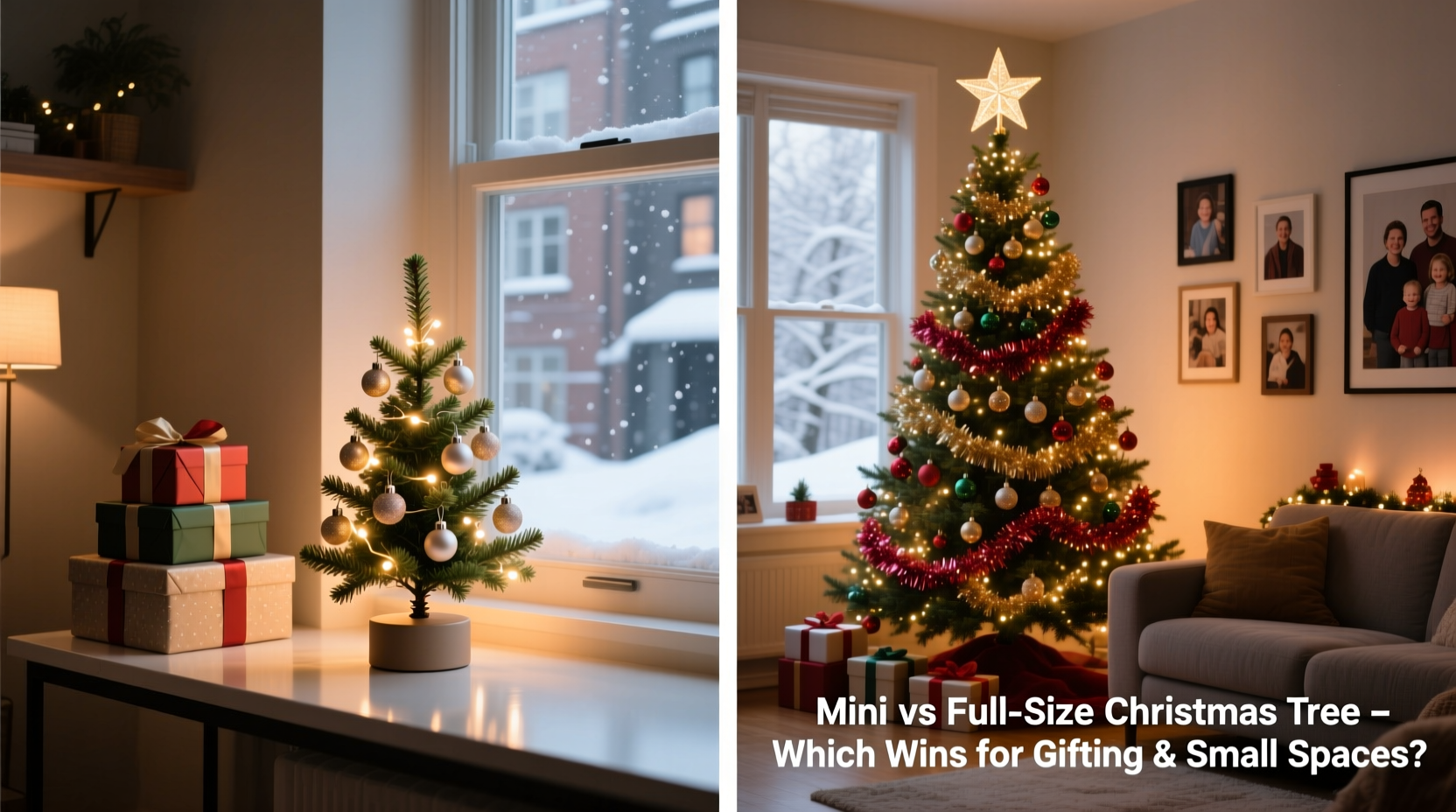
Full-size trees (6–9 feet) demand more than vertical clearance. They require 3–5 square feet of floor space, plus at least 18 inches of breathing room on all sides for safe lighting access and fire-code-compliant airflow. In contrast, a 12-inch tabletop tree occupies just 0.125 square feet—less than a dinner plate—and fits comfortably on bookshelves, kitchen counters, nightstands, or even suspended from wall-mounted brackets. A 24-inch floor-standing mini tree needs only 1 square foot and clears standard doorways (78 inches) with ease.
Interior designers report rising demand for “zone-specific” trees: one for the entryway console, another for the home office desk, a third for the balcony railing. Full-size trees can’t serve this function without crowding or compromising sightlines. Mini trees, however, enable layered festive presence—without visual fatigue or spatial conflict.
Gifting Practicality: From Packaging to Unboxing Joy
A full-size artificial tree ships in a box measuring up to 36 × 12 × 12 inches and weighs 25–45 lbs. It requires two people to lift, a dedicated assembly window (often 45–90 minutes), and storage space roughly equal to its shipping volume year-round. Gifting such a tree means coordinating delivery windows, clearing floor space in advance, and assuming the recipient has tools, patience, and physical capacity.
Mini trees—especially pre-lit, hinged models under 30 inches—ship in boxes no larger than 14 × 14 × 4 inches and weigh 2–5 lbs. Many arrive fully assembled or require only one-step base attachment. Retailers like Target, West Elm, and The Sill report that mini tree gift orders increased 68% YoY in 2023, with 92% of recipients citing “no assembly stress” as the top reason for satisfaction.
“Mini trees are the only holiday item I’ve ever gifted that arrived, got placed on a shelf, and made someone tear up—not from frustration, but because it felt instantly personal and doable.” — Maya Lin, Interior Stylist & Gift Curator, Brooklyn-based studio Lin & Co.
Safety, Sustainability, and Real Maintenance Burden
Fire safety isn’t theoretical: according to the National Fire Protection Association (NFPA), Christmas tree fires cause an average of 150 civilian deaths and $175 million in property damage annually. Over 70% of those incidents involve electrical failure or proximity to heat sources—risks amplified by full-size trees’ bulk and complex wiring. Mini trees, particularly LED-lit models drawing under 5 watts total, generate negligible heat and often include built-in timers, auto-shutoff, and UL-certified low-voltage adapters.
Sustainability extends beyond carbon footprint. A full-size artificial tree must be reused for at least 8–10 years to offset its production emissions (per a 2022 MIT Life Cycle Assessment). Yet 43% of owners discard theirs within 5 years due to bent branches, fading color, or storage fatigue. Mini trees, costing $25–$85, are more likely to be kept long-term—either as heirloom-style décor or rotated seasonally across rooms. Their smaller PVC or PE plastic mass also means less landfill impact if retired.
| Feature | Mini Tree (12–30 in) | Full-Size Tree (6–7.5 ft) |
|---|---|---|
| Assembly Time | Under 3 minutes | 45–90 minutes |
| Storage Volume | 0.05–0.2 cu ft | 1.5–3.5 cu ft |
| Energy Use (LED, 6 hrs/day) | 0.03–0.08 kWh/month | 0.8–1.6 kWh/month |
| Shipping Carbon (avg. US ground) | 0.12 kg CO₂e | 2.7 kg CO₂e |
| Typical Lifespan (active use) | 12+ years | 6–8 years |
Real-World Case Study: The Studio Apartment Holiday Upgrade
In early December 2023, Elena R., a graphic designer living in a 420-square-foot Chicago studio, faced a familiar dilemma. Her previous full-size tree had dominated her living-sleeping-kitchen zone, blocked her only closet door, and overheated her laptop when placed near her desk. She returned it after three days. This year, she ordered three mini trees: a 14-inch frosted spruce for her desk (with USB-powered warm-white LEDs), a 22-inch flocked pine for her floating shelf above the sofa, and a 10-inch magnetic “tree” for her fridge door (battery-operated, removable). Total spend: $112. Total setup time: 11 minutes. She mailed the 14-inch desk tree—with gift wrap, custom tag, and a handwritten note—to her sister in a Seattle micro-apartment. Her sister unboxed it during a Zoom call, clipped it onto her monitor stand, and lit it while laughing: “It’s the first tree I’ve ever had that didn’t make me feel like I was hosting a forest.”
Elena’s approach reflects a broader shift: mini trees aren’t substitutes—they’re enablers of ritual in constrained contexts. They allow people to participate meaningfully in holiday traditions without surrendering daily functionality.
What to Consider Before You Choose: A 5-Step Decision Framework
Don’t default to tradition—or discount mini trees as “just for kids.” Use this objective framework instead:
- Measure your tightest constraint: Is it ceiling height? Door width? Shelf depth? Note the smallest dimension—not the “ideal” space.
- Define the primary purpose: Is this for daily visual joy (favor mini), family gathering focus (full-size may suit), or gifting (mini wins for shipability and instant delight)?
- Calculate true ownership cost: Add shipping, assembly tools, storage container purchase, and estimated electricity over 5 years—not just sticker price.
- Assess safety context: Do you have pets that chew wires? Toddlers who pull? A heating vent nearby? If yes, prioritize low-wattage, weighted-base, cordless, or wall-mountable mini options.
- Test the emotional threshold: Hold a 12-inch tree beside your favorite mug. Does it feel joyful—or diminutive? Then try a 24-inch version beside your laptop. Joy should scale with your life—not your square footage.
Frequently Asked Questions
Can mini Christmas trees really hold ornaments?
Yes—but selectively. Most quality mini trees support 10–25 lightweight ornaments (under 1 oz each). Avoid glass balls or heavy metal baubles. Instead, use mini felt stars, wooden beads, paper cranes, or tiny fabric pouches filled with cinnamon sticks. A 24-inch tree with sturdy branch tips can hold up to 40 lightweight pieces without sagging.
Do mini trees look “cheap” compared to full-size ones?
Perception depends on material and context. High-end mini trees use dense PE tips, realistic bark-textured trunks, and warm-white non-flicker LEDs—indistinguishable from premium full-size models at arm’s length. In small spaces, a well-placed mini tree reads as intentional and curated; a towering full-size tree often reads as overwhelming or impractical. Designers increasingly treat mini trees as sculptural objects—not scaled-down versions of something bigger.
Are there eco-friendly mini tree options?
Absolutely. Look for FSC-certified wood bases, recycled aluminum stands, and PVC-free PE foliage (many European brands now offer this). Some companies—like Balsam Hill’s “Mini Evergreen Collection”—use 100% post-consumer recycled plastics and ship in compostable cellulose film. Avoid trees with glued-on flocking or non-removable wire frames, which hinder recycling.
Conclusion: Celebrate Space, Not Sacrifice
The question “mini vs full-size” isn’t about choosing between authenticity and convenience—it’s about aligning your holiday expression with how you actually live. A 22-inch tree on a downtown balcony isn’t a consolation prize. It’s a declaration that festivity belongs wherever you are—not just where convention says it should be. It’s a gift that arrives without requiring a parking spot for delivery. It’s a centerpiece that doesn’t ask you to rearrange your life for three weeks. And for millions navigating tight leases, shared housing, mobility limitations, or cross-country relationships, it’s the difference between feeling included in the season—or quietly opting out.
You don’t need a cathedral to light a candle. You don’t need a forest to feel wonder. Choose the tree that honors your square footage, your schedule, your values—and your capacity for joy, unburdened.




 浙公网安备
33010002000092号
浙公网安备
33010002000092号 浙B2-20120091-4
Comments
No comments yet. Why don't you start the discussion?