
Festivity isn’t measured in ornament count—it’s registered in the quiet catch of breath before a candlelit branch, or the visceral thrill of crimson velvet draped over gilded branches. The debate between the minimalist Scandinavian Christmas tree and the maximalist Victorian tree isn’t about aesthetics alone; it’s about divergent philosophies of celebration, memory, and emotional resonance. One invites stillness and intentionality. The other embraces abundance, narrative, and layered history. Neither is “more correct.” But one may feel more authentically festive—depending on who you are, where you live, and what “festive” truly means to you.
Defining the Two Traditions: Beyond Surface Aesthetics
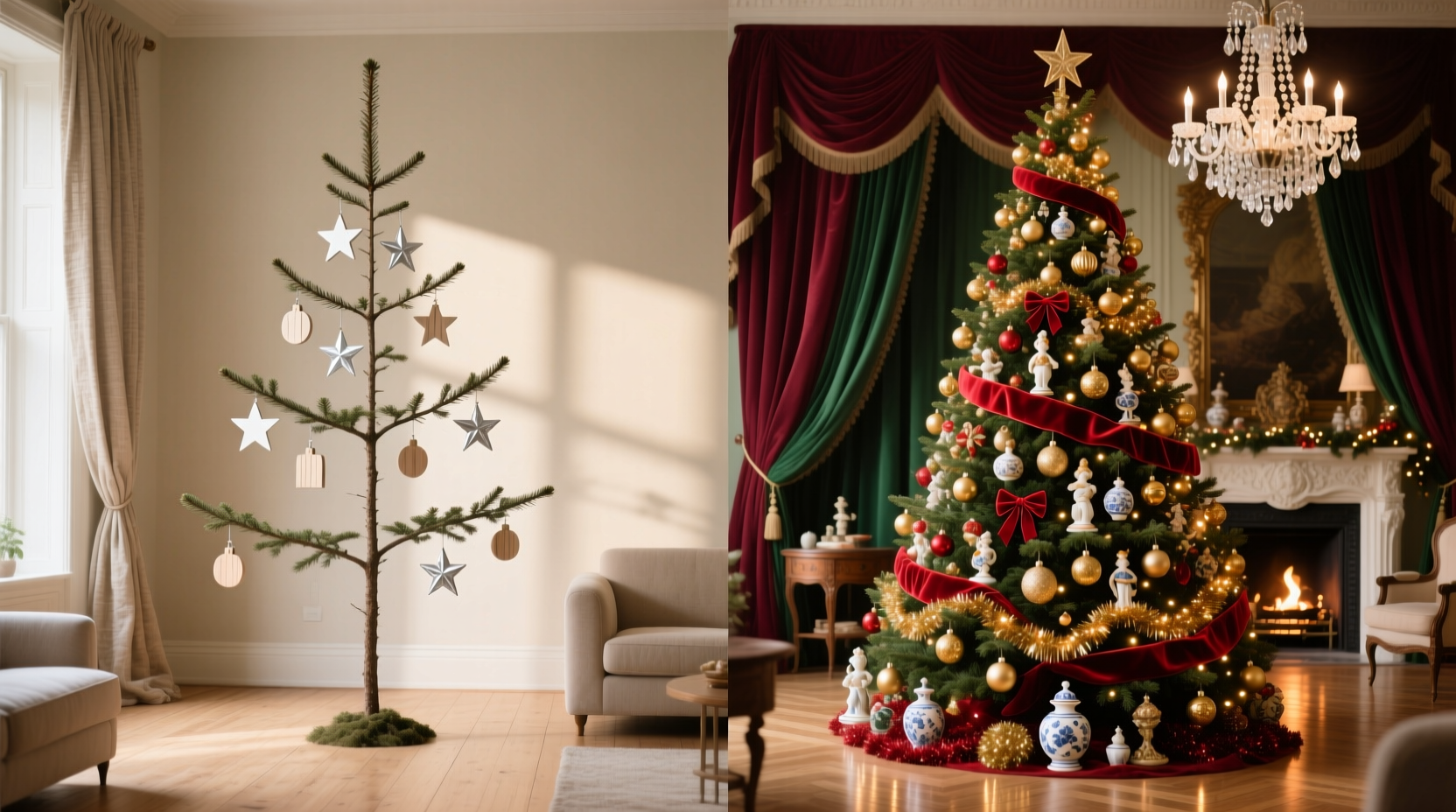
The Scandinavian tree—often a slender, single-species Nordmann fir or Norway spruce—is curated with restraint. Its palette is monochromatic: white, cream, soft grey, natural wood, and muted metallics like brushed brass or matte black. Ornaments are sparse, handmade, or deeply symbolic: hand-blown glass baubles in frosted tones, dried citrus slices, woven straw stars, or ceramic birds. Lights are warm-white LED strings, evenly spaced—not twinkling, but glowing. The base is often bare or dressed with moss, birch logs, or unbleached linen.
The Victorian tree, by contrast, is a theatrical heirloom. Rooted in mid-19th-century England—popularized after Queen Victoria and Prince Albert’s 1848 illustrated tree in the Illustrated London News—it thrives on accumulation. It’s dense, full-bodied, and often asymmetrical. Decorations include tinsel (originally real silver), wax candles (later replaced by electric lights), hand-painted glass ornaments, porcelain angels, paper chains, popcorn-and-cranberry garlands, and clusters of fruit like apples and oranges. Ribbons are wide, satin, and tied in elaborate bows. The tree skirt is a cascade of velvet or brocade, often embroidered with gold thread.
Crucially, these aren’t just styles—they’re cultural grammars. Scandinavian minimalism emerges from hygge, lagom, and kos: concepts prioritizing comfort, balance, and mindful presence. Victorian maximalism reflects industrial-era optimism, romantic historicism, and the desire to transform domestic space into a stage for wonder and moral uplift.
What “Feels More Festive”? Psychology, Not Preference
“Festive” is not synonymous with “busy” or “bright.” Neuroscience research shows that emotional resonance during holidays correlates less with visual saturation and more with three factors: familiarity, ritual scaffolding, and sensory coherence. A 2022 study published in the Journal of Environmental Psychology found participants reported higher levels of calm joy—and longer-lasting positive affect—when holiday environments featured consistent color temperature, predictable lighting rhythm, and tactile harmony (e.g., wool, wood, unglazed ceramics). These conditions align closely with Scandinavian minimalism.
Yet another strand of research, cited by Dr. Helen R. L. T. Hargreaves, cultural historian at King’s College London, emphasizes narrative density: “Victorian decor doesn’t just look rich—it tells stories. Each ornament was once a gift, a souvenir, a memento mori, or a symbol of divine protection. That accumulated meaning creates emotional weight. When people say ‘this feels like Christmas,’ they’re often recalling the layered stories embedded in their grandparents’ ornaments—not the number of them.”
“The Victorian tree is a three-dimensional family archive. The Scandinavian tree is a meditation bell made of pine. Both are valid—but they serve different emotional needs.” — Dr. Helen R. L. T. Hargreaves, Cultural Historian & Author of Holiday Memory and Material Culture
A Real-World Comparison: Two Homes, One Holiday Season
In Malmö, Sweden, Lena Andersson, a graphic designer and mother of two, rotates her tree annually between a pared-down spruce and a living potted fir. Her ornaments—collected over 17 years—are stored in a single wooden box: 32 pieces total. She hangs them slowly, one by one, while playing a specific vinyl recording of Swedish carols. “The silence between the notes matters as much as the music,” she says. “When the tree is lit, it’s not about seeing everything—it’s about noticing how light catches the curve of a single blown-glass sphere. That’s when I feel Christmas arrive. Not with fanfare—but with certainty.”
Across the North Sea in Bath, England, retired schoolteacher Arthur Finch maintains his great-grandfather’s 1893 walnut tree stand and a collection of 217 ornaments—many handmade by students over five decades. His tree takes three days to dress: first the garlands (popcorn, cranberries, ribbon), then the candles-turned-lights, then the ornaments—grouped by era and story. “The top angel came from my wife’s christening gown,” he explains. “The red glass apple? My father brought it home from Covent Garden in 1951. You don’t just look at this tree—you walk through time. Festivity, for me, is remembering out loud.”
Neither feels “less festive.” But their definitions diverge: Lena’s is anchored in presence; Arthur’s, in continuity. Their trees don’t compete—they coexist as legitimate expressions of human celebration.
Practical Decision Framework: Which Style Suits Your Life?
Choosing isn’t about trend alignment—it’s about sustainability, values, and daily reality. Below is a comparative table designed to help you assess fit—not based on taste, but on lived function.
| Factor | Scandinavian Minimalist Tree | Victorian Maximalist Tree |
|---|---|---|
| Time Investment | Low (30–45 mins to dress; 10 mins weekly maintenance) | High (6–12+ hours across multiple days; ongoing dusting/repair) |
| Spatial Fit | Ideal for small apartments, open-plan homes, or rooms with limited floor space | Requires generous vertical clearance, floor space for skirt, and ceiling height for full impact |
| Emotional Maintenance | Lower cognitive load; reduces seasonal stress and decision fatigue | Higher emotional engagement; may deepen nostalgia but also trigger pressure to “perform” tradition |
| Sustainability Profile | High: Natural materials, durable ornaments, low-energy LEDs, reusable bases | Variable: Many vintage ornaments are heirlooms (high sustainability), but modern reproductions often use PVC, plastic, and non-recyclable metals |
| Adaptability Over Time | Easily evolves: swap one ceramic bird for a new handmade piece; change ribbon color yearly | Deeply cumulative: new additions integrate slowly; abrupt changes can disrupt narrative cohesion |
Your Festive Alignment Checklist
Before committing to a style—or resisting one—ask yourself these questions honestly. Circle “Yes” or “No” for each:
- Do I feel calmer in spaces with fewer visual decisions? [Yes / No]
- Do I keep meaningful objects for decades—not because they’re valuable, but because they hold memory? [Yes / No]
- Is my holiday energy better spent preparing food, hosting, or creating—rather than assembling decor? [Yes / No]
- Do I find beauty in imperfection—a crooked branch, a chipped glaze, a slightly faded ribbon? [Yes / No]
- Do I want future generations to recognize my tree as distinctly *mine*, or as part of a lineage? [Yes / No]
If you answered “Yes” to three or more of the first three items, Scandinavian minimalism likely offers deeper festive resonance. If “Yes” appears most often in the last two, Victorian maximalism may deliver richer emotional returns—even if it demands more labor.
Step-by-Step: Building Your Authentic Festive Tree (Regardless of Style)
Authenticity matters more than adherence. Follow this universal sequence—whether your vision leans Nordic or Neo-Victorian:
- Select the tree with intention: Visit a local lot or farm. Touch the needles. Smell the sap. Choose one whose shape and energy resonate—not one that “fits the mold.”
- Prepare the base mindfully: Soak the trunk in water for 24 hours before erecting. Use a sturdy stand with 1-gallon capacity. Check water level twice daily.
- Light first, always: String lights evenly *before* adding ornaments—working from bottom to top, inside to outside. Ensure no bulbs are damaged or wires exposed.
- Add structure, not clutter: For Scandinavian: one garland (wood beads or linen rope). For Victorian: three—popcorn, cranberry, and velvet ribbon—each with distinct spacing and drape.
- Ornament in layers: Place 60% of ornaments at eye level (1.2–1.6m), 25% lower (for children/pets), 15% high (to draw the gaze upward). Never cluster—allow negative space to breathe.
- Finish with scent and sound: Place dried orange slices or cinnamon sticks in the water reservoir. Play a consistent soundtrack—no playlists. One album, on repeat.
FAQ: Clarifying Common Misconceptions
Does minimalist mean “cheap” or “unadorned”?
No. Scandinavian minimalism invests deeply in material integrity and craftsmanship. A single hand-thrown ceramic star may cost more than twenty mass-produced baubles. The restraint is curatorial—not economical.
Can a Victorian-style tree work in a modern apartment?
Yes—if scaled thoughtfully. Choose a narrower, taller tree (like a Blue Spruce) and focus ornament density on the middle third. Replace heavy velvet skirts with layered wool throws in deep burgundy or forest green. Prioritize quality over quantity: ten exceptional antique ornaments read louder than fifty generic ones.
Is one style more inclusive or culturally neutral?
Neither is neutral—but they carry different legacies. Scandinavian minimalism emerged from Lutheran traditions emphasizing humility and nature reverence. Victorian maximalism grew from Anglican theology intertwined with colonial trade (glass from Germany, oranges from Spain, tinsel from England’s silver mines). Acknowledging those roots allows conscious adaptation—e.g., using fair-trade glass ornaments or sourcing cranberries locally—without erasing history.
Conclusion: Festivity Is a Verb, Not a Noun
The question “which feels more festive?” assumes festivity is a static condition—something you achieve by selecting the right ornaments. In truth, festivity is a practice. It lives in the slowness of tying a bow, the warmth of shared memory while unwrapping an old ornament, the quiet awe of watching light filter through pine needles at dusk. A minimalist tree invites you to slow down and witness. A Victorian tree invites you to gather, remember, and narrate. Both are sacred acts—just expressed in different dialects.
Your home doesn’t need to choose sides. You might begin December with a stark, luminous Scandinavian tree—then, on the solstice, layer in a single Victorian garland as a gesture of ancestral acknowledgment. Or you might start with a lush Victorian base and, in the final week, remove all but three ornaments—one for hope, one for gratitude, one for rest—as a quiet transition into the new year.




 浙公网安备
33010002000092号
浙公网安备
33010002000092号 浙B2-20120091-4
Comments
No comments yet. Why don't you start the discussion?