
The right necklace can transform an outfit from forgettable to unforgettable. But when it comes to attracting attention and earning genuine compliments, should you reach for a delicate chain or a bold, eye-catching pendant? The debate between minimalist and statement necklaces isn’t just about personal taste—it’s about visibility, context, and social psychology. While both styles have their place, understanding when and why each garners admiration can help you make smarter jewelry choices.
Compliments aren’t random. They’re reactions—often subconscious—to contrast, craftsmanship, and confidence. A dainty gold chain might earn praise for its elegance at a morning meeting, while a chunky geometric pendant could stop conversations at a cocktail party. The key is knowing not just what looks good, but what resonates in different settings.
The Psychology of Compliments and Jewelry
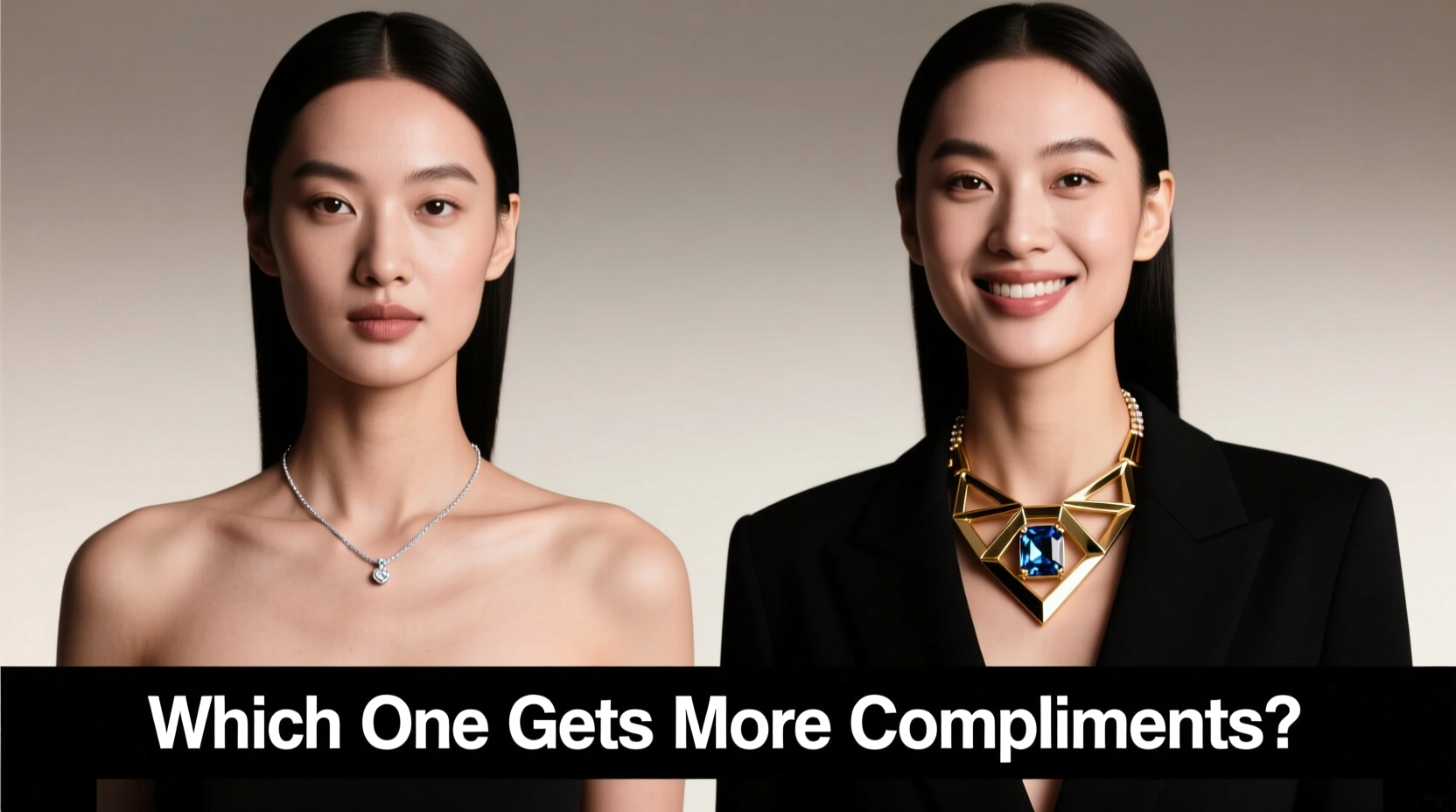
Why do people compliment accessories? Research in social perception suggests that noticeable, well-coordinated details signal intentionality and self-awareness. A 2021 study published in the Journal of Consumer Psychology found that participants were more likely to compliment individuals wearing standout accessories—particularly those that contrasted with their clothing—than those in neutral attire with no visible adornments.
However, subtlety also has psychological power. Minimalist pieces often evoke associations with refinement and sophistication. When someone notices a barely-there chain or a single diamond solitaire, the compliment usually carries a tone of quiet admiration: “Your necklace is so elegant.” In contrast, a statement piece tends to provoke immediate, visceral reactions: “Where did you get that? It’s stunning!”
“Jewelry acts as a nonverbal cue. A statement necklace says, ‘Look at me.’ A minimalist piece whispers, ‘I know what I’m doing.’ Both attract attention—but in very different ways.” — Dr. Lila Monroe, Behavioral Psychologist & Style Consultant
When Minimalist Necklaces Earn More Compliments
Minimalist jewelry thrives in environments where understatement is valued. Think boardrooms, daytime events, or minimalist fashion circles. A thin curb chain, a small pendant, or a layered set of delicate chains can stand out precisely because they don’t overpower.
In professional or casual settings, excessive ornamentation can be perceived as distracting. A minimalist necklace, especially one with high-quality materials like 14k gold or lab-grown diamonds, signals polish without drawing focus away from your face or conversation. Because these pieces are subtle, the fact that someone notices them at all often leads to a compliment rooted in appreciation for discernment.
Best occasions for minimalist necklaces:
- Office meetings and corporate events
- Brunches or daytime gatherings
- Outfits with intricate patterns (where bold jewelry would clash)
- Layering under other pieces for depth
When Statement Necklaces Dominate the Room
A statement necklace is designed to be seen. Whether it’s a cascading tassel, a sculptural metal piece, or a gemstone choker, its purpose is to anchor an outfit. These pieces work best when the rest of the look is simple—a little black dress, a plain white blouse, or solid-color separates.
Because they break visual monotony, statement necklaces naturally draw the eye. This makes them ideal for social events, photo opportunities, or any situation where making an impression matters. People are more likely to verbally acknowledge something they can’t ignore. In a survey of 300 women conducted by Style Pulse Magazine, 78% reported receiving more compliments on statement necklaces during evening events compared to everyday wear.
But there’s a caveat: overuse diminishes impact. Wearing a dramatic piece too often can make it feel ordinary. The surprise factor—the emotional trigger behind many compliments—is lost.
Real Example: The Wedding Guest Dilemma
Sophia attended a friend’s wedding wearing a sleek navy jumpsuit. She debated between her go-to delicate pendant and a bold amber resin necklace she’d never worn. She chose the statement piece. At the reception, three strangers approached her to ask where she bought it. One said, “That’s the most beautiful thing I’ve seen all night.” Meanwhile, her cousin wore a similar minimalist chain and received no comments. The takeaway? In high-visibility settings, bold wins attention.
Head-to-Head Comparison: Minimalist vs Statement
| Factor | Minimalist Necklace | Statement Necklace |
|---|---|---|
| Visibility | Low to moderate; requires close observation | High; immediately noticeable |
| Compliment Frequency | Fewer, but often more thoughtful | More frequent, especially in social settings |
| Versatility | High—works with almost any outfit | Moderate—requires simpler clothing |
| Lifespan & Trends | Timeless; rarely goes out of style | Can be trend-driven; may date quickly |
| Confidence Boost | Subtle; enhances self-assurance quietly | Strong; creates instant presence |
How to Choose Based on Your Lifestyle
The best choice depends less on universal rules and more on your daily routine, wardrobe, and goals. Consider this step-by-step decision guide:
- Assess your typical environment: Do you spend most days in meetings, remote work, or social events?
- Evaluate your wardrobe palette: If you wear lots of prints or textures, a minimalist piece prevents overload. If your clothes are mostly solid colors, a statement necklace adds dimension.
- Identify your style goal: Are you aiming to blend in with polished professionalism, or stand out with creative flair?
- Test both options: Wear each style for a week and track compliments, glances, or comments.
- Rotate intentionally: Use minimalist necklaces as daily staples and save statements for moments when you want to command attention.
Jewelry Selection Checklist
- ✔️ Does the necklace complement my neckline?
- ✔️ Is the metal tone consistent with my other jewelry?
- ✔️ Will it clash with patterns or textures in my outfit?
- ✔️ Am I wearing it for comfort, or to make a moment memorable?
- ✔️ Have I cleaned and maintained the piece recently?
FAQ: Common Questions About Necklace Compliments
Do men notice necklaces and give compliments?
Yes, but differently than women. Men are more likely to notice dramatic changes or standout pieces rather than subtle details. A bold necklace is more likely to register with male observers, though many appreciate minimalist elegance when pointed out.
Can a minimalist necklace ever get more compliments than a statement piece?
Absolutely—if it’s exceptional in quality or personal significance. A handcrafted fine chain or a family heirloom often invites deeper, more meaningful compliments. While fewer in number, these remarks tend to carry greater emotional weight.
Is it okay to wear both minimalist and statement necklaces?
Yes, through layering. Many fashion-forward individuals mix a delicate chain with a shorter, bolder pendant for contrast. Just ensure the metals match and the overall look feels intentional, not cluttered.
Final Thoughts: It’s Not Either/Or—It’s Timing and Intention
The idea that one style “gets more compliments” oversimplifies a nuanced reality. Statement necklaces win in volume—they generate more spontaneous reactions due to their visual dominance. Minimalist necklaces win in depth—they inspire quieter, more considered praise that often reflects long-term admiration.
The most effective jewelry strategy isn’t choosing sides, but mastering context. Keep a curated collection: a few minimalist staples for everyday grace, and one or two show-stopping pieces for moments that matter. Rotate them deliberately. Let your necklace reflect not just your outfit, but your intention for the day.
And remember: the most complimented accessory isn’t always the loudest. Sometimes, it’s the one that makes people lean in and say, “Wait—can I see that again?” That kind of attention doesn’t come from size. It comes from confidence, curation, and care.




 浙公网安备
33010002000092号
浙公网安备
33010002000092号 浙B2-20120091-4
Comments
No comments yet. Why don't you start the discussion?