
For aspiring photographers stepping into the world of interchangeable-lens cameras, the choice between mirrorless and DSLR models can feel overwhelming. The debate has evolved significantly over the past decade, with mirrorless technology rapidly advancing while DSLRs—once the undisputed kings of photography—have seen their dominance challenged. For beginners, the question isn't just about image quality or lens selection; it's whether the physical bulk and mechanical design of a DSLR still offer meaningful advantages in today’s compact, digital-first landscape.
The short answer: for most beginners, the traditional bulk and optical viewfinder system of a DSLR are no longer necessary—and in many cases, they're a step backward. Mirrorless cameras now deliver superior autofocus, real-time exposure preview, lighter bodies, and better video performance, all while matching or exceeding DSLR image quality. But that doesn’t mean DSLRs are dead. Understanding where each excels helps clarify whether the size and weight of a DSLR are justified—or simply outdated baggage.
How Mirrorless and DSLR Cameras Work: Core Differences
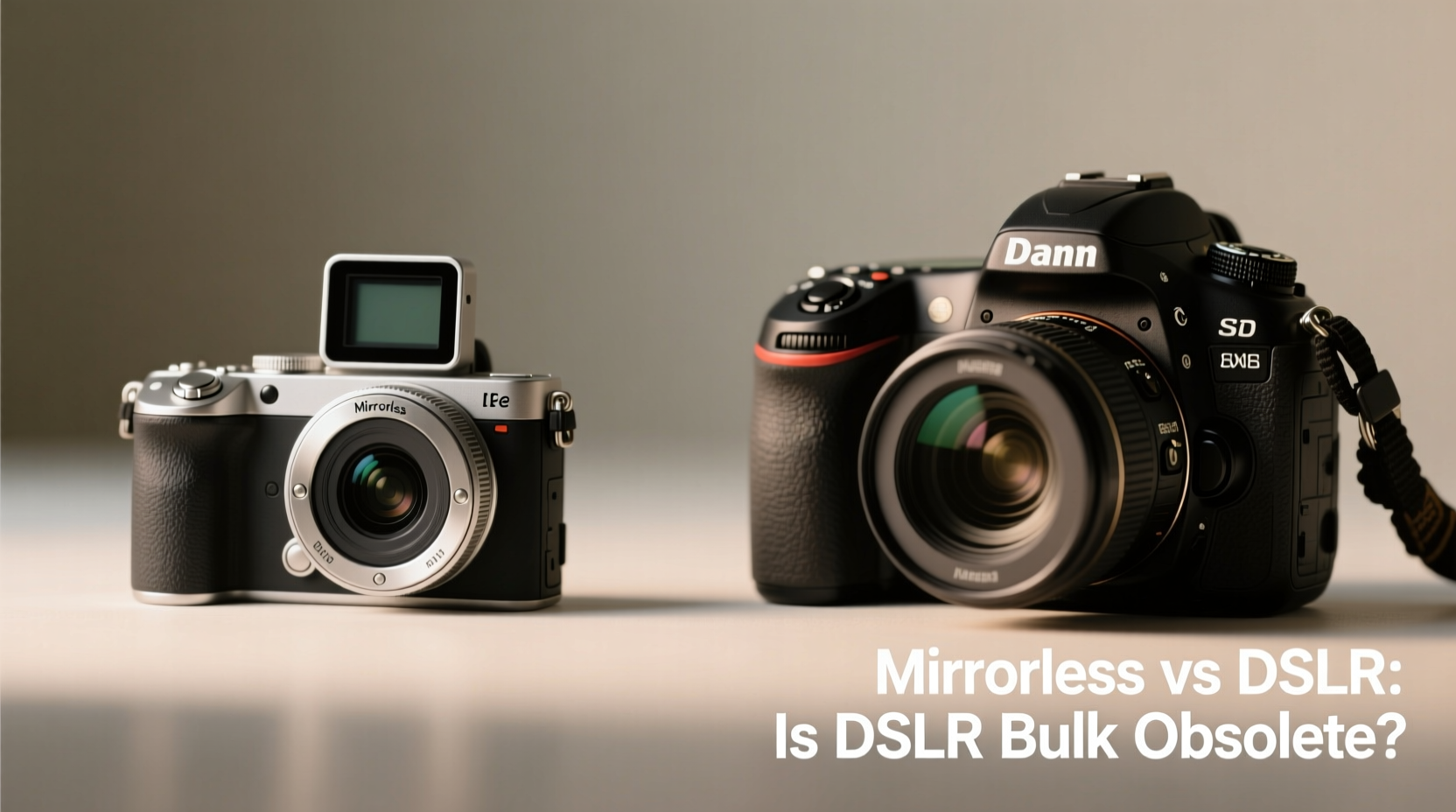
The fundamental distinction lies in how light reaches the sensor and how you compose your shot. DSLRs (Digital Single-Lens Reflex) use a mirror mechanism that reflects light from the lens up into an optical viewfinder. When you press the shutter, the mirror flips up, allowing light to hit the sensor. This mechanical process defines the DSLR experience: direct optical viewing, mechanical shutter sound, and consistent battery life due to lower power draw from the optical finder.
Mirrorless cameras eliminate the mirror entirely. Light passes directly from the lens to the image sensor, which then sends a live feed to an electronic viewfinder (EVF) or the rear LCD screen. This allows for continuous preview of exposure, white balance, and depth of field before taking the shot—a significant advantage for learning.
This architectural shift enables mirrorless cameras to be smaller and lighter. Without the mirror box and pentaprism, manufacturers can reduce body size significantly. It also allows for more advanced features like eye-tracking autofocus, focus peaking, and in-body image stabilization (IBIS), which are harder or impossible to implement in traditional DSLRs.
Performance Comparison: Where Each System Shines
Image quality between modern mirrorless and DSLR cameras is nearly indistinguishable at similar sensor sizes and price points. Both use APS-C or full-frame sensors, and both produce excellent dynamic range and low-light performance. However, operational differences create tangible advantages depending on how and what you shoot.
| Feature | Mirrorless Advantages | DSLR Advantages |
|---|---|---|
| Autofocus Speed & Accuracy | On-sensor phase detection, eye/face tracking, real-time subject lock | Reliable phase-detect AF but limited tracking capabilities |
| Battery Life | Shorter due to constant sensor/EVF use (typically 300–400 shots) | Longer (600–1000+ shots) thanks to optical viewfinder efficiency |
| Size & Weight | Compact bodies, easier portability | Larger, heavier, especially with pro lenses |
| Video Capabilities | 4K standard, advanced codecs, autofocus during recording | Limited 4K, poor AF in video, older compression standards |
| Durability & Weather Sealing | Varies by model; high-end models match DSLRs | Pro DSLRs have long-standing rugged build reputation |
| Lens Selection | Expanding rapidly, but some gaps remain | Mature ecosystem with decades of lens development |
The table illustrates a key point: while DSLRs still hold strengths in battery life and lens availability, mirrorless systems outperform them in areas that matter most to beginners—autofocus intelligence, usability, and video functionality. Learning photography is as much about confidence as it is about technique, and few things build confidence faster than a camera that reliably focuses on eyes or keeps a moving subject sharp.
Real-World Example: A Beginner’s Journey
Consider Sarah, a college student starting photography as a hobby. She initially considered a used Canon EOS 90D DSLR because it was highly rated and affordable on the secondhand market. However, after testing both it and the newer Canon EOS R50 (a mirrorless model), she noticed immediate differences. In low light, the R50’s EVF brightened the scene, making composition easier. Its face-tracking AF kept her roommate’s eyes in focus even when jumping on a couch. And when she tried vlogging, the flip-out touchscreen and clean 4K output made editing seamless.
She eventually chose the R50 despite its shorter battery life. “I didn’t realize how much I’d rely on the screen and auto-focus until I used it,” she said. “The DSLR felt like driving a manual car without knowing how to clutch.” Her experience reflects a growing trend: intuitive operation often outweighs legacy durability for new users.
“Modern mirrorless systems are designed to make photography accessible. They guide the user, correct mistakes, and adapt to conditions—exactly what beginners need.” — David Lin, Photography Educator and Workshop Leader
Is the Bulk of a DSLR Obsolete?
Physical size and weight were once trade-offs for durability, handling, and optical precision. Today, that equation has shifted. The bulk of a DSLR no longer correlates strongly with better image quality or reliability. Mirrorless bodies now offer weather sealing, robust magnesium alloy frames, and ergonomic grips comparable to mid-tier DSLRs—all in smaller packages.
Moreover, the heaviest part of any camera system is usually the lens, not the body. Whether using a DSLR or mirrorless, a 70-200mm f/2.8 will dominate your bag. Reducing body weight—even by 300 grams—can make a noticeable difference in comfort during long walks or travel days.
There are exceptions. Some professional photographers still prefer the balance of a large DSLR with big lenses, citing better weight distribution and tactile feedback. Others value the simplicity of an optical viewfinder in bright sunlight, where EVFs can sometimes struggle. But these are niche preferences, not beginner priorities.
For someone just starting out, carrying a bulky DSLR can become a deterrent to regular use. The goal should be consistency—not just owning a camera, but using it daily. A lighter, more responsive mirrorless system encourages that behavior.
Checklist: Choosing the Right Camera as a Beginner
- Evaluate your primary use: Will you shoot photos only, or do you plan to record video?
- Test the autofocus: Does it track eyes and faces reliably? Can it follow moving subjects?
- Check the EVF/LCD: Is the screen articulating? Is the electronic viewfinder clear and lag-free?
- Assess portability: Can you comfortably carry it for hours? Does it fit in your everyday bag?
- Review lens ecosystem: Are there affordable, versatile lenses available now?
- Consider future growth: Can this system support your skill progression over 3–5 years?
- Battery life awareness: Are spare batteries readily available and affordable?
Step-by-Step Guide to Making Your Decision
- Define your goals: Are you documenting family life, pursuing street photography, or creating YouTube content? Video-heavy use leans strongly toward mirrorless.
- Set a realistic budget: Include not just the body, but at least one good lens and accessories like extra batteries or memory cards.
- Research current models: Focus on entry-level mirrorless options like the Sony ZV-E10, Fujifilm X-T30 II, or Nikon Z50. Compare them to last-gen DSLRs like the Nikon D5600 or Canon 80D.
- Visit a camera store: Hold both types. Notice grip comfort, button layout, and viewfinder clarity.
- Watch side-by-side reviews: Look for comparisons of autofocus performance, low-light handling, and menu intuitiveness.
- Check used market trends: Mirrorless resale values are stabilizing, while DSLR prices continue to drop. Consider long-term value.
- Make your choice: Prioritize ease of use, responsiveness, and features that support learning.
Frequently Asked Questions
Can I use my old DSLR lenses on a mirrorless camera?
Yes, in many cases—but you’ll need an adapter. Manufacturers like Canon and Nikon offer official adapters that maintain autofocus and aperture control. Third-party options exist but may limit functionality. Note that adapting lenses often adds bulk, partially negating the size advantage of mirrorless bodies.
Are mirrorless cameras less durable than DSLRs?
Not inherently. While early mirrorless models had concerns around shutter lifespan, modern shutters are rated for 100,000+ cycles. High-end mirrorless cameras like the Sony A7 IV or OM System OM-1 are built to professional standards with extensive weather sealing. Entry-level models may use polycarbonate, but so do equivalent DSLRs.
Will DSLRs disappear completely?
They’re already disappearing from new development. Canon has stopped developing new DSLRs, and Nikon has shifted focus entirely to its Z-mount mirrorless line. While existing DSLR owners will continue using them for years, the ecosystem is no longer expanding. For beginners, investing in a DSLR means entering a shrinking platform.
Conclusion: Embracing the Future Without Losing Ground
The bulk of a DSLR was once a symbol of seriousness in photography—a badge of commitment. Today, that same bulk often represents outdated engineering rather than superior capability. Mirrorless cameras have closed every critical gap and opened new doors in usability, automation, and creative flexibility. For beginners, the choice is no longer about enduring complexity to earn results. It’s about leveraging smart tools to learn faster, shoot more confidently, and enjoy the process.
That doesn’t mean DSLRs have nothing to offer. Their optical viewfinders, long battery life, and vast lens libraries remain appealing in specific scenarios. But for someone starting from scratch, building a foundation on a mirrorless system offers a smoother, more intuitive path forward. Technology evolves not to complicate, but to empower. The camera that helps you take your best photo today—and inspires you to go out tomorrow—is the right one.




 浙公网安备
33010002000092号
浙公网安备
33010002000092号 浙B2-20120091-4
Comments
No comments yet. Why don't you start the discussion?