
The world of photography has shifted dramatically over the past decade. For years, DSLRs dominated the market — they were the go-to choice for professionals and hobbyists alike. But with the rapid rise of mirrorless cameras, many beginners are asking: should I still consider a DSLR, or has it been rendered obsolete? The answer isn’t as simple as “yes” or “no,” but understanding the real differences, advantages, and long-term value of each system is essential before making your first serious investment in photography gear.
Understanding the Core Differences
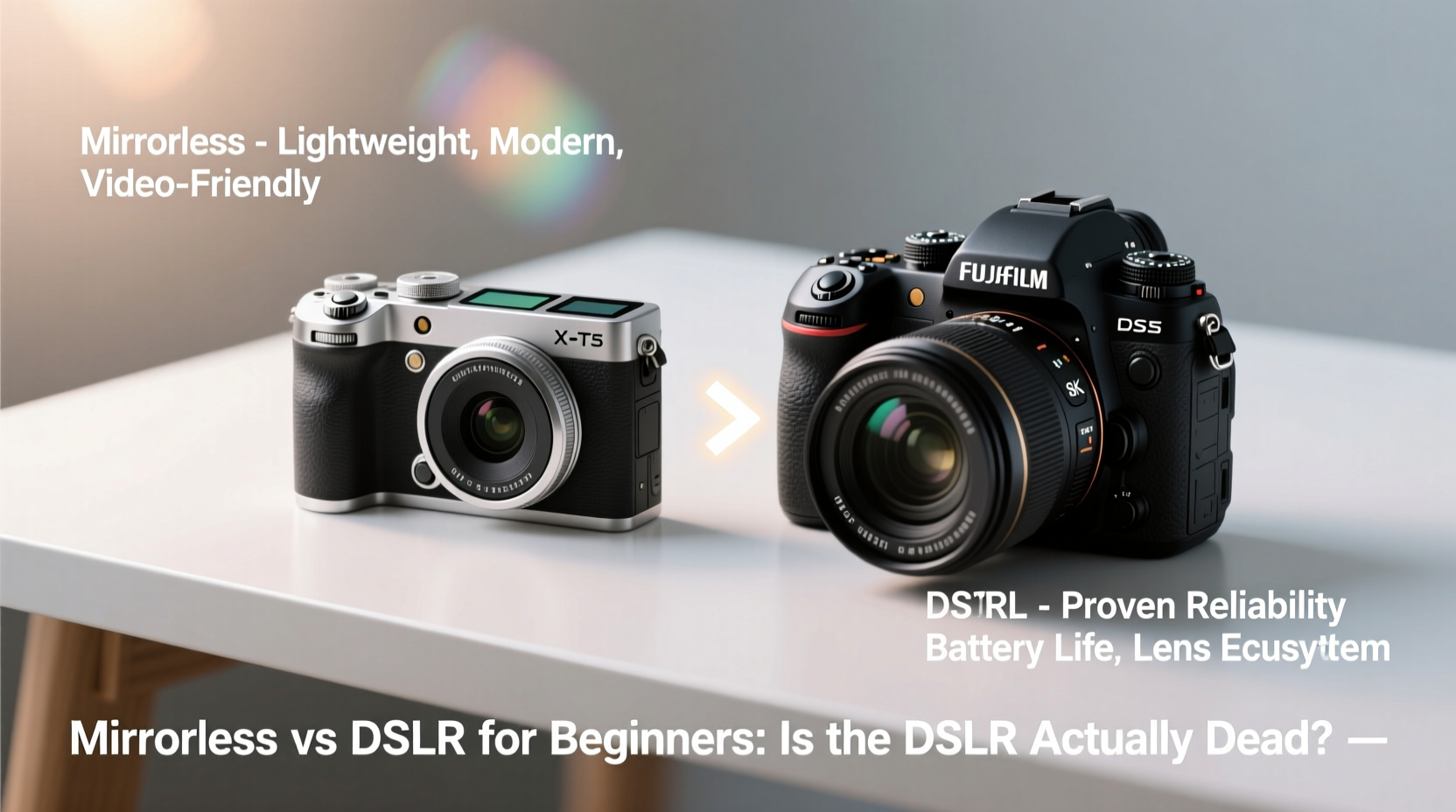
The fundamental distinction between DSLR (Digital Single-Lens Reflex) and mirrorless cameras lies in their internal design. DSLRs use a mirror mechanism that reflects light from the lens up into an optical viewfinder. When you press the shutter, the mirror flips up, allowing light to hit the sensor and capture the image. Mirrorless cameras, on the other hand, do away with this mirror entirely. Light passes directly to the sensor, which feeds a live preview to an electronic viewfinder (EVF) or the rear LCD screen.
This seemingly small engineering change has cascading effects on size, weight, autofocus performance, battery life, and overall user experience. While DSLRs were once praised for their robust build and reliable optics, mirrorless systems now offer faster processing, superior video capabilities, and more compact bodies — features increasingly demanded by modern creators.
DSLRs: Still Relevant or Fading Out?
It’s true that major manufacturers have largely pivoted to mirrorless. Canon and Nikon, once DSLR powerhouses, now focus most of their R&D on mirrorless lines like the Canon EOS R series and Nikon Z series. Even Pentax, one of the last holdouts, has only released minor DSLR updates since 2016. Meanwhile, Sony, Fujifilm, and OM System have built entire ecosystems around mirrorless technology.
But \"dead\" doesn't mean \"useless.\" Millions of working DSLRs remain in circulation, supported by vast libraries of lenses, accessories, and repair networks. Entry-level models like the Nikon D3500 or Canon EOS Rebel T7 are still available, affordable, and capable of producing excellent image quality — especially for beginners learning composition, exposure, and manual settings.
Moreover, DSLRs often have longer battery life due to their optical viewfinders not constantly drawing power. They also tend to perform well in low-light situations where older EVFs might lag or display noise. For someone who values simplicity, durability, and tactile feedback, a DSLR can still be a smart entry point.
“DSLRs aren’t dead — they’re mature. Like film cameras before them, they’ve reached peak refinement and now serve a niche audience.” — David Lin, Photography Educator and Gear Analyst
Mirrorless Advantages That Matter to Beginners
While mirrorless cameras used to suffer from poor battery life and limited lens options, those gaps have closed significantly. Today, mirrorless systems offer tangible benefits that align well with how beginners learn and shoot:
- Real-time exposure preview: The EVF shows exactly how brightness, contrast, and white balance will appear in the final image, helping newcomers understand exposure faster.
- Autofocus speed and coverage: Modern mirrorless cameras use on-sensor phase detection, covering nearly the entire frame. This makes tracking moving subjects — pets, kids, sports — far more reliable than most DSLRs.
- Compact size and lighter weight: Without the mirror box and pentaprism, mirrorless bodies are generally smaller, making them less intimidating and easier to carry daily.
- Better video performance: Most mirrorless models support 4K video, advanced stabilization, and external microphone inputs — important for hybrid shooters and content creators.
- In-body image stabilization (IBIS): Many mirrorless brands include IBIS, reducing blur from shaky hands without requiring stabilized lenses.
For a beginner interested in vlogging, travel photography, or social media content, these features translate into immediate creative flexibility. You’re not just learning photography — you’re building skills across formats.
Comparison Table: DSLR vs Mirrorless (Beginner-Focused)
| Feature | DSLR | Mirrorless |
|---|---|---|
| Size & Weight | Larger, heavier due to mirror mechanism | Smaller, lighter, more portable |
| Battery Life | Longer (600–1000 shots per charge) | Shorter (300–500 shots), improving |
| Viewfinder Type | Optical (real scene, no lag) | Electronic (live preview with settings) |
| Autofocus Performance | Good for static subjects; slower tracking | Fast, full-frame coverage; excellent tracking |
| Lens Selection | Extensive legacy glass available | Growing rapidly; adapters expand options |
| Video Capabilities | Limited to 1080p on most entry models | Most offer 4K, log profiles, mic input |
| Price (Entry-Level) | Generally cheaper new; great deals used | Slightly higher entry cost; better long-term ROI |
A Real Beginner’s Journey: Sarah’s Choice
Sarah, a college student interested in documenting campus life and creating Instagram content, started researching cameras in early 2023. She had a budget of $800 and wanted something easy to carry but capable of good photos and videos. Initially drawn to the Canon EOS Rebel SL3 for its affordability and positive reviews, she hesitated after watching several YouTube comparisons showing the Canon EOS R50 — a mirrorless model — offering better autofocus, flip-out screens, and 4K video.
She visited a local camera store and held both models. The DSLR felt sturdier, but the mirrorless was noticeably lighter. When she looked through the EVF of the R50, she could see how changing her ISO would affect the image in real time — a feature the salesperson said helped him teach beginners faster.
Sarah ultimately chose the EOS R50 with an 18-45mm kit lens. Within weeks, she was filming short reels with smooth autofocus transitions and taking sharper portraits thanks to eye-tracking. Six months later, she upgraded to a second lens via Canon’s growing RF lineup. Reflecting on her decision, she said: “I didn’t realize how much the tech would help me learn. The camera almost guides you.”
What Should a Beginner Do Now?
If you're stepping into photography today, here’s a practical checklist to guide your decision:
- Evaluate your primary use case: Are you shooting stills, video, or both? Video-heavy work leans heavily toward mirrorless.
- Consider portability: Will you carry the camera daily? Smaller mirrorless models win for convenience.
- Test the ergonomics: Visit a store if possible. A camera that fits your hand encourages regular use.
- Look at lens ecosystems: Choose a brand with lenses you’ll want down the line (e.g., fast primes, zooms, macro).
- Factor in future-proofing: Mirrorless systems are where innovation is happening. New features will appear there first.
- Check resale and used markets: DSLRs hold value decently, but mirrorless demand is rising — especially for newer models.
FAQ: Common Questions Answered
Can I use my old DSLR lenses on a mirrorless camera?
Yes, in most cases. Manufacturers offer official adapters (e.g., Canon EF-EOS R, Nikon FTZ), and third-party options exist. Autofocus performance may vary, but many combinations work very well. Some even improve functionality with added features like focus peaking.
Is it worth buying a DSLR in 2024?
Only under specific conditions: if you find a great deal on a used body, prefer optical viewfinders, need extreme battery endurance, or are inheriting a collection of DSLR lenses. For most beginners starting fresh, mirrorless offers better long-term value and support.
Do professional photographers still use DSLRs?
A few do, particularly in sports or photojournalism where ruggedness and battery life are critical. However, the majority have transitioned. Major events like the Olympics now show mirrorless cameras dominating sidelines. Even top-tier DSLR users often keep them as backups rather than primary tools.
Final Verdict: Is DSLR Dead?
No — but it's no longer leading the evolution of photography. Think of DSLRs like combustion-engine cars: still functional, widely supported, and beloved by enthusiasts, but no longer the direction of progress. Innovation, marketing, and ecosystem development are centered firmly on mirrorless platforms.
For a beginner, choosing a DSLR today is a deliberate step backward in terms of technology access. You’ll miss out on real-time feedback, advanced autofocus, and seamless video integration — all of which accelerate learning. While a DSLR won’t ruin your journey, a mirrorless camera will likely enhance it.
That said, the best camera is still the one you’ll use consistently. If budget constraints lead you to a used Nikon D7500 or Canon 80D, go for it. Learn the fundamentals. Then, when you’re ready, transition into a mirrorless system with confidence.
Conclusion: Your First Step Into Photography
The debate between mirrorless and DSLR isn’t about technical superiority alone — it’s about alignment with how we create now. Photography has expanded beyond still images into dynamic storytelling across platforms. Mirrorless cameras meet that reality head-on, offering tools that grow with your skill level.
You don’t need the latest gear to take great photos. But if you’re investing in your first \"real\" camera, aim for one that supports your curiosity, adapts to new challenges, and stays relevant for years. In 2024 and beyond, that path leads clearly through mirrorless.




 浙公网安备
33010002000092号
浙公网安备
33010002000092号 浙B2-20120091-4
Comments
No comments yet. Why don't you start the discussion?