
When it comes to seasonal lighting—especially during holidays like Christmas, Diwali, or Hanukkah—the ability to quickly adapt and rearrange your display is just as important as brightness and aesthetics. Many homeowners and event planners face the same annual challenge: untangling miles of wire, patching burnt-out bulbs, and struggling to reshape displays to fit new layouts. Enter two competing solutions—traditional string lights and modular light panels. While both have their place, one clearly outpaces the other when it comes to ease of reconfiguration over multiple seasons.
The core difference lies in design philosophy. Traditional string lights follow a linear, fixed pattern. Modular light panels, on the other hand, are engineered for adaptability, scalability, and repeat use with minimal effort. This article dives deep into why modular light panels offer superior reconfigurability year after year, backed by practical insights, real-world scenarios, and expert perspectives.
Understanding the Core Differences
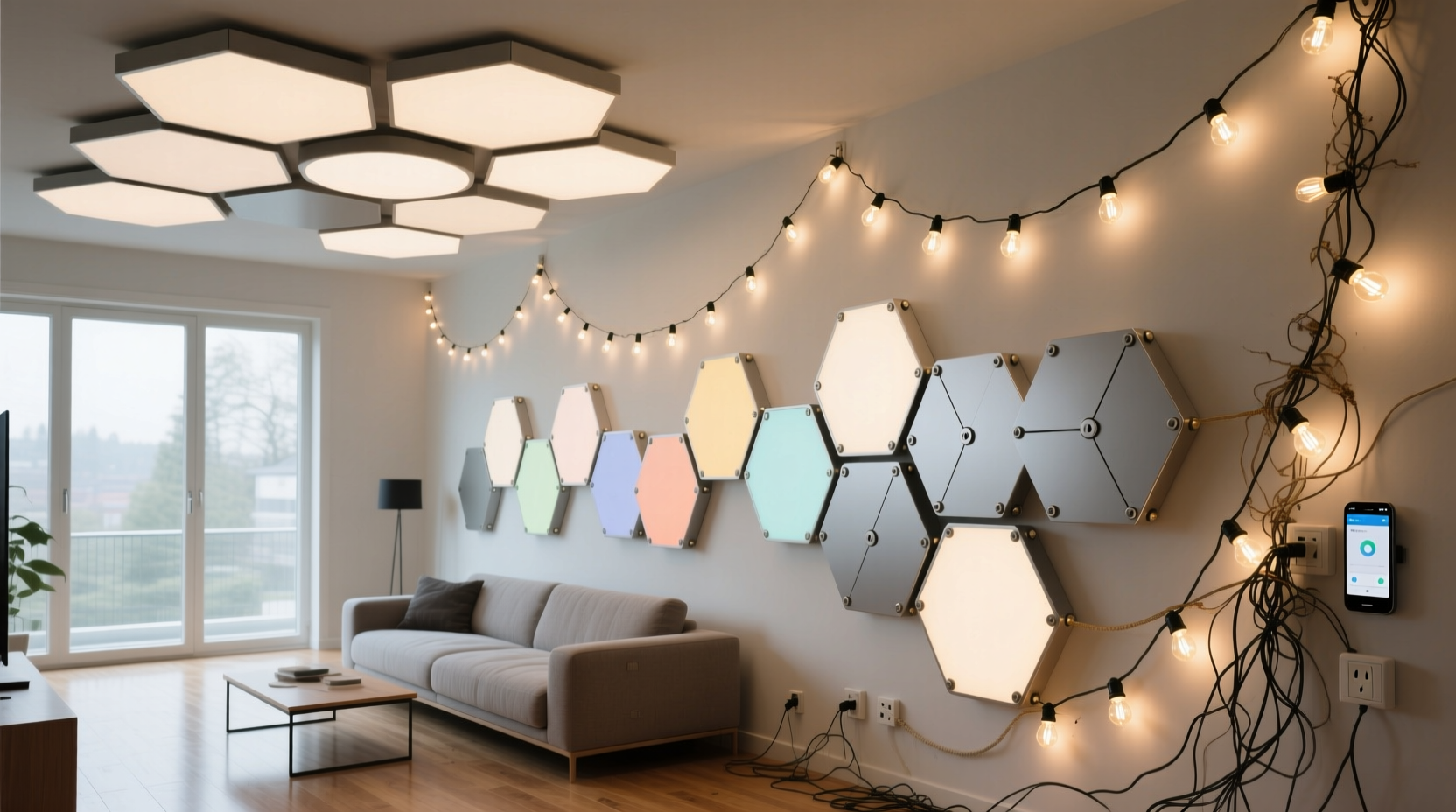
Before comparing reconfiguration ease, it's essential to understand what sets these two lighting systems apart at the structural level.
Traditional string lights consist of a long electrical cord with evenly spaced bulbs (incandescent or LED) wired in series or parallel. They come in fixed lengths—commonly 25, 50, or 100 feet—and are designed primarily for draping, wrapping, or hanging along predefined paths such as rooflines, trees, or railings. Their simplicity has made them a staple for decades, but that simplicity also limits flexibility.
Modular light panels, by contrast, are composed of individual illuminated units—often square, rectangular, or hexagonal—that connect magnetically, mechanically, or via plug-and-play wiring. Each panel contains multiple LEDs and can function independently or as part of a larger grid. These systems are commonly used in architectural lighting, stage design, and increasingly in residential seasonal decor due to their scalability and resilience.
The modularity allows users to add, remove, rotate, or reposition sections without rewiring entire runs. This makes redesigning an outdoor display from one year to the next not only possible but efficient.
Reconfiguration Challenges with Traditional String Lights
Every year, millions of households wrestle with the same ritual: pulling down boxes of tangled lights, testing each strand, replacing dead bulbs, and attempting to recreate—or slightly modify—last year’s setup. The process is time-consuming and frustrating, largely because of inherent limitations in string light design.
- Tangling and storage damage: Even carefully coiled strings often become knotted after storage, leading to wasted time and potential wire damage.
- Inflexible length: You’re constrained by the fixed length of each strand. Want to cover a longer eave? You’ll need another full strand, possibly leaving excess wire to manage.
- Daisy-chaining limits: Most manufacturers recommend no more than three to five strands daisy-chained together due to voltage drop and circuit load, limiting how much you can extend a single run.
- Bulb-level failures: A single burnt bulb in older series-wired strings can cause an entire section to go dark, requiring troubleshooting with a tester.
- Layout rigidity: Once installed, changing the shape—say, from vertical columns to horizontal bands—requires complete removal and re-hanging.
These constraints compound over time. As homes evolve—adding porches, changing siding, or remodeling entryways—string lights become harder to adapt. The result? Displays either stagnate or get abandoned altogether.
“Most people underestimate how much time they lose each season just managing old string lights. It’s not just about brightness—it’s about usability.” — Marcus Lin, Residential Lighting Designer, BrightAxis Studios
Why Modular Light Panels Excel in Reconfiguration
Modular light panels were designed with adaptability at their core. Whether used indoors for accent walls or outdoors for seasonal facades, their structure supports repeated changes without degradation in performance or safety.
Each panel functions as a self-contained unit with standardized connectors. This means you can:
- Swap out damaged panels without affecting the whole system.
- Add more panels to expand coverage as needed.
- Reorient panels to create different patterns—vertical stacks, diagonal grids, or custom shapes.
- Store them flat or stacked, reducing space and preventing tangles.
- Use control systems to adjust brightness, color, or animation per zone.
Because they’re built for integration, many modular systems support smart controls via Wi-Fi or DMX, allowing users to save multiple lighting “scenes” for different occasions. One configuration might be warm white for Christmas, while another uses animated blues for winter festivals—all without touching the physical hardware.
Moreover, since most modern panels are IP65-rated or higher, they withstand rain, snow, and UV exposure, making them durable across multiple seasons. Unlike string lights that degrade after 3–5 years, high-quality modular panels can last a decade or more with minimal maintenance.
Real Example: The Johnson Family’s Holiday Upgrade
The Johnsons in Portland, Oregon, used traditional C9 string lights for their front porch display for eight years. Each November, they spent nearly 12 hours untangling wires, replacing bulbs, and adjusting clips. In 2022, they invested in a 4x6-foot modular panel system with warm white LEDs and magnetic edge connectors.
The first installation took slightly longer—about 8 hours—but included mounting a lightweight aluminum frame. Since then, their reconfiguration process has changed dramatically:
- They unmount the entire panel array as a single unit in early January.
- Store it vertically in a garage cabinet (takes up less than 1 sq ft).
- In November, remounting takes under 2 hours.
- This year, they added two new side panels to highlight newly planted evergreens—simply snapping them into place.
“We used to dread December,” says homeowner Linda Johnson. “Now we look forward to it. We even let the kids design new light patterns using the app.”
Comparison: Key Features Side-by-Side
| Feature | Modular Light Panels | Traditional String Lights |
|---|---|---|
| Reconfiguration Time (Annual) | 1–3 hours | 6–12+ hours |
| Storage Efficiency | High – flat stacking | Low – prone to tangling |
| Expandability | Yes – plug-and-play | Limited by daisy-chain rules |
| Durability Over 5 Years | High – sealed units | Medium to low – wire stress, bulb failure |
| Layout Flexibility | High – any geometric arrangement | Low – linear only |
| Smart Integration | Common – app or DMX control | Optional – limited to newer LED strings |
Step-by-Step: Transitioning from String Lights to Modular Panels
If you're ready to make the switch, follow this proven sequence to ensure a smooth transition and long-term satisfaction:
- Assess Your Current Layout: Take photos and measurements of your existing string light placement. Note areas with poor coverage or frequent burnouts.
- Define Your Goals: Decide whether you want static lighting, color-changing effects, or programmable animations.
- Choose Panel Size and Brightness: Common sizes range from 12\"x12\" to 24\"x48\". For outdoor use, aim for at least 500 lumens per panel.
- Design Your Grid: Sketch a layout showing how many panels you’ll need and where connectors will align. Leave room for future expansion.
- Install Mounting Framework: Use aluminum channels, brackets, or a custom frame to securely hold panels. Avoid direct wood screwing unless panels include mounts.
- Connect and Test: Attach panels in sequence, ensuring weatherproof connectors are fully seated. Power on and verify uniform brightness.
- Store Off-Season Smartly: Label each panel and store in original packaging or padded containers. Keep connectors covered to prevent dust buildup.
FAQ: Common Questions About Reconfiguration
Can I mix modular panels with my existing string lights?
Yes, but not directly. You can run them on separate circuits and control them independently. Some advanced controllers allow synchronization of effects across different systems, provided they support protocols like DMX or RGBW.
Are modular light panels worth the higher upfront cost?
For most users who redecorate annually, yes. While modular panels may cost 2–3 times more initially, their longevity, lower labor time, and reusability typically deliver a better return within 3–4 seasons. Plus, reduced replacement purchases and energy efficiency add to savings.
Do modular panels work in extreme cold or heat?
High-quality panels rated for -20°C to 60°C (-4°F to 140°F) perform reliably in most climates. Always check the manufacturer’s environmental specifications before purchasing for harsh environments.
Final Checklist Before Making the Switch
Use this checklist to determine if modular light panels are right for your needs:
- ☐ I change my lighting layout every 1–2 years
- ☐ I spend more than 5 hours annually installing/removing lights
- ☐ I want color-changing or animated effects without complexity
- ☐ My current string lights are aging or frequently fail
- ☐ I have a budget for a long-term lighting solution
- ☐ I value clean, professional-looking displays
If four or more apply, modular panels are likely the smarter investment.
Conclusion: Embrace Change Without the Hassle
The choice between modular light panels and traditional string lights isn’t just about appearance or energy use—it’s about freedom. Freedom to experiment, to evolve, and to enjoy the creative process year after year without the burden of frustration and repair. While string lights still have their place in simple, temporary setups, they fall short when reconfiguration is a priority.
Modular light panels represent the next generation of decorative lighting: intelligent, durable, and designed for real human behavior. They turn what was once a chore into a joyful tradition—one where families can collaborate on designs, test new ideas, and build displays that grow more impressive with time.




 浙公网安备
33010002000092号
浙公网安备
33010002000092号 浙B2-20120091-4
Comments
No comments yet. Why don't you start the discussion?