
Nothing dampens holiday cheer faster than a sudden power loss in the middle of your meticulously arranged Christmas village—lights dimming, trains halting mid-track, animated figures freezing mid-wave. You reset the breaker, plug everything back in, and within minutes, it trips again. This isn’t just inconvenient; it’s a red flag signaling potential electrical overload, aging equipment, or hidden hazards. Unlike string lights on a porch, villages combine dozens of low-wattage devices—miniature buildings with internal LEDs, motorized trains, rotating carousels, fog machines, and sound modules—all drawing continuous current from a single outlet or power strip. When multiple units share one 15-amp circuit (standard in most U.S. living rooms), cumulative draw can easily exceed safe limits—especially when combined with other seasonal loads like tree lights or a space heater. This article walks through the real-world causes—not assumptions—and delivers field-tested, electrician-vetted solutions you can implement tonight.
Why Your Village Overloads Circuits: The Physics Behind the Trip
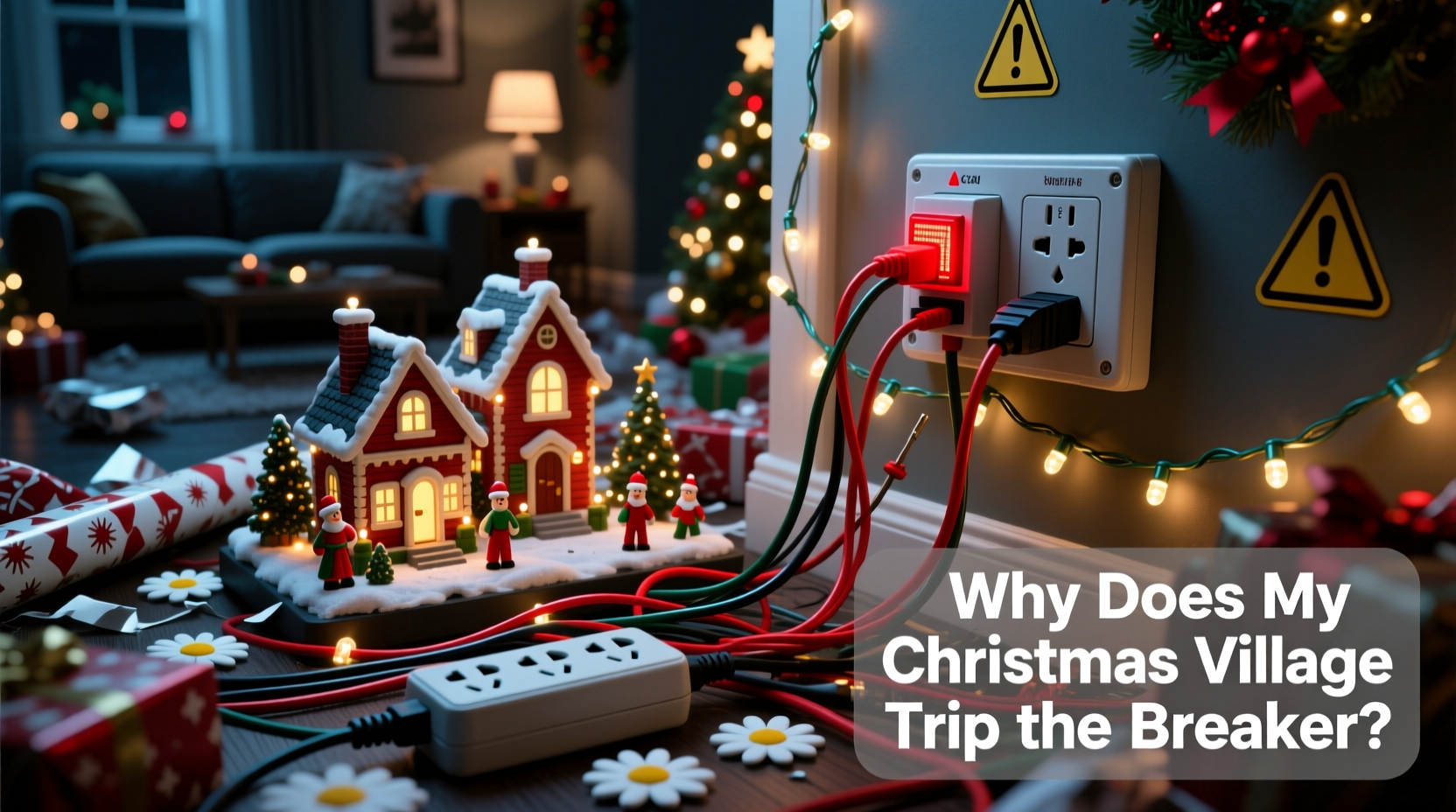
Circuit breakers trip to prevent overheating wires, which can ignite insulation and cause fires. A standard residential circuit is rated for 15 amps at 120 volts—translating to a maximum safe load of 1,800 watts. But the National Electrical Code (NEC) recommends operating circuits at no more than 80% capacity for continuous loads (those running over three hours), meaning your practical limit is just 1,440 watts. Now consider a typical village:
- A single illuminated house with LED lighting: 3–7 watts
- A battery-powered train converted to AC operation: 8–12 watts
- A miniature animated carousel with motor + lights: 15–22 watts
- A fog machine (even mini models): 60–120 watts
- A digital music/sound module: 5–9 watts
- A 10-foot section of 20-gauge landscape wire powering 12 houses: adds ~0.5–1.2 amps of resistance-based loss
It adds up quickly. Twelve houses (avg. 5W each) = 60W. Add two trains (10W each), a carousel (18W), fog machine (90W), and sound (7W)—that’s already 185W. But that’s only the *nameplate* rating. Real-world conditions inflate demand: voltage drop across long extension cords, aging transformers with reduced efficiency, and “inrush current” spikes when motors start (up to 3× normal draw for milliseconds). Older villages often use unregulated wall adapters that waste energy as heat—and draw more current than labeled. And crucially: many homeowners unknowingly daisy-chain power strips or plug their village into the same circuit powering a refrigerator, entertainment center, or overhead lighting. That unseen load pushes the system past its thermal threshold.
Step-by-Step Diagnostic Protocol: Find the Culprit in Under 15 Minutes
Don’t guess—measure. Follow this sequence methodically before adding any new components:
- Unplug everything. Reset the breaker. Confirm all village devices are disconnected—including controllers, timers, and USB-powered accessories.
- Test the circuit alone. Plug in only a known-good lamp (60W incandescent or equivalent LED). Leave it on for 5 minutes. If the breaker trips, the issue is in the wiring or receptacle—not your village. Call an electrician immediately.
- Map your circuit. Turn off the suspected breaker. Walk through your home testing outlets, lights, and appliances until you identify every device on that circuit. Note high-draw items (refrigerator compressors, AV receivers, HVAC zones).
- Calculate total load. Use a plug-in power meter (like the Kill A Watt P4400) to measure actual wattage of each village component—while running. Record values. Sum them. Compare to 1,440W (80% of 15A × 120V).
- Isolate the offender. Reconnect devices one by one, waiting 2 minutes between each. When the breaker trips, the last device added is likely faulty—or its transformer is shorting internally.
This process reveals whether the problem is systemic (overloaded circuit), component-specific (a failing motor), or infrastructure-related (old wiring).
Do’s and Don’ts: Safe Village Power Management
How you distribute power matters as much as how much you use. Here’s what seasoned display builders follow—backed by NEC guidelines and UL certification standards:
| Action | Do | Don’t |
|---|---|---|
| Power Distribution | Use UL-listed, 15-amp-rated power strips with individual circuit breakers per outlet bank. Plug strips into separate, dedicated circuits whenever possible. | Plug multiple strips into one outlet or use non-UL “dollar-store” strips with no overload protection. |
| Extension Cords | Use 12-gauge, SJTW-rated outdoor cords (rated for 15A) under 50 feet long. Keep cords untangled and off carpeted floors. | Use 16-gauge indoor extension cords longer than 25 feet—they overheat under sustained load. |
| Transformers & Adapters | Replace original wall warts older than 5 years. Use regulated, switching-mode power supplies with clear output ratings (e.g., “12V DC, 2A”). | Use unmarked, “universal” adapters with mismatched voltage/amperage or no safety certifications. |
| Wiring Between Pieces | Solder connections and insulate with heat-shrink tubing. Use stranded 22-gauge wire for runs under 15 feet. | Rely on alligator clips or exposed twist-on wire nuts—these corrode and arc over time. |
| Timing & Control | Use a programmable timer that cuts power completely overnight—not just dims lights. Reduces thermal stress on transformers. | Run village continuously 24/7 during December. Motors and electronics degrade faster under constant load. |
Real-World Fix: How Sarah Rescued Her 30-Year-Old Lionel Village
Sarah inherited her grandmother’s hand-painted Lionel village—17 buildings, 3 trains, a working water wheel, and vintage sound box. For three years, it tripped her living room breaker every evening around 7:15 p.m. She assumed it was “just old.” Then she measured: the total load was 1,320W—within theoretical limits. But her diagnostic revealed the culprit wasn’t wattage—it was voltage drop. Her 50-foot run of 16-gauge extension cord dropped voltage from 120V to 108V at the farthest building. Low voltage forces motors and transformers to draw more current to maintain output—pushing the circuit into overload. Sarah replaced the cord with a 12-gauge, 25-foot version and relocated her main power strip closer to the breaker panel using a dedicated 20-amp circuit (installed by her electrician). She also upgraded all 11 wall adapters to regulated 12V/2A supplies. Result? Zero trips in 47 days—and her 1980s train motor now runs quieter and cooler.
“Most village overloads aren’t about ‘too many lights’—they’re about poor power delivery. Voltage drop is the silent killer of miniature electronics. Measure at the device, not at the outlet.” — Rafael Mendoza, Senior Applications Engineer, Leviton Electrical Systems
Essential Troubleshooting Checklist
Before the holidays get hectic, run through this actionable checklist:
- ☑️ Verify your village’s total measured wattage stays below 1,440W (80% of 15A circuit)
- ☑️ Replace all power strips older than 3 years or lacking visible UL/ETL marks
- ☑️ Test every wall adapter with a multimeter: output voltage must match label ±5%; output amperage must meet or exceed device requirement
- ☑️ Inspect all cords for cracked insulation, bent prongs, or warm spots after 10 minutes of operation
- ☑️ Label each circuit breaker clearly—don’t rely on memory. Map which outlets serve your village zone
- ☑️ Install AFCI (Arc-Fault Circuit Interrupter) breakers if your panel supports them—they detect dangerous arcing faults traditional breakers miss
- ☑️ Keep at least one 3-outlet, 15-amp GFCI-protected outlet reserved exclusively for village use (no shared loads)
FAQ: Quick Answers to Pressing Questions
Can I safely run my village on a 20-amp circuit instead of 15-amp?
Yes—if your wiring, outlets, and devices are rated for 20 amps. But don’t assume. Check outlet faceplates: 20A outlets have a horizontal slot in one prong (T-slot). Standard 15A outlets won’t accept 20A plugs. Upgrading requires replacing outlets, breakers, and verifying wire gauge (12-gauge minimum). Consult an electrician first—most villages don’t need 20A unless using large fog machines or multiple high-wattage animations.
My village uses battery-operated pieces. Why do they still trip the breaker when I plug in the charger?
Battery chargers—even small ones—can draw significant inrush current. A typical NiMH charger may pull 1.5A for 2–3 seconds when first connected. If multiple chargers activate simultaneously (e.g., via a timer), that brief surge can trip a sensitive breaker. Solution: stagger charging times manually or use a smart plug with delayed startup.
Will using LED replacements for incandescent bulbs in older buildings solve the problem?
Often—but verify. Some vintage village buildings use 12V AC halogen bulbs drawing 5–10W each. Replacing with modern 12V DC LEDs (0.3–0.8W) cuts load by 85%. However, ensure the LED is compatible with AC or DC supply—mismatched polarity or waveform can damage drivers. Look for “AC/DC universal” LEDs rated for your transformer’s output.
Conclusion: Safety, Longevity, and the Joy of a Reliable Display
Your Christmas village is more than decor—it’s memory, craftsmanship, and intention made tangible. Letting electrical strain compromise its operation—or worse, your home’s safety—undermines everything it represents. Tripping breakers aren’t a “quirk” to tolerate; they’re precise, urgent feedback from your home’s electrical system. By measuring actual loads, upgrading infrastructure thoughtfully, and respecting the physics of power delivery, you transform frustration into control. You gain confidence that your display will glow steadily through Christmas Eve—and that your family remains protected from preventable hazards. Start tonight: grab a power meter, sketch your circuit map, and replace one aging adapter. Small actions compound. In a few hours, you’ll move from reactive panic to proactive peace of mind. And when your village runs flawlessly—train wheels turning, smoke gently rising, carols playing without interruption—you’ll know it wasn’t luck. It was preparation, respect for electricity, and care for what matters most.




 浙公网安备
33010002000092号
浙公网安备
33010002000092号 浙B2-20120091-4
Comments
No comments yet. Why don't you start the discussion?