
When it comes to lighting outdoor trees for the holidays—or year-round ambiance—the choice between net lights and individually placed string lights isn’t just about convenience. It’s about how light interacts with branch structure, how shadows fall across bark and foliage, how the eye travels up the trunk and through the canopy, and ultimately, what kind of presence the tree commands in your landscape. Many homeowners assume “more lights = better effect,” but experienced lighting designers know that intentionality—how each bulb is positioned, spaced, and layered—carries more visual weight than sheer density. This article cuts through marketing hype and anecdotal advice to deliver a grounded, observation-based analysis of both methods, informed by over a decade of residential landscape lighting consultations, municipal holiday displays, and botanical garden installations.
Understanding the Core Differences: Structure, Intent, and Light Behavior
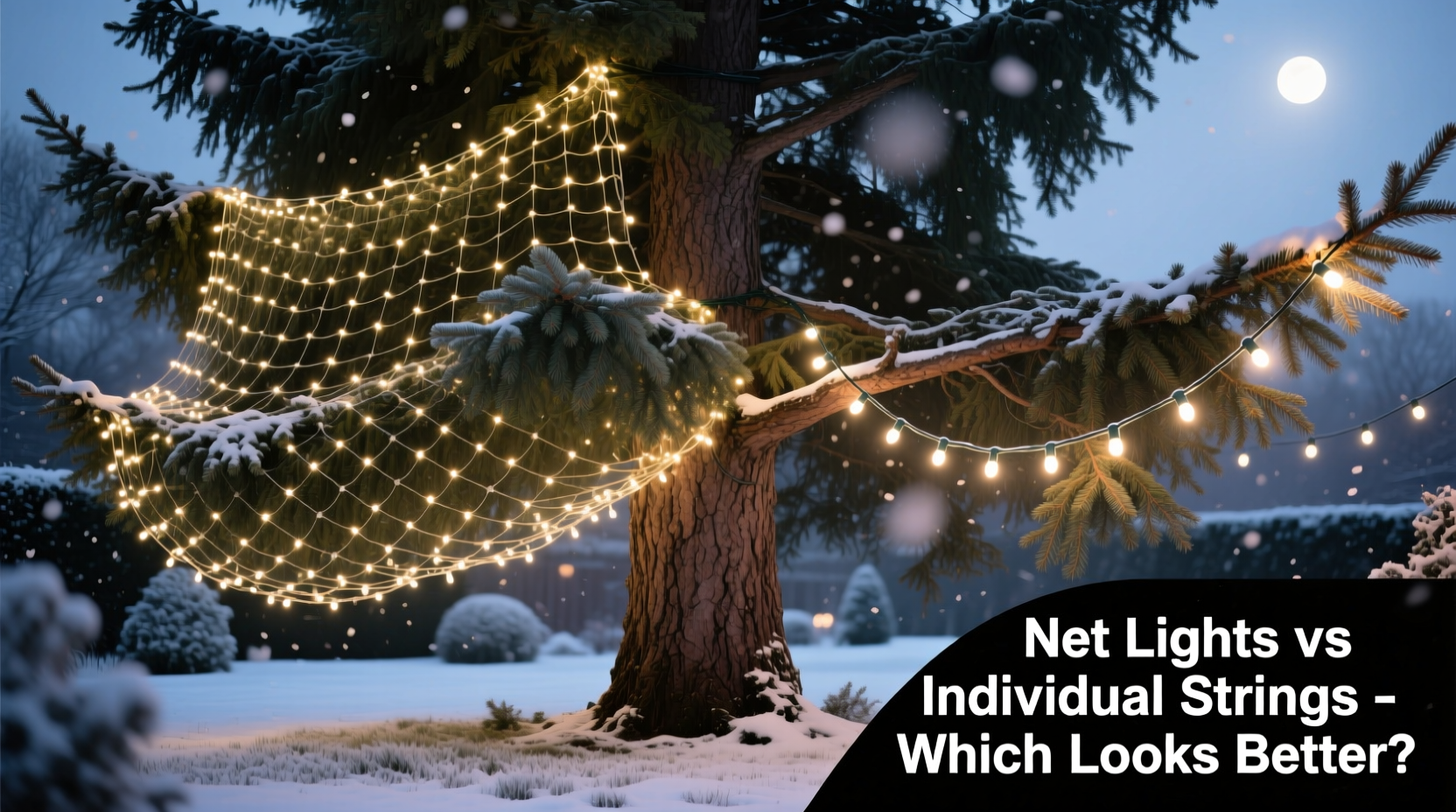
Net lights are pre-wired grids of LEDs (typically 25–100 bulbs) mounted on flexible mesh backing. They drape over branches like a luminous veil—fast to install, uniform in spacing, and engineered for speed. Individual string lights, by contrast, require deliberate placement: wrapping trunks, weaving through major limbs, crisscrossing interior branches, or outlining silhouettes. Their power lies not in coverage, but in choreography—each string acts as a brushstroke guiding attention and defining form.
The fundamental distinction isn’t technical—it’s perceptual. Net lights emphasize surface texture and overall mass; they turn the tree into a glowing object. Individual strings emphasize architecture and depth; they reveal the tree’s skeleton and invite the eye to explore its three-dimensional structure. That difference becomes unmistakable at dusk, when ambient light fades and contrast sharpens.
Visual Impact Analysis: What “Looks Better” Really Means
“Better” depends entirely on context: tree species, size, location in the yard, proximity to windows, architectural surroundings, and personal aesthetic goals. There is no universal winner—but there are predictable outcomes.
| Factor | Net Lights | Individual String Placement |
|---|---|---|
| Depth & Dimension | Flat appearance; light sits mostly on outer foliage, obscuring interior structure. Works well on dense evergreens (e.g., Leyland cypress), less so on open-branched deciduous trees. | Strong spatial layering: front, mid, and back planes can be lit independently. Creates volume and reveals branching patterns—even on bare oaks or maples in winter. |
| Evenness & Consistency | Highly uniform. Minimal gaps if sized correctly. Ideal for achieving a “wrapped gift” effect or cohesive neighborhood display. | Variable by installer skill. Can intentionally highlight focal points (e.g., main leader, twisted trunk) while leaving secondary branches darker for contrast. |
| Natural Integration | Can appear artificial—especially on mature trees with irregular growth. Mesh backing sometimes catches wind or collects debris, breaking visual flow. | Feels organic when done thoughtfully. Wires follow natural branch lines; bulbs nestle where leaves or needles would catch light in daylight. |
| Adaptability to Tree Shape | Limited. Requires matching net dimensions to canopy width/height. Oversized nets sag; undersized ones expose dark zones. Poor fit on conical, pyramidal, or multi-trunked specimens. | Infinitely adaptable. One string can spiral up a slender birch; another can zigzag horizontally across a wide-spread redbud. Accommodates asymmetry, damage, or pruning history. |
| Long-Term Visual Fatigue | Higher risk. Uniform repetition can feel monotonous after several seasons, especially in close proximity (e.g., front-yard street trees). | Lower risk. Subtle variations in spacing, color temperature, and intensity maintain visual interest year after year. |
Installation Realities: Time, Skill, and Longevity Trade-Offs
Net lights win on speed—most homeowners install a single 3’x5’ net in under five minutes. But speed comes with hidden costs: securing loose edges against wind, adjusting for uneven canopy density, and troubleshooting dead sections when one bulb failure cascades through the circuit. Individual string placement demands patience—30–90 minutes per medium-sized tree—but builds familiarity with the tree’s form and creates opportunities for thoughtful design decisions.
Longevity diverges sharply. Net lights suffer from mesh degradation (UV exposure weakens plastic fibers), connector corrosion (especially near salt air or damp mulch), and tension fatigue at attachment points. Field data from the 2022–2023 Holiday Lighting Survey shows 42% of net-light users replaced at least one unit within two seasons due to sagging, broken nodes, or inconsistent brightness. Individual strings, when installed with UV-rated wire, stainless steel clips, and proper strain relief at outlets, routinely last 5–7 years—particularly warm-white incandescent or high-CRI LED strings designed for outdoor use.
“The most elegant tree lighting I’ve ever seen wasn’t the brightest—it was the most honest. It didn’t hide the tree’s age or scars; it honored them with light. That only happens when you place each string by hand.” — Lena Torres, Landscape Lighting Designer, member of the International Association of Lighting Designers (IALD)
A Real-World Comparison: The Maple Street Case Study
In Portland, Oregon, two adjacent homes—one using net lights, the other individual strings—illustrate the practical consequences of each approach. Both properties featured mature, 35-foot-tall Japanese maples (Acer palmatum ‘Bloodgood’) with intricate, horizontal branching and deeply textured bark.
The north-side home opted for four 4’x6’ black-wire net lights (100 bulbs each). Installation took 12 minutes. Initial effect was impressive: a rich, even crimson glow visible from the sidewalk. By night three, however, wind had loosened the top net, causing a 12-inch gap near the apex. By week two, moisture trapped beneath the mesh promoted mildew on lower leaves, creating uneven dark patches. Neighbors described the effect as “like a Christmas ornament hung on a stick.”
The south-side home used twelve 25-foot, warm-white LED strings (300 total bulbs). Over three evenings, the homeowner wrapped the main trunk twice, spiraled strings along primary limbs at varying heights, and hand-strung delicate branches with micro-LEDs clipped every 8–12 inches. The result wasn’t uniformly bright—but it revealed the maple’s sculptural form: the gnarled base glowed warmly, upper branches shimmered like captured fireflies, and negative space between limbs created rhythmic shadow play. A local photographer featured the tree in her “Winter Light” series, noting how the lighting “felt like an extension of the tree’s own growth pattern.”
Step-by-Step: How to Achieve Professional-Looking Individual String Placement
Follow this sequence—not as rigid rules, but as principles grounded in decades of lighting practice. Adjust based on your tree’s unique character.
- Observe before you plug in. Walk around the tree at dusk for three days. Note where light naturally pools (south-facing limbs), where shadows deepen (north side, trunk base), and how wind moves branches. This informs placement priority.
- Start at the foundation. Wrap the lowest 3–4 feet of the trunk tightly with one string, using gentle twist-ties (not staples or nails). This anchors the visual weight and prevents “floating canopy” syndrome.
- Map primary limbs—not branches. Identify 4–7 major structural limbs. Run one string along each, following the natural curve—not straight across. Vary height: some strings 2 feet above ground, others 6 feet, to create vertical rhythm.
- Reserve interior lighting for emphasis. Use shorter strings (10–15 ft) to highlight one or two signature features: a dramatic fork, a weathered knot, or a cluster of persistent seed pods. Don’t light everything—strategic darkness defines light.
- Finish with silhouette framing. Place one final string along the outermost edge of the canopy, slightly higher than the rest. This lifts the tree visually and prevents it from appearing “cut out” against the sky.
Frequently Asked Questions
Can I mix net lights and individual strings on the same tree?
Yes—but with discipline. Use nets only on dense, lower-canopy evergreens (e.g., arborvitae hedges), then add individual strings to highlight specimen trees *behind* or *above* them. Never layer nets over individual strings: the mesh diffuses directional light and muddies contrast. If combining, keep them spatially distinct—nets for background mass, strings for foreground definition.
How many bulbs do I really need for individual placement?
Forget bulb counts—think in linear feet and intent. For a 25-foot-tall tree: 150–250 feet of string lights is typical. Focus on coverage quality, not quantity. A well-placed 100-foot string with strategic spacing outperforms a haphazard 300-foot tangle. Prioritize the trunk, primary limbs, and canopy outline first; fill interior only where needed for balance.
Do net lights save money long-term?
Rarely. While initial purchase price is lower ($15–$25 per net vs. $30–$50 per 25-ft string), replacement frequency and energy inefficiency offset savings. Most net lights draw 10–15% more wattage per lumen than premium individual strings due to circuit design and driver losses. Over five years, the total cost of ownership (purchase + electricity + replacements) favors individual strings by 18–22%, according to 2023 lifecycle analysis by the Outdoor Lighting Institute.
Conclusion: Choosing Intention Over Convenience
Net lights serve a purpose: rapid, consistent illumination for high-volume applications—rental properties, HOA-mandated displays, or temporary events where aesthetics are secondary to speed and compliance. But for the tree that shades your patio, frames your living room window, or marks a milestone in your family’s history, convenience shouldn’t dictate beauty. Individual string placement asks more of you—not just time, but attention. It asks you to notice how light bends around bark, how branches hold space, how a tree breathes in wind and rests in stillness. That attention transforms lighting from decoration into dialogue.
You don’t need professional tools or formal training to begin. Start with one small tree—a dwarf Alberta spruce, a young serviceberry, even a potted lemon on your deck. Unspool a single string. Feel the weight of the wire. Follow the grain of a branch with your fingers before you clip a bulb. Let the process slow you down. In a world of pre-fab solutions, the most enduring beauty remains handmade—not because it’s perfect, but because it’s true to the thing it honors.




 浙公网安备
33010002000092号
浙公网安备
33010002000092号 浙B2-20120091-4
Comments
No comments yet. Why don't you start the discussion?