
When it comes to portable gaming, few devices offer the flexibility and library of the Nintendo Switch family. But for travelers—whether commuting daily, road-tripping, or flying internationally—the decision between the Nintendo Switch Lite and the Switch OLED isn’t just about preference. It’s about practicality, comfort, durability, and how well each model adapts to life on the move.
The Switch Lite was built from the ground up as a dedicated handheld, while the OLED model enhances the original hybrid concept with a superior screen and improved audio. Both have strengths, but when you're constantly on the go, subtle differences in design, usability, and functionality can make a big impact on your experience.
This guide breaks down every aspect that matters for travelers, offering real-world insights, direct comparisons, and expert-backed recommendations so you can pick the device that truly fits your mobile lifestyle.
Portability and Design: Built for the Road?
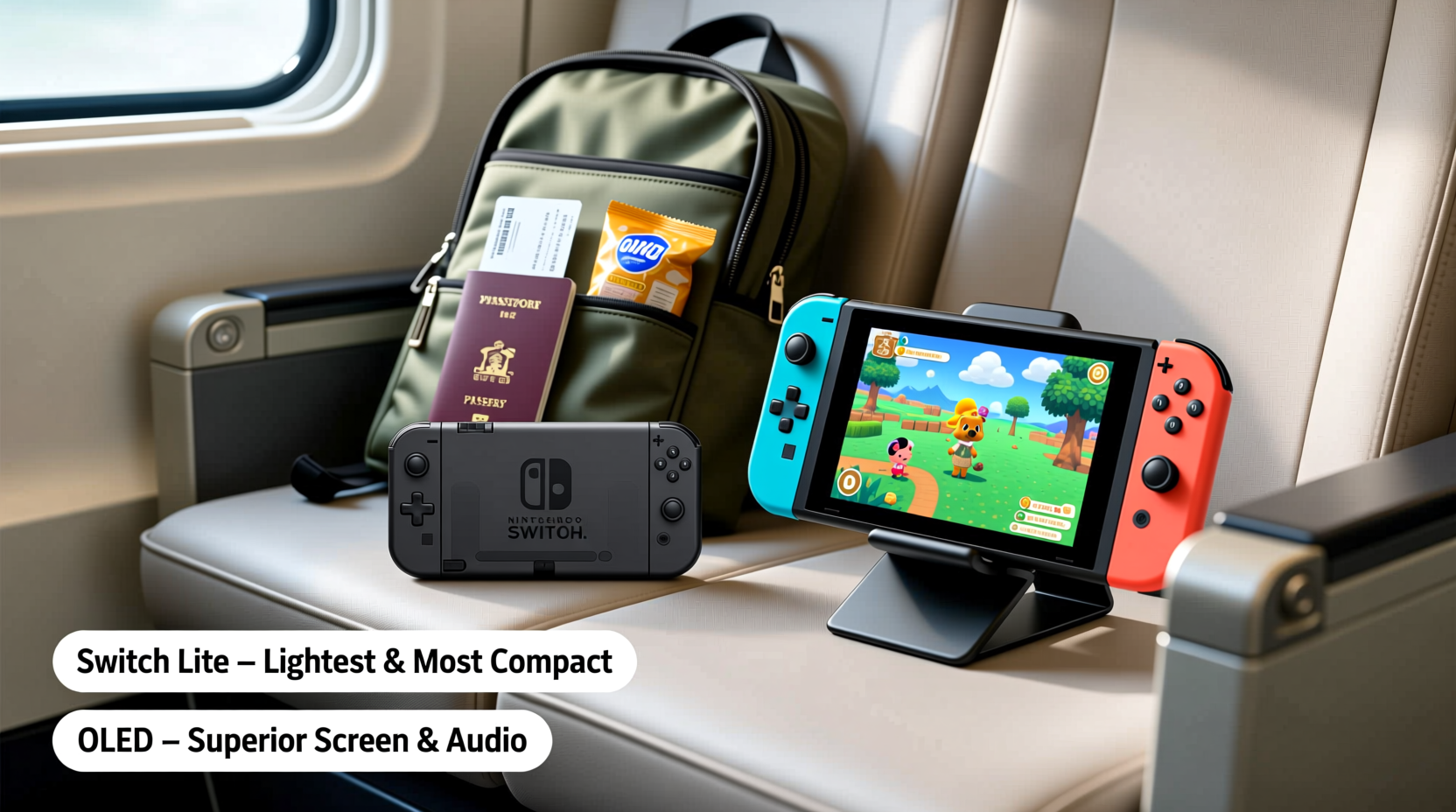
The most immediate factor for any traveler is how easy a device is to carry and use in confined spaces. The Switch Lite weighs in at 275 grams (9.8 oz) and measures 208 x 91 x 13.9 mm—compact enough to slip into a jacket pocket or small bag. Its integrated controls and lack of detachable Joy-Cons make it inherently more streamlined than other Switch models.
In contrast, the Switch OLED weighs 320 grams (11.3 oz), slightly heavier due to its larger 7-inch OLED screen and internal kickstand. While still highly portable, its bulk becomes noticeable during long flights or extended train rides. However, the adjustable stand offers greater versatility when playing on tray tables or hotel desks without needing external support.
For backpackers, subway riders, or those who prioritize minimalism, the Lite has a clear edge in pure portability. But if you value screen real estate and don’t mind carrying an extra 45 grams, the OLED’s footprint remains manageable.
Screen and Display Quality: Clarity on the Move
Travel often means gaming in less-than-ideal lighting conditions: bright sunlight through a car window, dim cabin lights on a plane, or flickering fluorescent bulbs in a waiting area. Here, display quality becomes critical.
The Switch Lite features a 5.5-inch LCD screen with a resolution of 1280x720. While serviceable, it struggles in direct sunlight and lacks deep blacks or vibrant color reproduction. Viewing angles are narrow, making shared play or angled viewing uncomfortable.
The OLED model, on the other hand, boasts a 7-inch organic LED screen with richer contrast, true blacks, and significantly better brightness and color accuracy. This makes games like The Legend of Zelda: Breath of the Wild or Super Mario Odyssey far more immersive, even in suboptimal environments. The wider viewing angles also allow for easier sharing or adjusting your position mid-game.
While the Lite’s smaller screen saves power and space, the OLED’s visual superiority is undeniable. For travelers who care about immersion and clarity, especially during long journeys, this difference can elevate the entire experience.
“On extended flights, a high-quality screen reduces eye strain and increases enjoyment. The OLED’s contrast and brightness make it ideal for varied lighting conditions.” — Jordan Lee, Tech Reviewer at PortableGamer Weekly
Battery Life and Charging: Staying Powered Abroad
Battery longevity is crucial when outlets are scarce. The Switch Lite generally outperforms the OLED in this category. Depending on usage, the Lite delivers between 3 to 7 hours of gameplay—closer to 5–6 hours with moderate brightness and standard titles like Animal Crossing or Metroid Dread.
The OLED model, despite improvements in efficiency, averages 4.5 to 9 hours. However, graphically intensive games such as Bayonetta 2 or docked-mode play will drain it faster. In handheld mode, most users report around 5–6 hours under typical conditions—nearly identical to the Lite in real-world scenarios.
Both systems use USB-C charging, which is widely supported by modern power banks, laptops, and car adapters—making recharging on the go straightforward. Still, the Lite’s marginally better efficiency gives it a slight advantage for multi-day trips without reliable access to power.
One often-overlooked factor is charge speed. Neither model supports fast charging out of the box, but using a higher-wattage charger (e.g., 18W or above) can reduce downtime. Travelers should consider packing a compact GaN charger for faster top-ups during layovers.
Game Compatibility and Play Style: Flexibility vs Focus
This is where the fundamental design philosophy diverges. The Switch Lite is a dedicated handheld—no TV output, no detachable controllers. All games must be playable in handheld mode, which excludes titles requiring motion controls or separate Joy-Cons, such as Zelda: Skyward Sword HD or 1-2-Switch.
Nintendo clearly labels incompatible games in the eShop, but casual travelers might not realize certain titles won’t work until after purchase. For someone who primarily plays single-player adventures (Pikmin 4, Fire Emblem, Brilliant Stars), this limitation rarely matters. But for families or social gamers, the Lite’s restrictions can be a dealbreaker.
The OLED model retains full hybrid functionality. You can play on the go, then dock it at a hotel to enjoy games on a big screen. That flexibility is invaluable for travelers staying multiple nights somewhere with access to a TV. Even if you don’t dock daily, having the option adds long-term value.
Moreover, the OLED’s detachable Joy-Cons allow for local multiplayer without additional hardware. Playing Overcooked! All You Can Eat or Snipperclips with a friend on a cross-country train ride becomes effortless.
| Feature | Switch Lite | Switch OLED |
|---|---|---|
| Weight | 275g | 320g |
| Screen Size | 5.5\" LCD | 7\" OLED |
| Battery Life | 3–7 hrs | 4.5–9 hrs |
| Dockable | No | Yes |
| Detachable Controllers | No | Yes |
| Internal Storage | 32GB | 64GB |
| Kickstand | Fixed, small | Adjustable, wide |
| Audio Quality | Average | Enhanced speakers |
Durability and Travel Safety
Travel exposes electronics to risks: drops, pressure changes, temperature swings, and rough handling by baggage crews. The Switch Lite’s monolithic design—where buttons and joysticks are part of the main body—is both a strength and a vulnerability. There are fewer moving parts to break, but if the left joystick fails (a known issue across Switch models), repair is more complex.
The OLED model uses modular Joy-Cons, which can be replaced individually. However, their protruding nature makes them more susceptible to damage in tight bags. A protective case that covers the analog sticks is strongly recommended.
Both consoles benefit from microfiber-lined cases with rigid shells. Avoid soft pouches unless used inside another bag. Also, extreme temperatures—like leaving the console in a hot car or freezing airport terminal—can damage batteries and screens over time.
Real-World Example: A Cross-Country Road Trip
Sophia, a college student, drove from Denver to Seattle with her younger brother. She brought her Switch OLED, while he borrowed a friend’s Lite. Over five days, they played co-op games like Ittle Dew 2+ and Rayman Legends using the OLED’s detachable controllers—no extra gear needed. At rest stops, she propped it open on the dashboard for hands-free navigation via maps app (using browser workaround).
Meanwhile, her brother struggled when he wanted to play Just Dance using motion controls; the Lite couldn’t support it. He also found the smaller screen tiring during eight-hour stretches. While lighter, he admitted he’d trade weight for better visuals and versatility.
At night, they docked the OLED to the hotel TV for multiplayer fun—something the Lite simply can’t do. By trip’s end, Sophia’s device proved more adaptable despite being slightly heavier.
Step-by-Step Guide: Choosing Your Travel Console
- Assess your primary use case: Will you only play handheld games, or do you want docking capability?
- Check game library compatibility: Review your wishlist on Nintendo’s site to ensure titles work on the Lite.
- Evaluate travel duration: For short commutes, the Lite suffices. For multi-day trips, consider OLED’s flexibility.
- Test ergonomics: If possible, hold both models. Smaller doesn’t always mean more comfortable for long sessions.
- Plan accessories: Budget for a good case, screen protector, and portable charger regardless of choice.
- Consider future needs: Will you want to play on a TV occasionally? Does multiplayer matter?
Frequently Asked Questions
Can I connect the Switch Lite to a TV?
No. The Switch Lite lacks HDMI output and cannot be docked. It is strictly a handheld device.
Is the OLED model worth the extra cost for travelers?
If you value screen quality, audio, storage, and the ability to dock, yes. The $50–$70 premium pays off in versatility, especially on longer trips.
Does the Switch Lite have better battery life than the OLED?
Marginally. In practice, both last around 5–6 hours with similar games. The Lite may edge ahead in very light usage, but the difference isn’t dramatic.
Final Recommendation: Who Should Choose Which?
The **Nintendo Switch Lite** is best for:
- Commuting students or urban professionals
- Younger players or gift recipients with limited budgets
- Those focused on solo RPGs, puzzle games, or indie titles
- Minimalist travelers who prioritize weight and size
The **Nintendo Switch OLED** is ideal for:
- Frequent travelers with variable environments
- Gamers who want to play on TVs during stays
- Families or friends who enjoy local multiplayer
- Anyone investing in a long-term, versatile system
Ultimately, “better” depends on your definition of travel convenience. The Lite wins on pure portability. But the OLED offers a more complete, adaptable, and enjoyable experience across diverse travel scenarios.




 浙公网安备
33010002000092号
浙公网安备
33010002000092号 浙B2-20120091-4
Comments
No comments yet. Why don't you start the discussion?