
The handheld gaming market has never been more diverse. On one end sits the Nintendo Switch—a powerhouse of mainstream appeal, portability, and blockbuster franchises. On the other, the Playdate emerges as an eccentric outlier: a tiny yellow device with a crank, monochrome screen, and a curated catalog of experimental games. At first glance, comparing the two feels like pitting a sports car against a bicycle. Yet both have carved out passionate followings. The real question isn’t just about specs or sales—it’s whether unique hardware can justify a limited game library in today’s gaming landscape.
For players seeking escapism through expansive RPGs or multiplayer brawls, the Switch delivers. But for those drawn to minimalist design, tactile novelty, and bite-sized interactive art, the Playdate offers something no other console does. Understanding their differences—and what each prioritizes—reveals deeper truths about how we define value in gaming hardware.
Design Philosophy: Function vs. Form
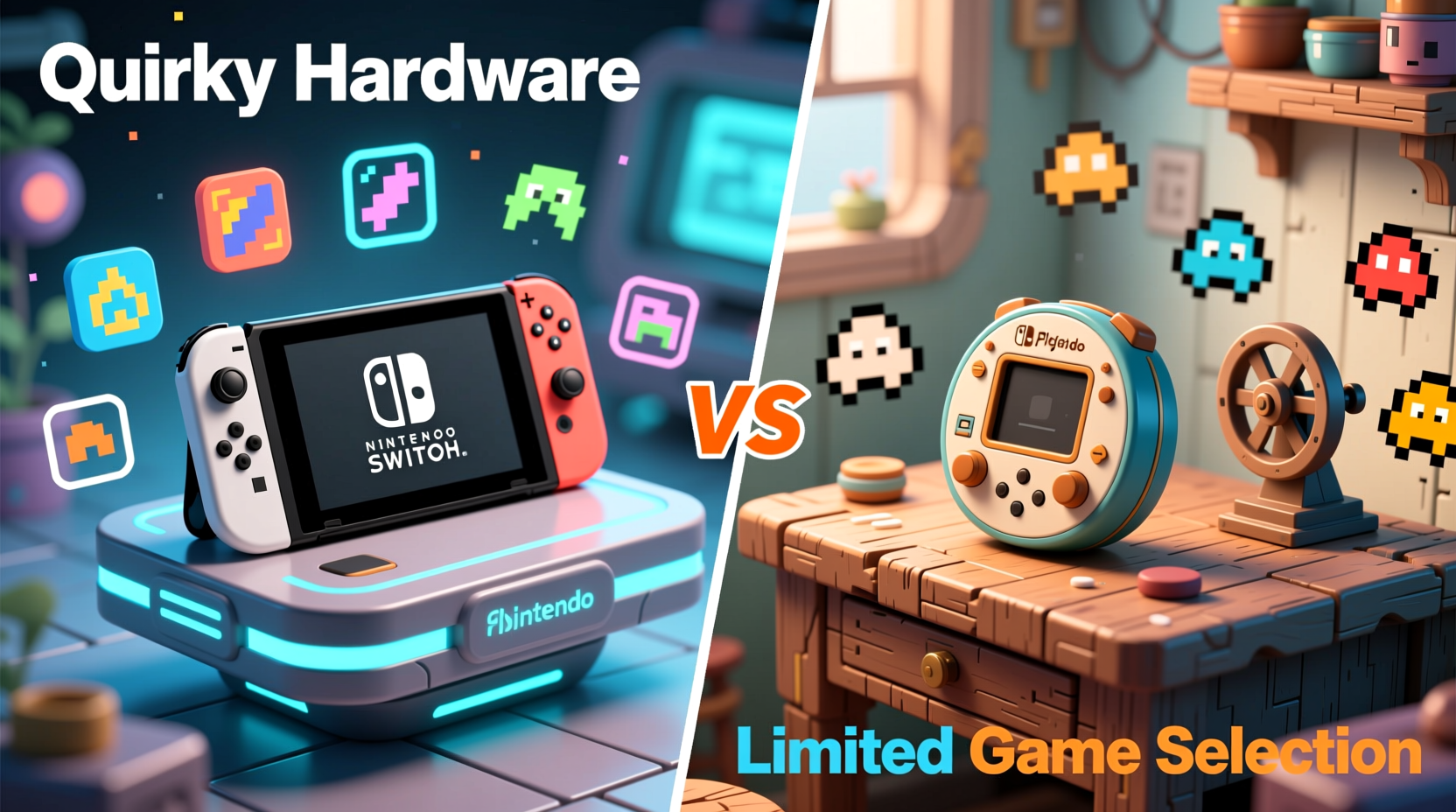
The Nintendo Switch was engineered for versatility. Its hybrid model allows seamless transitions between home console and portable device. Detachable Joy-Cons enable local multiplayer on the go, while its vibrant 720p LCD screen ensures games like The Legend of Zelda: Tears of the Kingdom or Super Mario Odyssey remain visually engaging. It's designed to be picked up by anyone—casual players, families, competitive gamers alike.
In contrast, the Playdate is intentionally constrained. Manufactured by Panic, the software company behind tools like Transmit and Nova, it reflects a designer-first ethos. The device features a 2.7-inch black-and-white display with a 1-bit resolution reminiscent of early Game Boys. There’s no backlight, no analog sticks, and most notably, a physical hand-crank on the side. This isn’t nostalgia bait; it’s a deliberate choice to encourage developers to think differently about interaction.
The Playdate’s aesthetic is deliberately retro-futuristic. Its bright yellow casing stands out, almost whimsically, in a world of matte blacks and brushed metals. It doesn’t try to blend in. Instead, it invites curiosity. When someone sees you using the crank to steer a character through a puzzle platformer, they’re likely to ask, “What *is* that?” That social intrigue is part of its charm.
Game Libraries: Quantity vs. Curation
No discussion of these consoles can ignore their software ecosystems. The Nintendo Switch boasts over 1,000 first- and third-party titles, including industry-defining exclusives such as Animal Crossing: New Horizons, Metroid Dread, and Pikmin 4. Third-party support remains robust, with ports of major franchises from Capcom, Bethesda, and FromSoftware regularly appearing on the eShop. Players aren’t just buying a console—they’re buying access to years of content.
The Playdate takes the opposite approach. Rather than open development, it launched with a season-based model: 24 games released biweekly over several months. These were developed by indie creators known for experimental work—Bennett Foddy (Getting Over It), Keita Takahashi (Untitled Goose Game), and others. Games like Crankin’s Time Travel Adventure use the crank not as a gimmick but as a core mechanic, requiring players to rotate it forward to move time ahead, backward to rewind.
This curation creates a distinct rhythm. You don’t download dozens of games and leave them unfinished. You receive one every two weeks, encouraging focused engagement. There’s no pressure to “catch up.” The experience mimics a serialized story rather than a digital storefront binge.
“Playdate isn’t trying to compete on volume. It’s asking what happens when constraints breed creativity.” — Jane Ng, award-winning game developer and narrative designer
Performance and Practicality Comparison
| Feature | Nintendo Switch (OLED Model) | Playdate |
|---|---|---|
| Display | 7-inch OLED, 720p color | 2.7-inch LCD, 1-bit monochrome |
| Controls | D-pad, buttons, analog sticks, motion controls, touch (on some models) | D-pad, two face buttons, crank |
| Internal Storage | 64 GB (expandable via microSD) | 4 GB (non-expandable) |
| Battery Life | 4.5–9 hours | Up to 10 days (with typical seasonal usage) |
| Price (MSRP) | $349.99 | $179 (sold out at launch; now resold at premium) |
| Game Availability | Thousands, including AAA titles | ~50 official Season games + indie releases via SD card |
| Target Audience | Families, casual and hardcore gamers | Indie enthusiasts, designers, tinkerers |
The disparity in specs is intentional. The Switch targets mass-market entertainment; the Playdate targets experiential novelty. Where the Switch thrives on performance, the Playdate leverages minimalism. Its processor is slow by modern standards, but this forces developers to focus on mechanics over visuals. The lack of color means games rely on clever UI, sound design, and timing—elements often overshadowed in high-budget productions.
A Real-World Perspective: One User’s Journey
Consider Maya, a graphic designer and longtime Nintendo fan who preordered a Playdate during its initial crowdfunding campaign. She already owned a Switch OLED and used it weekly for co-op games with her partner. Curious about the hype, she decided to give the Playdate a three-month trial.
At first, she struggled. Only receiving a new game every two weeks felt painfully slow. She missed the instant gratification of downloading a title and diving in. But over time, something shifted. She found herself thinking about gameplay mechanics between sessions. She played during coffee breaks, commutes, even while waiting in line—sessions rarely exceeding 15 minutes. The crank became a fidget tool, a tactile anchor in her day.
One evening, she played Time Paradox, a puzzle game where rotating the crank controlled both movement and time flow. Solving a particularly tricky level gave her a sense of satisfaction unlike anything in bigger games. “It wasn’t about achievement,” she later wrote in a blog post. “It was about presence. I wasn’t grinding—I was playing.”
She still uses her Switch regularly. But the Playdate occupies a different space—one of mindfulness, surprise, and creative inspiration.
When Quirky Hardware Makes Sense
The Playdate challenges the assumption that more features equal better experiences. In an era where controllers grow increasingly complex—with haptic feedback, adaptive triggers, gyroscopes, voice commands—the Playdate strips everything back. What remains is pure interactivity.
Its limitations are its strengths. The absence of a backlight encourages play in natural light. The small library reduces decision fatigue. The crank introduces a kinesthetic element absent from touchscreens or analog sticks. These aren’t compromises; they’re design decisions meant to alter behavior.
Still, it’s not for everyone. Parents looking for kid-friendly multiplayer won’t find it here. Competitive gamers craving online leaderboards will feel alienated. And while homebrew development is possible via SD card, the ecosystem remains niche.
Step-by-Step: Choosing the Right Device for Your Lifestyle
Deciding between the Switch and Playdate isn’t purely technical—it’s personal. Follow this timeline to assess which aligns with your habits and values.
- Week 1: Audit Your Gaming Habits
Track how much time you spend playing, what genres you prefer, and where you usually play (couch, commute, bed). - Week 2: Define Your Goals
Are you seeking immersion, competition, relaxation, creativity, or social connection? - Week 3: Test Drive Both Philosophies
Play a short indie game on Switch (e.g., Untitled Goose Game) to simulate Playdate-style humor and simplicity. Then, spend 20 minutes daily on a mobile puzzle game using only basic inputs to mimic constraint. - Week 4: Make a Decision
If you crave variety, replayability, and visual richness, the Switch is likely ideal. If you appreciate novelty, brevity, and tactile experimentation, the Playdate may resonate—even with fewer titles.
FAQ: Common Questions About the Switch vs. Playdate
Can the Playdate run modern games like Breath of the Wild?
No. The Playdate lacks the processing power, screen resolution, and control scheme to run large-scale 3D games. It’s built exclusively for small, inventive titles that leverage its unique hardware.
Is the Playdate worth the price if it only has 24 games?
That depends on your definition of value. If you measure worth in hours played per dollar, the Switch wins easily. But if you value originality, artistic expression, and mindful engagement, the Playdate offers intangible returns. Many owners describe it as “a toy for adults” or “a pocket-sized gallery of playable ideas.”
Can I develop my own games for the Playdate?
Yes. Panic provides free SDKs and documentation for Lua-based development. While not as accessible as Switch’s licensed dev kits (which require corporate approval), the Playdate community actively shares tools and tutorials. Independent games can be loaded via microSD.
Checklist: Before You Buy Either Console
- ✅ Assess your primary gaming environment (portable vs. docked)
- ✅ Identify your favorite genres and whether they’re supported
- ✅ Consider battery life and charging needs
- ✅ Evaluate storage requirements and expansion options
- ✅ Determine if local multiplayer or social features matter to you
- ✅ Reflect on whether you enjoy tinkering or prefer plug-and-play
- ✅ Research backward compatibility and future game roadmaps
Conclusion: Beyond Specs Lies Experience
The Nintendo Switch and Playdate represent two poles of handheld gaming. One maximizes capability, accessibility, and breadth. The other embraces limitation, curiosity, and craftsmanship. Neither is objectively better. Each serves a different vision of what play can be.
The Playdate proves that a limited game library doesn’t automatically mean low value—especially when those games are thoughtfully designed, emotionally resonant, and mechanically inventive. Its quirky hardware isn’t a flaw; it’s the foundation of its identity. For a growing number of players, that distinction matters more than frame rates or follower counts.
If you’ve ever wished games felt less like chores and more like discoveries, the Playdate might be exactly what you didn’t know you needed. And if you want epic adventures, shared laughter, and cinematic depth, the Switch remains unmatched.




 浙公网安备
33010002000092号
浙公网安备
33010002000092号 浙B2-20120091-4
Comments
No comments yet. Why don't you start the discussion?