
Commuting is one of the most consistent parts of modern life—whether by train, bus, subway, or car. For many, it’s also a rare window of personal time. That makes headphones an essential accessory. But with so many options available, a critical question arises: should you invest in active noise-canceling (ANC) headphones, or will standard noise-isolating models suffice?
The answer isn’t always straightforward. While ANC has become a selling point across premium audio brands, it comes at a cost—both financially and technically. Understanding the difference between noise canceling and noise isolating is key to making a smart purchase that aligns with your actual needs.
How Noise Canceling and Noise Isolating Work Differently
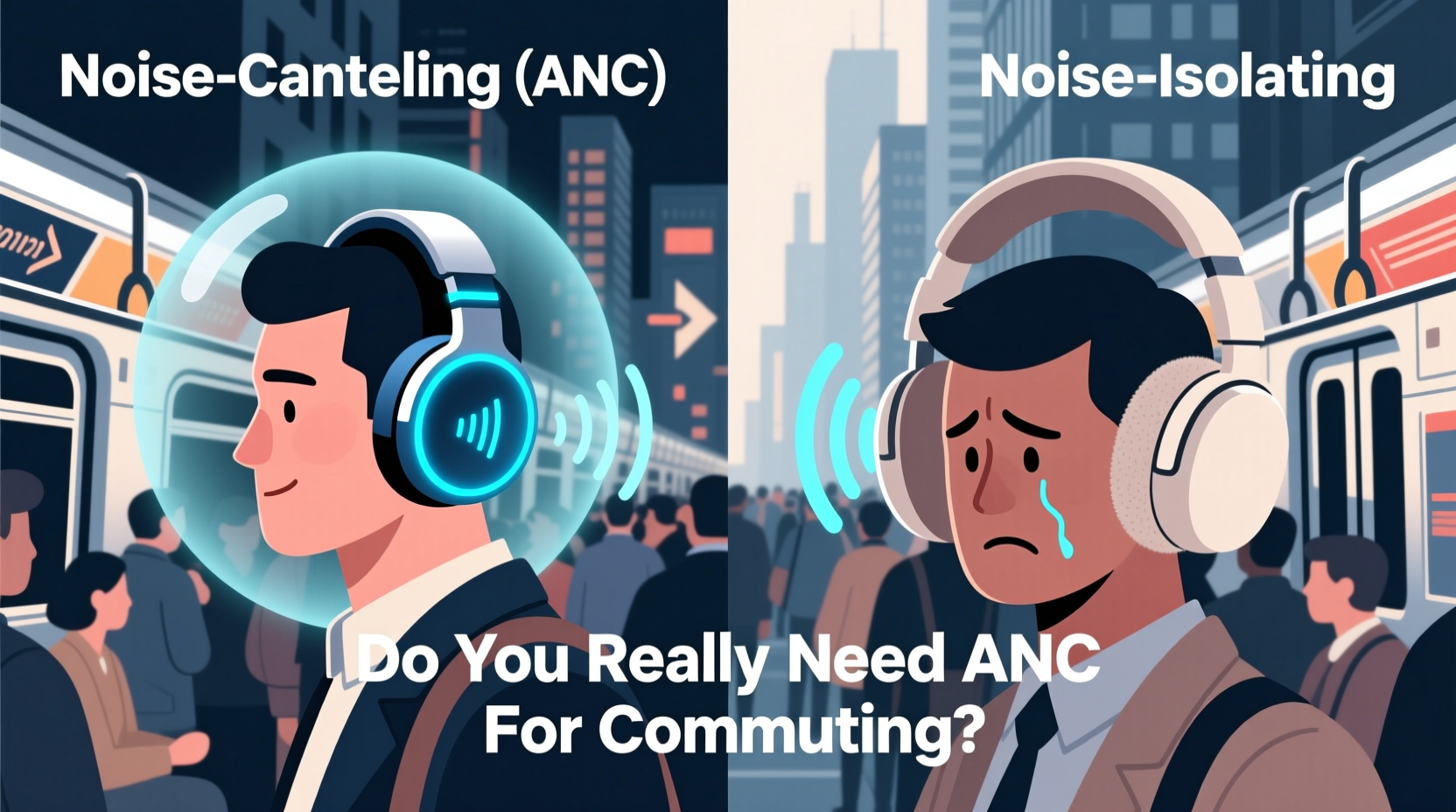
At first glance, both types of headphones aim to reduce unwanted sound. However, their mechanisms are fundamentally different.
Noise isolation is a passive method. It relies on physical barriers—like earcup padding, seal tightness, and material density—to block external sounds from entering your ears. Think of it like closing a window to keep out street noise. In-ear monitors (IEMs), over-ear headphones with thick cushions, and well-fitted earbuds all offer varying degrees of passive isolation.
Effective noise isolation works best against higher-frequency sounds: chatter, clinking cups, phone ringtones, and keyboard tapping. These are short-wavelength noises that can be physically blocked. However, low-frequency rumbles—such as engine hums, subway vibrations, or airplane cabin noise—are much harder to stop passively.
This is where active noise cancellation (ANC) steps in. ANC uses built-in microphones to detect ambient sounds in real time. The headphones then generate inverse sound waves—anti-noise—that cancel out incoming sound before it reaches your ear. This process, called destructive interference, is particularly effective against continuous low-frequency noise.
For example, if the microphone picks up a 100Hz drone from a train engine, the ANC system produces a matching 100Hz wave that’s 180 degrees out of phase. When the two waves meet, they neutralize each other, significantly reducing perceived volume.
“Active noise cancellation doesn’t eliminate sound—it manages it intelligently. Its strength lies in consistency, not silence.” — Dr. Lena Park, Audio Engineer & Acoustics Researcher, MIT Media Lab
When ANC Makes a Real Difference for Commuters
Not every commute benefits equally from ANC. The value depends largely on your environment, duration, and sensitivity to noise.
Consider these scenarios:
- Air travelers: Airplane cabins produce a constant 85–90 dB low-frequency roar. ANC excels here, cutting fatigue and improving comfort during long flights.
- Subway riders: Trains generate rhythmic rumbling beneath platforms and inside cars. ANC reduces this droning, making music or podcasts clearer without cranking up volume.
- Urban commuters using open-back headphones: If you wear less-sealed designs, ANC compensates for weaker passive isolation.
In contrast, someone walking short distances in a quiet neighborhood or cycling through light traffic may find little benefit from ANC. The irregular, transient nature of those sounds—birds chirping, distant horns, footsteps—makes them poor candidates for cancellation.
Noise Isolation: The Underrated Alternative
Despite the marketing buzz around ANC, high-quality noise isolation remains highly effective—and often overlooked.
A well-designed pair of in-ear monitors with silicone or foam tips can block 20–30 dB of ambient sound simply through fit and materials. Memory foam earbuds, for instance, expand inside the ear canal to create a near-perfect seal. Over-ear models with plush, protein-leather cushions achieve similar results.
Advantages of relying on passive isolation include:
- No battery dependency—no charging, no power loss mid-commute.
- Lower cost—many excellent isolating models are priced under $100.
- Better sound integrity—some users report ANC introduces a slight \"pressure\" sensation or background hiss.
- Fewer technical failures—no mics, processors, or firmware to degrade over time.
If your commute involves mostly intermittent noise—pedestrian zones, outdoor stations, or hybrid work with frequent transitions—passive isolation might be all you need. Pair it with moderate volume levels, and you’ll protect your hearing while staying aware of surroundings.
Comparative Breakdown: ANC vs. Noise Isolation
| Feature | Active Noise Canceling (ANC) | Noise Isolation (Passive) |
|---|---|---|
| Mechanism | Electronic anti-noise via microphones and processors | Physical barrier using earcup/earbud design |
| Best Against | Low-frequency, continuous noise (engines, AC units) | High-frequency, intermittent noise (voices, clicks, alarms) |
| Battery Required | Yes | No |
| Lifespan Factors | Sensor degradation, firmware issues, battery decay | Wear of padding, ear tips, cable strain |
| Cost Range | $150–$400+ | $30–$200 |
| Hearing Safety | Reduces need for high volume in noisy settings | Depends on user discipline; sealing helps lower volume needs |
| Situational Awareness | Can impair awareness; some models include transparency modes | Natural environmental perception when not playing audio |
Real-World Example: Two Commuters, Two Choices
Case Study: Sarah and James
Sarah commutes 45 minutes each way on a packed subway line. Her route includes underground tunnels, above-ground tracks, and transfers through loud stations. She listens to audiobooks daily and found herself increasing volume to overcome the rumble—until she developed mild tinnitus last year.
She invested in a pair of ANC headphones. After two weeks, she noticed she could listen at 40% volume instead of 70%. More importantly, her post-commute fatigue dropped significantly. “It’s not silent,” she says, “but the constant drone is gone. I arrive feeling calmer.”
James, meanwhile, walks 20 minutes to a light rail station, rides 15 minutes, then walks another 10. His environment varies: quiet mornings, occasional construction, but rarely sustained noise. He uses high-end in-ear monitors with triple-flange silicone tips. They isolate well enough that he rarely plays anything above 50% volume.
He tested ANC headphones but found the pressure sensation uncomfortable. “I didn’t feel like I was gaining much,” he explains. “And I like being able to hear announcements without pausing music.”
Their experiences highlight a crucial point: the ideal choice depends on context, not specs alone.
Do You Really Need ANC for Commuting?
The short answer: only if your commute involves prolonged exposure to low-frequency, continuous noise.
Ask yourself:
- Is your primary noise source a steady hum (bus engine, train wheels, airplane)? → ANC likely helps.
- Are sounds mostly sudden or mid-to-high frequency (people talking, doors closing, horns)? → Isolation may be sufficient.
- Do you experience listening fatigue or find yourself turning volume dangerously high? → ANC could protect your hearing.
- Do you value situational awareness or dislike the “sealed” feeling? → Passive models offer more natural openness.
ANC shines in specific conditions. But for many urban commuters, especially those with shorter trips or mixed environments, a well-isolating pair of earbuds delivers 80% of the benefit at half the price—and without battery anxiety.
Step-by-Step Guide: Choosing the Right Headphones for Your Commute
- Map your commute noise profile: Take notes over three days. What dominates—engine noise, voices, wind, announcements?
- Determine your priorities: Silence? Awareness? Battery life? Comfort during extended wear?
- Test isolation first: Try high-quality earbuds with foam tips. If they block enough noise, consider skipping ANC.
- Rent or trial ANC models: Use return windows to test in real conditions. Pay attention to pressure effects and battery longevity.
- Evaluate long-term costs: Factor in replacement cycles, repair availability, and software support.
- Check for transparency mode: If using ANC, ensure the model includes a clear passthrough feature for safety.
- Make your decision based on usage, not hype: Just because ANC is popular doesn’t mean it’s necessary for you.
FAQ
Can noise isolation be as effective as ANC?
In certain situations—especially against high-frequency sounds—yes. A properly sealed in-ear monitor can block nearly as much ambient noise as mid-tier ANC headphones. However, for low-frequency drones, ANC still holds a clear advantage.
Does ANC damage hearing?
No, ANC itself does not harm hearing. In fact, by reducing the need to increase volume in noisy environments, it can help prevent noise-induced hearing loss. However, over-reliance on ANC in unsafe areas (e.g., busy streets) can lead to accidents due to reduced environmental awareness.
Are there health risks associated with ANC?
Some users report a sensation of “ear pressure” or mild dizziness when using ANC, often due to the brain interpreting the lack of expected ambient cues. This usually subsides with use. If discomfort persists, switching to passive isolation or using transparency mode may help.
Checklist: What to Consider Before Buying
- ✅ Type of noise encountered during commute (low vs. high frequency)
- ✅ Commute duration and frequency (daily 2-hour trip vs. weekly 15-minute ride)
- ✅ Budget range and willingness to replace every 2–3 years
- ✅ Importance of battery life and charging access
- ✅ Need for situational awareness (e.g., crossing streets, hearing announcements)
- ✅ Comfort for extended wear (over-ear vs. in-ear)
- ✅ Availability of trial period or return policy
Conclusion: Make the Choice That Serves Your Reality
Active noise cancellation is impressive technology, and for frequent travelers exposed to constant mechanical noise, it’s transformative. But it’s not universally necessary. Many commuters overpay for features they don’t fully utilize.
Noise isolation, when done right, offers substantial acoustic benefits without complexity. By focusing on fit, seal, and material quality, you can achieve a quiet listening experience that supports focus, relaxation, and hearing health.
Before upgrading to ANC, challenge the assumption that you need it. Try improving passive isolation first. You might discover that silence was within reach all along—without the extra cost, weight, or battery dependence.




 浙公网安备
33010002000092号
浙公网安备
33010002000092号 浙B2-20120091-4
Comments
No comments yet. Why don't you start the discussion?