
In a smartphone market dominated by glass slabs with nearly identical layouts, the Nothing Phone 2 stands out—literally. With its transparent back, glowing Glyph Interface, and minimalist aesthetic, it screams individuality. On the other side, the Google Pixel 7a delivers a no-nonsense approach: clean Android, excellent cameras, and solid performance in a familiar but refined package. The question isn’t just about specs—it’s whether the Phone 2’s striking design compensates for its software inconsistencies when stacked against the reliable, polished experience of the Pixel 7a.
Design Philosophy: Form vs Function
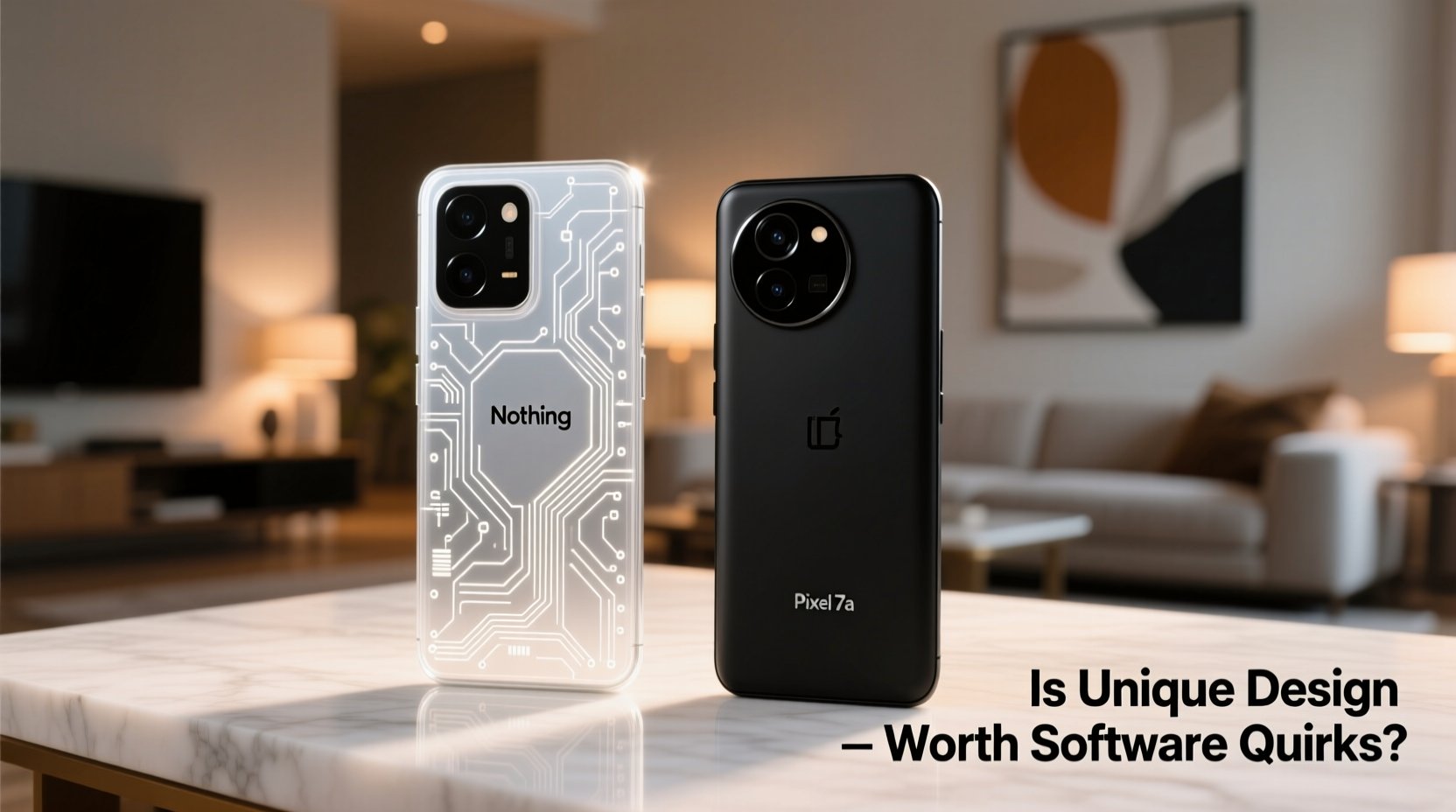
The Nothing Phone 2 doesn’t try to blend in. Its transparent polycarbonate back reveals a symmetrical internal layout, including visible screws and circuit-like patterns. Paired with dual LED strips (the Glyph Interface) along the spine, it creates a futuristic look that feels more like wearable tech than a traditional phone. This isn’t just cosmetic; the Glyphs can pulse during calls, flash with notifications, or even act as a camera light during video recording.
In contrast, the Pixel 7a embraces subtlety. It features an aluminum frame, a matte polymer back, and Google’s signature two-tone design. While not groundbreaking, it’s ergonomic, water-resistant (IP67), and built for daily use without drawing undue attention. It fits comfortably in pockets and hands, prioritizing practicality over spectacle.
Software Experience: Clean vs Customized
Google’s Pixel phones run stock Android with timely updates and exclusive AI-powered features like Call Screen, Hold for Me, and Magic Eraser. The Pixel 7a ships with Android 13 (upgradable to Android 14 and beyond) and promises three major OS updates and five years of security patches—a gold standard in mid-range devices.
Nothing OS, based on Android 13, aims for minimalism with subtle customizations. It removes bloatware, offers gesture navigation, and introduces Glyph-integrated animations. However, users report occasional stutters, inconsistent app behavior, and delayed background processes. Early versions had issues with Bluetooth stability and call quality—though recent updates have improved reliability.
“Stock Android remains the benchmark for smoothness and long-term support. Even well-intentioned skins like Nothing OS often introduce subtle friction.” — David Kim, Mobile Software Analyst at TechPulse Insights
While Nothing OS is visually appealing and refreshingly ad-free, it lacks the maturity and ecosystem integration of Google’s offering. Pixel-exclusive apps like Recorder, Wallet, and Assistant are deeply optimized and add tangible value. Nothing’s ecosystem, still in early stages, offers little beyond aesthetics.
Performance and Hardware Comparison
Under the hood, both phones target the upper mid-range segment but take different paths.
| Feature | Nothing Phone 2 | Pixel 7a |
|---|---|---|
| Processor | Qualcomm Snapdragon 8+ Gen 1 | Google Tensor G2 |
| RAM / Storage | 8/12GB | 128/256/512GB | 8GB | 128GB |
| Battery | 4700 mAh | 4385 mAh |
| Charging | 45W wired, 15W wireless | 18W wired, no wireless |
| Display | 6.7” OLED, 120Hz, HDR10+ | 6.1” OLED, 90Hz, HDR |
| Rear Cameras | 50MP main + 50MP ultrawide | 64MP main + 13MP ultrawide |
| Front Camera | 32MP | 13MP |
| Water Resistance | IP54 (splash resistant) | IP67 (dust/water resistant) |
| Starting Price | $599 | $499 |
The Phone 2 clearly wins on raw hardware: faster charging, higher peak brightness, larger battery, and superior front camera. The Snapdragon 8+ Gen 1 also edges out the Tensor G2 in CPU-intensive tasks, though the latter excels in AI-driven photography and voice processing thanks to Google’s dedicated matrix processor.
However, benchmarks don’t tell the full story. In day-to-day use, the Pixel 7a feels snappier due to better software optimization. App launches are consistent, system animations are smoother, and background management is more predictable. The Phone 2, while powerful, sometimes falters under heavy multitasking or after prolonged use—likely due to thermal throttling and less mature software tuning.
Camera Performance: Computational Photography vs Versatility
The Pixel 7a continues Google’s legacy of punching above its weight in photography. Its 64MP main sensor captures stunning detail, especially in daylight. Night Sight produces clean, balanced low-light shots, and the computational HDR keeps highlights and shadows in check. Portrait mode uses depth mapping effectively, and the lack of a telephoto lens is mitigated by high-resolution cropping.
The Phone 2’s dual 50MP setup (Sony IMX890 main, Samsung JN1 ultrawide) offers higher resolution and better dynamic range on paper. In practice, photos are vibrant but occasionally oversharpened. Color science leans warm, which some prefer, but consistency across lighting conditions lags behind the Pixel. Video stabilization is solid, but lacks cinematic modes or advanced audio filtering found in Pixels.
Where the Phone 2 shines is versatility. The 32MP front camera is ideal for content creators, and the inclusion of wireless charging and IP54 splash resistance adds convenience. Meanwhile, the Pixel 7a lacks wireless charging and has a smaller screen, but its compact size makes it easier to use one-handed.
Mini Case Study: Content Creator’s Dilemma
Alex, a freelance photographer and YouTuber, tested both phones over two weeks. He loved the Phone 2’s front camera and Glyph lights for vlogging intros but grew frustrated with inconsistent autofocus during outdoor shoots. The Pixel 7a, while less flashy, delivered reliable results every time—especially in mixed lighting. “I spent less time editing Pixel footage,” he said. “The Phone 2 looks cool on camera, but the Pixel helps me work faster.”
Longevity and Ecosystem Considerations
Software support timelines play a crucial role in long-term satisfaction. The Pixel 7a guarantees updates until July 2028—three OS upgrades and five years of security patches. Nothing promises only two major OS updates and three years of security patches for the Phone 2. Given that Android 14 is already rolling out, this means the Phone 2 may stop receiving updates as early as 2026.
Ecosystem integration is another factor. Pixel owners benefit from seamless ties to Google Photos, Drive, Assistant, and Find My Device. Nothing is building its own ecosystem—Glyph-enabled earbuds, chargers, and accessories—but it’s limited in scope and geographic availability. For users invested in Google services, switching to Nothing means sacrificing convenience.
Checklist: Choosing Between the Two
- ✅ Prioritize camera quality and software polish → Pixel 7a
- ✅ Want fast charging and a standout design → Nothing Phone 2
- ✅ Need wireless charging or higher storage options → Nothing Phone 2
- ✅ Value long-term software support and updates → Pixel 7a
- ✅ Prefer a compact, pocketable device → Pixel 7a
- ✅ Use your phone for content creation or social media presence → Nothing Phone 2
- ✅ Live in a humid or rainy climate → Pixel 7a (IP67 rating)
Frequently Asked Questions
Is the Nothing Phone 2’s Glyph Interface useful or just gimmicky?
It depends on usage. For silent notifications, camera cues, or ambient lighting effects, the Glyphs add functional flair. But they’re not essential—most alerts can be handled through vibration or sound. Over time, many users disable non-critical animations, reducing their role to stylistic accent rather than utility.
Can the Pixel 7a compete with flagship phones?
Yes, particularly in photography and software experience. While its Tensor G2 isn’t the fastest chip, Google’s AI optimizations make it feel responsive. Features like Magic Eraser, Photo Unblur, and Real Tone imaging give it advantages even over more expensive devices. It’s one of the best values in modern Android.
Does the Phone 2’s transparent back scratch easily?
The polycarbonate back is more prone to micro-scratches than glass, especially when carried loose in pockets with keys. Nothing includes a soft TPU case in the box, which helps. For long-term protection, using a case and avoiding direct contact with abrasive surfaces is recommended.
Conclusion: Balancing Innovation and Reliability
The Nothing Phone 2 is a statement piece—an invitation to rethink what a smartphone can look like. Its design is daring, its hardware robust, and its ambitions clear: to disrupt the status quo. But innovation comes at a cost. Software quirks, shorter update support, and niche appeal mean it won’t suit everyone.
The Pixel 7a, meanwhile, represents refinement. It doesn’t dazzle with flashy lights or see-through backs, but it delivers where it counts: consistent performance, top-tier cameras, and long-term reliability. It’s the kind of phone you can trust for years without second-guessing.
If you’re drawn to technology as expression—if you want your phone to reflect personality and creativity—the Phone 2’s design may indeed be worth its software compromises. But if you value peace of mind, seamless updates, and dependable daily performance, the Pixel 7a remains the smarter choice.




 浙公网安备
33010002000092号
浙公网安备
33010002000092号 浙B2-20120091-4
Comments
No comments yet. Why don't you start the discussion?