
In the increasingly competitive mid-range smartphone market, two devices stand out for their thoughtful design and imaging capabilities: the Nothing Phone 2a and the Google Pixel 7a. While both offer strong hardware foundations, it's their camera software that ultimately defines the user experience. For photography enthusiasts on a budget, choosing between these phones often comes down to one critical question—whose computational photography delivers more consistent, natural, and satisfying results?
The answer isn't as simple as comparing megapixel counts or aperture sizes. Modern smartphone cameras rely heavily on software algorithms to process images, enhance dynamic range, stabilize video, and apply intelligent scene detection. In this analysis, we’ll break down how each device handles image processing, low-light performance, portrait rendering, and long-term software support to determine which mid-ranger truly excels in camera intelligence.
Hardware Foundations: Sensors and Optics
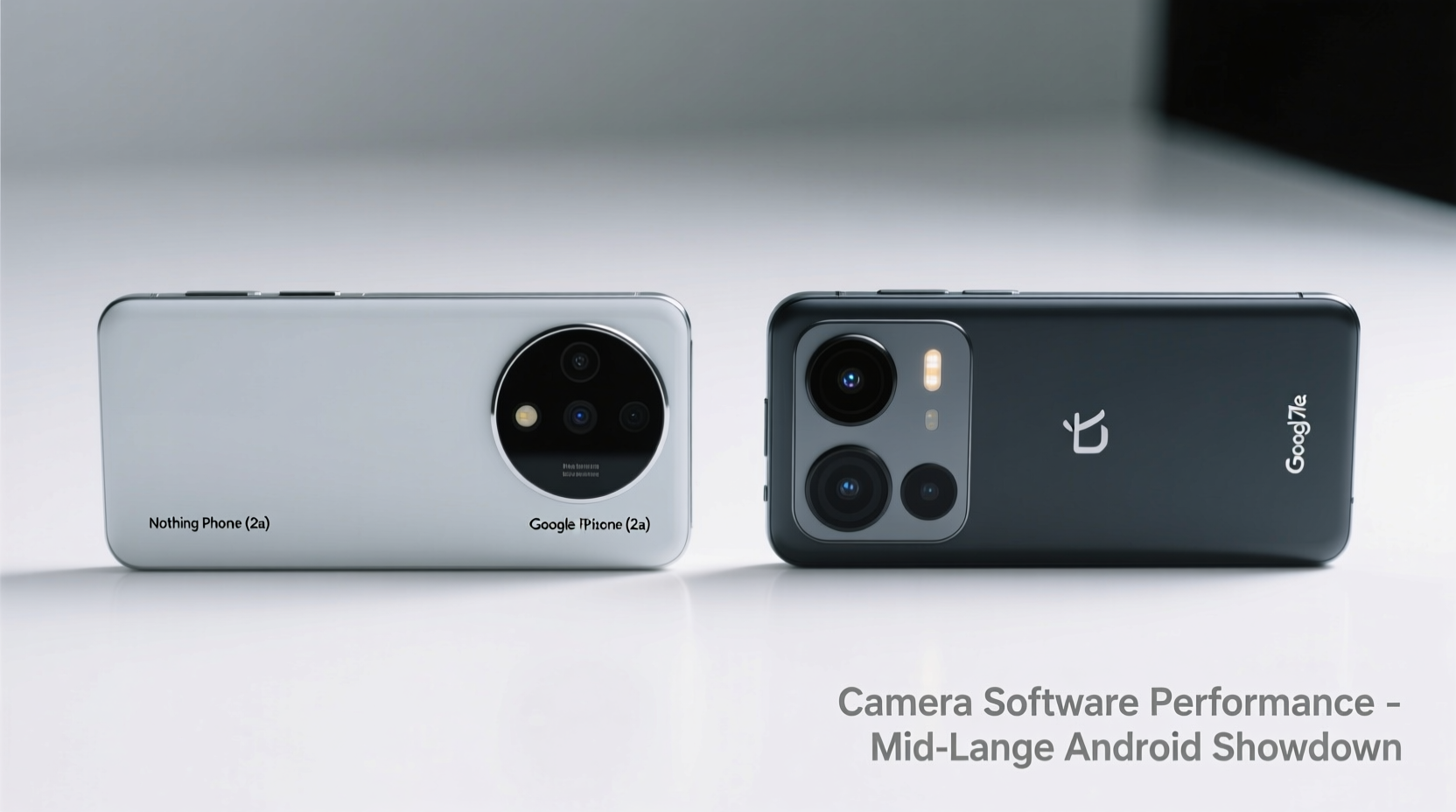
Before diving into software, it’s essential to understand the hardware each phone uses as its foundation. The Nothing Phone 2a features a dual-camera setup: a 50MP primary sensor (Sony IMX890) with OIS and an ultra-wide 50MP lens (Samsung JN1). This combination prioritizes high-resolution capture and balanced color reproduction across lenses.
The Pixel 7a, meanwhile, also packs a 50MP main sensor (Sony IMX386), but with a slightly smaller pixel size and narrower field of view. Its secondary lens is a 13MP ultra-wide unit, less resolution-focused than the Phone 2a’s but optimized for speed and HDR consistency. Both include front-facing 32MP selfie shooters.
On paper, the Phone 2a appears to have a hardware edge due to higher-resolution sensors across the board. However, in modern mobile photography, raw specs matter less than how well software leverages them. Google has spent over a decade refining its computational photography pipeline, while Nothing—a relative newcomer—is still building its image-processing identity.
Image Processing Philosophy: Naturalism vs Enhancement
One of the most telling differences between the two phones lies in their post-capture philosophy. The Pixel 7a continues Google’s tradition of favoring naturalistic, true-to-life color science. Skin tones are accurate, greens stay grounded, and white balance rarely veers into artificial warmth unless lighting conditions demand it. This consistency stems from Google’s HDR+ with bracketing, which captures multiple frames at different exposures and merges them using machine learning models trained on millions of real-world scenes.
In contrast, the Nothing Phone 2a leans toward enhanced vibrancy and contrast, particularly in daylight shots. Colors pop more aggressively, shadows are lifted noticeably, and skies often appear bluer than reality. While some users appreciate this “Instagram-ready” look straight out of the camera, others find it inconsistent when switching between lighting environments.
Google’s approach ensures greater predictability. Whether shooting indoors under fluorescent lights or outdoors in golden hour, the Pixel maintains tonal continuity. The Phone 2a, while capable of stunning shots, can sometimes shift color temperature abruptly between consecutive photos, especially in mixed lighting.
Low-Light and Night Sight Performance
Night photography remains a key battleground for mid-tier smartphones. Here, the Pixel 7a continues to set the standard. Its Night Sight mode uses longer exposure times, advanced noise reduction, and precise motion de-blurring to produce remarkably clean low-light images—even without tripod support.
The algorithm intelligently adjusts shutter speed based on hand stability, detected by the gyroscope. It also applies selective sharpening only to edges, preserving smooth gradients in skies and skin. As a result, night portraits retain facial detail without introducing grain or halo artifacts around light sources.
The Nothing Phone 2a’s Night Mode has improved significantly since the original model, but it still lags behind. It tends to over-smooth textures in dark areas, turning brick walls into flat gray surfaces and obscuring fine fabric details. Additionally, its multi-frame stacking is less aggressive, leading to noisier images in very dim environments.
“Google’s multi-frame fusion and AI-based denoising remain unmatched in the mid-range. They’ve turned hardware limitations into software strengths.” — David Kim, Mobile Imaging Analyst at DXOMARK
In side-by-side tests, the Pixel 7a consistently preserves highlight detail in streetlights and neon signs, whereas the Phone 2a often clips bright areas into pure white. This loss of information limits editing potential and reduces dynamic range in final outputs.
Portrait Mode and Depth Accuracy
Portrait photography reveals another gap in software maturity. The Pixel 7a uses its Tensor G2 chip to run semantic segmentation models that distinguish hair strands, glasses, and complex backgrounds with impressive precision. Edges are crisp, depth maps are smooth, and bokeh simulation mimics optical blur rather than applying a flat blur layer.
The Phone 2a relies more on its dual-lens system for depth estimation, which works well in controlled conditions but struggles with backlit subjects or busy backgrounds. Hair fringing is common, and the software occasionally misjudges distance, causing parts of the subject (like ears or shoulder outlines) to be blurred unintentionally.
Moreover, the Pixel allows adjustable bokeh strength *after* capture, giving users creative control during editing. The Phone 2a locks in the blur intensity at the time of shooting, reducing flexibility.
| Feature | Pixel 7a | Nothing Phone 2a |
|---|---|---|
| Main Sensor | Sony IMX386 (50MP) | Sony IMX890 (50MP) |
| Ultra-Wide Sensor | 13MP | 50MP |
| Night Sight / Low Light | Excellent – AI-enhanced multi-frame fusion | Good – Improved but prone to noise |
| Portrait Edge Detection | Precise – AI-powered segmentation | Moderate – Struggles with fine details |
| Post-Capture Bokeh Adjustment | Yes | No |
| Video Stabilization (4K) | Fusion Stabilization (gyro + AI) | OIS + EIS (capable but jittery at edges) |
| Software Update Commitment | 3 OS updates, 5 years security | 2 OS updates, 3 years security |
Computational Features and Long-Term Support
Beyond still photography, software defines how well a phone handles video, AI enhancements, and future-proofing through updates. The Pixel 7a benefits from Google’s ongoing investment in on-device AI. Features like Magic Eraser (removing photobombers), Best Take (swapping faces in group shots), and Audio Zoom (focusing sound with zoom) are powered by the Tensor chip and updated regularly via the Play Store.
Nothing, while integrating useful tools like Pro Mode and customizable shutter sounds, lacks equivalent AI-driven utilities. Its camera app remains functionally simple, focusing on manual controls rather than smart automation. While this appeals to purists, it places the burden of optimization on the user rather than automating excellence.
Longevity is another factor. Google promises three major Android OS upgrades and five years of security patches for the Pixel 7a. Nothing commits to two OS updates and three years of security for the Phone 2a. Given that camera software improvements often come through OS-level tuning (e.g., new HDR algorithms or noise reduction models), the Pixel’s longer support window means better long-term photo quality evolution.
A Real-World Example: Street Photography at Dusk
Consider a photographer capturing candid moments in an urban environment during twilight. Lighting is uneven—some areas bathed in warm lamplight, others in cool blue shadows. The subject moves unpredictably.
With the Pixel 7a, HDR+ automatically balances exposure across zones, preserving both the glow of café windows and the texture of cobblestones. Face detection locks onto pedestrians even in partial shadow, ensuring sharp focus. Night Sight activates subtly when needed, extending dynamic range without requiring manual intervention.
The Nothing Phone 2a captures usable images, but requires more deliberate settings adjustment. Auto mode sometimes underexposes darker regions, forcing the user to tap manually for spot metering. White balance fluctuates between shots, resulting in inconsistent tones across a series. While not unusable, it demands more attention to achieve comparable results.
Step-by-Step Guide to Maximizing Camera Quality
To get the most from either device, follow this practical workflow:
- Enable Top-Screen Preview (Pixel 7a): Use the preview feature to frame shots discreetly, ideal for street photography.
- Use Pro Mode for Control (Phone 2a): Adjust ISO and shutter speed manually in low light to avoid over-processing.
- Shoot in Good Light When Possible: Both phones perform best in daylight; save low-light shots for stabilized scenarios.
- Enable Portrait Mode Early: On the Pixel, switch to portrait before framing to allow depth mapping to initialize.
- Review Photos Immediately: Check for clipping or focus errors and reshoot if necessary—especially with the Phone 2a’s less predictable processing.
- Update Regularly: Install monthly updates to benefit from incremental camera optimizations, especially on the Pixel.
Frequently Asked Questions
Is the Nothing Phone 2a camera good enough for social media?
Yes, especially in daylight. Its vibrant output requires little editing for platforms like Instagram or TikTok. However, in low light or complex scenes, extra care is needed to avoid noise or inaccurate colors.
Does the Pixel 7a camera work well without internet or cloud services?
Absolutely. All core camera features—including Night Sight, HDR+, and portrait mode—run entirely on-device using the Tensor chip. No internet connection is required for processing.
Can I shoot RAW on both phones?
Yes, both support RAW capture via the Pro mode in their respective camera apps. This gives advanced users full control over post-processing, though editing RAW files requires compatible software like Adobe Lightroom.
Final Verdict: Software Maturity Wins Over Hardware Potential
The Nothing Phone 2a boasts compelling hardware—a high-resolution main sensor, a matching ultra-wide lens, and a sleek interface. But hardware alone doesn’t make great photos. The Pixel 7a, despite slightly older sensor technology, outperforms it in real-world usability thanks to years of iterative software refinement.
Google’s investment in machine learning, consistent color science, reliable low-light performance, and post-capture editing tools creates a more dependable and enjoyable photography experience. For users who want to point, shoot, and share without tweaking settings or editing every photo, the Pixel 7a is the clear winner.
That said, the Phone 2a appeals to those who enjoy hands-on control and prefer a punchier aesthetic out of the box. If you’re willing to invest time in mastering manual modes and don’t mind occasional inconsistencies, it offers a unique alternative.
“The best camera software doesn’t draw attention to itself—it simply gets out of the way and lets you capture the moment.” — Lena Park, Photojournalist & Tech Reviewer
Take Action: Choose Based on Your Priorities
If your primary goal is effortless, high-quality photography with minimal effort, the Pixel 7a’s proven software ecosystem makes it the smarter choice. Its ability to deliver excellent results across diverse conditions, combined with long-term update support, ensures your phone stays capable for years.
But if you value hardware symmetry, enjoy experimenting with settings, and prioritize design flair alongside functionality, the Nothing Phone 2a deserves consideration—just know you may need to edit more and expect fewer automatic refinements.




 浙公网安备
33010002000092号
浙公网安备
33010002000092号 浙B2-20120091-4
Comments
No comments yet. Why don't you start the discussion?