
The number 7 appears more than 700 times in the Bible and holds a unique place in biblical numerology. Unlike modern numerology, which often assigns mystical or arbitrary meanings to numbers, the Bible uses numbers symbolically within its theological framework. Among these, the number 7 stands out as a symbol of completeness, divine perfection, and God’s sovereign order. From creation to prophecy, the number 7 weaves through Scripture as a divine signature.
Its prominence begins at the very foundation of the biblical narrative—the seven-day creation week—and continues through the Law, the Prophets, and the New Testament, culminating in the Book of Revelation with seven churches, seven seals, and seven trumpets. Understanding the number 7 is not about unlocking secret codes but recognizing the consistent pattern of God’s perfect work.
Creation and the Foundation of Seven
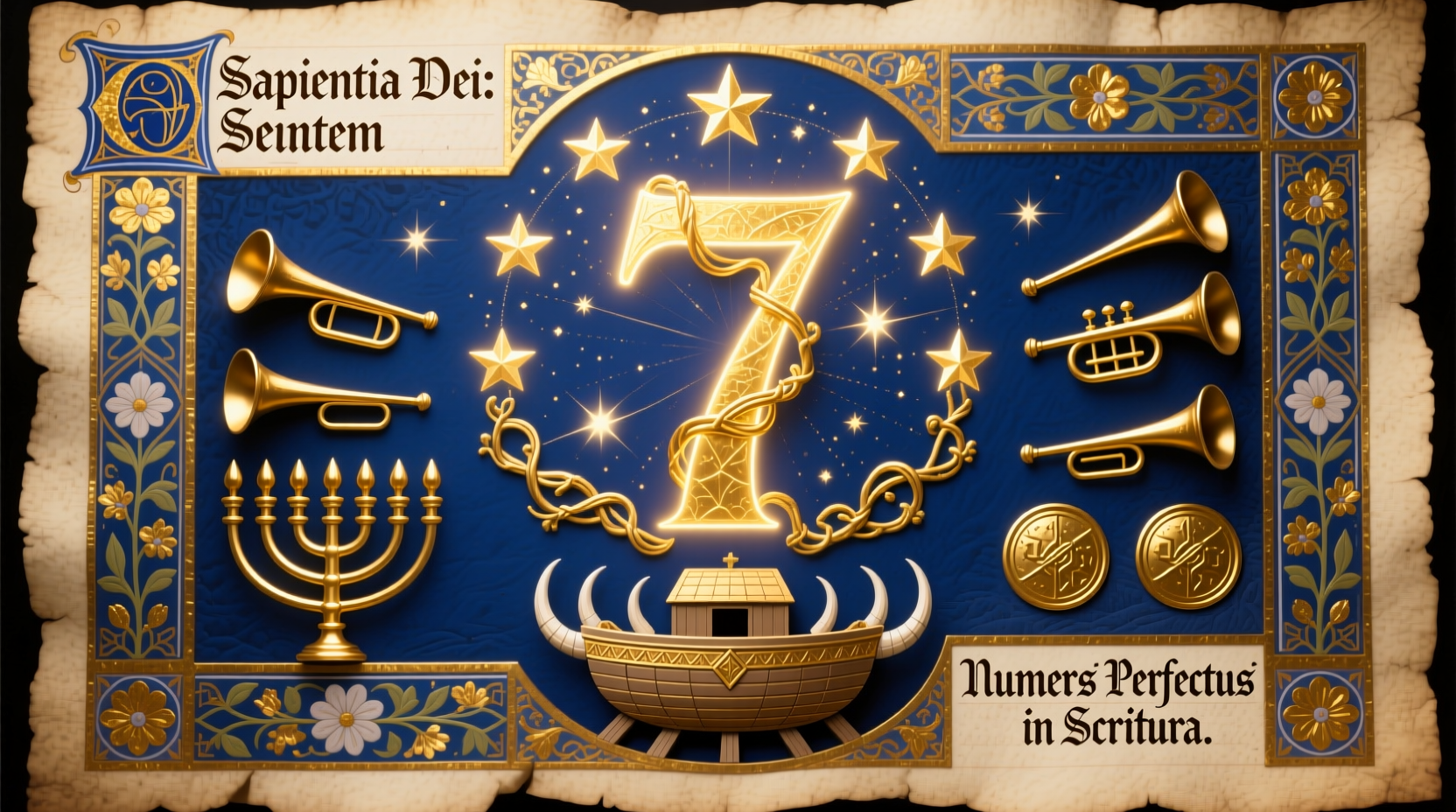
The first mention of the number 7 occurs in Genesis 2:2–3, where God completes His work of creation in six days and rests on the seventh. This act establishes the Sabbath as a holy day, setting apart the number 7 as sacred from the beginning:
“And on the seventh day God ended His work which He had done, and He rested on the seventh day from all His work which He had done. Then God blessed the seventh day and sanctified it.” — Genesis 2:2–3
This rhythm of six days of labor and one of rest became embedded in Israelite culture through the commandment to keep the Sabbath (Exodus 20:8–11). The weekly cycle, rooted in creation, reflects divine order. The number 7 thus becomes associated with completion—not because seven is inherently magical, but because God declared His work complete on the seventh day.
Even before the word “Sabbath” is used, the structure of creation introduces a sevenfold pattern that echoes throughout Scripture. This foundational use sets the tone for how the number will be interpreted: not as a superstition, but as a reflection of God’s perfect timing and fulfillment.
Symbolism of Completeness and Divine Perfection
In biblical thought, the number 7 does not represent infinity like the number 8 sometimes does, nor chaos like the number 6. Instead, 7 signifies fullness, wholeness, and divine approval. It conveys the idea that something has been finished according to God’s design.
Consider the Hebrew word for “seven,” sheva, which is linguistically linked to shavua, meaning “week,” and possibly to shava, meaning “to swear” or “to complete an oath.” This linguistic connection suggests that seven is tied to covenantal fulfillment and binding promises.
For example, in Genesis 21:27–31, Abraham sets aside seven ewe lambs as a witness in a treaty with Abimelech. The place is named Beersheba—“well of seven” or “well of the oath”—indicating that the number was used to seal a covenant. Here, seven is not just a count; it is a symbol of commitment and completeness.
Seven in the Tabernacle and Temple Worship
The number 7 is deeply embedded in Israel’s worship practices. The Tabernacle and later the Temple were designed with sevens in mind, reinforcing the holiness and completeness of God’s presence among His people.
- The menorah in the Tabernacle had seven lamps (Exodus 25:37), representing the light of God’s wisdom and the fullness of His Spirit.
- The Feast of Unleavened Bread lasted seven days (Leviticus 23:6).
- The Day of Atonement occurred on the tenth day of the seventh month (Leviticus 23:27), combining the symbolic numbers 7 and 10 for divine completeness and law.
- The Year of Jubilee came after seven cycles of seven years (Leviticus 25:8)—a total of 49 years, with the 50th year being the Jubilee, emphasizing liberation and restoration.
These ritual uses of seven show that God structured Israel’s religious life around this number to remind them of His holiness and the need for periodic renewal and repentance.
Seven in Prophecy and the Book of Revelation
No book in the Bible uses the number 7 more dramatically than Revelation. The final book of the New Testament is saturated with sevens, forming the backbone of its apocalyptic vision:
| Symbol | Description |
|---|---|
| Seven Churches | Ephesus, Smyrna, Pergamum, Thyatira, Sardis, Philadelphia, Laodicea (Revelation 1–3) |
| Seven Spirits of God | Representing the fullness of the Holy Spirit (Revelation 1:4; 4:5) |
| Seven Seals | Sealed on the scroll opened by the Lamb (Revelation 5–8) |
| Seven Trumpets | Sounding judgments during the tribulation (Revelation 8–11) |
| Seven Bowls | Final plagues poured out (Revelation 15–16) |
| Seven Heads and Horns | On the dragon and beast, symbolizing power and authority (Revelation 12–13) |
While some interpret these sevens literally, many scholars see them as symbolic representations of God’s complete judgment, redemption, and ultimate victory over evil. As theologian Dr. G.K. Beale notes:
“The sevenfold repetitions in Revelation are not merely numerical but theological—they emphasize the comprehensive scope of Christ’s redemptive work and the exhaustive nature of divine judgment.” — Dr. G.K. Beale, The Book of Revelation: A Commentary on the Greek Text
The use of seven here is not about predicting exact events but revealing the fullness of God’s plan unfolding in history.
Historical and Cultural Patterns of Seven
Beyond theology, the number 7 appears in historical narratives to mark pivotal moments of completion or testing. For instance:
- Naaman was told to wash in the Jordan seven times to be healed of leprosy (2 Kings 5:10). His obedience led to complete cleansing.
- Joshua and the Israelites marched around Jericho once a day for six days and seven times on the seventh day before the walls fell (Joshua 6:3–16). The number underscores divine orchestration.
- In Daniel’s prophecy, “seventy weeks” (literally seventy sevens) are decreed for Israel (Daniel 9:24), outlining a timeline for atonement, anointing, and the coming of the Messiah.
These stories reinforce that seven often marks a period of testing, preparation, or fulfillment. When God’s people align with His timing, breakthrough follows.
Mini Case Study: The Healing of Naaman
Naaman, a Syrian commander, suffered from leprosy despite his military success. When he followed Elisha’s instruction to dip seven times in the Jordan, he was completely healed (2 Kings 5:14). Initially skeptical, Naaman only received healing when he submitted to the full sevenfold process. This story illustrates that divine completeness requires full obedience—not partial effort. The number 7 here is not arbitrary; it represents the totality of God’s prescribed remedy.
Practical Applications and Spiritual Insights
While the Bible does not encourage numerology as a form of divination, recognizing the pattern of seven can deepen our understanding of Scripture and God’s character. Here are actionable ways to apply this insight:
- Observe a weekly Sabbath rhythm, even in modern life, to honor God’s pattern of work and rest.
- When reading prophetic books like Daniel or Revelation, look for repeated sevens as clues to thematic completeness.
- Reflect on areas of your life that feel incomplete—could they require a season of faithful waiting or obedience, like the seven days at Jericho?
- Use seven-day prayer cycles (e.g., one petition per day) to cultivate consistency in intercession.
- Teach children biblical patterns by exploring stories with sevens—creation, Noah’s animals, etc.
Frequently Asked Questions
Is the number 7 considered lucky in the Bible?
No, the Bible does not present 7 as “lucky” in a superstitious sense. Its significance is theological, representing divine completeness and perfection, not chance or fortune.
Why are there seven gifts of the Spirit or seven virtues in tradition?
While the New Testament doesn’t list exactly seven gifts, traditions like the sevenfold Spirit in Isaiah 11:2 (wisdom, understanding, counsel, might, knowledge, fear of the Lord, delight in the Lord) influenced later Christian teachings. These groupings reflect the fullness of the Spirit’s work.
Does the number 7 appear in the New Testament outside Revelation?
Yes. Jesus tells Peter to forgive “not seven times, but seventy times seven” (Matthew 18:22), using the number to signify boundless forgiveness. The feeding of the 4,000 involved seven loaves and baskets (Mark 8:8–9), echoing themes of abundance and divine provision.
Conclusion: Embracing Divine Fullness
The number 7 in the Bible is far more than a recurring digit—it is a divine watermark of completion, holiness, and God’s faithful ordering of time and history. From the rest of the seventh day to the final trumpet in Revelation, the pattern reminds us that God finishes what He starts. His plans are perfect, His timing is precise, and His promises are sure.
As you read Scripture, watch for the quiet recurrence of seven—not to predict the future, but to trust the One who holds it. Let the rhythm of seven inspire reverence, patience, and faith in the One who declares, “It is finished” (John 19:30), and who will one day make all things new.




 浙公网安备
33010002000092号
浙公网安备
33010002000092号 浙B2-20120091-4
Comments
No comments yet. Why don't you start the discussion?