
The battle for dominance in standalone virtual reality has entered a new phase. Meta’s Oculus Quest 2 remains one of the most popular VR headsets ever sold, but its Chinese rival, the Pico 4, has emerged as a serious contender. While both devices offer compelling hardware, the deciding factor for many users—especially developers and long-term adopters—is app selection. The number, quality, and variety of available applications can make or break a VR experience. So, when comparing the Oculus Quest 2 and Pico 4, which platform actually delivers a richer, more diverse ecosystem?
This isn’t just about how many apps are listed in each store. It’s about what kinds of experiences are accessible, how frequently they’re updated, whether major titles are exclusive, and how easy it is to discover and install them. For casual users, fitness enthusiasts, or enterprise adopters, these differences matter significantly.
Market Share and Ecosystem Maturity
The Oculus Quest 2 launched in 2020 and quickly captured over 70% of the global standalone VR market. That early lead translated into massive developer interest. When a platform has millions of active users, developers prioritize it. As a result, Meta’s Horizon Store became the de facto hub for high-quality VR content. By contrast, Pico—owned by ByteDance (the parent company of TikTok)—entered the Western market much later, with the Pico 4 launching in late 2022.
According to data from analytics firm IDC, as of 2023, the Quest 2 still holds nearly half of all standalone VR shipments worldwide. Pico 4, while growing fast in Europe and parts of Asia, remains a distant second. This gap in user base directly affects developer incentives. Major studios like Resolution Games, nDreams, and Fast Travel Games continue to release first-party titles on Quest before considering Pico ports—if at all.
“Platform momentum is everything in VR. Developers go where the users are. Right now, that’s still overwhelmingly Meta’s ecosystem.” — Arjun Sethi, AR/VR Analyst at TechInsight Group
App Quantity and Quality Comparison
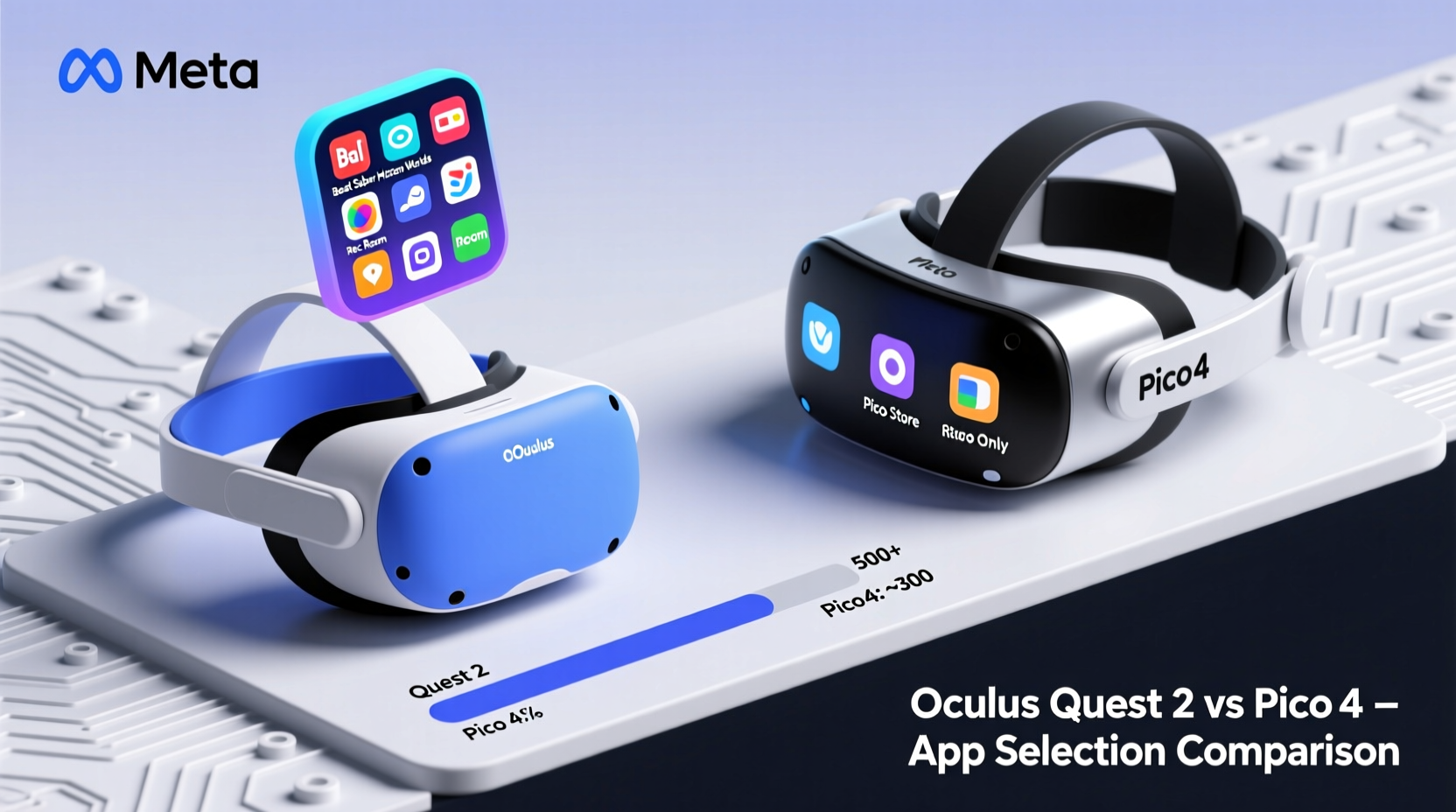
As of mid-2024, the Meta Quest Store lists over 500 full-fledged VR experiences, including games, productivity tools, social platforms, and fitness apps. Another 300+ titles are available through side-loading via platforms like SideQuest, giving users access to experimental builds, indie darlings, and adult content not permitted on the official store.
Pico’s official store, known as Pico Store, features around 350 apps. While this may sound competitive, the disparity becomes clear upon closer inspection. Many Pico apps are localized versions of Chinese-developed software, often lacking English support or international optimization. Only about 180 of these are available globally, and fewer than 60 are direct equivalents to top-tier Quest titles.
Differences in Key App Categories
| Category | Oculus Quest 2 | Pico 4 |
|---|---|---|
| Fitness | Supernatural, Les Mills Bodycombat, FitXR, BoxVR | FitXR, Holofit (limited), Pico Fitness (basic) |
| Gaming | Resident Evil 4 VR, Medal of Honor: Above and Beyond, Red Matter 2 | Red Matter 2 (ported), some indie shooters |
| Social & Productivity | Horizon Workrooms, Bigscreen VR, Spatial | Limited support; no native Workrooms equivalent |
| Entertainment | Veer, Pluto TV VR, Netflix VR, YouTube VR | YouTube VR, iQIYI VR (China-focused) |
| Education | Anatomyou, Unimersiv, Nanome | Few educational titles outside China |
The table illustrates a consistent trend: Quest 2 dominates in both breadth and depth across categories. Even when Pico 4 offers similar apps, updates are often delayed, and localization is spotty. For example, Supernatural—a premium subscription-based VR fitness program—is only available on Quest. Similarly, Beat Saber, though originally multi-platform, receives priority updates and DLC on Quest.
Exclusive Titles and Developer Support
Exclusivity plays a crucial role in shaping app ecosystems. Meta has invested heavily in securing exclusive content. While not all are permanent exclusives, many launch first—or only—on Quest. Examples include:
- After the Fall – Co-op zombie shooter developed by Vertigo Studios
- Contractors – AAA-style FPS with persistent progression
- Walkabout Mini Golf – Critically acclaimed social mini-golf game
Pico, meanwhile, has secured a few notable exclusives in Asia, such as Green Hell VR and Shattered State, but none have achieved global traction. Additionally, Pico’s developer incentives are less aggressive. Meta offers financial support, SDK integration assistance, and marketing boosts for select titles. Pico runs occasional grant programs, but they lack scale and visibility.
Another critical difference lies in development tools. The Meta Quest SDK is mature, well-documented, and compatible with Unity and Unreal Engine. Pico uses OpenXR, which improves cross-platform compatibility, but lacks robust debugging tools and community forums compared to Meta’s developer network.
Real-World Example: Launching an Indie Game
Consider a small studio based in Berlin developing a narrative-driven puzzle game. They plan to release on both platforms. On Quest, they use Meta’s developer portal to submit their build, receive automated feedback within 48 hours, and launch with featured placement due to strong art direction. Their game appears in “Recommended” sections and gains visibility.
On Pico, the same team struggles with untranslated documentation, delayed review cycles (up to two weeks), and minimal discoverability. Despite identical gameplay, the Pico version earns 1/10th the downloads. Without user traction, future updates are deprioritized. This scenario repeats across dozens of indie teams, reinforcing the cycle of Quest-first development.
Side-Loading and Openness
One area where Pico 4 technically outperforms Quest 2 is openness. Pico allows unrestricted side-loading without requiring developer mode approval. You can download APKs directly and install them—ideal for accessing region-locked or non-store content.
Meta, however, tightened restrictions after 2022. Installing apps from outside the Quest Store now requires enabling Developer Mode, linking a computer, and using ADB commands—a barrier for average users. While security improvements justify part of this shift, it limits access to cutting-edge mods, early prototypes, and open-source projects.
However, this advantage is largely theoretical for most consumers. The vast majority of high-quality side-loaded content—such as VRChat custom avatars, modded Beat Saber, or advanced training sims—are created by English-speaking communities centered around Quest. Even if Pico makes installation easier, the content itself is optimized for Quest’s controllers and display specs.
- ✅ Need access to top-tier fitness apps? → Choose Quest 2
- ✅ Want the latest AAA VR games? → Choose Quest 2
- ✅ Prefer open platform with easy APK installs? → Choose Pico 4
- ✅ Using VR for enterprise training or collaboration? → Choose Quest 2 (Workrooms, Spatial)
- ✅ Located in Europe or Southeast Asia with local language needs? → Pico 4 may offer regional advantages
Performance and App Optimization
Hardware differences also influence app availability. The Pico 4 boasts superior resolution (4320 x 2160 combined vs. Quest 2’s 3664 x 1920) and pancake lenses, which reduce glare. However, both run on Qualcomm Snapdragon XR2 chips. The real distinction lies in thermal management and sustained performance.
Some graphically intensive apps—like Blade & Sorcery: Nomad or Onward VR—run longer sessions on Pico 4 due to better heat dissipation. But optimization lags behind. Developers often tune performance profiles specifically for Quest, leading to frame drops or texture loading issues on Pico—even when hardware is comparable.
Additionally, controller ergonomics affect app design. Quest 2’s Touch controllers are bulkier but widely emulated in development environments. Pico’s slimmer remotes aren’t as universally supported in cross-platform engines, leading to input mapping errors in certain ports.
FAQ: Common Questions About VR App Selection
Can I play Quest apps on Pico 4?
Not officially. While both are Android-based, the stores are siloed. Some technically skilled users have ported APKs manually, but licensing, DRM, and compatibility issues often prevent success. Services like AirLink or Virtual Desktop work only within their respective ecosystems.
Is the Pico Store growing?
Yes, especially in China and parts of Europe. ByteDance is investing in local developer partnerships and publishing deals. However, growth remains concentrated in specific regions. Global expansion is slow, and English-language content updates are inconsistent.
Should I wait for Pico 5 instead?
If app library is your top concern, yes. Waiting for Pico 5 could mean improved developer buy-in, especially if ByteDance commits to matching Meta’s publishing incentives. However, there’s no guarantee. Meta’s ecosystem lead is structural, not just technological.
Conclusion: Which Headset Offers Better App Selection?
The answer is unequivocal: the Oculus Quest 2 offers a significantly better app selection than the Pico 4. Its lead isn’t just in numbers—it’s in quality, consistency, global availability, and developer engagement. From blockbuster games to specialized productivity tools, the Quest 2 ecosystem is deeper, more polished, and actively maintained.
Pico 4 brings solid hardware and promising openness, but it cannot yet compete with the breadth of content available on Quest. Unless you’re in a region where Pico has strong local support or you prioritize side-loading over curated experiences, the app gap makes Quest 2 the smarter choice for anyone who values software diversity.
That said, the landscape is evolving. If Pico continues expanding its global presence and secures key partnerships, it could close the gap within the next two years. For now, though, Meta’s early investment in developers and users has paid off handsomely.




 浙公网安备
33010002000092号
浙公网安备
33010002000092号 浙B2-20120091-4
Comments
No comments yet. Why don't you start the discussion?