
In 2025, television technology has reached a pivotal point where two dominant display types—OLED and Mini LED—offer exceptional picture quality but with distinct trade-offs. Consumers no longer need to settle for mediocre visuals; instead, they face a more nuanced decision: which technology aligns best with their viewing habits, room environment, and long-term expectations? This guide breaks down the core differences between OLED and Mini LED TVs, evaluates real-world performance, and identifies which one truly delivers the best overall picture in today’s market.
Understanding the Core Technologies
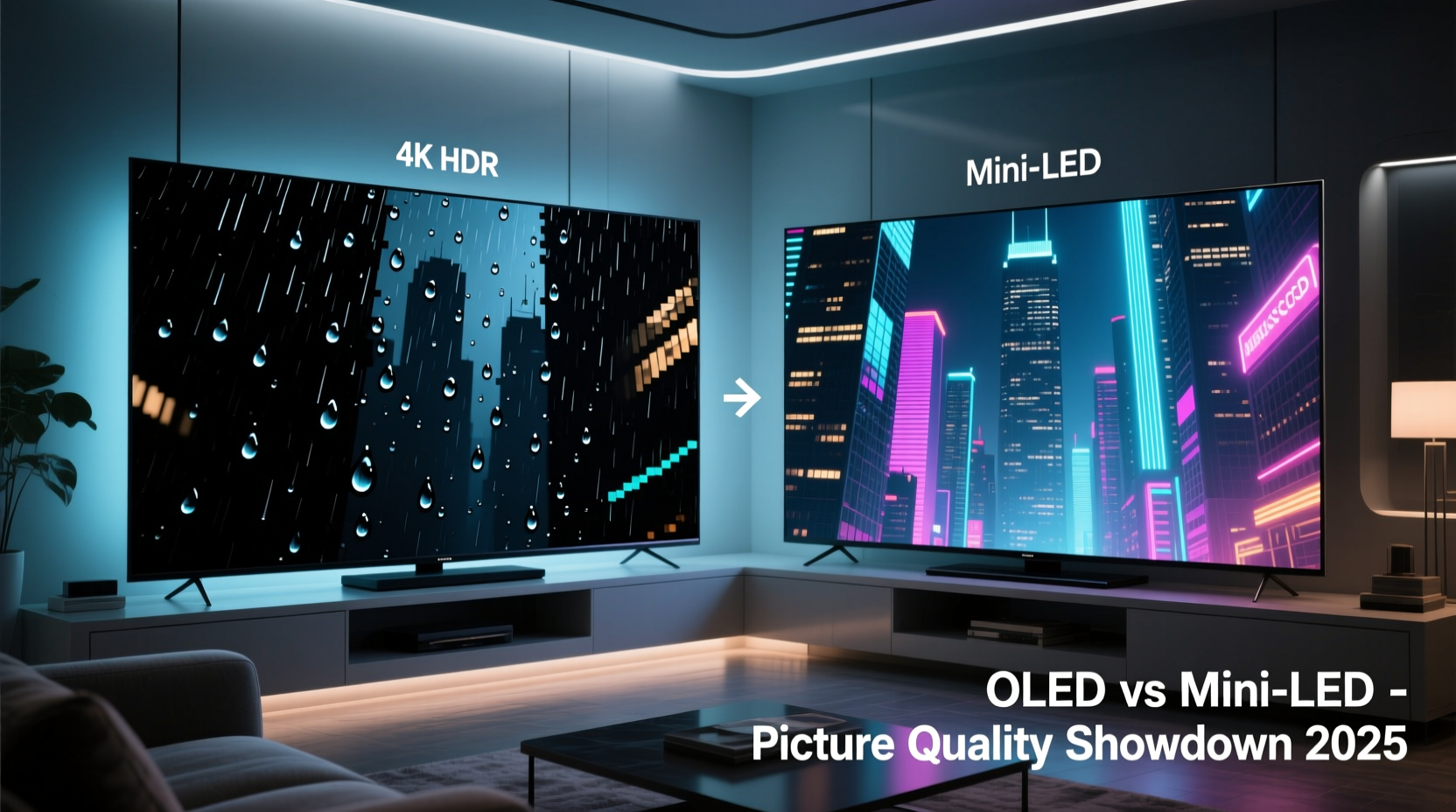
OLED (Organic Light-Emitting Diode) and Mini LED are fundamentally different in how they produce light and manage contrast. OLED panels use self-emissive pixels—each pixel generates its own light and can turn completely off when displaying black. This allows for perfect blacks and infinite contrast ratios, a hallmark of premium image quality.
Mini LED, on the other hand, is an advanced evolution of traditional LED/LCD technology. It uses thousands of tiny LEDs as a backlight behind an LCD panel. These micro-sized LEDs enable much finer control over brightness zones through local dimming, drastically improving contrast and reducing blooming compared to older edge-lit or standard full-array LED models.
The key distinction lies in light generation: OLED creates light at the pixel level, while Mini LED relies on a separate backlight layer. This foundational difference influences everything from peak brightness to longevity and susceptibility to burn-in.
Picture Quality: Contrast, Brightness, and Color Accuracy
When evaluating picture quality, three primary factors dominate: contrast ratio, peak brightness, and color reproduction. Each plays a vital role depending on content type and ambient lighting.
Contrast and Black Levels
OLED remains unmatched in contrast due to its ability to switch individual pixels off. True black means no light emission, resulting in infinite contrast ratios. This is especially noticeable in scenes with deep shadows or night skies, where details remain visible without grayish halos around bright objects—a phenomenon known as \"blooming.\"
Mini LED TVs have made significant strides with full-array local dimming (FALD), using hundreds or even thousands of dimming zones to minimize light bleed. High-end models like Samsung’s QN900C or LG’sQN900B come close to OLED-level contrast, but under scrutiny, slight blooming around bright objects on dark backgrounds persists. In practical terms, only in near-total darkness will this be distracting.
Brightness and HDR Performance
Here, Mini LED takes a decisive lead. Top-tier Mini LED sets can achieve peak brightness levels exceeding 2,000 nits, far surpassing most OLEDs, which typically max out between 800–1,000 nits (though newer MLA OLEDs reach up to 1,500). This extra luminance is crucial for impactful HDR (High Dynamic Range) content, making highlights like sunlight reflections, explosions, or specular details appear more lifelike.
In brightly lit living rooms or sun-facing spaces, Mini LED maintains visibility and punch, whereas OLED can appear washed out. However, because OLED has perfect blacks, its perceived contrast often compensates for lower absolute brightness in controlled environments.
Color Volume and Gamut
Both technologies support wide color gamuts such as DCI-P3 and Rec. 2020. OLED excels in color accuracy straight out of the box, thanks to stable per-pixel luminance. Mini LED requires precise calibration to avoid color shifts in dim areas caused by imperfect local dimming.
However, Mini LED benefits from quantum dot enhancement in many models (marketed as QLED), boosting saturation and maintaining color fidelity at high brightness—something OLED struggles with slightly due to ABL (Automatic Brightness Limiter) kicking in during large bright scenes.
“While OLED still holds the crown for cinematic black levels, Mini LED’s brightness and resilience in varied lighting make it the more versatile performer in 2025.” — David Lin, Senior Display Analyst at TechVision Labs
Longevity, Burn-In, and Real-World Durability
A major concern for OLED owners has always been burn-in—the permanent discoloration caused by static images displayed for extended periods. While modern OLEDs include pixel refreshers, logo dimming, and scrolling features to mitigate risk, the threat isn’t eliminated. Users who frequently watch news channels, play video games with HUDs, or use smart TV interfaces with fixed elements must remain cautious.
Mini LED, being based on inorganic LEDs and LCD layers, does not suffer from burn-in. Its components degrade slowly over time, with typical half-life ratings exceeding 60,000 hours. This makes Mini LED a safer choice for heavy daily use, commercial settings, or households with diverse viewing patterns.
Lifespan aside, OLED panels are also more sensitive to moisture and prolonged exposure to direct sunlight, which can accelerate organic material degradation. Mini LED’s rigid construction and protective layers offer better resistance to environmental stressors.
Energy Efficiency and Heat Output
OLED consumes less power when displaying dark content since inactive pixels are off. However, during bright scenes, power draw increases significantly. Mini LED generally uses more energy due to constant backlight operation, though efficient drivers and dynamic dimming help reduce waste.
Heat management favors Mini LED as well. OLEDs generate heat directly within the emissive layer, contributing to faster aging if operated at high brightness continuously. Mini LED distributes heat across the rear panel, allowing for better thermal dissipation.
Performance Across Viewing Scenarios
The “best” picture depends heavily on context. Below is a breakdown of how each technology performs in common real-world situations.
| Scenario | OLED Advantage | Mini LED Advantage |
|---|---|---|
| Dark Room Movie Nights | Perfect blacks, infinite contrast, cinematic depth | Moderate blooming may distract in starry scenes |
| Bright Living Room / Daytime Viewing | Image can look flat due to lower peak brightness | Superior glare resistance and vibrant HDR pop |
| Gaming (4K/120Hz, VRR) | Faster response times (~0.1ms), minimal motion blur | Higher brightness reduces eye strain during long sessions |
| Sports & Fast Action | Excellent motion clarity with proper settings | Brighter images enhance detail in fast-moving scenes |
| News/Browser Use (Static Elements) | Risk of burn-in over time | No risk; ideal for mixed interface usage |
Mini Case Study: The Martinez Family’s Upgrade Dilemma
The Martinez family upgraded their living room TV in early 2025. They wanted a 75-inch model for movie nights and weekend sports. After testing both technologies side-by-side at a retailer, they noticed the OLED delivered stunning shadow detail in *Dune: Part Two*, but during the Sunday NFL game, sunlight streaming through the windows washed out the screen. The Mini LED, while showing faint halos around score banners, kept colors vivid and text readable all afternoon. They ultimately chose the Mini LED QN90C, prioritizing daytime usability and peace of mind about long-term durability—especially with kids often leaving paused screens unattended.
Which Technology Is Right for You? A Decision Checklist
Choosing between OLED and Mini LED isn’t about which is objectively superior, but which fits your lifestyle. Use this checklist to determine the best match:
- Do you primarily watch movies and series in a dark or dimly lit room? → OLED scores higher here.
- Is your TV exposed to natural daylight or artificial room lighting? → Mini LED handles brightness better.
- Will you use the TV for gaming with static UI elements? → Mini LED avoids burn-in concerns.
- Do you value future-proof HDR impact (e.g., Dolby Vision, HDR10+)? → Mini LED’s brightness wins.
- Are you planning to keep the TV for 7+ years? → Consider Mini LED’s longer lifespan and stability.
- Is absolute motion clarity critical (e.g., fast-paced action, competitive gaming)? → OLED has faster pixel response.
Future Outlook: Where Are These Technologies Headed?
By 2025, both OLED and Mini LED have evolved significantly. LG’s MLA (Micro Lens Array) OLED panels boost brightness by up to 70%, narrowing the gap with Mini LED. Meanwhile, Samsung and TCL are pushing Mini LED toward 10,000 dimming zones, achieving near-pixel-level precision. Quantum Dot OLED (QD-OLED), used in高端 models from Samsung and Sony, combines self-emissive blue OLED subpixels with red and green quantum dots, delivering brighter colors and improved efficiency.
Looking ahead, the convergence of these technologies suggests hybrid solutions may emerge—such as dual-layer OLED or hybrid backlights—but for now, the divide remains clear. MicroLED remains prohibitively expensive for mainstream adoption, leaving OLED and Mini LED as the top contenders.
Frequently Asked Questions
Can OLED TVs last 10 years without burn-in?
Possibly, but it depends on usage. With moderate brightness, varied content, and avoiding static logos for hours, modern OLEDs can last a decade. However, users with high-risk habits (e.g., 8-hour news loops) may see retention issues earlier. Manufacturers typically offer 1–2 year warranties covering severe burn-in, not gradual wear.
Is Mini LED better than OLED for gaming?
It depends on priorities. OLED offers faster response times and deeper blacks, ideal for immersive single-player experiences. Mini LED provides higher sustained brightness, better anti-glare, and zero burn-in risk—making it preferable for competitive multiplayer or long gaming marathons with persistent HUDs.
Will OLED prices continue to drop in 2025?
Yes, but gradually. As production scales and new materials like WRGB and QD-OLED mature, entry-level OLEDs are becoming more affordable. However, they still command a $200–$500 premium over comparable Mini LED models. Significant price drops may wait until MicroLED becomes viable.
Conclusion: Making Your Move in 2025
In 2025, the battle between OLED and Mini LED isn’t about declaring a single winner—it’s about matching technology to lifestyle. OLED continues to set the gold standard for cinematic authenticity, offering unparalleled contrast and elegance in darkness. Yet, Mini LED has closed the gap in meaningful ways, delivering brighter, more durable, and versatile performance suited to real homes with real lighting challenges.
If your priority is theater-like immersion and you control your viewing environment, OLED remains a compelling choice. But if you want a TV that performs brilliantly at noon, lasts longer under heavy use, and fearlessly handles mixed content—from sports to streaming to gaming—Mini LED emerges as the more balanced, future-ready option.




 浙公网安备
33010002000092号
浙公网安备
33010002000092号 浙B2-20120091-4
Comments
No comments yet. Why don't you start the discussion?