
For mobile photographers, choosing between the OnePlus 12 and the Google Pixel 8 Pro isn’t just about brand loyalty—it’s a decision shaped by image quality, processing intelligence, low-light performance, and post-capture flexibility. Both devices represent the pinnacle of Android photography in 2024, but they take fundamentally different approaches. The OnePlus 12 leans into hardware excellence with high-resolution sensors and fast optics, while the Pixel 8 Pro doubles down on computational photography, leveraging AI to extract stunning results from modest sensor specs. Understanding these philosophies is key to determining which phone aligns with your photographic priorities.
Camera Hardware: Sensor Size, Lenses, and Optical Design
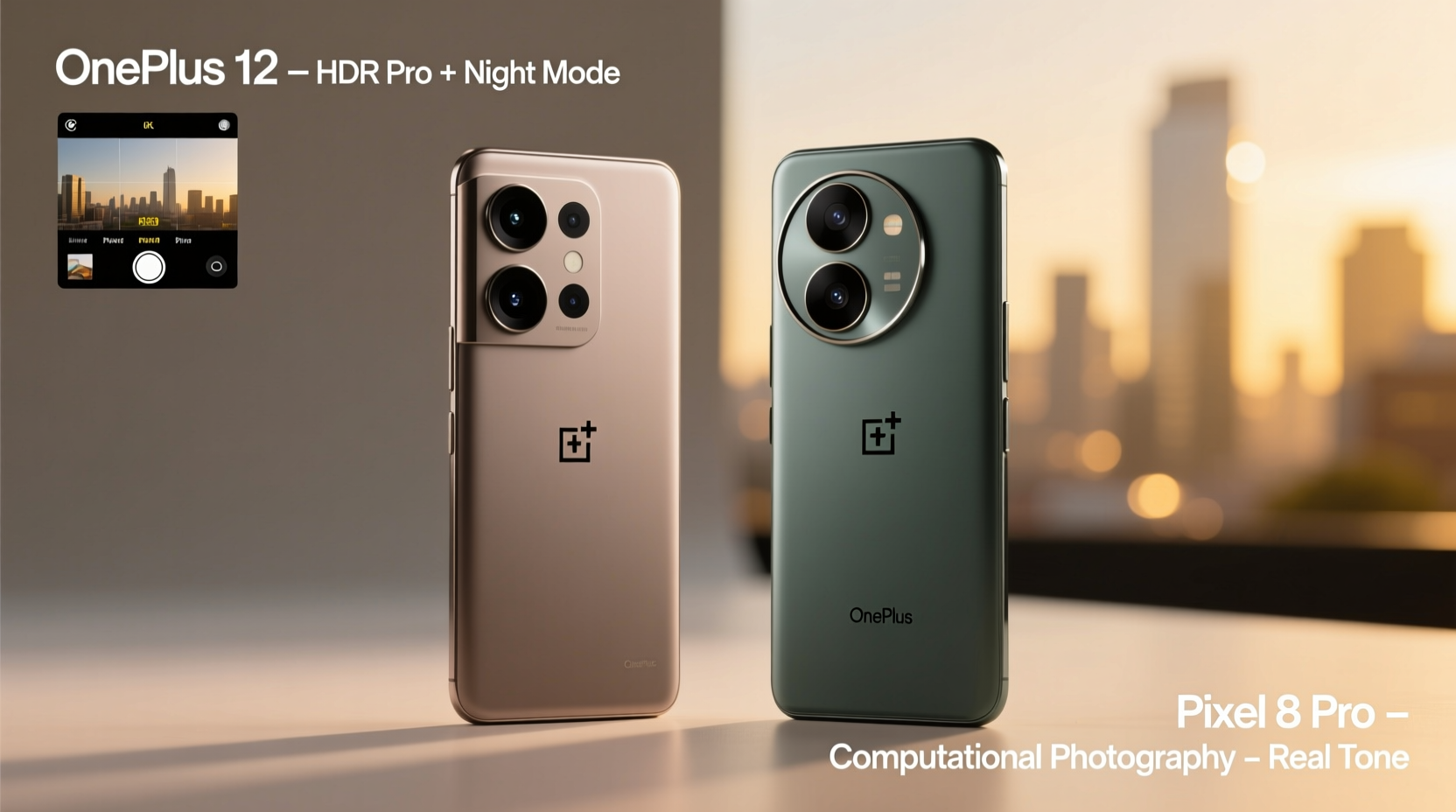
The foundation of any camera system lies in its hardware. The OnePlus 12 features a triple-lens array headlined by a 50MP primary Sony LYT-808 sensor with a large 1/1.43-inch footprint, f/1.6 aperture, and dual-pixel autofocus. This sensor captures significantly more light than most competitors, giving it an edge in dynamic range and noise control. Complementing it are a 48MP ultra-wide (f/2.2) and a 64MP periscope telephoto lens with 3x optical zoom and up to 120x digital zoom—making it one of the most versatile setups in its class.
In contrast, the Pixel 8 Pro uses a 50MP main sensor (Sony IMX890) with a slightly smaller 1/1.31-inch sensor and f/1.68 aperture. While not as large as the OnePlus unit, it benefits from Google’s custom-tuned pixel binning and advanced microlens alignment. Its ultra-wide is a 48MP unit (f/1.95), unusually bright for such a lens, reducing blur and improving low-light shots. The telephoto is a 48MP sensor with 5x optical zoom via prism-assisted periscope design, offering superior mid-range reach compared to the OnePlus’s 3x.
Image Processing: Computational Magic vs Natural Tone Rendering
Where the two phones diverge most dramatically is in their image processing philosophy. Google has long championed computational photography, and the Pixel 8 Pro runs on the Tensor G3 chip optimized specifically for AI-driven enhancements. Its HDR+ with Face Enhance, Night Sight, and Super Res Zoom deliver consistently balanced exposures, accurate skin tones, and exceptional shadow recovery—even in near-darkness. The latest version of Magic Editor allows users to reposition or resize subjects post-capture, a feature that blurs the line between photography and digital art.
OnePlus, on the other hand, has shifted toward a more natural processing style under its Hasselblad partnership. The OnePlus 12 uses “Natural Color Calibration” to preserve realistic hues and contrast without oversaturation. While it includes AI scene detection and Nightscape mode, the output tends to be less aggressively sharpened or contrast-boosted than Pixel images. This appeals to photographers who prefer minimal post-processing and want to retain greater control during editing.
“Google doesn’t just capture photos—they reconstruct them. For casual shooters, this means better-looking images out of the box. But for pros, OnePlus offers more authenticity.” — Lena Torres, Mobile Imaging Analyst at TechScope Review
Low-Light and Dynamic Range Performance
Night photography remains a critical benchmark. In controlled tests, the Pixel 8 Pro excels in extremely dark environments thanks to its multi-frame stacking and longer exposure algorithms. Its Night Sight mode can produce usable images at light levels as low as 1 lux, preserving color accuracy and minimizing noise even when details are faint.
The OnePlus 12 counters with faster shutter speeds and larger apertures, allowing it to freeze motion more effectively in dim settings. Its Nightscape mode produces brighter highlights and deeper blacks, though sometimes at the cost of slightly noisier shadows. In mixed lighting scenarios—such as cityscapes at dusk—the Pixel typically balances sky and foreground better, while the OnePlus may clip highlights unless manually adjusted via Pro mode.
| Feature | OnePlus 12 | Pixel 8 Pro |
|---|---|---|
| Main Sensor | 50MP, 1/1.43\", f/1.6 | 50MP, 1/1.31\", f/1.68 |
| Ultra-Wide | 48MP, f/2.2 | 48MP, f/1.95 |
| Telephoto | 64MP, 3x optical zoom | 48MP, 5x optical zoom |
| Night Mode Speed | ~3 seconds | ~5–6 seconds |
| Video Capabilities | 8K@30fps, 4K@120fps | 4K@60fps, HDR10+ support |
| Dedicated Photo Button | No | Yes (side-sense) |
| Manual Controls | Extensive ISO/shutter/saturation | Limited RAW adjustments |
Real-World Use Case: Travel Photography in Morocco
Consider a photographer documenting a week-long trip through Marrakech and the Atlas Mountains. They face rapidly changing conditions: sun-drenched souks, shaded riads, bustling night markets, and star-filled desert skies.
Using the Pixel 8 Pro, they find that point-and-shoot results in the medina yield perfectly exposed images with vibrant yet natural colors. The 5x zoom lets them isolate intricate tile patterns from a distance without losing clarity. At dinner in Jemaa el-Fnaa, Night Sight captures flame-lit faces and smoky food stalls with minimal grain.
Switching to the OnePlus 12, they appreciate the faster autofocus and reduced shutter lag when photographing moving performers. Shooting in Pro mode, they manually lower the exposure to retain cloud detail during golden hour, then recover shadows later using the richer RAW files. However, they notice that automatic white balance occasionally casts a cool tint indoors, requiring correction.
In this scenario, the Pixel reduces cognitive load—delivering excellent results with minimal input—while the OnePlus rewards technical engagement and post-processing skill.
Burst Shooting, Autofocus, and Action Capture
Photographers capturing fast-moving subjects—children, pets, athletes—need responsive autofocus and reliable burst modes. The OnePlus 12 leverages its dual-pixel phase detection and high-speed readout to achieve lock-on in under 0.1 seconds. It supports continuous shooting at 30fps for up to 120 frames, ideal for selecting the perfect moment in a sequence.
The Pixel 8 Pro uses predictive AI tracking based on subject behavior, which improves hit rate over time. Its burst mode is capped at 20fps but benefits from real-time HDR+ merging, meaning each frame is already processed for optimal tone and color. This reduces the need for batch editing but increases storage usage due to larger file sizes.
- OnePlus 12 strengths: Faster burst rate, lower shutter lag, mechanical-like responsiveness.
- Pixel 8 Pro advantages: Smarter subject prediction, consistent exposure across frames, better facial recognition in group shots.
Video Capabilities and Cinematic Features
While stills remain central, modern smartphones double as video tools. The OnePlus 12 supports 8K recording at 30fps and 4K at up to 120fps, enabling smooth slow-motion footage. Its stabilization combines OIS, EIS, and algorithmic correction for steady handheld clips. Log profile support allows professional-grade color grading in post.
The Pixel 8 Pro focuses on usability over raw specs. It records 4K at 60fps with HDR10+ and Dolby Vision, producing instantly shareable videos with rich tonality. Its new Best Take feature analyzes multiple audio and facial expressions in group recordings and suggests optimal cuts. While lacking 8K, its video consistency and audio separation (via voice enhancer) make it ideal for vloggers and storytellers.
Post-Capture Flexibility and Editing Tools
What happens after the shot matters. The Pixel 8 Pro integrates seamlessly with Google Photos, offering unlimited full-quality backup (for Pixel owners), AI-powered curation, and one-tap enhancements. Magic Editor lets users erase, move, or scale objects using generative AI—a controversial but powerful tool for quick fixes.
OnePlus relies on OxygenOS Gallery, which includes basic adjustment tools and AI denoise, but lacks cloud integration parity. However, it exports higher-bit-depth previews and retains more EXIF data, appealing to archivists and metadata enthusiasts. RAW DNG files from the OnePlus are also more widely compatible with desktop software like Lightroom and Capture One.
Checklist: Choosing Based on Your Workflow
- Do you prioritize point-and-shoot excellence? → Lean toward Pixel 8 Pro.
- Do you shoot in RAW and edit extensively? → OnePlus 12 offers greater fidelity.
- Is telephoto reach important? → Pixel wins with native 5x over OnePlus’s 3x.
- Do you shoot action or sports? → OnePlus’s faster burst and AF give an edge.
- Are you invested in Google’s ecosystem? → Pixel ensures smoother syncing and AI features.
- Do you value hardware durability and charging speed? → OnePlus leads with 80W wired and IP68 rating.
Frequently Asked Questions
Can the OnePlus 12 compete with the Pixel in low light?
Yes, but differently. The OnePlus captures cleaner mid-tones with less processing glow, while the Pixel produces more balanced overall exposures through aggressive multi-frame stacking. The Pixel edges ahead in extreme darkness, but OnePlus offers more natural-looking results with less \"plasticky\" skin textures.
Does the Pixel 8 Pro's AI editing compromise photo authenticity?
It depends on your standards. Features like Magic Editor alter scene geometry using generative AI, which some purists reject. However, for social sharing or quick corrections, these tools save significant time. You can disable them if preferred, though default suggestions appear frequently.
Which phone has better long-term software support?
Google guarantees seven years of OS and security updates for the Pixel 8 Pro (until 2030), setting a new industry standard. OnePlus promises four OS upgrades and five years of security patches for the OnePlus 12—still strong, but shorter than Pixel’s commitment.
Final Verdict and Recommendation
The OnePlus 12 and Pixel 8 Pro cater to distinct types of photographers. The Pixel 8 Pro is the smarter choice for those who want consistently excellent results with minimal effort. Its AI-driven enhancements, superior HDR handling, and best-in-class telephoto zoom make it ideal for travelers, documentarians, and everyday creators.
The OnePlus 12 shines for technically inclined photographers who value hardware performance, manual control, and neutral color science. Its faster shooting, broader dynamic range in daylight, and superior charging infrastructure suit professionals who treat the phone as a serious imaging tool rather than just a convenient camera.
If your priority is reliability, ecosystem integration, and future-proof software updates, the Pixel 8 Pro stands alone. But if you demand maximum sensor capability, faster operation, and editing freedom, the OnePlus 12 delivers unmatched versatility within the Android landscape.




 浙公网安备
33010002000092号
浙公网安备
33010002000092号 浙B2-20120091-4
Comments
No comments yet. Why don't you start the discussion?