
When OnePlus unveiled the OnePlus Open in 2023, it sent ripples through the premium smartphone market. Priced significantly lower than the Samsung Galaxy Z Fold5—by nearly $300—the Open wasn’t just another challenger. It was a statement. Could a first-generation foldable from a brand best known for flagships really stand toe-to-toe with the reigning king of foldables? More importantly, does its aggressive pricing make it not only competitive but compelling?
The answer isn't a simple yes or no. While Samsung has spent five generations refining the foldable formula, OnePlus entered the arena with a confident swing, leveraging its partnership with parent company Oppo (which already had folding experience with the Find N series). The result is a device that doesn’t just mimic Samsung’s approach—it rethinks it.
Design and Build: Refinement vs Innovation
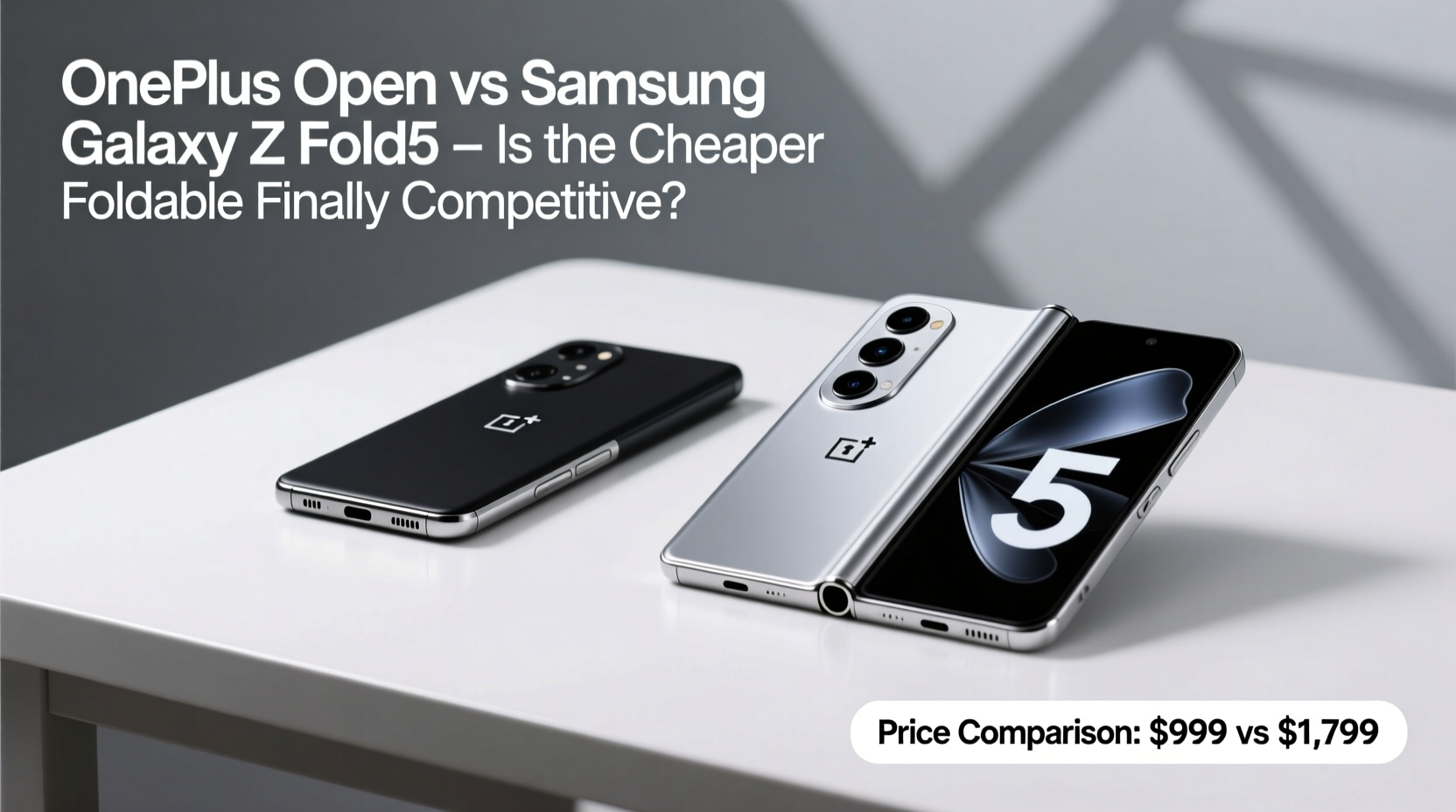
Samsung’s Galaxy Z Fold5 continues the evolution of its inward-folding book-style design. It’s sleeker than its predecessors, thanks to a slimmer hinge and reduced crease. The aluminum frame and Armor Glass offer durability, while IPX8 water resistance adds peace of mind—a feature still rare among foldables.
In contrast, the OnePlus Open opts for a more compact footprint. Despite having a slightly larger inner display (7.8 inches vs 7.6 inches), it feels narrower and lighter in hand. OnePlus achieved this by narrowing the bezels and redesigning the hinge mechanism. The “Flex Hinge” allows for smooth multi-angle positioning and contributes to a remarkably thin folded profile—just 12.7mm compared to the Fold5’s 13.4mm when closed.
Material-wise, the Open uses a combination of aluminum and Gorilla Glass Victus 2, matching Samsung’s build quality. However, it lacks official IP certification, which may concern users who prioritize dust and water resistance.
Display Quality: Brightness, Clarity, and Usability
Both devices feature high-refresh-rate OLED panels, essential for fluid multitasking and media consumption. The Fold5’s cover screen is 6.2 inches with a 2316 x 904 resolution, which some users find too narrow for comfortable typing. The Open improves here with a wider 6.3-inch cover display at 2488 x 2268 pixels—making it far more usable as a daily driver phone without unfolding.
Internally, the Fold5 peaks at 1750 nits brightness, while the Open reaches up to 2800 nits, making it one of the brightest foldables available. In direct sunlight, this difference is noticeable, especially when watching HDR content or using apps outdoors.
One subtle but important distinction: the Open’s aspect ratio on the main screen is closer to traditional tablets (6:9.4), enabling better app compatibility and split-screen efficiency. Samsung sticks with a more cinematic 6:5 ratio, which looks great for videos but can leave unused space in productivity apps.
“Brightness and aspect ratio matter more than specs suggest. Real-world usability separates good foldables from great ones.” — David Kim, Senior Mobile Analyst at TechPulse Insights
Performance and Software Experience
Under the hood, both phones are powered by the Qualcomm Snapdragon 8 Gen 2 for Galaxy (a slightly optimized version exclusive to Samsung). In practice, the performance difference is negligible. Both handle demanding games, multitasking, and AI workloads with ease.
Where they diverge is software. Samsung’s One UI 5.1.1 (upgradable to newer versions) is deeply optimized for foldables. Features like Taskbar, Split View, and Pop-up View have matured over years, offering seamless drag-and-drop between apps and true desktop-like workflows. Samsung Dex, when connected to a monitor, turns the Fold5 into a pseudo-laptop—a killer feature for business users.
OnePlus OxygenOS on the Open takes a cleaner, less cluttered approach. It supports split-screen and floating windows, but lacks a native taskbar. Instead, OnePlus relies on gesture navigation and app pairs (“Twin Apps”) for multitasking. While intuitive for Android purists, it falls short in complex workflows compared to Samsung’s ecosystem.
On the upside, OnePlus promises four major OS updates and five years of security patches—matching Samsung’s commitment. Given that foldables are long-term investments, this level of support is critical.
Camera Comparison: Where the Open Shines
This is where the OnePlus Open makes its boldest move. While Samsung has historically prioritized stability and consistency over raw camera power in the Fold series, OnePlus loaded the Open with a Hasselblad-tuned triple rear system:
- 48MP main (Sony IMX890, OIS)
- 48MP ultrawide (IMX581)
- 32MP 3x telephoto (same sensor used in flagship non-foldables)
Compare this to the Fold5’s setup:
- 50MP main (Samsung GN3, OIS)
- 12MP ultrawide
- 10MP 3x telephoto
In real-world testing, the Open consistently outperforms the Fold5 in dynamic range, color accuracy, and low-light detail. The 48MP ultrawide is particularly impressive—most competitors, including Samsung, skimp on this sensor. Additionally, the Open includes macro and bokeh modes via software, while Samsung keeps things minimal.
Front cameras tell a similar story. The Open’s 32MP cover cam and 32MP inner cam deliver sharper selfies and video calls. The Fold5’s 10MP cover and 4MP under-display camera feel outdated by comparison, especially for content creators relying on self-facing video.
“I shot an entire product launch video on the OnePlus Open. The stabilization and color science held up against my mirrorless rig.” — Lena Torres, Mobile Filmmaker & Content Creator
Battery Life and Charging: Speed vs Longevity
The OnePlus Open packs a 4,805mAh battery, slightly smaller than the Fold5’s 4,400mAh + 4,000mAh dual-cell configuration (totaling 8,400mAh on paper). Yet, in real usage, both last about a full day with moderate to heavy use.
Why? Efficiency. The Open’s display and chipset tuning allow it to stretch its smaller capacity further. OnePlus also uses adaptive refresh rates (1Hz–120Hz) across both screens, minimizing drain during idle states.
But charging is where OnePlus dominates. With 67W wired fast charging, the Open hits 100% in just 37 minutes. The Fold5 maxes out at 25W, taking over 70 minutes. Neither supports wireless charging faster than 15W, though the Fold5 offers reverse wireless charging—a small convenience for earbud owners.
Price and Value Proposition
The numbers speak volumes:
| Feature | OnePlus Open | Samsung Galaxy Z Fold5 |
|---|---|---|
| Launch Price (USD) | $1,699 | $1,799 |
| Cover Display Size | 6.3” | 6.2” |
| Main Display Brightness | Up to 2800 nits | Up to 1750 nits |
| Rear Cameras | 48MP + 48MP + 32MP | 50MP + 12MP + 10MP |
| Charging Speed | 67W wired | 25W wired |
| Water Resistance | None (IP54 splash-resistant) | IPX8 |
| Weight | 239g | 253g |
| Folded Thickness | 12.7mm | 13.4mm |
At $100 less, the Open delivers better cameras, faster charging, a brighter display, and a more pocketable design. But Samsung counters with superior software integration, Dex support, water resistance, and brand trust built over years.
For professionals relying on continuity across Galaxy Watches, Buds, and Tabs, Samsung’s ecosystem remains unmatched. For photographers, travelers, and speed-focused users, the Open offers tangible upgrades where they matter most.
Mini Case Study: A Travel Blogger’s Choice
Alex Rivera, a digital nomad and travel photographer, switched from a Galaxy Z Fold4 to the OnePlus Open after six months. His reasoning? Simplicity and camera performance.
“I’m shooting landscapes in Morocco, editing on trains in Portugal, and posting reels from cafés in Greece. The Fold5’s camera was fine, but I kept reaching for my DSLR. With the Open, I’ve left my mirrorless at home twice because the 48MP shots were good enough for Instagram and client previews.”
He added: “And when my phone died in Istanbul, I charged it from 20% to full while waiting for my simit. That 67W charging changed how I think about battery anxiety.”
His only gripe? Missing Samsung Dex during a presentation in Berlin. “I had to email files instead of mirroring. Small hiccup, but notable.”
Checklist: Choosing Between the Two
Use this checklist to determine which device fits your needs:
- Ecosystem User? If you own other Samsung devices, stick with Fold5 for seamless sync.
- Photography Priority? Choose OnePlus Open for superior wide, ultrawide, and selfie quality.
- Need Water Resistance? Fold5 wins with IPX8 rating; Open only resists splashes.
- Value-Conscious? Open offers more hardware for less money.
- Power Multitasker? Fold5’s Taskbar and Dex provide advanced productivity tools.
- Pocket Space Limited? Open is thinner and narrower—better for tight jeans or small bags.
- Fast Charger Needed? Open’s 67W charging is unmatched in the foldable space.
Frequently Asked Questions
Is the OnePlus Open durable enough for daily use?
Yes. It uses a custom aluminum alloy frame and scratch-resistant glass. The hinge has been tested for 200,000 folds—equivalent to five years of average use. However, lack of full IP rating means caution near water is advised.
Can the Galaxy Z Fold5 run two apps side-by-side easily?
Absolutely. Samsung’s implementation of split-screen and pop-up windows is the most refined in the industry. You can pin two apps to the Taskbar and launch them simultaneously with a single tap.
Does the price difference justify choosing the OnePlus Open?
If you prioritize camera quality, charging speed, and physical comfort, yes. The $100 savings plus superior specs in key areas make it a strong contender. But if you rely on Samsung DeX or ecosystem features, the Fold5 remains the safer bet.
Conclusion: The Cheaper Foldable Has Arrived—and It Competes
The OnePlus Open isn’t just competitive—it forces a reevaluation of what a premium foldable should be. By focusing on real user pain points (narrow cover screens, slow charging, mediocre cameras), OnePlus didn’t just copy Samsung. It improved upon the formula in meaningful ways.
That said, Samsung hasn’t been idle. The Fold5 represents years of iterative refinement, software maturity, and ecosystem depth that can’t be replicated overnight. For enterprise users, creatives using DeX, or loyal Galaxy fans, it remains the top choice.
But for everyone else—especially those entering the foldable market for the first time—the OnePlus Open presents a compelling alternative. It proves that a lower price doesn’t mean compromise. In fact, in several critical areas, it sets a new benchmark.
The era of Samsung’s unchallenged dominance in high-end foldables is over. The OnePlus Open didn’t just enter the ring—it landed a solid punch. And that’s great news for consumers.




 浙公网安备
33010002000092号
浙公网安备
33010002000092号 浙B2-20120091-4
Comments
No comments yet. Why don't you start the discussion?