
Minimalist holiday design isn’t about scarcity—it’s about intentionality. In a season saturated with tinsel, plastic, and sensory overload, a light-only Christmas tree offers quiet elegance, environmental mindfulness, and surprising emotional resonance. This approach removes the physical tree entirely—no cutting, no water, no disposal—and transforms illumination into architecture. It’s not a shortcut or a compromise; it’s a deliberate aesthetic choice rooted in Scandinavian hygge, Japanese wabi-sabi, and contemporary interior design principles. Done thoughtfully, a lights-only tree becomes a focal point that breathes calm into a room, draws attention without demanding it, and honors the season’s essence: warmth, pause, and gentle radiance.
The Philosophy Behind Light-Only Trees
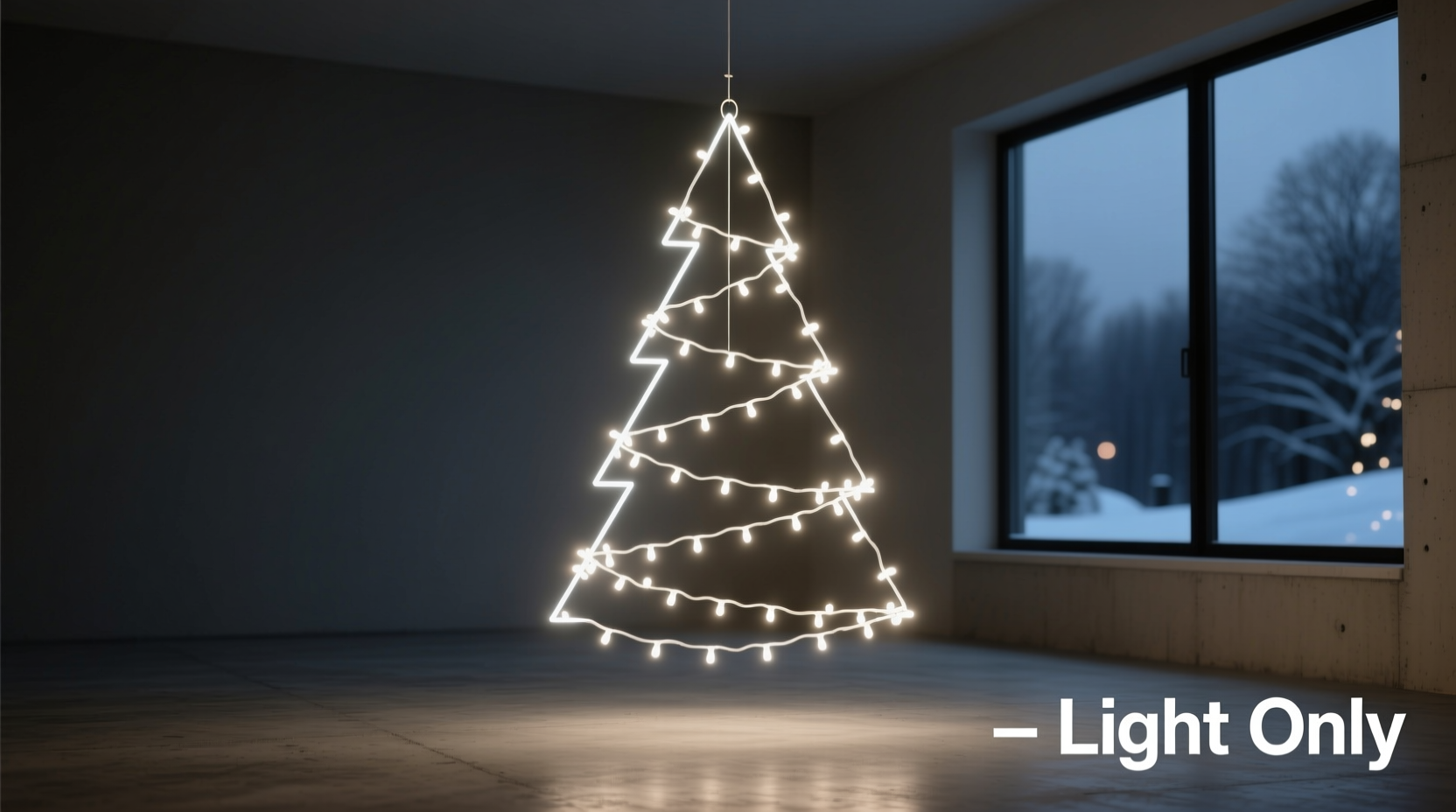
A minimalist Christmas tree built solely from lights reflects a broader cultural shift toward conscious consumption and spatial awareness. Interior designers increasingly cite “light as structure” as a defining trend in 2024–2025 residential projects—especially in compact urban homes, rental apartments, and modern lofts where traditional trees feel impractical or visually overwhelming. According to architect and lighting specialist Lena Voss, whose studio designs seasonal installations for museums and boutique hotels:
“Light doesn’t occupy space—it defines it. When you remove the trunk, branches, and ornaments, you’re not subtracting meaning; you’re inviting the viewer to participate in the shape-making. The eye completes the triangle. The mind recalls the tradition. That’s where minimalism becomes emotionally rich.”
This philosophy also aligns with sustainability imperatives. The average real Christmas tree takes 7–15 years to grow, consumes significant water during its retail life, and contributes to landfill waste if not properly composted. Artificial trees, while reusable, are typically made from non-biodegradable PVC and often end up discarded after 6–9 years. A lights-only installation eliminates both issues: no harvesting, no plastic, no storage burden. What remains is pure function—warmth, rhythm, and ritual—expressed through carefully arranged luminescence.
Essential Materials & Smart Selection Criteria
You don’t need dozens of components—but you do need precision in selection. Every element must serve dual purposes: structural integrity and visual harmony. Below is a curated checklist of what to acquire, with rationale for each choice.
- LED String Lights (Warm White, 2700K–3000K): Choose incandescent-style bulbs (not microdots) with visible filament or soft-diffused lenses. Avoid cool white (5000K+), which reads clinical rather than festive. Prioritize lights with memory function (they return to last setting after power loss) and dimmability.
- Support Structure (Non-Visible): A single, matte-black telescoping curtain rod (240–300 cm), wall-mounted brackets, and adjustable tension rods. No wood, no metal frames—only hardware that recedes visually.
- Mounting Hardware: Heavy-duty double-sided foam tape (3M VHB), removable wall hooks rated for 10+ kg, and self-adhesive cable clips. All must be color-matched to your wall (e.g., matte white tape on white walls).
- Power Management: One smart plug (e.g., TP-Link Kasa) for scheduling and remote control; one multi-outlet surge protector with USB-C ports for centralized power delivery.
- Optional Texture Enhancer: A single strand of matte-finish copper wire (1.2 mm gauge) wrapped *once* around the outer perimeter of the light shape—adds subtle depth without breaking minimalism.
Step-by-Step Assembly: Building the Shape in Space
This is not hanging lights on a pre-existing form. You’re constructing geometry with light. Follow this precise sequence—deviations compromise the illusion of a cohesive, floating tree.
- Measure & Mark Anchor Points: Use a laser level to mark three points on your wall: base left (15 cm above floor), base right (same height, 120–180 cm horizontally from left), and apex (centered horizontally between them, 210–240 cm above floor). These define your ideal isosceles triangle.
- Install Primary Support Rod: Mount the telescoping curtain rod horizontally at the apex height, centered. Extend it so ends sit 15 cm beyond each base point. This rod will hold the top third of your lights and anchor the vertical drop.
- String the Vertical Axis: Take one full string of lights (minimum 10 m, 100–150 bulbs). Starting at the apex rod, drape straight down to the midpoint between base points. Secure the bulb-end there with a removable hook. Do not loop or zigzag—this is your central spine, the silent core.
- Build the Left Slope: Using a second string, begin at the apex rod and angle downward left to the base-left anchor. Maintain consistent 10–12 cm spacing between bulbs. Clip every third bulb to the wall with adhesive clips—no sagging, no variance.
- Build the Right Slope: Repeat identically on the right side. Use the same string length and clip rhythm. At this stage, you have three clean lines: spine, left slope, right slope.
- Add Subtle Density (Optional but Recommended): Use a third string to create one horizontal “tier” 60 cm below the apex—spanning only between the two slope lines, not touching the spine. This implies branch depth without clutter. Keep it sparse: 12–15 bulbs max.
- Final Power Integration: Route all cords vertically down the wall behind the spine, secured with clips. Plug into the surge protector, then into the smart plug. Test dimming, timing, and fade functions before finalizing wall attachments.
Do’s and Don’ts: Preserving Minimalist Integrity
Maintaining authenticity requires discipline. A single decorative misstep collapses the entire concept. Refer to this table when making decisions throughout planning and installation.
| Category | Do | Don’t |
|---|---|---|
| Color Palette | Stick exclusively to warm white (2700K–3000K). Add zero accent colors—even gold or silver bulbs break tonal purity. | Introduce multicolor, cool white, or RGB strings. Avoid “twinkle” modes with random strobing. |
| Scale & Proportion | Respect golden ratio spacing: apex height ≈ 1.6x base width. For small rooms (under 20 m²), max height = 210 cm. | Stretch beyond 300 cm height or widen base past 200 cm—disrupts architectural balance and overwhelms sightlines. |
| Surface Context | Install only on uncluttered, solid-color walls (matte paint preferred). Ensure no artwork, shelves, or mirrors intersect the triangle zone. | Place near busy wallpaper, textured brick, or adjacent to large framed art—the eye competes for hierarchy. |
| Temporal Rhythm | Program lights to fade on/off gently (15–30 sec transitions). Set automatic schedule: on at dusk, off at 11 p.m. daily. | Leave lights on 24/7 or use abrupt on/off toggling—undermines the meditative quality central to minimalism. |
Real-World Case Study: The Brooklyn Studio Apartment
Maya R., a graphic designer living in a 42 m² rent-controlled studio in Williamsburg, faced a recurring dilemma: her landlord prohibited nails in plaster walls, her ceiling height was only 2.4 meters, and she refused to buy another plastic tree after her third one cracked in storage. Last December, she implemented a lights-only tree using the method described here—modified for her constraints.
She used a 210 cm matte-black tension rod anchored between two doorframes (no wall contact), hung three 8-meter warm-white LED strings (120 bulbs each), and added a single copper wire outline. Because her wall was pale sage green, she chose charcoal-gray adhesive clips instead of black. She programmed the smart plug to sync with sunset via geolocation and added a Bluetooth speaker playing low-volume piano covers—no visual ornament, but layered sensory warmth.
The result? Her tree became a conversation anchor—not for its novelty, but for its serenity. Guests consistently described it as “the first thing they noticed upon entering, yet the last thing they remembered leaving.” Maya reported reduced holiday stress: no assembly anxiety, no cleanup, no post-holiday guilt. Most significantly, she kept the installation up year-round, dimmed to 10% brightness in January and February—transforming it into ambient architectural lighting. “It stopped being ‘Christmas decor’ and became part of my home’s quiet language,” she said.
Frequently Asked Questions
Can I use battery-operated lights for this?
Yes—but only high-capacity, rechargeable lithium models with 30+ hour runtime on low mode. Avoid disposable AA/AAA sets: inconsistent voltage causes flicker, and frequent battery changes contradict the low-maintenance ethos. Always verify battery packs are mounted discreetly behind the spine cord route.
What if I live in a shared space or can’t mount anything?
Use freestanding alternatives: a matte-black floor lamp with adjustable gooseneck arms (position two arms outward at 45° angles, wrap lights around each), or a tall, narrow bookshelf with upper shelf cleared—drape lights from shelf edge downward in triangular formation. Anchor cords with weighted fabric pouches filled with rice, hidden beneath a neutral linen runner.
How do I store these lights without tangling?
Wind each string around a rigid 30 cm cardboard rectangle (cut from shipping box), securing ends with reusable silicone straps—not tape or rubber bands. Store flat in a labeled archival box with desiccant packets to prevent moisture corrosion on contacts. Inspect connections annually with a multimeter.
Conclusion: Light as Legacy
A minimalist Christmas tree made of lights alone is more than decoration—it’s a quiet act of resistance against excess, a testament to the power of restraint, and a deeply personal ritual rendered visible. It asks nothing of the earth, leaves no residue, and demands only your attention to proportion, warmth, and stillness. You don’t need a forest to evoke reverence. You don’t need ornaments to signify joy. You need only the courage to let light speak for itself.
This isn’t the absence of tradition—it’s its distillation. Every time you dim the room and watch the triangle glow, you’re participating in centuries of human celebration reduced to its luminous core: hope, held in space.




 浙公网安备
33010002000092号
浙公网安备
33010002000092号 浙B2-20120091-4
Comments
No comments yet. Why don't you start the discussion?