
In an era where attention spans are fragmented across streaming platforms, social media, and packed work schedules, a quiet but profound shift is reshaping how people play video games. The once-celebrated 100-hour open-world epic—packed with side quests, collectibles, and sprawling maps—is now facing scrutiny. Are players still willing to invest dozens of hours into a single game, or has modern life made such commitments impractical? More importantly, does a massive map equate to meaningful gameplay, or just filler content?
The debate between open-world freedom and tightly paced linear narratives isn't new. But it's evolved. What was once a conversation about creative design has become one about time, value, and player agency. As development budgets soar and player expectations grow, developers must now ask: are expansive worlds enhancing the experience—or becoming burdensome obligations?
The Rise and Fatigue of the Open World
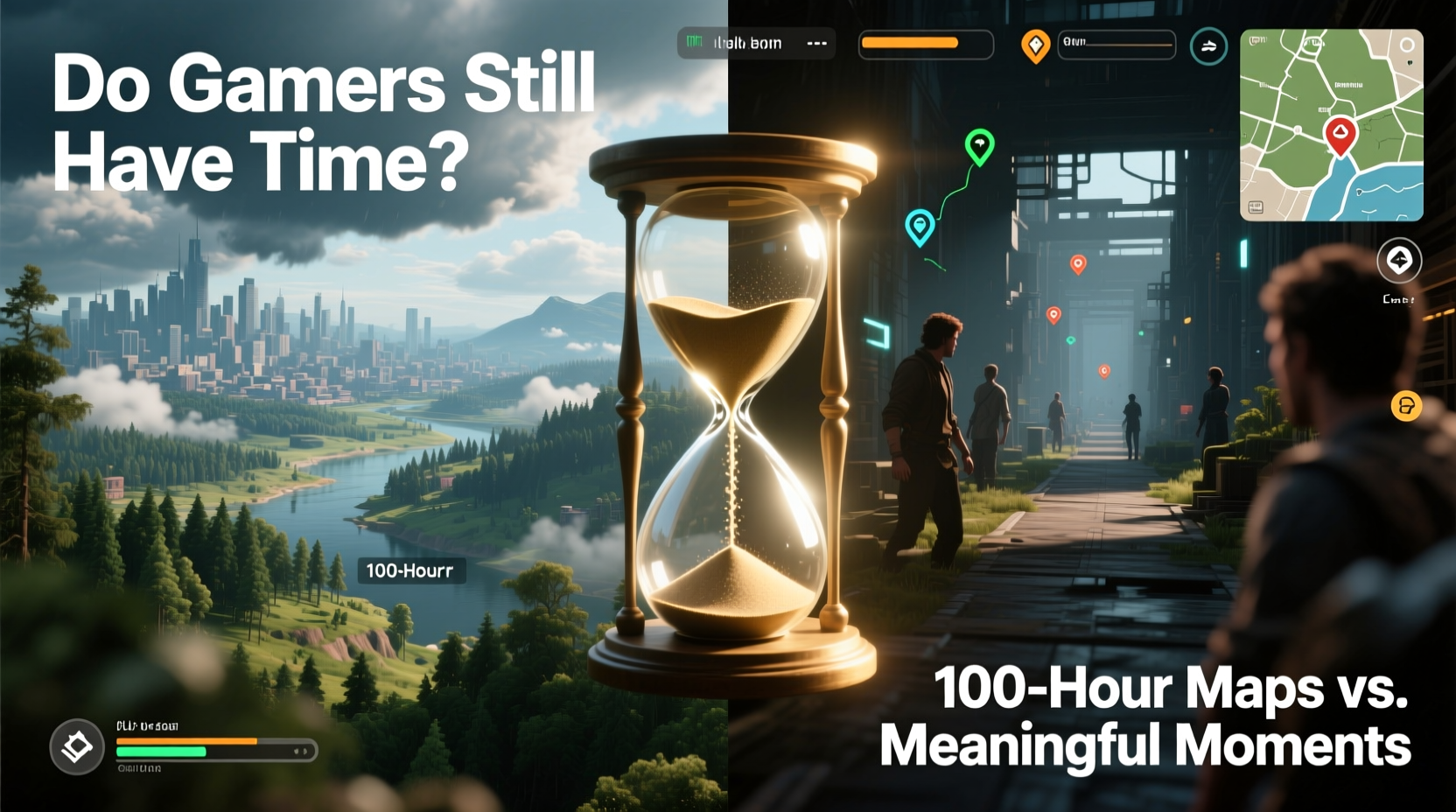
Open-world games exploded in popularity in the early 2000s with titles like Grand Theft Auto III and The Elder Scrolls III: Morrowind. These games offered unprecedented freedom—players could go anywhere, do anything, and shape their own stories. That sense of agency was revolutionary.
Fast forward to today, and franchises like The Legend of Zelda: Breath of the Wild, Red Dead Redemption 2, and Starfield present meticulously crafted universes that take 60 to over 100 hours to complete. Yet, while these games are critically acclaimed, completion rates tell a different story. According to Steam statistics, only around 15–20% of players finish most AAA titles, and even fewer complete all side content.
This suggests a growing disconnect: developers are building vast worlds, but many players aren’t engaging with them fully. Why?
- Time scarcity: The average adult gamer spends 6–7 hours per week playing, making 100-hour games a months-long commitment.
- Completion guilt: Players feel pressured to “finish” games they’ve paid $70 for, leading to burnout.
- Content bloat: Many open worlds rely on repetitive tasks (e.g., clearing towers, collecting herbs) to inflate playtime.
Linear Narratives: The Quiet Resurgence
While open worlds dominate marketing campaigns, some of the most memorable recent experiences have been linear. Games like Alan Wake 2, Marvel’s The Last Remnant, and Returnal prove that tightly written, well-paced stories can be just as immersive—even more so—than sprawling sandboxes.
Linear games offer curated journeys. Every level, cutscene, and encounter is designed to serve the narrative. There’s no risk of getting lost in tangents or losing emotional momentum. This structure often results in stronger character arcs, sharper pacing, and higher replayability due to intentional design rather than sheer volume.
Take God of War (2018) as an example. Though it features a large, interconnected world, the game maintains a strong narrative spine. Exploration is encouraged, but never mandatory. Side content enriches the story rather than distracting from it. It strikes a balance—offering openness without sacrificing focus.
“Players don’t crave more content—they crave meaning. A five-hour game that moves you is worth more than 50 hours of checklist grinding.” — Lydia Cho, Narrative Designer at Annapurna Interactive
Player Behavior in the Modern Era
Understanding whether gamers have time for 100-hour maps requires examining real-world behavior. Recent studies from the Entertainment Software Association (ESA) show that:
- Average gaming session length is under 90 minutes.
- Over 60% of players engage with games on multiple devices (PC, console, mobile).
- Completion rates drop significantly after 20 hours of playtime.
This data paints a picture of fragmented engagement. Gamers aren’t abandoning deep experiences—they’re adapting to fit them into tighter schedules. A player might spend six months slowly progressing through Elden Ring, dipping in for short bursts between work and family responsibilities.
Moreover, subscription services like Xbox Game Pass and PlayStation Plus Premium encourage variety over depth. Why sink 80 hours into one title when you can sample ten different games each month? This shift promotes breadth, not longevity.
Case Study: The Journey of a Casual Gamer
Meet Alex, a 32-year-old software developer and parent of a toddler. Alex loves gaming but rarely plays more than three times a week, averaging 60–90 minutes per session. Last year, Alex bought Hogwarts Legacy at launch, excited by the magic and exploration.
After 10 hours, Alex reached the midpoint of the main story. Then life got busy. Work deadlines, family trips, and sleep deprivation pushed the game aside. Months later, Alex returned—only to feel overwhelmed by the checklist of side quests, collection points, and skill upgrades needed to stay competitive.
Eventually, Alex stopped playing altogether—not because the game was bad, but because it demanded a sustained commitment that no longer fit into daily life. In contrast, Alex recently finished Inside, a 3-hour linear puzzle-platformer, in two sittings. Despite its brevity, it left a lasting impression.
This scenario is increasingly common. Time isn’t just a resource—it’s a constraint that shapes what kinds of games people can realistically enjoy.
Designing for Today’s Player: A Balanced Approach
The future of game design may lie not in choosing between open world and linear—but in redefining both. Developers are beginning to experiment with hybrid models that prioritize player choice without demanding endless investment.
Games like Death Stranding blend open-world traversal with mission-based progression, allowing players to engage at their own pace. Others, like Disco Elysium, offer immense narrative depth within a fixed environment, proving that scale isn’t necessary for immersion.
Key innovations include:
- Scalable content: Optional side activities that enhance lore but don’t gate progress.
- Time-efficient design: Short, impactful missions that respect the player’s schedule.
- Save-anywhere flexibility: Seamless suspension and resumption across devices.
| Game Type | Avg. Playtime to Complete | Completion Rate (Steam) | Player Satisfaction (Metacritic User Score) |
|---|---|---|---|
| Traditional Open World (e.g., Assassin’s Creed Valhalla) | 120+ hours | 18% | 7.1/10 |
| Linear Narrative (e.g., The Last of Us Part I) | 12–15 hours | 43% | 9.3/10 |
| Hybrid Design (e.g., God of War Ragnarök) | 25–30 hours (main + extras) | 35% | 8.9/10 |
| Short-Form Experience (e.g., GRIS) | 5–6 hours | 61% | 8.7/10 |
The data suggests a trend: shorter, more focused games achieve higher completion and satisfaction rates. This doesn’t mean open worlds are obsolete—but they must evolve to meet changing player realities.
Checklist: Choosing the Right Game for Your Lifestyle
Not all games suit all players. Use this checklist to find experiences that match your available time and preferences:
- Assess your weekly availability: Do you have 3+ hours per week, or less than 5?
- Determine your goals: Are you seeking escapism, story, challenge, or relaxation?
- Check completion estimates: Use sites like HowLongToBeat.com to gauge realistic playtimes.
- Look for flexible progression: Can you pause and resume easily? Is auto-saving frequent?
- Read player reviews: Look for comments like “felt too grindy” or “perfect weekend game.”
- Consider replay value: Will you want to return, or is one playthrough enough?
FAQ
Are open-world games dying?
No—but they are evolving. While blockbuster open-world titles still sell well, developers are recognizing the need for tighter design, better pacing, and reduced bloat. The future lies in quality, not quantity.
Can a short game be as impactful as a long one?
Absolutely. Games like Journey (2 hours) and What Remains of Edith Finch (3 hours) are considered masterpieces despite their brevity. Emotional impact comes from storytelling and design, not runtime.
Why do studios keep making 100-hour games if few finish them?
Marketing. Long playtimes signal value. A \"100-hour adventure\" sounds impressive in trailers, even if most players won’t reach the end. Additionally, hardcore fans and completionists drive post-launch engagement and streaming content.
Conclusion: Rethinking Value in Game Design
The question isn’t whether gamers have time for 100-hour maps—it’s whether those maps are worth the time. In a world where every minute counts, players are increasingly selective. They’re not rejecting depth; they’re rejecting filler.
Developers who listen will thrive. The next generation of standout titles won’t necessarily be the biggest—they’ll be the smartest. Games that respect the player’s time, deliver emotional resonance, and allow for flexible engagement will define the future.
For players, the takeaway is empowerment. You don’t owe any game 100 hours. Play what fulfills you, when it fits your life. Whether it’s a weekend-long thriller or a years-long saga, your experience is valid.




 浙公网安备
33010002000092号
浙公网安备
33010002000092号 浙B2-20120091-4
Comments
No comments yet. Why don't you start the discussion?