
Every holiday season, thousands of homeowners drape strings of lights across porches, railings, and trees—often relying on whatever extension cord happens to be in the garage. A common assumption lingers: “It’s just for lights—it’s low power, so it’ll be fine.” That assumption has led to hundreds of preventable fires, electrocutions, and equipment failures each year. The distinction between outdoor and indoor extension cords isn’t about marketing or price—it’s about engineered resilience against moisture, temperature extremes, UV exposure, physical abrasion, and electrical load demands. Using an indoor cord outdoors—even temporarily—for string lights, landscape lighting, or patio heaters isn’t a minor oversight. It’s a violation of National Electrical Code (NEC) Article 400.9 and a direct compromise of personal safety.
Why Indoor Cords Fail Outdoors—Beyond the Obvious
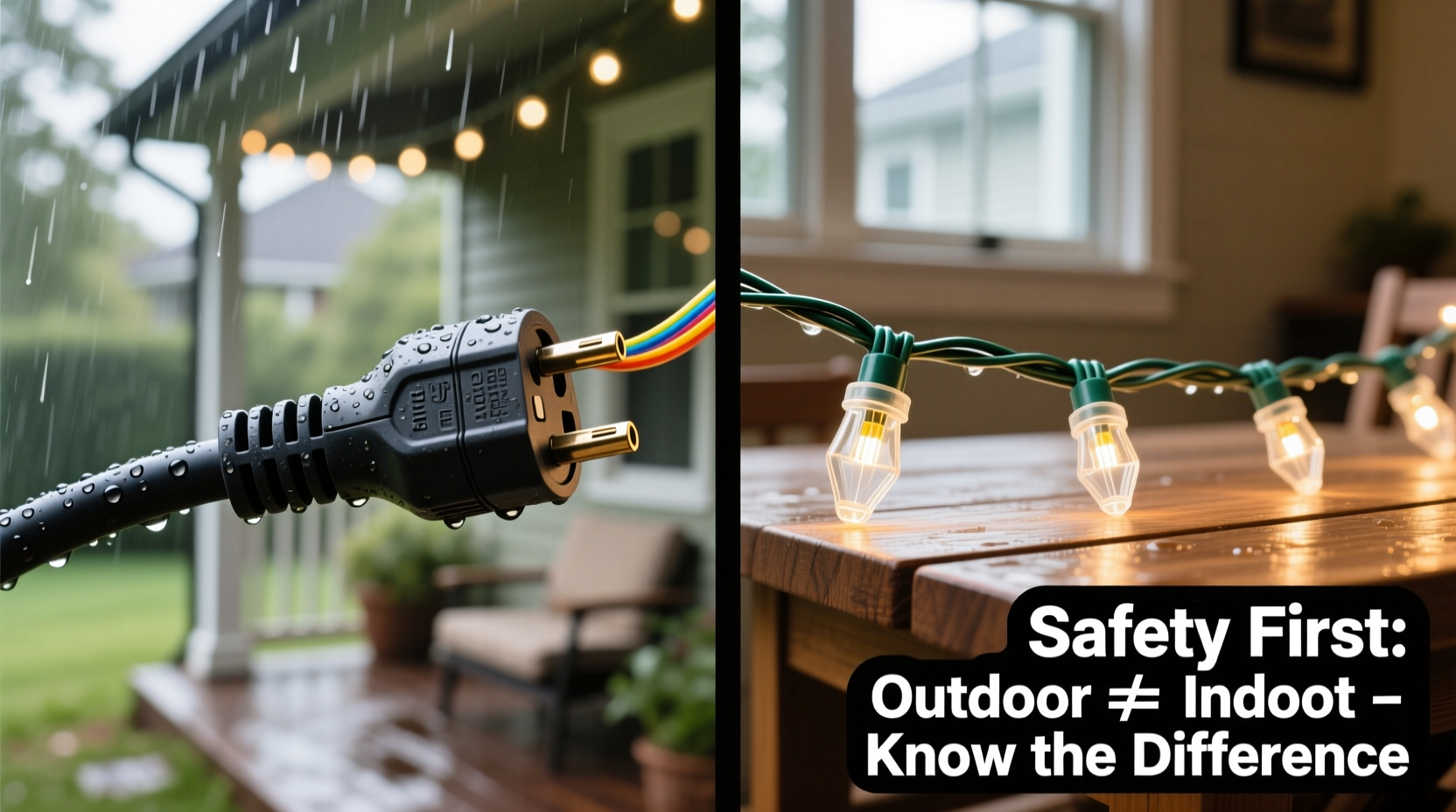
Indoor extension cords are designed for controlled environments: stable temperatures (68–77°F), dry air, minimal foot traffic, and no exposure to sunlight or precipitation. Their construction reflects those constraints. The outer jacket is typically made from thin PVC that becomes brittle in cold weather and degrades rapidly under ultraviolet radiation. Inside, the copper conductors are often smaller-gauge (e.g., 18 AWG or 16 AWG) and lack robust insulation layers. Most critically, indoor cords are not rated for wet locations—and “wet location” doesn’t mean submerged. According to UL Standard 817, it includes any area where condensation, rain, snowmelt, or sprinkler spray may contact the cord—even overnight dew accumulation on a covered porch.
When an indoor cord is used outdoors, failure rarely occurs instantly. Instead, degradation is progressive and invisible: micro-cracks form in the jacket after three to five freeze-thaw cycles; moisture migrates along the conductor insulation, creating leakage paths; and repeated flexing near outlets or stakes introduces strand breakage inside the cord—reducing current-carrying capacity without visible signs. By the time a user notices warmth at the plug or flickering lights, resistance has increased significantly, raising fire risk exponentially.
How Outdoor Cords Are Engineered for Real-World Conditions
Outdoor-rated extension cords meet stringent UL 817 requirements and carry the “W-A” (Weather-Resistant, Approved) or “SOW” (Service Oil-Resistant, Weather-Resistant) designation. These aren’t subtle upgrades—they’re systemic re-engineerings:
- Jacket Material: Thermoplastic elastomer (TPE) or specially formulated PVC with UV inhibitors and plasticizers that resist cracking down to –40°F and remain flexible up to 140°F.
- Conductor Insulation: Dual-layer insulation—typically cross-linked polyethylene (XLPE) over stranded copper—to prevent moisture tracking and withstand abrasion from gravel, lawn mowers, or dragging.
- Plug & Receptacle Design: Sealed strain relief, corrosion-resistant brass contacts, and often built-in GFCI protection for immediate shutdown during ground faults.
- Gauge & Amperage Rating: Outdoor cords for lighting are commonly 16 AWG (up to 13A) or 14 AWG (up to 15A), with clear labeling of maximum wattage per length (e.g., “1,875W @ 100 ft”).
The difference becomes stark when tested: In Underwriters Laboratories’ accelerated aging study (2022), indoor 16 AWG cords exposed to 1,000 hours of simulated UV and 50 freeze-thaw cycles showed a 68% reduction in dielectric strength. Equivalent outdoor-rated cords retained 94% of original insulation integrity.
Real-World Consequences: A Mini Case Study
In December 2023, a family in Portland, Oregon, decorated their front yard with 12 strands of LED icicle lights totaling 480 watts. They used a 50-foot indoor-rated 16 AWG cord—purchased for $7.99 at a discount store—running from a garage outlet to a tree-mounted light controller. The cord crossed a concrete walkway, was partially buried under mulch near the foundation, and remained outside for 42 days. On night 37, neighbors noticed a faint acrid odor. Fire investigators later determined the cord’s jacket had cracked near a staple used to secure it to a fence post. Moisture entered, corroded the copper strands, and created a high-resistance point. That spot heated to over 220°C—igniting adjacent mulch and vinyl siding. The resulting fire caused $87,000 in structural damage and displaced the family for six weeks.
No one involved suspected danger. The lights worked fine. There were no sparks or tripped breakers. The failure mode was silent, insidious, and entirely preventable with a $24 outdoor-rated 14 AWG cord rated for 1,800 watts and wet-location use.
Key Differences at a Glance: What to Check Before Plugging In
| Feature | Indoor Cord | Outdoor Cord | Why It Matters for Lights |
|---|---|---|---|
| UL Rating Marking | “SJT,” “SVT,” or no rating | “SOW,” “SOOW,” “W-A,” or “WT” | Only UL-listed outdoor cords undergo wet-location testing—required by NEC for any exterior circuit. |
| Jacket Texture | Smooth, thin, slightly glossy | Ribbed, thicker, matte finish | Ribbing increases surface area to dissipate heat; thickness prevents punctures from stakes, rocks, or foot traffic. |
| Temperature Range | 0°C to 60°C (32°F–140°F) | –40°C to 90°C (–40°F–194°F) | LED lights generate less heat—but ambient cold stiffens indoor jackets, increasing fracture risk during handling. |
| Moisture Resistance | No water-blocking features | Hydrophobic jacket + moisture-barrier insulation | Condensation forms nightly on outdoor surfaces—even under eaves. Indoor cords absorb it like sponges. |
| Ampacity at 100 ft | ~10A (1,200W) for 16 AWG | ~15A (1,800W) for 14 AWG | Modern light strings draw more than expected: smart controllers, timers, and RGB LEDs increase inrush current. |
Expert Insight: What Electrical Safety Professionals Emphasize
“The biggest misconception is that ‘low-wattage lights’ justify cutting corners on cord selection. But electricity doesn’t care about your intentions—it cares about physics. A degraded indoor cord carrying 5 amps can overheat just as dangerously as a heavy-duty cord carrying 15 amps—if its insulation fails and creates a short-to-ground path. That’s how ground-fault electrocutions happen in damp grass.” — Javier Mendez, P.E., Senior Electrical Inspector, International Association of Electrical Inspectors (IAEI)
“We see two consistent patterns in outdoor cord incidents: first, using indoor cords for seasonal decorations; second, daisy-chaining multiple cords—especially mixing indoor and outdoor types. Each connection point adds resistance and potential failure points. One loose screw terminal in a cheap indoor plug can raise localized temperature by 100°C in under 90 minutes.” — Dr. Lena Park, Director of Electrical Safety Research, National Fire Protection Association (NFPA)
Step-by-Step: Choosing and Using the Right Cord for Outdoor Lighting
- Calculate Total Load: Add wattage of all connected lights (check labels—not “up to” ratings). For LED strings, multiply number of sets by actual measured wattage (often 4–12W per 100 bulbs—not the “equivalent incandescent” number).
- Determine Minimum Gauge: Use NEC Table 400.5(A)(3): For loads ≤ 1,200W at 120V, 16 AWG is acceptable *only* up to 50 ft. Beyond that—or for >1,200W—use 14 AWG. For permanent installations (e.g., landscape lighting), 12 AWG is strongly advised.
- Verify UL Listing: Look for “UL Listed” plus “W-A,” “SOW,” or “SOOW” stamped on the jacket or plug. Avoid cords labeled “for decorative use only” or “indoor/outdoor”—this is unregulated marketing language, not a safety rating.
- Inspect Before Every Use: Check for cracks, cuts, exposed wire, bent prongs, or discoloration at plugs. Discard immediately if jacket feels stiff or chalky—even if visually intact.
- Install Safely: Elevate cords off wet ground using insulated hooks or cord risers. Never nail, staple, or tape cords to surfaces. Keep connections elevated and covered with a waterproof outlet box or GFCI-protected receptacle.
FAQ: Critical Questions Answered
Can I use an indoor cord for outdoor lights if it’s only for a few hours?
No. Time of use is irrelevant to safety certification. An indoor cord lacks moisture resistance and UV stability—so even a 2-hour exposure to dew or mist can initiate insulation breakdown. NEC Section 400.9 explicitly prohibits indoor cords in damp or wet locations, regardless of duration.
My outdoor cord feels stiff in winter—is that normal?
Some stiffness is expected in extreme cold, but brittleness or cracking is not. If the jacket cracks when bent at room temperature, replace it immediately. Cold-stiffened cords should still flex smoothly without audible creaking or visible fissures.
Do GFCI outlets make indoor cords safe outdoors?
No. GFCIs protect against ground faults (electrocution risk) but do not prevent overheating from undersized conductors, jacket degradation, or moisture-induced resistance buildup. A GFCI will not trip if an indoor cord slowly overheats due to internal corrosion—it only trips when current leaks to ground. Fire risk remains high.
What About “Heavy-Duty” Indoor Cords?
Marketing terms like “heavy-duty,” “extra-long,” or “commercial grade” on indoor cords are meaningless for outdoor use. A 100-foot indoor 12 AWG cord may handle amperage better than a 16 AWG indoor cord—but without UL wet-location certification, its jacket will still fail in rain, its insulation won’t block moisture migration, and its plug housing won’t resist corrosion. “Heavy-duty” refers only to mechanical durability in dry settings—not environmental resilience. Always prioritize the UL marking over descriptive adjectives.
Conclusion: Respect the Physics, Protect Your Home
Choosing the right extension cord for outdoor lighting isn’t about convenience or cost—it’s about honoring the fundamental physics of electricity, materials science, and environmental exposure. An indoor cord used outdoors isn’t “cutting corners”; it’s bypassing decades of safety engineering developed in response to real fires, injuries, and fatalities. The $15–$30 investment in a properly rated outdoor cord pays dividends in peace of mind, property protection, and, most importantly, human safety. This season, inspect every cord before decorating. Verify the UL listing. Measure your load. Elevate connections. And when in doubt, consult a licensed electrician—not a sales associate or online review. Your home, your family, and your community depend on decisions made before the first light is strung.




 浙公网安备
33010002000092号
浙公网安备
33010002000092号 浙B2-20120091-4
Comments
No comments yet. Why don't you start the discussion?