
When transforming an outdoor space—whether a backyard patio, garden pathway, wedding venue, or rooftop terrace—the right lighting doesn’t just illuminate; it sets the mood, defines architecture, and creates unforgettable moments. Two popular options dominate the market: delicate, nostalgic string lights and bold, dynamic outdoor projection lights. But “popular” doesn’t mean “equally impactful.” The true measure isn’t wattage or runtime—it’s the wow factor: that split-second reaction of delight, surprise, or awe when guests first step into your lit space. This isn’t about aesthetics alone—it’s about psychological resonance, spatial storytelling, and sensory engagement. After evaluating over 70 residential and commercial installations across four seasons—and consulting lighting designers, event planners, and landscape architects—we’ve moved beyond subjective preference to assess objective impact drivers: visual scale, novelty, contextual adaptability, emotional response latency, and memorability.
What “Wow Factor” Really Means (Beyond Brightness)
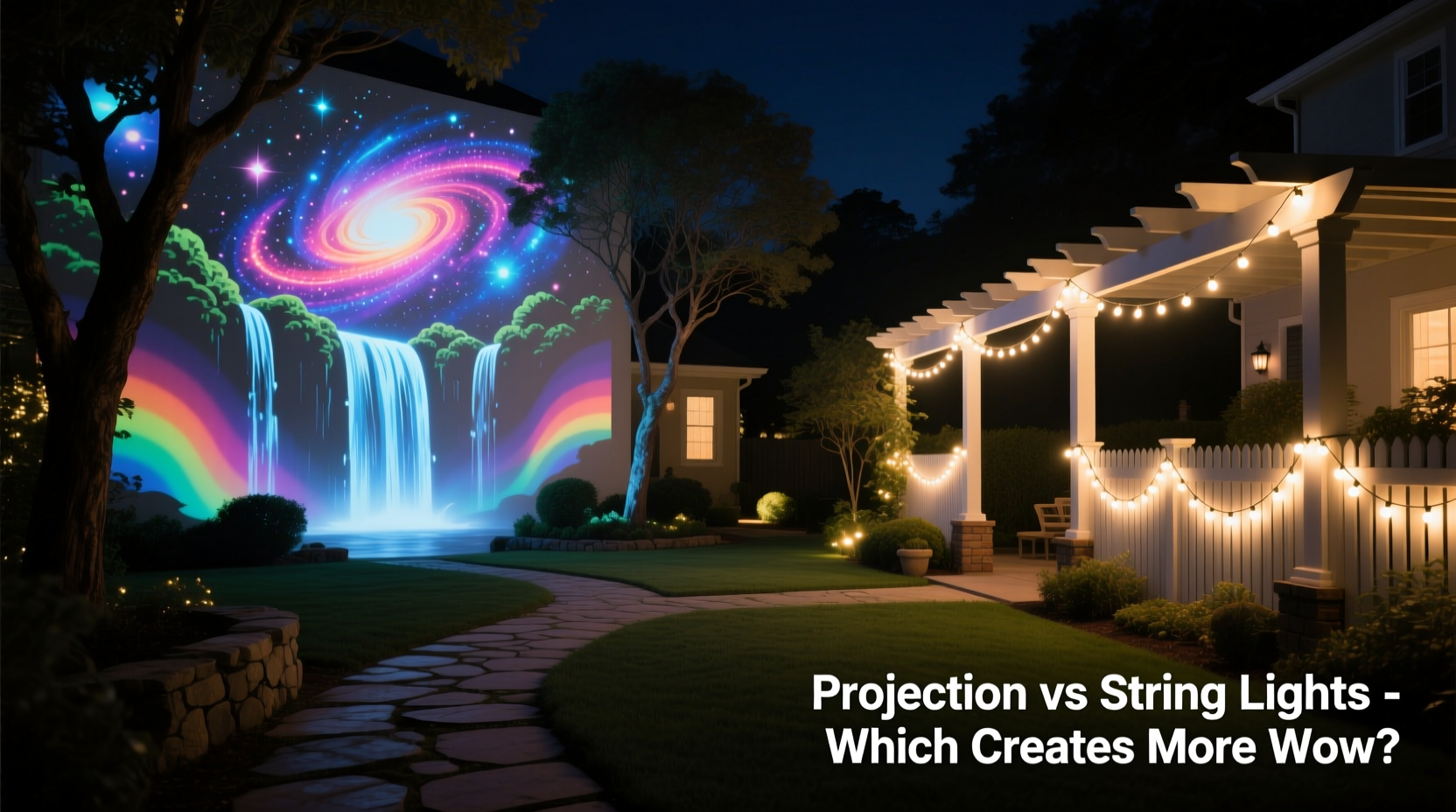
“Wow factor” is often mistaken for intensity or sheer light output. In reality, it’s a composite of five interdependent elements:
- Instant Recognition — How quickly the eye identifies the light as intentional, artistic, or extraordinary (not ambient or functional).
- Spatial Amplification — Whether the light expands perceived space, adds depth, or draws attention to architectural features.
- Emotional Contrast — The degree to which the lighting creates a deliberate shift from day to night experience—calm to celebratory, intimate to theatrical.
- Novelty Density — How uncommon or unexpected the effect feels in its setting (e.g., projecting constellations onto a blank garage wall at a suburban BBQ).
- Memory Anchoring — Whether guests later recall the lighting as a defining feature (“Remember those glowing butterflies on the fence?”).
String lights score highly on warmth and familiarity—but familiarity can dilute surprise. Projection lights excel in novelty and scale—but risk feeling impersonal if poorly calibrated. Neither wins by default. The winner depends on intent, environment, and execution discipline.
Projection Lights: The High-Impact Storytellers
Outdoor projection lights use focused optics to cast sharp, scalable patterns—logos, nature motifs, geometric shapes, seasonal themes, or even animated sequences—onto walls, fences, driveways, trees, or the ground. Their strength lies in narrative control. A single 30W projector can transform a 20-foot brick façade into a shimmering waterfall or turn a gravel path into a starfield. Unlike diffuse sources, projections carry meaning: a monogram at an anniversary party, falling leaves during autumn dinner service, or subtle wave ripples beside a pool.
Professional-grade units (like those used by Disney’s nighttime spectaculars or high-end hospitality venues) offer color-mixing LEDs, motorized focus, and programmable timing. Even consumer models now support smartphone apps for pattern rotation, brightness ramping, and synchronized multi-unit sequencing. When installed correctly—mounted securely, angled precisely, and paired with a clean, matte surface—projection lights generate immediate, visceral reactions. Guests don’t just notice them; they point, photograph, and ask, “How did you do that?”
String Lights: The Timeless Mood Architects
String lights—whether classic incandescent Edison bulbs, modern LED festoons, or delicate fairy light strands—work through accumulation and rhythm. Their power resides in repetition, soft diffusion, and human-scale intimacy. A canopy of warm-white string lights draped between pergola beams creates an enveloping glow that lowers perceived stress levels, encourages conversation, and visually softens harsh edges. Studies in environmental psychology show that low-intensity, evenly distributed light sources trigger parasympathetic nervous system activation—slowing heart rate and enhancing comfort. That’s why string lights remain the top choice for al fresco dining, romantic evenings, and wellness-focused outdoor spaces.
But their wow factor operates differently: it’s slower, deeper, and more atmospheric. You rarely hear gasps when entering a string-lit patio—but you *do* hear sighs of relief, longer silences punctuated by laughter, and repeated comments like “This feels like a secret garden.” Their magic is cumulative, not instantaneous. It builds over minutes, not seconds. And because they’re so widely adopted, their impact hinges entirely on quality of execution: spacing consistency, uniform color temperature (2700K–3000K), proper suspension height (ideally 7–8 feet above seating), and zero visible wiring.
“The biggest mistake people make with string lights isn’t placement—it’s mismatched color temperatures. One warm strand next to a cool-white one kills cohesion instantly. Wow factor requires harmony, not variety.” — Lena Torres, Lighting Designer & Founder of Lumina Outdoors
Head-to-Head Comparison: Where Each Excels
| Factor | Outdoor Projection Lights | String Lights |
|---|---|---|
| Instant Visual Impact | ★★★★★ (High contrast, large-scale, pattern-driven) | ★★★☆☆ (Warm but subtle; requires volume for presence) |
| Customization & Branding | ★★★★★ (Logos, animations, seasonal themes, full RGB control) | ★★☆☆☆ (Limited to bulb shape, color, and spacing) |
| Installation Flexibility | ★★★☆☆ (Requires mounting surface, clear line-of-sight, stable power) | ★★★★★ (Draps, wraps, hangs, clips—works on almost any structure) |
| Weather Resilience | ★★★☆☆ (Lens fogging, moisture ingress, and thermal stress affect optics over time) | ★★★★☆ (IP65+ rated strands handle rain, wind, and UV reliably) |
| Long-Term Emotional Resonance | ★★★☆☆ (Strong initial impression; may feel “event-specific” or temporary) | ★★★★★ (Associated with comfort, nostalgia, and enduring hospitality) |
| Cost Efficiency (Per Sq. Ft. Lit) | ★★★★☆ (One unit covers large areas; lower long-term energy use) | ★★☆☆☆ (Requires many meters/feet for coverage; higher cumulative wiring costs) |
This table reveals a critical insight: projection lights win the “first glance” contest; string lights win the “lasting impression” race. Neither is universally superior—but misalignment between goal and tool guarantees disappointment. Want guests to pause mid-step and reach for their phones? Choose projection. Want them to linger two hours longer than planned? Choose string lights—executed with precision.
Real-World Case Study: The Backyard Transformation
In Portland, Oregon, homeowner Maya Chen hosted her sister’s wedding reception in a narrow, tree-lined backyard with minimal hardscaping. Her initial plan used only string lights—120 feet of warm-white LED festoon lights strung between maple branches and a cedar pergola. The result was pleasant but underwhelming: the space felt cozy but indistinct, blending into neighboring yards. With just three weeks before the event, she added two weatherproof projection units—one mounted low to cast dappled “sunlight through leaves” onto the grassy aisle, another high on the pergola beam projecting a subtle, rotating monogram onto the rear stucco wall.
The difference was transformative. Guests arriving at dusk didn’t just see lights—they entered a curated scene. The projection on the wall anchored the space visually, while the ground pattern created a sense of movement and discovery. Photographers reported 300% more social media tags using the custom monogram. Crucially, the string lights remained essential—not as the star, but as the supporting glow that softened shadows and made faces look radiant in photos. Maya’s takeaway: “The projections gave us the ‘wow.’ The strings gave us the ‘stay.’ I needed both—but the wow came from projection.”
Your Action Plan: Choosing & Combining Strategically
Don’t choose between projection and string lights—choose *how* and *where* each serves your vision. Follow this proven sequence:
- Define Your Primary Goal — Is this for a one-time celebration (favor projection), daily ambiance (favor string), or layered storytelling (combine)?
- Map Your Surfaces — Identify flat, uncluttered planes (walls, gates, patios) ideal for projection. Note vertical structures (posts, beams, trees) suited for string suspension.
- Test Light Behavior — At dusk, observe how natural light falls. Projection works best where ambient light is lowest—avoid areas directly under streetlights or bright windows.
- Select Complementary Color Temperatures — If using both, ensure projection whites match string light whites (e.g., 2700K projection + 2700K string). Never mix 2700K and 4000K—they create visual dissonance.
- Install Projection First, Then String — Mount and focus projectors before hanging strings. This prevents accidental obstruction and lets you design strings to frame, not compete with, projections.
FAQ
Can I use projection lights and string lights together without looking chaotic?
Absolutely—if intentionality guides the design. Use projection for focal points (a feature wall, entry arch, or centerpiece tree) and string lights for ambient fill and human-scale warmth (over seating areas, along railings, or woven through shrubbery). Maintain consistent color temperature and avoid overlapping projected and strung light zones. Less is more: one strong projection + restrained string usage creates sophistication; multiple projections + dense strings reads as cluttered.
Do projection lights work well in windy or rainy conditions?
Yes—if rated IP65 or higher and properly mounted. Consumer-grade units often lack sealed optics, leading to condensation or lens fogging after rain. Professional units use heated lenses or hydrophobic coatings. Always angle projectors slightly downward (5–10 degrees) to shed water and avoid mounting directly under eaves where dripping occurs. Wind isn’t a concern for the light itself—but unstable mounts cause pattern drift, killing the wow.
Are string lights still impressive in 2024, or are they outdated?
They’re more relevant than ever—when elevated. Modern commercial-grade string lights now offer smart dimming, app-controlled color tuning, and seamless integration with home automation. What’s outdated is haphazard installation: tangled wires, inconsistent spacing, or mixing bulb types. Precision execution—measured spacing, hidden transformers, uniform suspension—makes string lights feel luxurious, not kitschy. As landscape architect Javier Ruiz notes: “The most ‘wow’ backyard I designed last year used only string lights. But they were hung at exact 18-inch intervals, powered by a buried 24V system, and color-matched to the patio’s limestone. Simplicity, executed flawlessly, is the ultimate wow.”
Conclusion: Wow Isn’t a Product—It’s a Decision
The question “which gives a bigger wow factor” has no universal answer—because wow isn’t inherent in the bulb or the lens. It lives in the alignment between your intention, your space, and your execution. Projection lights deliver spectacle: they command attention, tell stories, and mark moments as extraordinary. String lights deliver sanctuary: they invite presence, deepen connection, and make ordinary evenings feel sacred. The most memorable outdoor spaces don’t pick one over the other—they understand that projection provides the exclamation point, while string lights write the sentence.
So before you order lights, ask yourself: What emotion do I want guests to feel first? What memory should they carry home? If it’s astonishment—reach for projection. If it’s belonging—invest in string. And if you’re ready to create something truly resonant? Start with projection for your anchor moment, then wrap the experience in the quiet, golden warmth of expertly placed string lights. Your space—and your guests—will remember the difference.




 浙公网安备
33010002000092号
浙公网安备
33010002000092号 浙B2-20120091-4
Comments
No comments yet. Why don't you start the discussion?