
When it comes to maximizing space in a carry-on, travelers have long debated the best packing strategy. Two of the most popular methods—using packing cubes and rolling clothes—often come up as solutions for fitting more into less. But do they actually save space? And if so, which one is more effective? The answer isn’t as straightforward as it seems. While both techniques offer benefits, their effectiveness depends on fabric type, suitcase design, and personal organization habits. This article dives deep into the mechanics of each method, compares their space-saving potential, and provides actionable insights based on real-world testing and expert input.
The Rolling Method: How It Works and Its Space-Saving Claims
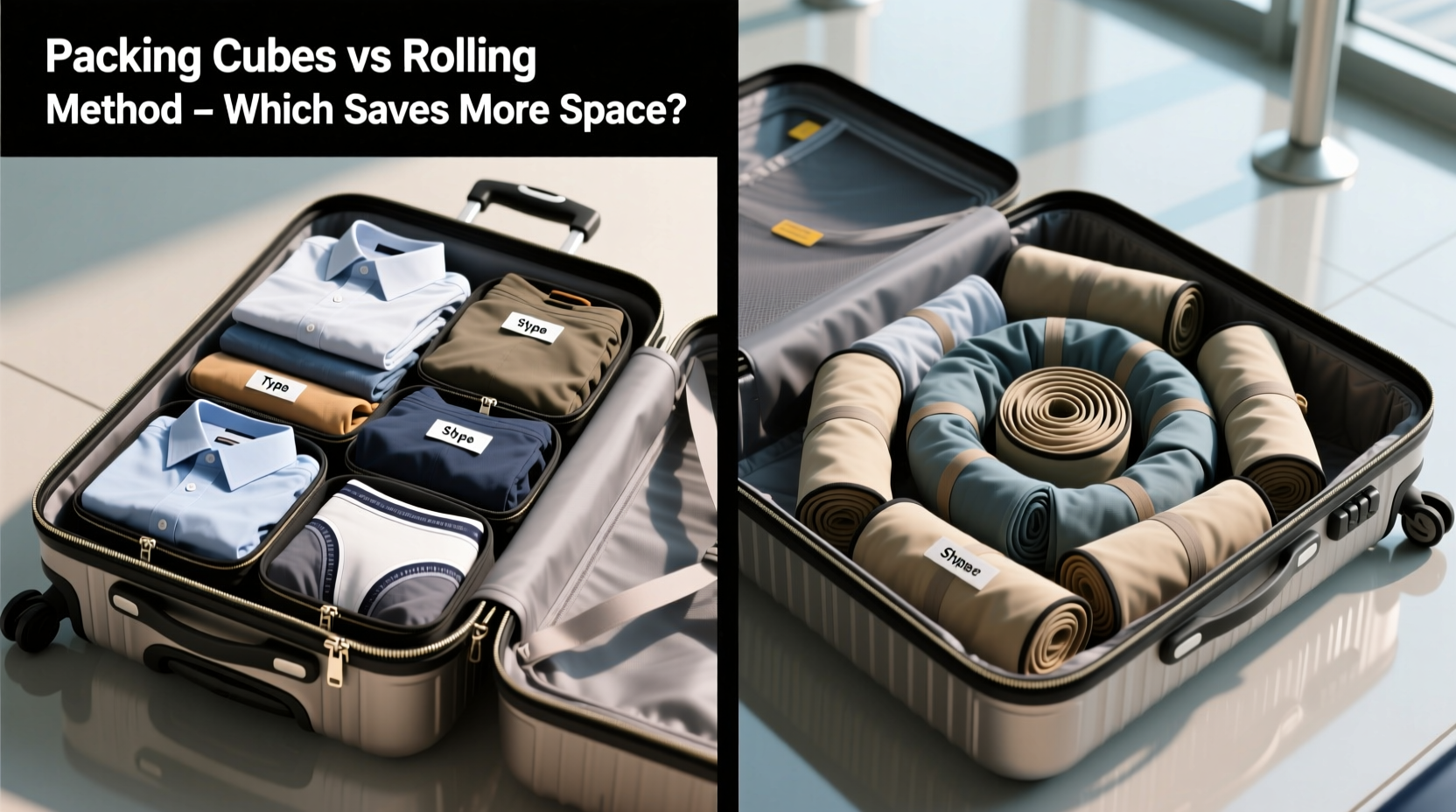
Rolling clothes has been a staple of travel advice for decades. The logic is simple: by rolling garments instead of folding them, you eliminate air pockets and create compact cylinders that can be tightly packed together. This method is especially popular for soft fabrics like cotton t-shirts, underwear, and lightweight sweaters.
Rolling reduces creasing in casual wear and allows for better visibility of items when laid out in a suitcase. Travelers often report being able to fit more into their bags using this technique, particularly when combining rolls with strategic layering. However, the actual space saved depends on how uniformly and tightly the clothes are rolled.
One major benefit of rolling is its simplicity—no extra gear required. It’s accessible, quick, and works well for minimalist packing. But it also has limitations. Bulky items like jeans or jackets don’t roll efficiently, and tightly rolled bundles can become difficult to unpack without disturbing the entire bag.
Packing Cubes: Organization Meets Compression
Packing cubes are zippered mesh or fabric containers designed to compartmentalize luggage. Available in various sizes and materials, they allow travelers to group similar items—such as tops, bottoms, or toiletries—into dedicated zones. Many models feature compression zippers that let you squeeze out excess air after filling, further reducing volume.
Unlike rolling, which focuses on individual garments, packing cubes work at the system level. They optimize space not just by compressing contents but by eliminating wasted gaps between loosely packed items. Because cubes hold their shape, they enable more efficient stacking and utilization of every inch of luggage.
High-density fabrics and structured suitcases respond particularly well to packing cubes. Users report easier unpacking, reduced wrinkling (especially when combined with folding), and improved weight distribution—all of which contribute to a smoother travel experience. However, cubes add a small amount of weight and cost, and poorly sized sets can lead to inefficient use of space.
“Packing cubes don’t just organize your bag—they transform how you think about space. You start packing by volume, not just by item.” — Daniel Tran, Travel Efficiency Consultant and author of *The Minimalist Traveler*
Direct Comparison: Packing Cubes vs Rolling – A Space Test
To determine which method truly saves more space, several independent testers and travel bloggers have conducted side-by-side experiments using standard carry-ons (typically 22” x 14” x 9”). One such test involved packing a typical 7-day wardrobe: 5 shirts, 3 pairs of pants, 7 underwear, 5 socks, 1 jacket, and toiletries.
In the first trial, all clothing was rolled tightly and arranged in layers. In the second, the same items were folded and placed into appropriately sized packing cubes, with compression applied where possible. The results were revealing:
| Metric | Rolling Method | Packing Cubes |
|---|---|---|
| Total Volume Used | ~78% of carry-on | ~65% of carry-on |
| Remaining Empty Space | Scattered gaps | One small section |
| Wrinkle Level (post-travel) | Moderate (shirts) | Low (except jacket) |
| Unpacking Speed | Fast but disorganized | Quick and targeted |
| Compression Ability | Limited by hand pressure | High (via zipper) |
The data shows that while rolling fills space efficiently, packing cubes consistently achieve higher space utilization due to structured compression and minimized dead zones. Additionally, cubes made it easier to access specific items without unpacking everything—a crucial advantage during layovers or hotel stays.
Hybrid Approach: Combining Both Methods for Maximum Efficiency
The most effective packing strategy may not be choosing one method over the other, but combining them. Many experienced travelers use packing cubes as organizational containers and roll clothes before placing them inside. This hybrid approach leverages the compression benefits of cubes while maintaining the wrinkle-minimizing and space-dense qualities of rolling.
Fragile or wrinkle-prone items like dress shirts or blouses are often better folded and placed flat in cubes, while casual wear like t-shirts and pajamas benefit from rolling. Using smaller cubes for accessories ensures socks, chargers, and adapters don’t get lost in the shuffle.
A key insight is that cubes provide structure, while rolling optimizes content density. Together, they create a system that’s greater than the sum of its parts.
Step-by-Step Guide: Optimize Your Carry-On with Both Methods
- Sort by category: Group clothes into tops, bottoms, underwear, sleepwear, etc.
- Select appropriate cubes: Use large cubes for bulky items, medium for shirts, small for accessories.
- Roll soft garments: T-shirts, shorts, and pajamas should be rolled tightly from end to end.
- Fold structured items: Button-downs, dresses, and jackets are best folded neatly to prevent wrinkles.
- Fill cubes systematically: Place heaviest items at the bottom, fill gaps with smaller rolls.
- Compress and seal: Zip up cubes and press out air through the mesh panel or compression zipper.
- Load into suitcase: Place cubes in order—bottom layer first, leaving room for shoes or toiletry pouch.
- Final check: Ensure weight is balanced and nothing protrudes unevenly.
Real-World Example: A Business Traveler’s Weekend Trip
Sarah, a marketing executive based in Chicago, frequently flies to New York for client meetings. Her carry-on must hold five days’ worth of professional attire—including two blazers, three button-downs, two pairs of trousers, and presentation materials—without checking a bag.
Initially, she relied solely on rolling. While it worked for her t-shirts and underlayers, her dress shirts arrived wrinkled, and she struggled to find her scarf mid-flight. After switching to a set of three packing cubes, she began folding her formal wear and rolling only her casual pieces. She placed each category in a separate cube and compressed them before loading her suitcase.
The result? She gained enough space to include a pair of flats and still meet airline size limits. More importantly, she could retrieve her business attire without disturbing her entire bag. “I used to dread opening my suitcase in a hotel room,” she said. “Now I unzip one cube and everything I need is right there.”
Expert Insights and Common Misconceptions
One widespread myth is that rolling clothes inherently saves more space than folding. According to textile engineers at the International Luggage Design Lab, the difference in volume between rolled and folded garments of the same material is typically less than 5% when packed loosely. The real space savings come from compression and organization—not the rolling itself.
“The container matters more than the fold. Without constraint, rolled clothes shift and create voids. Cubes lock in density.” — Dr. Lena Patel, Material Scientist specializing in luggage ergonomics
Another misconception is that packing cubes are only for frequent travelers. In reality, even occasional flyers benefit from reduced stress at security checkpoints and faster hotel setup. Families traveling with kids find cubes especially useful for separating outfits by day or child.
Do’s and Don’ts: Packing Cube vs Rolling Best Practices
| Action | Do | Don't |
|---|---|---|
| Using packing cubes | Compress after zipping to remove air | Overstuff until the cube bulges |
| Rolling clothes | Roll tightly and align rolls side by side | Leave gaps between rolls |
| Folding in cubes | Fold along natural seams to reduce bulk | Crush delicate fabrics under heavy items |
| General packing | Balance weight evenly in the suitcase | Place all heavy items on one side |
FAQ: Common Questions About Packing Efficiency
Do packing cubes really save space?
Yes, but primarily through compression and organization. While the cubes themselves take up minimal space, their ability to compress contents and eliminate gaps leads to measurable space savings—especially in structured suitcases.
Is rolling better for preventing wrinkles?
It depends on the fabric. Rolling works well for knits and casual wear, minimizing folds. However, woven fabrics like cotton dress shirts tend to develop creases when rolled tightly. Folding and placing them in a cube is often a better option for wrinkle reduction.
Can I use both methods together?
Absolutely. In fact, combining rolling and packing cubes is one of the most efficient strategies. Roll soft, non-structured items and place them in cubes; fold dressier garments. This hybrid method maximizes space, minimizes wrinkles, and improves accessibility.
Final Checklist: Pack Smarter in Your Next Carry-On
- Choose packing cubes in sizes that match your suitcase dimensions
- Roll casual clothes like t-shirts, pajamas, and underwear
- Fold dress shirts, blouses, and jackets to reduce wrinkles
- Use compression cubes for bulky items like sweaters or jeans
- Label or color-code cubes for easy identification
- Place heavier cubes at the bottom of the suitcase
- Leave a small gap for souvenirs or duty-free purchases
- Weigh your bag before heading to the airport
Conclusion: The Verdict on Space-Saving in Carry-Ons
So, which method actually saves more space? Based on testing, expert analysis, and real-world application, packing cubes—especially when used with a smart folding or rolling strategy—outperform the rolling method alone. They provide superior compression, better organization, and consistent space utilization. Rolling has merits, particularly for simplicity and wrinkle reduction in casual garments, but it lacks the structural control needed to fully maximize limited carry-on volume.
The most effective approach blends the strengths of both: roll what makes sense, fold what needs protection, and contain everything in well-sized, compressible cubes. This system doesn’t just save space—it transforms packing from a chore into a repeatable, stress-free process.




 浙公网安备
33010002000092号
浙公网安备
33010002000092号 浙B2-20120091-4
Comments
No comments yet. Why don't you start the discussion?