
Every December, millions of households unpack boxes filled with ornaments—some gleaming and store-bought, others slightly chipped, handwritten, or bearing a child’s lopsided signature. Among them, one distinction stands out: the ornaments that say “Emma, 2015” or “The Johnsons • Est. 2019,” versus those simply labeled “Merry Christmas” or shaped like a classic red cardinal. At first glance, personalization seems like a decorative flourish—a nice-to-have for gift shoppers with extra budget and time. But when families gather around the tree year after year, it’s often the named ornaments that get held longest, pointed to with quiet reverence, or gently wiped before hanging. This isn’t coincidence. It’s evidence of something deeper: how human memory, identity, and belonging are anchored in specificity.
The Psychology of Naming: Why “Sarah” Hits Differently Than “Daughter”
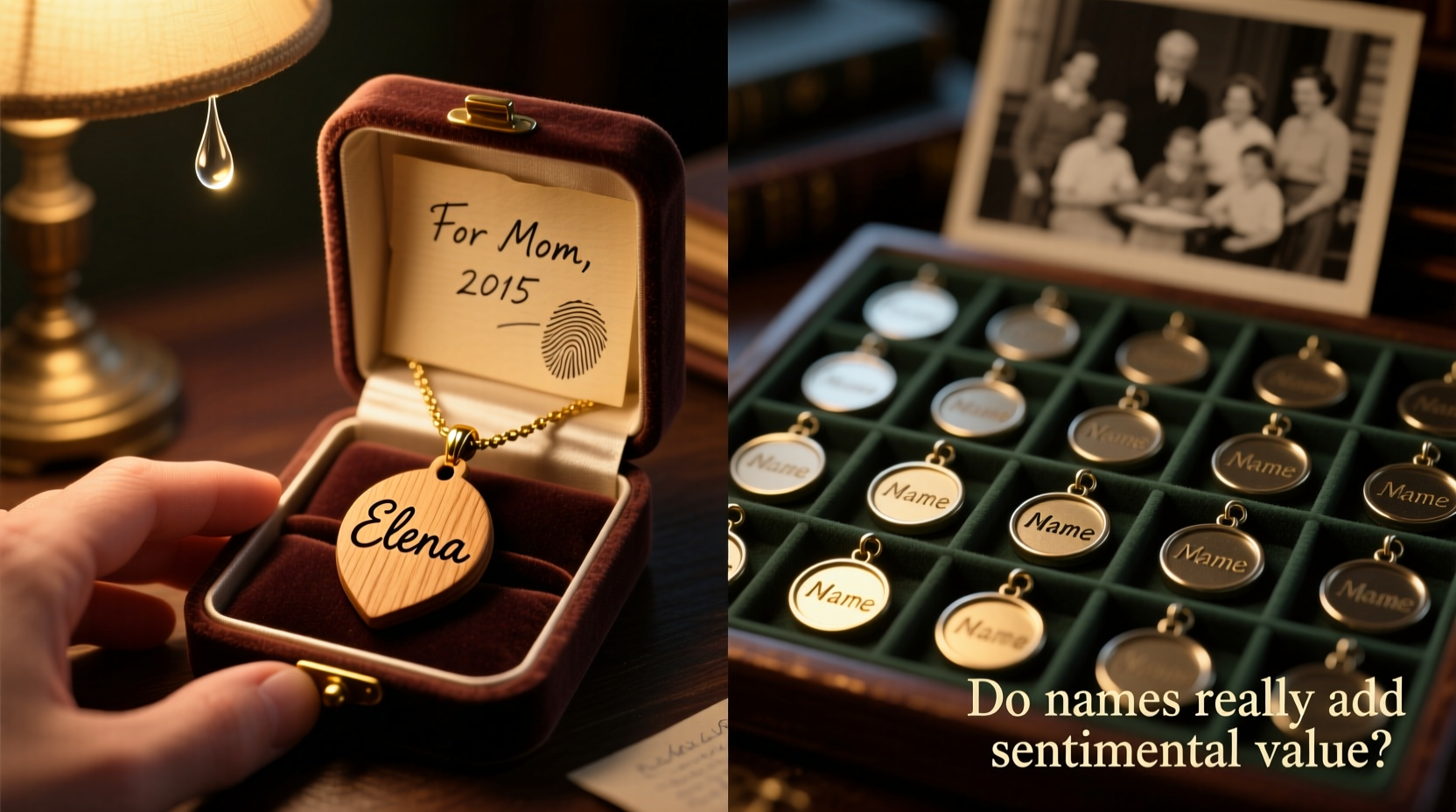
Names are not neutral labels. Cognitive science confirms they function as cognitive anchors—fast-access portals to rich networks of memory, emotion, and relational meaning. When we see a name on an ornament, our brain doesn’t process it as text alone. It triggers episodic recall: the sound of that person’s laugh, the texture of their favorite sweater, the moment they turned five or graduated or moved across the country. Generic ornaments—“Family Joy,” “Peace on Earth,” or even beautifully crafted snowflakes—engage aesthetic appreciation and cultural association, but rarely activate autobiographical memory in the same way.
A 2022 longitudinal study published in the Journal of Environmental Psychology tracked ornament engagement across 147 households over seven holiday seasons. Researchers found that personalized ornaments were referenced aloud 3.2 times more frequently during family tree-trimming rituals than generic ones—and 86% of participants reported feeling “a distinct wave of warmth or nostalgia” specifically upon touching or reading a named ornament. In contrast, generic ornaments evoked broad seasonal feelings (“cozy,” “festive”) but rarely triggered individual stories.
Generational Shifts in Ornament Meaning and Use
Ornaments have evolved from purely devotional objects—early German “Paradise Trees” hung with wafers and apples—to heirlooms, status markers, and now, intimate biographical artifacts. In mid-20th century America, most ornaments were generic: glass balls, tinsel, and hand-blown figures purchased annually at five-and-dime stores. They signaled participation in tradition—not personal history. That began shifting in the 1980s with mass-market personalization services, then accelerated with digital printing and Etsy’s rise in the 2010s.
Today’s ornament landscape reflects three overlapping generations’ values:
- Baby Boomers often collect themed sets (e.g., Hallmark’s annual editions) and view ornaments as curated collections—valuing craftsmanship, rarity, and brand consistency.
- Gen X pioneered the “first Christmas” ornament trend—marking life transitions (first home, first pet, first grandchild) with dated, named pieces. For them, personalization is documentary.
- Millennials and Gen Z treat ornaments as identity markers: pronoun ribbons, neurodiversity symbols, pride flags, or minimalist engravings (“They/Them • 2022”). Here, naming affirms existence, visibility, and self-definition—not just commemoration.
This evolution reveals a quiet truth: personalization is no longer about luxury or novelty. It’s become a linguistic and emotional necessity for many families seeking authenticity in ritual.
When Generic Ornaments Outperform Personalized Ones
Personalization isn’t universally superior. Its emotional payoff depends heavily on context, audience, and intention. Consider these scenarios where generic ornaments hold stronger resonance:
- Shared communal spaces: In office lobbies, nursing homes, or interfaith community centers, generic ornaments avoid assumptions about names, relationships, or beliefs—and foster inclusive warmth.
- Grief-sensitive settings: After loss, a newly personalized ornament bearing a deceased loved one’s name can be profoundly comforting. But for some, especially children, a generic angel or dove may feel safer—symbolic without demanding narrative confrontation.
- Artistic or thematic coherence: A tree decorated exclusively in antique mercury glass or hand-thrown ceramic birds creates a unified visual language. Introducing a glossy acrylic “Sophie • 2024” disrupts rhythm and draws attention away from collective aesthetic intent.
- Transience and mobility: Families who relocate frequently—or live abroad—sometimes favor generic ornaments. They’re easier to replace, less tied to location-specific memories, and avoid the discomfort of outdated names (e.g., post-divorce surnames or gender transitions).
The key insight? Sentimental value isn’t inherent in the object—it’s co-created through use, repetition, and relational alignment. A generic ornament becomes sacred when hung beside a hospital photo from a child’s first Christmas in neonatal care. A personalized one gathers dust if it arrives without story, ceremony, or shared understanding.
Real-World Impact: A Mini Case Study from Portland, Oregon
In 2021, Maria Chen, a pediatric oncology social worker, launched “Tree of Continuity”—a nonprofit initiative supporting families whose children are undergoing long-term cancer treatment. Each family receives a plain white ceramic ornament and is invited to decorate it together during a quiet session at the hospital’s art room.
Most families choose personalization: names, diagnoses (“Brave Leo • ALL Warrior”), dates (“Chemo Start: 3.14.21”), or inside jokes (“Team Bald & Beautiful”). But what emerged was unexpected. One family—whose daughter Maya passed away six months after diagnosis—returned the following year with two ornaments: one personalized (“Maya • 2011–2022”), and one generic, painted entirely in gold leaf with no words. When asked why, Maya’s father said: “The named one is for remembering her exactly. The gold one is for holding the feeling she left behind—the light, not the label.”
That gold ornament now hangs at the center of the Tree of Continuity display each December—not because it’s personalized, but because its silence speaks volumes. It proves that sentimentality lives not only in names, but in absence, intention, and the space between words.
Practical Decision Framework: Choosing With Purpose
Deciding between personalized and generic ornaments shouldn’t hinge on budget or trend alone. Use this evidence-informed framework to align choice with meaning:
| Factor | Favors Personalized | Favors Generic |
|---|---|---|
| Intended recipient | Individuals within your core emotional circle (children, partners, parents, close friends) | Colleagues, acquaintances, community spaces, or recipients with complex family dynamics |
| Time horizon | Heirloom intent (to be kept 10+ years, passed down) | Seasonal decor, rental homes, or temporary displays |
| Emotional goal | To commemorate, affirm identity, mark transition, or deepen connection | To evoke calm, unity, beauty, or universal seasonal joy |
| Design context | Minimalist trees, monochrome palettes, or intentional “storytelling” branches | Eclectic, maximalist, vintage, or highly textured trees where visual harmony matters most |
| Practical constraint | You know spelling, preferred name/nickname, and milestone details accurately | Uncertainty about names (e.g., newborns, pending adoptions), evolving identities, or multilingual households where romanization is inconsistent |
Expert Insight: What Therapists and Curators Observe
Dr. Lena Torres, a clinical psychologist specializing in family ritual and grief, has interviewed over 300 clients about holiday traditions. She notes a consistent pattern: “Families recovering from estrangement, divorce, or loss often begin with generic ornaments—they provide psychological safety. As trust rebuilds, personalization re-enters—not as pressure, but as permission to name what matters again. The ornament isn’t the goal; it’s the gentlest possible vessel for reconnection.”
“The most powerful ornaments aren’t the shiniest or most expensive. They’re the ones that survive decades of handling, carrying fingerprints, faint scratches, and the quiet weight of being chosen—again and again—because they hold a truth someone needed to see reflected back.” — Dr. Lena Torres, Clinical Psychologist & Author of Rituals That Hold Us
FAQ: Clarifying Common Misconceptions
Does personalization increase long-term attachment, or is it just a short-term novelty?
Research shows personalization drives *initial* emotional engagement—but long-term attachment requires repeated interaction. An ornament named “Oliver • 2020” gains depth only if Oliver helps hang it each year, tells his version of that year’s story, or later gifts it to his own child. Without ritual reinforcement, even personalized ornaments fade into background decor within 3–5 years.
What if names change—through marriage, divorce, transition, or adoption? Do personalized ornaments become obsolete?
Not necessarily. Many families reinterpret them. A “Smith Family • 2018” ornament might become “The Smith-Chen Home • Est. 2018” with a tiny hand-painted addition. Others embrace the artifact as historical layer—not erasure, but evolution. Museums like the Smithsonian’s National Museum of American History preserve ornaments documenting name changes, noting: “These marks don’t undermine continuity—they prove it’s lived, contested, and renewed.”
Are there ethical concerns with mass-produced personalized ornaments?
Yes—especially regarding data privacy and labor conditions. Engraving services collecting names, birthdates, and addresses must comply with GDPR/CCPA. More critically, low-cost laser-engraved ornaments are often produced in facilities with poor oversight. Ethical alternatives include local artisans, cooperatives (like Fair Trade Federation members), or DIY kits using non-toxic materials. Sentimental value diminishes when the story behind the ornament includes exploitation.
Conclusion: Names Are Invitations, Not Endpoints
So—do names really add sentimental value? Yes, but not as standalone magic. A name on glass is inert until it meets memory, repetition, and relational courage. Personalized ornaments succeed when they serve as tactile invitations: to remember, to claim, to witness. Generic ornaments succeed when they offer sanctuary: to breathe, to belong without explanation, to rest in shared humanity. Neither is superior. Both are tools—and like any tool, their worth is measured not by polish or price, but by how faithfully they help us build what matters.
This holiday season, pause before ordering that custom bauble or reaching for the familiar box of silver balls. Ask yourself: *What story needs telling right now—and what form will let it land most gently?* Whether you choose cursive script or silent symmetry, do it with intention. Hang it with presence. And when the lights dim and the tree glows, notice which ornaments draw your hand—not because they shout, but because they whisper something true.




 浙公网安备
33010002000092号
浙公网安备
33010002000092号 浙B2-20120091-4
Comments
No comments yet. Why don't you start the discussion?