
For families with pets and young children, convenience often comes at a premium. As urban lifestyles evolve and outdoor activities become more inclusive of all family members—even furry ones—many parents wonder: can a single stroller serve both their infant and their dog or cat? The idea sounds efficient: one device, two purposes, less clutter, lower cost. But in practice, the differences between pet strollers and baby joggers are significant enough to warrant careful consideration. While some models blur the lines, most are engineered with distinct priorities—safety for babies, comfort and ventilation for pets. Understanding these distinctions is essential before making a decision that affects your child’s well-being or your pet’s comfort.
Key Differences in Design and Safety Standards
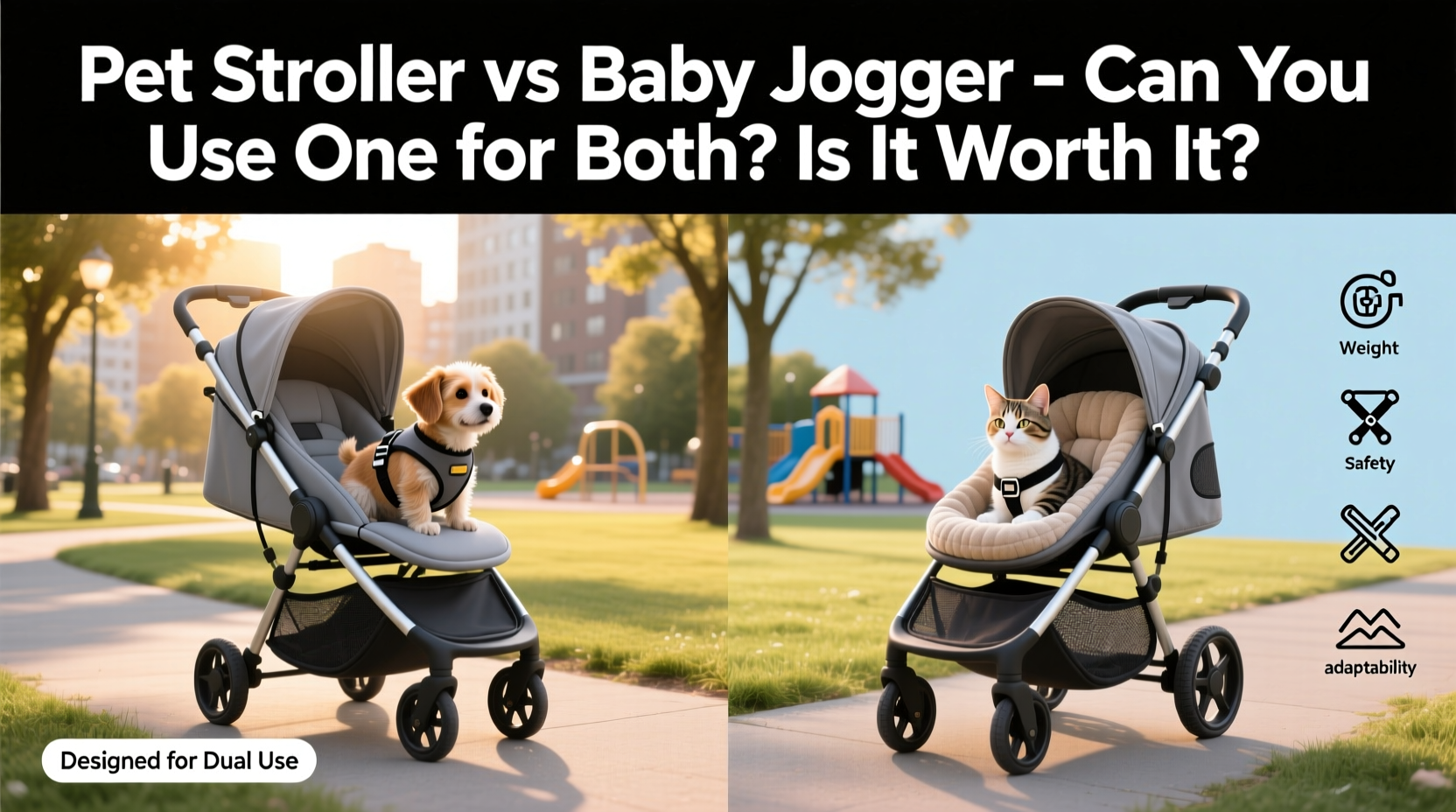
Baby joggers and pet strollers may look similar at first glance—both have wheels, a canopy, and a push handle—but their engineering diverges sharply when it comes to safety, stability, and regulatory compliance.
Baby joggers are built to meet strict federal safety standards such as those set by the Consumer Product Safety Commission (CPSC). They feature a five-point harness system, a wrist tether for the parent, a parking brake, and often a front wheel lock for stability on uneven terrain. These features are non-negotiable when transporting an infant or toddler, especially during jogs or walks on trails.
Pet strollers, on the other hand, prioritize airflow and visibility. Many come with mesh panels on multiple sides, larger viewing windows, and removable liners for easy cleaning after muddy paws or shedding fur. However, they typically lack the rigid safety features required for human infants. Most pet strollers use simpler restraint systems—like clip-on leashes or basic seatbelts—that wouldn’t pass infant safety tests.
The structural integrity also differs. Baby joggers are built with reinforced frames, shock absorption, and large pneumatic tires designed to handle pavement, gravel, and grass. Pet strollers often use lighter materials to reduce weight, which makes them easier to fold and carry but less stable on rough surfaces.
Can You Safely Use a Pet Stroller for a Baby?
The short answer: generally, no. Using a pet stroller for a baby poses several risks:
- Lack of crash-tested restraints: Pet strollers rarely include a five-point harness, increasing the risk of ejection during sudden stops.
- No regulatory oversight: Unlike baby gear, pet products aren’t subject to mandatory safety testing in the U.S.
- Less stability: Lightweight frames can tip easily, especially on inclines or curbs.
- Inadequate suspension: Babies need smooth rides to protect developing spines; many pet strollers lack proper shock absorption.
While some dual-purpose strollers claim to accommodate both pets and children, always verify whether they meet ASTM F833 safety standards for juvenile strollers. If a model doesn’t explicitly state compliance, it’s not worth the risk.
“Infants require specialized support and protection during transport. A stroller not certified for human occupancy should never be used for a baby.” — Dr. Lena Patel, Pediatric Safety Consultant
What About Using a Baby Jogger for Your Pet?
This scenario is more feasible—but still comes with caveats. Many pet owners successfully use baby joggers for small dogs or cats, particularly if the animal is calm and already leash-trained.
The advantages include:
- Sturdy construction and better maneuverability on sidewalks and trails.
- Superior sun protection with adjustable canopies.
- Durability against chewing or scratching (depending on materials).
However, drawbacks exist:
- Limited ventilation compared to pet-specific models.
- Narrower entry points, which can stress anxious animals.
- Potential for overheating in warm weather due to reduced airflow.
If you plan to use a baby jogger for your pet, consider modifying it with breathable mesh inserts or removable floor liners to manage messes. Always supervise your pet and avoid extended use in hot climates.
Comparison Table: Pet Stroller vs Baby Jogger Features
| Feature | Pet Stroller | Baby Jogger |
|---|---|---|
| Safety Harness | Basic leash clip or 3-point strap | Five-point harness with chest pad |
| Federal Safety Certification | Rarely certified | CPSC & ASTM F833 compliant |
| Ventilation | High – full mesh walls and roof | Moderate – limited mesh panels |
| Tire Type | Hard rubber or foam | Pneumatic (air-filled), off-road capable |
| Weight Capacity | Typically 25–40 lbs | Up to 50–75 lbs (including cargo) |
| Foldability | Compact, often umbrella-style | Bulkier, requires more space |
| Washable Interior | Yes, frequently removable | Sometimes, but less common |
| Use on Trails | Limited – best on pavement | Excellent – designed for jogging and terrain |
Hybrid Models: Are Dual-Purpose Strollers Worth It?
A growing number of manufacturers now offer hybrid strollers marketed for both pets and children. Brands like Pet Gear and GB Pacer have introduced models with convertible interiors, dual harness systems, and enhanced ventilation. These aim to bridge the gap between function and safety.
Take the Pet Gear No-Zip Pet & Child Stroller, for example. It includes a five-point harness for a child on one side and a pet containment area with a clip-in leash on the other. The frame meets juvenile product safety standards, and the entire unit folds compactly. While heavier than a standard pet stroller, it offers peace of mind for families who want to bring both baby and dog on weekend outings.
Still, compromises remain:
- The shared cabin reduces individual space for both occupants.
- Ventilation is improved over baby joggers but not as robust as dedicated pet models.
- Higher price point—often $250–$400, compared to $100–$150 for basic pet strollers.
For occasional dual use, a hybrid may be a smart investment. But if you regularly jog with your baby or take long hikes with an anxious pet, specialized equipment will deliver better performance and safety.
Mini Case Study: One Family’s Experiment with a Hybrid Stroller
The Thompson family from Portland, Oregon, purchased a dual-use stroller to simplify weekend park visits with their 18-month-old daughter and 12-pound rescue dog, Milo. Initially thrilled with the convenience, they quickly noticed challenges.
“Milo gets anxious in tight spaces,” said Sarah Thompson. “Even though the stroller had mesh on three sides, he would bark and paw at the fabric. Meanwhile, our daughter needed the harness tightened every time we hit a bump.”
After six weeks, they reverted to using separate strollers—one for Milo on longer walks, and their trusted baby jogger for runs. “It takes up more trunk space,” Sarah admitted, “but everyone is calmer, safer, and happier.”
Step-by-Step Guide: Choosing the Right Option for Your Needs
Follow this decision-making process to determine whether one stroller can serve both roles—or if separate units are wiser.
- Assess your primary use case: Will you be jogging, walking on pavement, or hiking trails? High-impact activity favors baby joggers.
- Evaluate your pet’s temperament: Does your dog stay calm in confined spaces? Anxious pets need maximum airflow and visibility.
- Check weight and size requirements: Ensure the stroller supports your child’s age/weight and your pet’s dimensions.
- Verify safety certifications: Look for ASTM F833 or JPMA certification if carrying a child.
- Test ventilation needs: In hot climates, prioritize mesh coverage and shade options.
- Consider storage and portability: Do you need something lightweight for apartment living or public transit?
- Determine budget: Hybrid models cost more upfront but may save money long-term—if they meet all your needs.
Checklist: Is a Single Stroller Right for You?
Answer “yes” to most of these to consider a hybrid or shared stroller:
- ✅ You only walk on flat, paved surfaces.
- ✅ Your pet is small (under 25 lbs) and relaxed in enclosures.
- ✅ Your child is older than 6 months and can sit upright.
- ✅ The stroller has a five-point harness and safety certification.
- ✅ You prioritize convenience over high-performance mobility.
If you answered “no” to two or more, separate strollers are likely the safer, more comfortable choice.
Frequently Asked Questions
Can I legally use a pet stroller for my baby?
No legal statute prohibits it, but doing so violates consumer safety guidelines. If an accident occurs, insurance or liability claims could be affected. More importantly, it puts your child at risk. Always use a stroller certified for human infants.
Are there any baby joggers designed for pets too?
Not officially. However, some high-end jogging strollers from brands like Thule and BOB have large cargo baskets that can fit small, calm pets in secure carriers. This is safer than placing a pet directly in the seating area, as the original harness and safety systems remain intact for the child.
How do I clean a stroller used for both pets and babies?
Opt for models with removable, machine-washable liners. Use pet-safe, fragrance-free wipes for daily cleaning. For deep cleans, spot-treat fabric with mild detergent and allow full drying to prevent mold. Avoid bleach or ammonia-based cleaners near areas where babies rest.
Final Verdict: Is It Worth Using One Stroller for Both?
The dream of a universal stroller is appealing—but reality demands compromise. While hybrid models have made progress, they often fall short in critical areas: ventilation for pets, safety for babies, and durability for active families.
If your priority is safety and performance, investing in two purpose-built strollers is the smarter long-term choice. A quality baby jogger ensures your child rides securely on every adventure, while a dedicated pet stroller keeps your companion cool, calm, and comfortable. The added storage burden is outweighed by peace of mind.
That said, if your lifestyle involves light, occasional use and you choose a certified dual-purpose model, a single stroller can work—provided you never sacrifice safety for convenience.
“The right tool for the job isn’t always the most convenient one—but it’s always the safest.” — Marcus Lin, Product Safety Analyst at Juvenile Products Association




 浙公网安备
33010002000092号
浙公网安备
33010002000092号 浙B2-20120091-4
Comments
No comments yet. Why don't you start the discussion?