
When it comes to smartphone photography, two names dominate the conversation: Google’s Pixel series and Apple’s iPhone. The Pixel 7 and iPhone 14 represent flagship-tier imaging systems, but they approach photography from opposite philosophies. The Pixel leans heavily on computational photography—using AI and advanced software to enhance every shot—while the iPhone 14 emphasizes consistency, color accuracy, and a seamless ecosystem experience. But in practical terms, which phone actually takes better photos? And more importantly, does the Pixel’s reputation for \"magic\" hold up under scrutiny, or is the iPhone still the undisputed king?
Philosophy of Photography: Software vs. System
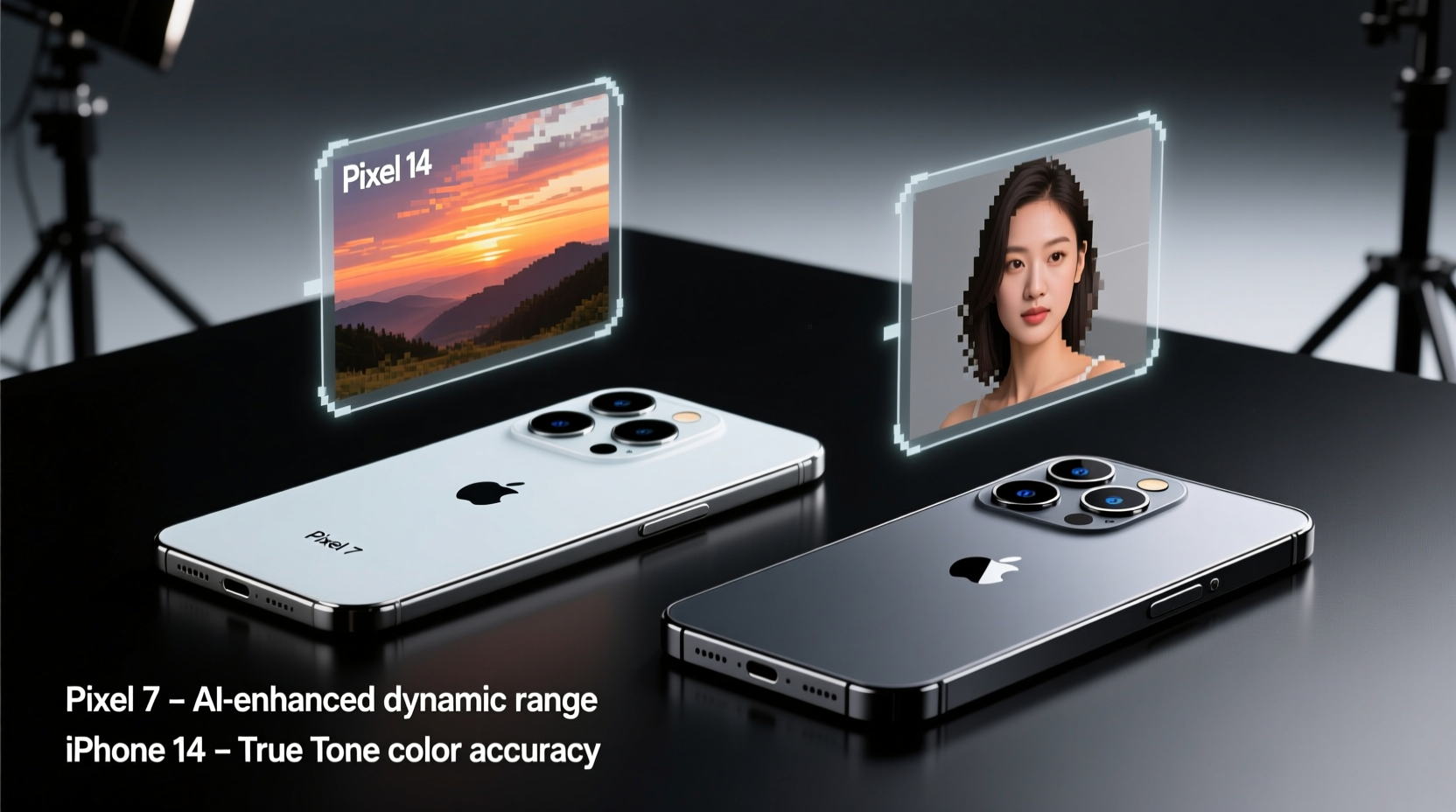
The fundamental difference between the Pixel 7 and iPhone 14 lies in their approach to image capture. Google treats the camera as a data processor. Every photo taken with the Pixel 7 benefits from HDR+, Night Sight, Super Res Zoom, and Real Tone algorithms—all running behind the scenes to optimize exposure, dynamic range, and skin tones. This means that even in challenging lighting, the Pixel often produces images with more detail in shadows and highlights than what the hardware alone could achieve.
Apple, by contrast, prioritizes naturalism. The iPhone 14 uses Smart HDR 4 to balance light and dark areas, but its goal is realism over dramatic enhancement. Skin tones are consistent across environments, colors are calibrated to match human perception, and video stabilization is industry-leading. While the iPhone doesn’t always produce the most “impressive” stills at first glance, its output is reliable, predictable, and well-suited for professional use.
“Google has redefined mobile photography not by adding lenses, but by teaching phones how to see better.” — David Pogue, Tech Journalist & Author
Low-Light Performance: Where the Pixel Shines
In dimly lit restaurants, nighttime cityscapes, or poorly lit indoor spaces, the Pixel 7 consistently outperforms the iPhone 14. Its Night Sight mode activates automatically in low light and can capture usable images even when the scene appears nearly pitch-black to the naked eye. Noise suppression is excellent, and the algorithm preserves fine textures like fabric, brickwork, and foliage far better than many competitors.
The iPhone 14 improves upon earlier models with larger pixels and better sensor efficiency, but it tends to default to brighter, more washed-out results in darkness. It lifts shadows aggressively, which can introduce grain and reduce contrast. While usable, these shots often lack the depth and clarity of Pixel captures.
Daylight and Dynamic Range: A Closer Call
In well-lit conditions, both phones deliver excellent results—but with distinct styles. The Pixel 7 pushes saturation slightly, making skies bluer and greens more vibrant. Highlights are preserved through HDR+ merging, and shadows retain detail without looking artificially brightened.
The iPhone 14 takes a more conservative approach. Colors appear truer to life, though sometimes at the expense of visual excitement. In high-contrast scenes—such as backlit portraits or sunsets—the iPhone occasionally clips highlights (losing detail in bright areas), while the Pixel manages them more gracefully due to multi-frame processing.
One area where the iPhone pulls ahead is video. With cinematic mode now available in 4K at 30fps, Dolby Vision HDR recording, and superior optical stabilization, the iPhone 14 remains the preferred tool for creators who value smooth, broadcast-quality footage. The Pixel 7 records capable 4K video, but rolling shutter and inconsistent autofocus make it less ideal for dynamic scenes.
Portrait Mode and Subject Detection
Portrait mode performance reveals another divergence in strategy. The Pixel 7 uses machine learning to detect not just people, but dogs, cats, and even statues, applying bokeh effects intelligently. Edge detection is among the best in the industry, with hair strands and glasses rendered accurately. The addition of Magic Eraser and Photo Unblur gives users post-capture editing tools no other phone offers.
The iPhone 14 relies on its dual-camera system and LiDAR scanner for depth mapping. Results are consistent and natural-looking, though sometimes overly aggressive in blurring backgrounds. It excels in recognizing human faces and adjusting lighting accordingly, especially in studio-like conditions. However, it lacks the creative flexibility of the Pixel’s AI-powered tools.
Camera Comparison Table: Key Features Side-by-Side
| Feature | Pixel 7 | iPhone 14 |
|---|---|---|
| Main Sensor | 50MP, f/1.85, 1.2µm | 12MP, f/1.5, 1.9µm |
| Ultrawide | 12MP, f/2.2, 120° FoV | 12MP, f/2.4, 120° FoV |
| Zoom | None (digital only) | No telephoto (digital only) |
| Low Light (Night Sight) | ✅ Excellent, customizable | ✅ Good, automatic |
| Video Recording | 4K@30/60fps, limited stabilization | 4K@24/30/60fps + Dolby Vision |
| AI Editing Tools | ✅ Magic Eraser, Unblur, Best Take | ❌ Limited to basic adjustments |
Real-World Example: Concert Photography
Consider a scenario: you're at an outdoor music festival at dusk. The stage lights flash unpredictably, performers move rapidly, and the crowd is dense. You want to capture a clear shot of the lead singer mid-performance.
With the Pixel 7, you raise the phone, frame the shot, and tap. The camera automatically engages Night Sight, stacking multiple frames to reduce noise. Even though the singer is partially backlit, facial details remain visible. Later, using Magic Eraser, you remove a stray pole that crept into the edge of the frame.
With the iPhone 14, the image is brighter and more immediately shareable, but some highlights are blown out. The dynamic range struggles with the extreme contrast between stage lights and shadowed areas. While the photo looks good on social media, recovering lost detail in editing proves difficult.
This example illustrates the core truth: the Pixel thrives in complexity, while the iPhone excels in simplicity.
Checklist: Choosing the Right Phone for Your Needs
- Choose the Pixel 7 if: You prioritize still photography, shoot often in low light, value AI-powered editing, and want the most detailed point-and-shoot experience.
- Choose the iPhone 14 if: You record a lot of video, prefer natural color science, rely on ecosystem integration (like iMovie or Final Cut Pro), or need consistent performance across apps.
- Want pro-level zoom? Neither satisfies fully—both rely on digital zoom beyond 2x.
- Need long-term software support? iPhone wins with up to 6 years of updates vs. Pixel’s guaranteed 3.
- Care about resale value? iPhones typically depreciate slower.
Frequently Asked Questions
Is the Pixel 7 camera better than the iPhone 14 overall?
It depends on your priorities. For still photography—especially in low light and with post-processing—the Pixel 7 often delivers superior results. However, the iPhone 14 offers better video quality, more consistent color science, and stronger ecosystem integration, making it a better all-around device for many users.
Does the Pixel 7’s camera improve over time?
Yes. Google frequently rolls out new camera features via software updates, such as improved Night Sight algorithms or new AI editing tools. This means your Pixel’s camera can get better months after purchase—a rarity in the smartphone world.
Can the iPhone 14 compete with the Pixel in night photography?
It can produce acceptable results, but not at the same level. The iPhone’s Night mode is competent, but it doesn’t offer manual control or the same degree of shadow recovery. The Pixel’s dedicated processing pipeline gives it a measurable edge in extremely dark environments.
Final Verdict: Hype vs. Reality
The hype around the Pixel 7’s camera is real—but it’s not universal. Google has engineered a phone that punches far above its price point in still photography, leveraging AI and computational magic to extract stunning detail from seemingly impossible conditions. If your primary metric is “which phone takes the best photo right now,” the Pixel 7 often wins.
Yet the iPhone 14 remains the king of reliability, ecosystem cohesion, and video excellence. It may not wow with every snapshot, but it never disappoints. For professionals, vloggers, and those embedded in Apple’s ecosystem, the iPhone continues to be the safer, more complete choice.
In the end, the answer isn't binary. The Pixel proves that software can rival hardware. The iPhone proves that consistency builds trust. One might take the better photo. The other might be the better camera system.




 浙公网安备
33010002000092号
浙公网安备
33010002000092号 浙B2-20120091-4
Comments
No comments yet. Why don't you start the discussion?