
For many smartphone users still relying on the Samsung Galaxy S20 FE, the question isn’t whether their device works—it does—but whether it still meets modern demands. Released in late 2020, the S20 FE was a standout mid-tier flagship with strong performance, solid battery life, and a vibrant display. But nearly four years later, newer models like the Google Pixel 7 have redefined what users can expect from a premium Android experience. So, is upgrading to the Pixel 7 in 2024 truly worthwhile?
This isn't just about specs on paper. It's about real-world usability, long-term software support, camera quality, and overall user satisfaction. The answer depends on your priorities: raw power, ecosystem integration, photography, or longevity. Let’s break down how these two phones compare across key areas that matter most today.
Performance and Hardware: A Shift in Priorities
The S20 FE was powered by either the Qualcomm Snapdragon 865 (in most regions) or Exynos 990 (in some markets), both high-end chips at launch. Even in 2024, this processor handles everyday tasks well—browsing, messaging, video streaming, and even moderate gaming remain smooth for most users.
In contrast, the Pixel 7 runs on Google’s custom Tensor G2 chip. While not built for peak benchmark scores like the Snapdragon 8 Gen series, the Tensor platform excels in AI-driven features, voice processing, photo enhancement, and system-level efficiency. Real-world performance feels snappier due to tighter hardware-software integration, especially when using Google Assistant, Live Translate, or Call Screen.
RAM-wise, the S20 FE launched with 6GB or 8GB, while the Pixel 7 comes standard with 8GB. Both use UFS 3.1 storage, but the Pixel 7 benefits from faster internal optimization thanks to its clean Android implementation.
Camera Comparison: Where the Pixel Shines
If photography is a deciding factor, the Pixel 7 pulls significantly ahead. The S20 FE’s triple-camera setup—12MP main, 12MP ultra-wide, and 8MP telephoto—was impressive in 2020, but lacks computational depth in low-light and dynamic range compared to current standards.
The Pixel 7 features a dual-camera system: a 50MP main sensor and a 12MP ultra-wide. No telephoto lens, yes—but Google’s HDR+, Night Sight, Super Res Zoom, and Magic Eraser deliver superior results in most lighting conditions. Portrait mode is more accurate, skin tones are natural, and shadow detail recovery is unmatched among non-Pro Pixels.
“Google’s computational photography has turned modest hardware into class-leading imaging. It’s not about megapixels—it’s about intelligence.” — David Naguib, Senior Mobile Analyst at TechPulse Insights
In practical terms, if you frequently take photos in dim environments, share images directly to social media, or value point-and-shoot reliability, the Pixel 7 offers a tangible upgrade. Its consistency across different scenes reduces the need for post-processing.
Software and Longevity: Future-Proofing Your Device
This is where the decision becomes clearer. The S20 FE originally shipped with Android 10 and is expected to receive updates only up to Android 14—with no further security patches guaranteed beyond mid-2024. That means limited access to new features, declining app compatibility, and growing security risks over time.
The Pixel 7, released in 2022, comes with a commitment to five years of OS and security updates, taking it through 2027. As of 2024, it already runs Android 14 with a clean, bloat-free interface and exclusive features like Now Playing, Direct My Call, and advanced privacy controls.
| Feature | Samsung S20 FE | Google Pixel 7 |
|---|---|---|
| Launch OS | Android 10 | Android 13 |
| Latest OS Support | Android 14 (final) | Upgradable to Android 17 |
| Security Updates | Likely ended in 2024 | Guaranteed until 2027 |
| Bloatware | One UI with pre-installed apps | Near-stock Android, minimal bloat |
| AI Features | Limited | Live Translate, Recorder Intelligence, etc. |
For users who want peace of mind knowing their phone will stay secure and functional for years, the Pixel 7 offers a significant advantage.
Battery Life and Charging: Practical Daily Use
The S20 FE packs a 4,500mAh battery, which in 2020 offered all-day endurance. However, after three-plus years of charging cycles, most units now suffer from reduced capacity. Even under ideal conditions, heavy usage often requires a top-up by late afternoon.
The Pixel 7 uses a smaller 4,355mAh cell but compensates with better power efficiency from the Tensor G2 and adaptive battery learning. With moderate use, it consistently lasts a full day. Fast charging (up to 30W) gets you to 50% in about 30 minutes, though wireless charging remains capped at 21W.
Neither phone supports ultra-fast charging out of the box, but the Pixel 7’s battery health algorithms help preserve longevity over time. Additionally, Google’s Digital Wellbeing tools provide deeper insights into usage patterns.
Real-World Example: Sarah’s Upgrade Decision
Sarah, a freelance photographer and part-time educator, had been using her S20 FE since early 2021. She loved the bright AMOLED display and stereo speakers, but noticed increasing lag when editing photos and joining Zoom calls. Her camera struggled in indoor classroom settings, and she grew frustrated with inconsistent app crashes after the last major One UI update.
After testing a friend’s Pixel 7, she was struck by how quickly photos processed in low light and how smoothly Google Meet handled background blur. The Always-On Display showed calendar events clearly, and she appreciated the lack of intrusive ads in the default launcher. Within two weeks of switching, she reported fewer interruptions, better photo output, and renewed confidence in her device’s reliability.
For Sarah, the upgrade wasn’t about chasing novelty—it was about regaining productivity and creative control.
Checklist: Should You Upgrade?
Before making the move, ask yourself the following:
- Does your S20 FE struggle with app loading or multitasking?
- Are you no longer receiving regular OS or security updates?
- Do you wish your night-time or indoor photos looked sharper and more natural?
- Do you use Google services (Photos, Drive, Gmail, Assistant) daily?
- Is battery life becoming unreliable despite good charging habits?
- Do you plan to keep your phone for another 2+ years?
If you answered “yes” to three or more, the Pixel 7 represents a meaningful step forward—not just technologically, but in daily usability.
Frequently Asked Questions
Can the Pixel 7 really outperform a Snapdragon 865 device?
Yes, in real-world scenarios. While the S20 FE wins in raw CPU/GPU benchmarks, the Pixel 7 delivers smoother interactions thanks to optimized software, better memory management, and AI acceleration. Tasks like photo editing, voice transcription, and app launching feel faster due to system cohesion.
Is the lack of a telephoto lens a dealbreaker?
Not necessarily. The Pixel 7 uses Super Res Zoom, powered by machine learning, to produce surprisingly usable 5x zoomed images. For casual zooming, it performs better than the S20 FE’s 3x hybrid zoom, especially in daylight. Only dedicated zoom enthusiasts will miss optical reach.
Will my accessories work with the Pixel 7?
Most USB-C headphones and chargers will work. However, the S20 FE’s IP68 rating allows underwater use up to 1.5 meters; the Pixel 7 also has IP68 but with shorter submersion limits (30 minutes at 1 meter). Cases and screen protectors are not interchangeable due to different dimensions and curvature.
Final Verdict: Is the Upgrade Worth It in 2024?
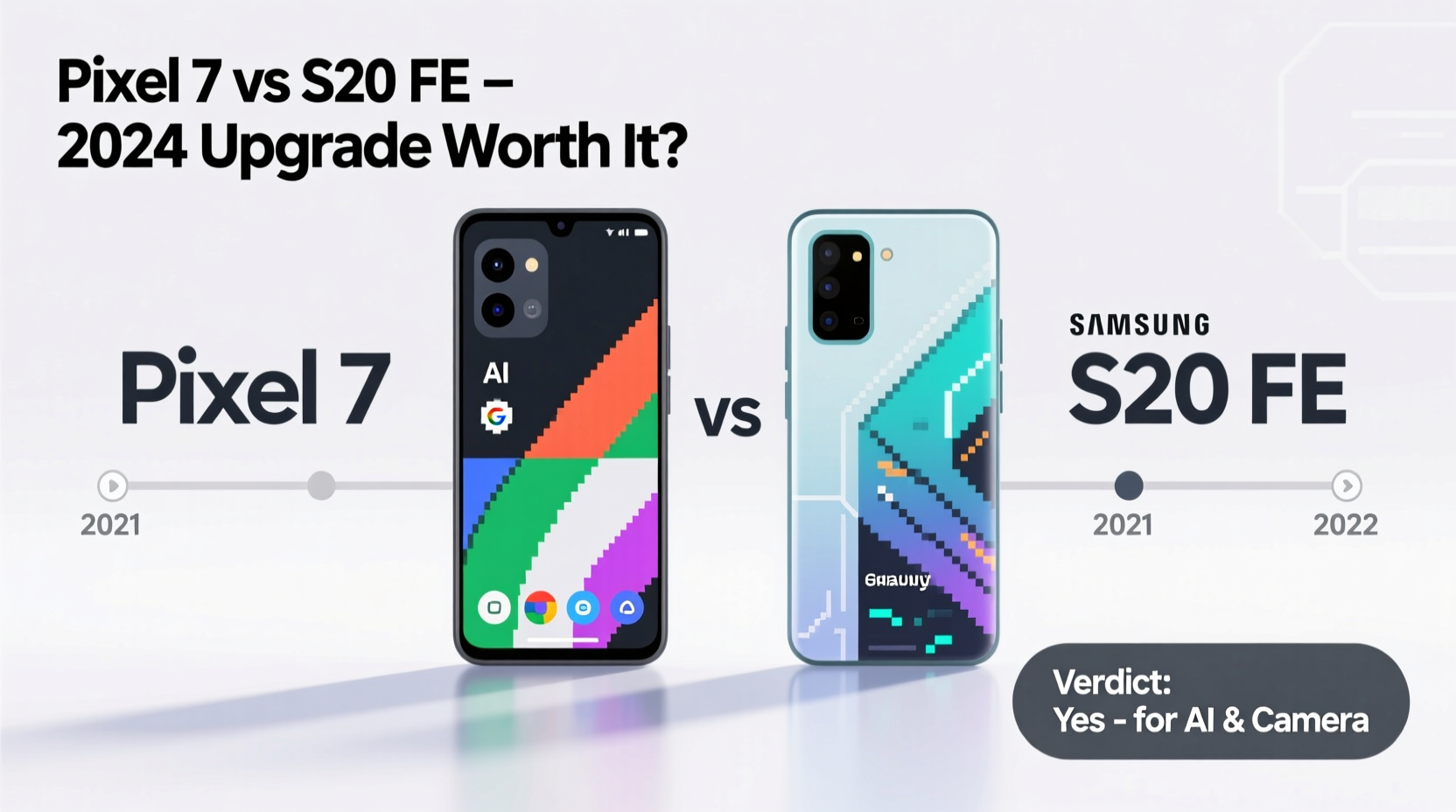
The Samsung Galaxy S20 FE was an excellent phone in its time, and many units still function adequately. But technology evolves, and so do user expectations. In 2024, the Pixel 7 offers compelling advantages: longer software support, superior computational photography, cleaner Android experience, and stronger integration with cloud and AI tools.
It’s not merely a hardware upgrade—it’s a shift toward a more intelligent, sustainable, and future-ready mobile experience. If you value consistent performance, reliable updates, and a camera that works harder behind the scenes, the Pixel 7 is absolutely worth the switch.




 浙公网安备
33010002000092号
浙公网安备
33010002000092号 浙B2-20120091-4
Comments
No comments yet. Why don't you start the discussion?