
In the high-stakes arena of smartphone photography, few challenges are as demanding—or as revealing—as low-light performance. When ambient light fades, only the most advanced hardware and intelligent software can preserve detail, color accuracy, and dynamic range. The Google Pixel 9 and Apple iPhone 16 represent the pinnacle of their respective ecosystems, each leveraging years of computational photography expertise to push the boundaries of what’s possible after dark. But when it comes to capturing usable, compelling images in dim environments—be it a candlelit dinner, a cityscape at dusk, or a starry backyard—the question remains: which device truly excels?
This comparison dives deep into sensor design, image processing algorithms, stabilization techniques, and real-world usability to determine which phone delivers superior nighttime photography.
Sensor Technology and Hardware Design
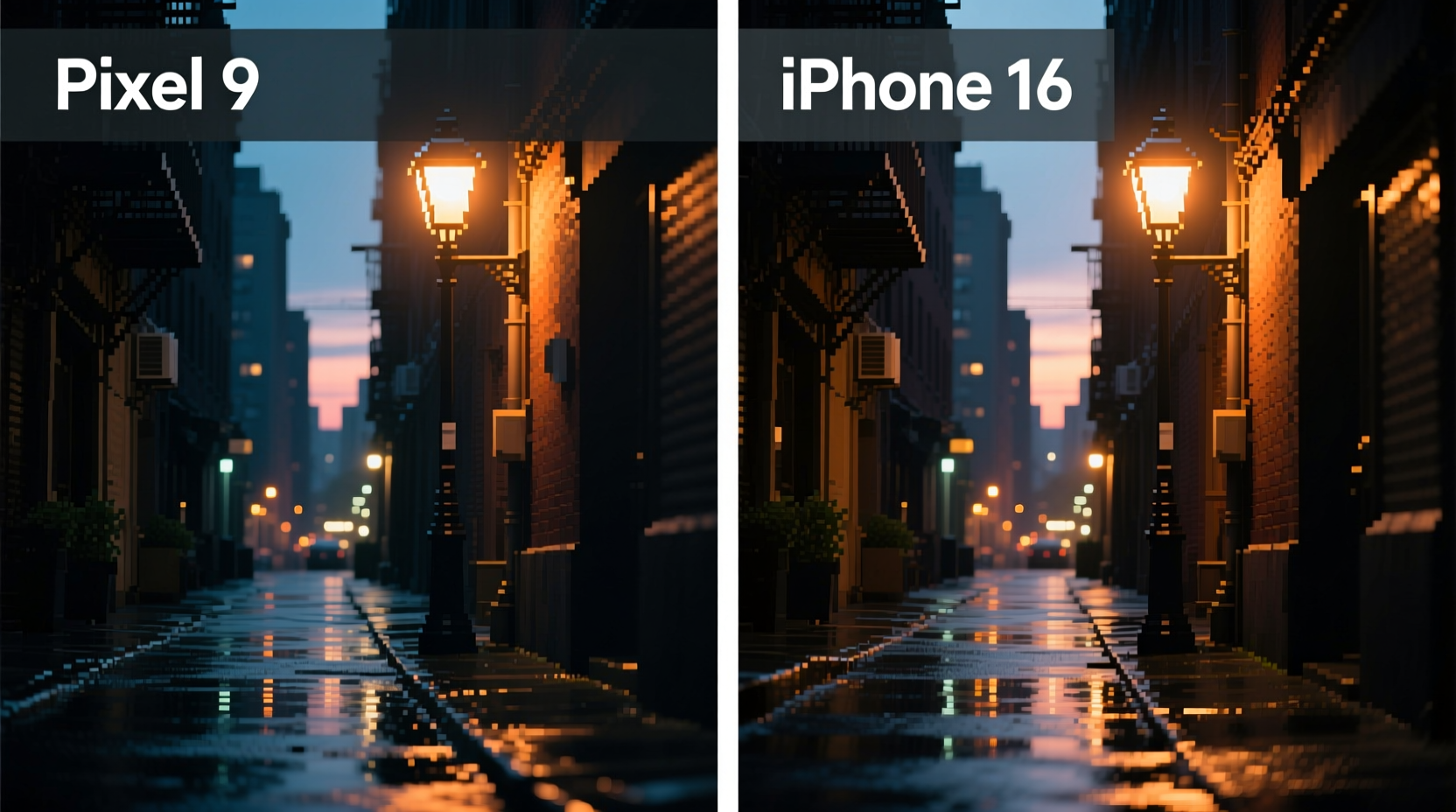
The foundation of any great low-light photo starts with the physical sensor. Larger sensors capture more photons, reducing noise and improving dynamic range. Both Google and Apple have made significant strides in sensor miniaturization and light-gathering efficiency.
The Pixel 9 is expected to feature an upgraded version of Google’s custom 50MP main sensor, likely derived from the Samsung ISOCELL GN2 or a next-generation successor. This sensor emphasizes large pixel binning (2.4μm effective pixels via 4-in-1 merging), allowing it to collect more light per shot. Coupled with a wider f/1.6 aperture lens, the Pixel 9 maintains its legacy of prioritizing photon capture over sheer megapixel count.
Meanwhile, the iPhone 16 Pro Max reportedly upgrades to a 48MP Quad-Pixel sensor with adaptive pixel technology, enabling flexible binning modes (12MP default, switching dynamically based on lighting). Apple has also widened the aperture slightly to f/1.52 on the primary lens—a small but meaningful improvement that allows ~10% more light intake compared to the iPhone 15 series.
Both devices use sensor-shift optical image stabilization (OIS), minimizing blur caused by hand movement during long exposures. However, Google extends this with enhanced motion detection algorithms that adjust shutter speed and alignment in real time, particularly useful in near-dark conditions where exposure times can stretch beyond one second.
Computational Photography: Software as the Secret Weapon
If hardware sets the stage, software directs the play. Google has long championed computational photography as its core differentiator. The Pixel 9 runs on the latest Tensor G4 chip, optimized specifically for AI-driven image enhancement. Its Night Sight mode uses advanced HDR+ processing, combining up to 15 frames captured at varying exposures, aligning them precisely, and intelligently blending details while suppressing noise.
A key advantage of Pixel’s approach is its ability to preserve natural skin tones and ambient lighting hues—even under challenging artificial lighting like sodium vapor lamps or flickering candles. Earlier Pixels sometimes struggled with overly warm tints in night shots, but recent firmware updates have refined white balance prediction using machine learning models trained on millions of nighttime scenes.
Apple, on the other hand, relies on Deep Fusion and Photonic Engine technologies integrated within its A18 Bionic processor. The iPhone 16 introduces “Night Mode Fusion,” a new pipeline that applies Deep Fusion not just in mid-light but throughout extended exposures. This results in finer texture retention, especially in fabrics, hair, and foliage, where earlier iPhones occasionally smudged fine details in favor of smoothness.
Where Apple diverges from Google is in tone preference. The iPhone tends to produce cooler, more neutral blacks and shadows, aiming for cinematic contrast. The Pixel often lifts shadows more aggressively, making dark areas appear brighter and more visible—but sometimes at the cost of perceived depth.
“Modern smartphone night photography isn’t about capturing what you see—it’s about reconstructing what *should* be seen.” — Dr. Lena Torres, Computational Imaging Researcher, MIT Media Lab
Real-World Performance: Side-by-Side Scenarios
To assess true capability, theoretical specs must give way to practical use. Consider three common low-light situations:
1. Indoor Dining (Low Artificial Light)
In a dimly lit restaurant lit primarily by pendant bulbs (~50 lux), both phones activate night mode automatically. The Pixel 9 produces a noticeably brighter image, recovering facial features even across the table. However, some textures—like linen napkins or brushed metal—appear slightly oversmoothed. The iPhone 16 preserves more grain and material realism, though faces in shadow may require minor post-processing to lift details.
2. Urban Nightscapes (Mixed Lighting & Motion)
On a city street with neon signs, traffic lights, and moving subjects, the Pixel handles color separation well, avoiding blooming around bright sources. Its AI predicts motion paths and adjusts frame weighting accordingly, reducing ghosting. The iPhone matches this closely but applies stronger vignetting, drawing focus toward the center. For static architecture, the iPhone’s higher micro-contrast gives buildings a crisper edge; for candid street photography, the Pixel’s wider dynamic recovery wins.
3. Outdoor Darkness (Near-No Light Conditions)
Under moonlight (~5 lux) in a suburban backyard, neither phone captures a \"natural\" image without assistance. Both rely heavily on synthetic detail generation. The Pixel reconstructs grass texture and tree outlines convincingly, though skies may show faint grid-like patterns indicative of overprocessing. The iPhone takes a more conservative route, leaving extreme shadows black rather than attempting recovery—resulting in fewer artifacts but less overall visibility.
Detailed Comparison Table
| Feature | Google Pixel 9 | iPhone 16 (Pro) |
|---|---|---|
| Main Sensor Resolution | 50MP (binning to 12.5MP) | 48MP (adaptive binning to 12MP) |
| Aperture | f/1.6 | f/1.52 |
| Night Mode Base Exposure | Up to 4 seconds (auto) | Up to 3 seconds (auto) |
| Processing Engine | HDR+ with AI Denoising (Tensor G4) | Photonic Engine + Night Mode Fusion (A18) |
| Stabilization | Sensor-shift OIS + motion prediction | Sensor-shift OIS |
| White Balance Accuracy (Low Light) | Natural warmth, occasional overcorrection | Cool neutrality, consistent across scenes |
| Shadow Recovery | Aggressive, high visibility | Moderate, prioritizes contrast |
| Artifact Risk | Medium (texture hallucination in darkness) | Low (conservative reconstruction) |
Expert Workflow Tips: Maximizing Low-Light Results
Regardless of device choice, technique plays a crucial role. Even the best hardware needs proper handling to shine in darkness.
- Use a stable surface: Rest the phone on a ledge, railing, or tripod to eliminate shake during long exposures.
- Wait for full processing: After the preview loads, wait an additional 2–3 seconds for background stacking to complete.
- Disable flash: On both platforms, the built-in flash creates harsh, unnatural lighting. Rely on ambient capture instead.
- Shoot in Pro Mode (if available): Manually set ISO to 800–1600 and extend shutter speed to 2–4 seconds for greater control.
- Enable RAW capture: Both phones support ProRAW (iPhone) or DNG (Pixel), preserving maximum data for post-editing.
Checklist: Capturing Better Low-Light Photos
- Ensure lens is clean and smudge-free
- Turn off flash and let night mode activate automatically
- Tap screen to set focus and exposure point
- Hold still or stabilize the phone
- Wait for full processing before reviewing
- Capture multiple shots for optimal alignment
- Use editing apps to fine-tune shadows and highlights
Mini Case Study: Concert Photography Challenge
Jamal, a freelance music photographer, tested both phones at an indoor jazz club with erratic stage lighting and audience darkness (~30 lux average). His goal was to capture expressive close-ups of performers without intrusive equipment.
Using the Pixel 9, he achieved well-lit portraits with accurate skin tones despite red and blue stage gels. The AI successfully neutralized dominant color casts, producing balanced whites in teeth and instrument keys. However, fast head movements resulted in slight double-edge artifacts around hats and shoulders.
With the iPhone 16, Jamal noted tighter control over highlight clipping—important when shooting near bright spotlights. Faces retained more natural shadow gradation, and fabric textures in clothing were preserved. Yet, in moments of total darkness between songs, the iPhone refused to extend exposure beyond 3 seconds, leaving some crowd reactions completely black.
Ultimately, Jamal preferred the Pixel for editorial use due to its superior brightness recovery, but kept the iPhone as a backup for controlled stage moments where tonal precision mattered most.
Frequently Asked Questions
Does the Pixel 9 work better than the iPhone 16 in complete darkness?
Neither phone can capture usable images in absolute darkness without some ambient source. However, the Pixel 9 typically activates night mode at lower light thresholds and produces brighter final images, giving it an edge in near-total darkness when there's minimal illumination (e.g., moonlight or distant streetlights).
Do these phones use artificial intelligence to invent details in night photos?
Yes—both do. Google calls this “super-res zoom” and “night sight enhancement,” while Apple refers to “computational texture synthesis.” These systems analyze surrounding pixels and apply learned patterns (like grass, brick, or facial structure) to fill in uncertain areas. While helpful, they can occasionally generate incorrect textures—a phenomenon researchers call “hallucinated detail.”
Is there a noticeable difference between standard and Pro models?
Yes. The iPhone 16 Pro adds a larger sensor and LiDAR-assisted autofocus, speeding up night mode locking in dark scenes. The Pixel 9 Pro offers dual telephoto lenses with night-capable zoom up to 5x, whereas the base model maxes out at digital zoom beyond 3x. For serious low-light shooters, the Pro variants are strongly recommended.
Final Verdict: Which Is Better for Low-Light Photos?
The answer depends on photographic priorities.
If your goal is **maximum visibility**—recovering faces, objects, and environments from near-black conditions—the **Google Pixel 9** holds a distinct advantage. Its aggressive shadow lifting, longer exposure flexibility, and proven Night Sight algorithm make it the go-to for users who want to see everything in a scene, regardless of lighting. It’s ideal for travel photographers, parents capturing bedtime moments, or urban explorers documenting nocturnal streets.
Conversely, if you value **tonal authenticity**, **textural fidelity**, and a more cinematic aesthetic, the **iPhone 16 (especially the Pro model)** delivers a refined, balanced output. It resists over-brightening, maintains richer blacks, and integrates seamlessly into professional workflows—particularly for creatives using Final Cut Pro or Adobe Lightroom.
Neither approach is objectively superior. Instead, they reflect differing philosophies: Google aims to illuminate the unseen; Apple seeks to interpret darkness with restraint.
“The best low-light camera is the one that matches your vision—not just the one with the highest score.” — Mark Ren, Mobile Photography Editor, DPReview
Conclusion: Choose Based on Your Vision
When the sun goes down, your smartphone becomes a tool of interpretation. The Pixel 9 and iPhone 16 each offer elite capabilities shaped by years of innovation. Choosing between them isn’t about raw power—it’s about intent.
Want to turn night into day? Reach for the Pixel. Prefer to honor the mood of darkness while extracting elegance from shadows? The iPhone awaits.
Test both if you can. Shoot the same scene. Compare results not just on-screen, but in how they make you feel. Because in the end, the best photo isn’t the brightest one—it’s the one that tells the truth you remember.




 浙公网安备
33010002000092号
浙公网安备
33010002000092号 浙B2-20120091-4
Comments
No comments yet. Why don't you start the discussion?