
Spending long hours on your feet demands footwear that balances comfort, stability, and proper foot alignment. As warm weather rolls in, many turn to open-footwear options like platform sandals and flat slides. While both are popular for casual wear and travel, their structural differences significantly impact arch support—especially during extended walking. Understanding how each style affects foot mechanics can help prevent discomfort, fatigue, and even long-term strain.
This article breaks down the biomechanics, design features, and real-world performance of platform sandals versus flat slides. Whether you're navigating city streets, standing in museum queues, or exploring a new destination, choosing the right shoe could be the difference between an energized day and one spent searching for a bench.
Understanding Arch Support and Why It Matters
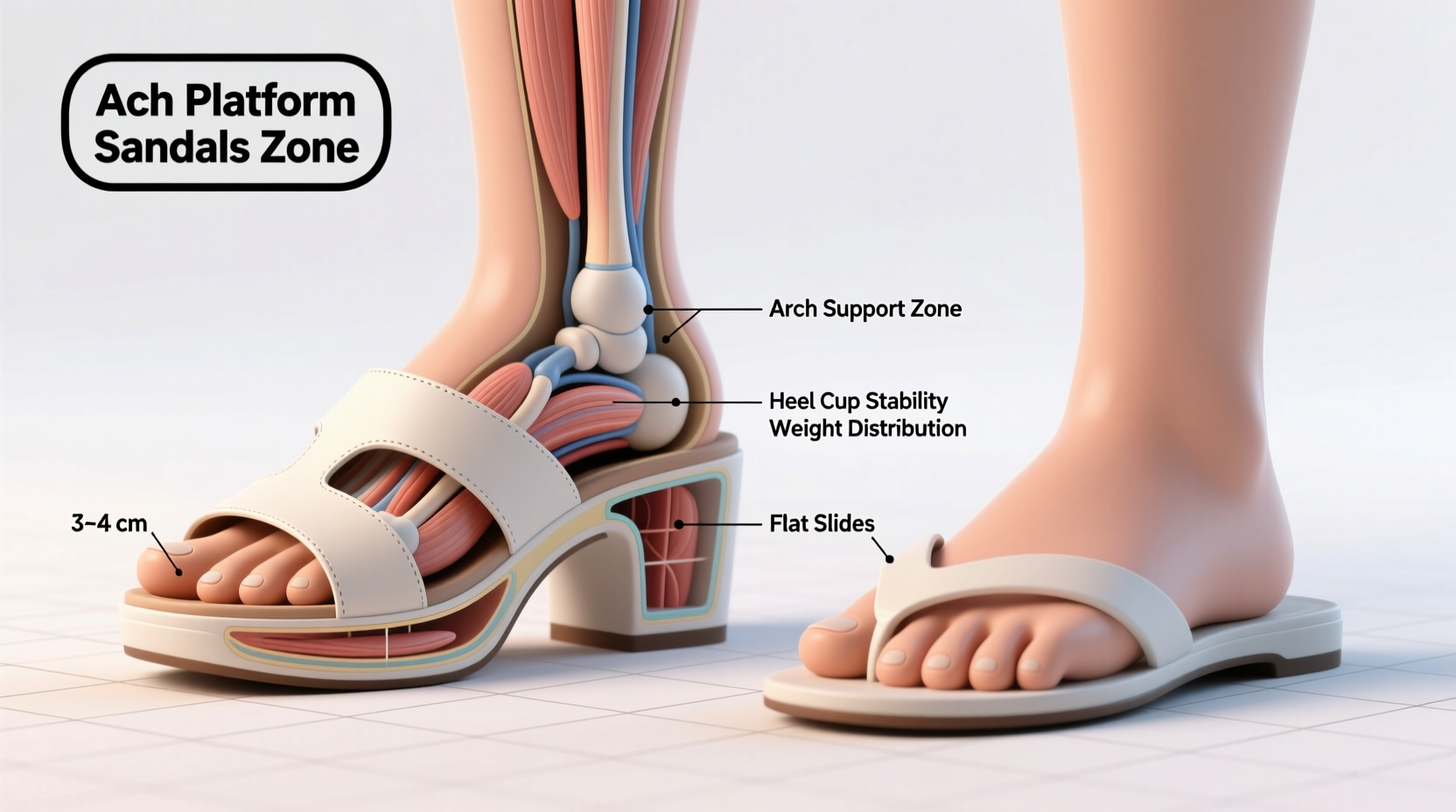
Arch support refers to the degree to which a shoe’s insole cradles the natural curve along the inner edge of the foot—the medial longitudinal arch. This structure acts as a shock absorber, distributing body weight and reducing stress on joints during movement. Without adequate support, the arch can collapse (a condition known as overpronation), leading to plantar fasciitis, heel pain, shin splints, or lower back issues over time.
For walking all day, consistent arch support helps maintain posture, reduces muscle fatigue, and improves gait efficiency. The ideal supportive shoe should:
- Mirror the contour of the foot’s arch
- Distribute pressure evenly across the sole
- Provide cushioning at key impact zones (heel and ball of foot)
- Offer a secure fit to minimize foot slippage
While high heels or athletic shoes often dominate discussions about foot health, casual summer styles like platform sandals and flat slides are equally important—particularly because they’re frequently worn for prolonged periods without users realizing their limitations.
Platform Sandals: Structure, Stability, and Support Features
Platform sandals are characterized by a thick, elevated sole under both the heel and forefoot, often ranging from 1 to 3 inches in height. Unlike stilettos or wedges, platforms typically provide a level base, meaning the heel isn’t higher than the toes—a design that promotes more natural spinal alignment.
The thicker outsole allows for additional materials within the midsole, such as EVA foam, memory foam, or molded arches. Many premium platform sandals incorporate built-in arch support, contoured footbeds, and heel cups designed to stabilize the rearfoot. Brands like Birkenstock, Aetrex, and Teva have engineered platform styles specifically for all-day wear, combining fashion with orthopedic principles.
Because platform soles are rigid and less flexible than flat thongs, they offer greater torsional stability. This means the shoe resists twisting when walking on uneven surfaces, reducing strain on ligaments and tendons. Additionally, most platform sandals feature adjustable straps across the instep and ankle, securing the foot and preventing compensatory gripping motions that tire the toes.
Advantages of Platform Sandals for Walking
- Greater potential for integrated arch support due to thicker footbeds
- Better shock absorption from elevated, cushioned soles
- Improved foot containment via multiple straps
- Reduced ground impact thanks to increased distance between foot and surface
Flat Slides: Simplicity vs. Structural Limitations
Flat slides are minimalist by design—essentially a flat sole with a single wide strap or toe post that allows the foot to slip in easily. Their appeal lies in convenience, breathability, and versatility. However, these benefits come at a cost when it comes to foot support.
Most flat slides lack structured arch support entirely. Their thin soles—often made of rubber, foam, or synthetic materials—provide minimal cushioning and no anatomical shaping. The absence of straps around the heel or midfoot means the foot must actively grip the shoe during walking, engaging small intrinsic muscles unnecessarily. Over time, this leads to fatigue and altered gait patterns.
“Wearing unsupported flat slides for extended periods is biomechanically similar to walking barefoot on hard surfaces—it increases load on the plantar fascia and Achilles tendon.” — Dr. Lena Rodriguez, Podiatrist and Gait Specialist
Some modern slide designs attempt to improve ergonomics with contoured footbeds or added foam padding. Examples include the Crocs Classic Slide or the OluKai Ohana, which integrate mild arch contours and heel cups. Still, even these enhanced versions fall short compared to purpose-built supportive footwear due to their open-back design and limited adjustability.
When Flat Slides Fall Short
- No heel retention leads to toe clawing
- Thin soles transmit more vibration and impact
- Lack of lateral support increases risk of ankle roll on uneven terrain
- Flat profile places full body weight directly onto unsupported arch
Direct Comparison: Key Differences in Support and Function
| Feature | Platform Sandals | Flat Slides |
|---|---|---|
| Arch Support | Often built-in; customizable in premium models | Rarely present; mostly flat or minimally contoured |
| Sole Thickness | 1–3 inches; provides cushioning and insulation | Typically under 0.5 inches; minimal protection |
| Foot Stability | High (straps secure foot, reduce slippage) | Low (open back allows heel lift and side motion) |
| Shock Absorption | Good to excellent (multi-layer midsoles common) | Poor to fair (thin, dense materials) |
| Adjustability | Frequently includes straps with buckles or Velcro | None or limited (slip-on only) |
| Suitable for All-Day Walking? | Yes, if well-designed and properly fitted | Rarely—only select ergonomic models with caveats |
The data clearly favors platform sandals when arch support and endurance are priorities. That said, not all platform styles are created equal—some prioritize fashion over function, featuring exaggerated heights without internal support. Always assess the footbed quality, not just the external appearance.
Real-World Example: A Day at the Theme Park
Consider Sarah, a visitor spending 10 hours at a major theme park. She wears two different pairs over separate trips: first, a pair of trendy flat slides with a smooth foam footbed; second, a pair of sport-style platform sandals with adjustable straps and visible arch contouring.
During her first visit, Sarah begins feeling foot soreness by mid-afternoon. By evening, she experiences sharp heel pain—later diagnosed as early-stage plantar fasciitis. Her gait analysis shows excessive flattening of the arch and increased pronation, exacerbated by constant pavement walking.
On her next trip, she switches to supportive platform sandals. Though initially skeptical about the bulkier look, she notices immediate differences: less foot fatigue, no toe gripping, and sustained energy throughout the day. Post-trip, she reports zero pain and plans to replace her everyday slides with more supportive options.
This scenario reflects a common pattern among podiatrists’ patients—short-term convenience leading to long-term discomfort. The choice between styles isn't merely aesthetic; it has tangible physiological consequences.
How to Choose the Right Shoe for All-Day Walking
Selecting footwear for extended walking requires evaluating both design and personal needs. Use the following checklist to make an informed decision:
✅ Footwear Selection Checklist
- Check the footbed: Press your thumb into the arch area. Does it resist slightly, mimicking your natural curve?
- Test heel security: Walk on a slight incline. Does your heel stay firmly seated, or does it lift excessively?
- Evaluate sole thickness: Is there at least 1 inch of material under the heel for impact reduction?
- Look for adjustability: Can straps be tightened to accommodate swelling or varied sock use?
- Assess flexibility: Bend the shoe gently. It should flex at the ball of the foot, not the arch.
- Walk test: Try them on carpet and tile. Do you feel stable, or do you catch yourself balancing?
Frequently Asked Questions
Can flat slides ever be good for walking long distances?
Only if they are specifically designed with orthotic-grade footbeds, heel support, and durable cushioning. Most standard flat slides lack these features. Models like the Vionic Tide III or Chaco Z/Cloud X offer slide-like ease with actual biomechanical support—but they are exceptions, not the norm.
Are higher platforms bad for your feet?
Not necessarily. Platforms that maintain a level base (where heel and forefoot are elevated equally) do not alter joint angles the way high heels do. In fact, the added sole thickness often allows for superior cushioning and support. Problems arise only when platforms are poorly balanced or too rigid to flex naturally with the foot.
Do I need custom orthotics with either style?
If you have flat feet, high arches, or existing foot conditions, adding custom or over-the-counter orthotics can enhance support in compatible sandals. Look for models with removable footbeds to accommodate inserts. Many platform sandals allow this; few flat slides do.
Final Verdict: Which Offers Better Arch Support?
When comparing platform sandals and flat slides for all-day walking, platform sandals generally provide superior arch support. Their construction allows for deeper heel cups, contoured midsoles, and multi-point foot fixation—key elements in maintaining healthy foot mechanics over time. While some advanced flat slides incorporate modest improvements, they remain inherently limited by their open-back, strap-minimal design.
That said, not every platform sandal is automatically supportive. Prioritize brands known for foot health engineering—such as Birkenstock, Dansko, OluKai, or Vionic—and inspect the footbed closely before purchasing. Avoid purely fashion-driven designs with flat interiors, regardless of sole height.
Ultimately, comfort shouldn’t be sacrificed for style—or convenience. Investing in well-supported footwear pays dividends in mobility, energy, and long-term foot health. If you regularly walk several miles a day, stand for work, or travel extensively, choosing a supportive platform sandal over a basic flat slide is a practical, science-backed decision.
“The best shoe is the one that lets you forget you’re wearing it—because it’s doing its job silently and effectively.” — Dr. Marcus Tran, Biomechanics Researcher, University of Oregon
Take Action for Healthier Feet Today
Your feet carry you through life—one step at a time. Don’t let a momentary preference for lightweight simplicity compromise your comfort and health. Re-evaluate your go-to summer footwear. Swap out unsupportive flat slides for thoughtfully designed platform sandals that combine style with substance. Your arches will thank you after the first mile, and your future self will appreciate the prevention of avoidable strain.




 浙公网安备
33010002000092号
浙公网安备
33010002000092号 浙B2-20120091-4
Comments
No comments yet. Why don't you start the discussion?