
Choosing the right footwear for all-day wear isn’t just about style—it’s a decision that impacts posture, foot health, and long-term comfort. Among the most common choices are platform sandals and flats, both staples in modern wardrobes. While they may appear similar at first glance, their structural differences significantly affect arch support and overall foot mechanics. Understanding which option truly supports your arches over extended periods can prevent discomfort, fatigue, and even chronic foot conditions.
Arch support is critical because it helps distribute body weight evenly across the foot, reduces strain on ligaments and tendons, and maintains proper alignment from the feet up through the spine. When support is lacking, issues like plantar fasciitis, overpronation, or metatarsalgia can develop. This article examines how platform sandals and flats compare in delivering consistent arch support throughout the day, backed by biomechanical principles, design analysis, and real-world usability.
The Anatomy of Arch Support in Footwear
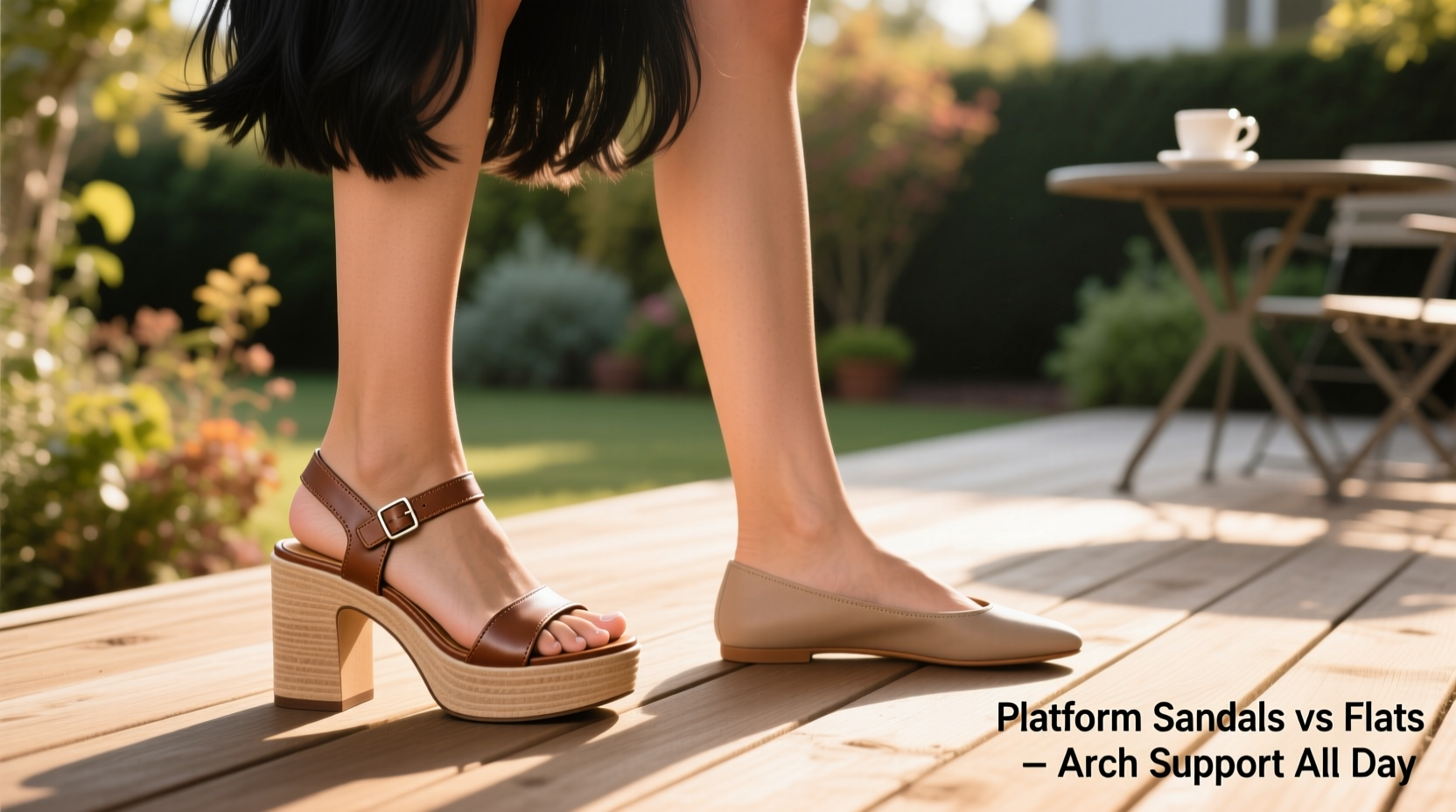
Effective arch support goes beyond cushioning. It involves a shoe’s ability to cradle the medial longitudinal arch—the natural curve along the inner side of the foot—preventing it from collapsing under load. A well-supported arch maintains the foot’s neutral position, minimizing excessive inward rolling (overpronation) and reducing stress on joints.
Key components of supportive footwear include:
- Midsole structure: The layer between the outsole and insole that provides shock absorption and shape retention.
- Contoured footbed: A molded insole that mirrors the foot’s anatomy, particularly the arch and heel cup.
- Heel counter stability: A firm back portion that stabilizes the heel and aligns the rearfoot.
- Material density: Firm yet flexible materials that resist compression over time.
Flats often sacrifice these features for slim profiles, while platform sandals vary widely depending on brand, construction, and intended use. Neither category guarantees good support by default—design quality matters more than style classification.
Flats: Style Over Substance?
Traditional flats—whether ballet-style, loafers, or pointed-toe designs—are prized for their sleek appearance and versatility. However, many lack essential structural elements needed for prolonged standing or walking. Most mass-market flats feature flat, unstructured insoles with minimal padding and no true arch contour.
Wearing unsupportive flats for hours leads to several common complaints:
- Increased pressure on the ball of the foot due to lack of forefoot cushioning.
- Arch fatigue as the plantar fascia stretches without reinforcement.
- Pronation-related knee and lower back pain from unstable foot alignment.
That said, not all flats are created equal. Some premium brands incorporate orthotic-grade footbeds, memory foam, or dual-density midsoles. Brands like Ecco, Vionic, and Cole Haan have engineered dressy flats with built-in support systems that rival athletic shoes in functionality.
Still, even high-end flats face limitations. Their low profile restricts the depth available for substantial arch structures. Without elevation, there’s less room for engineered support layers, making it harder to achieve biomechanical efficiency compared to elevated styles.
Platform Sandals: Elevated Comfort or Fashion Trap?
Platform sandals—defined by a thick sole unit extending from heel to toe—have evolved from 1970s fashion statements into mainstream summer essentials. Modern versions range from minimalist slide styles to chunky, sport-inspired designs. What sets them apart is the increased sole volume, which allows for more internal engineering.
This extra space enables manufacturers to embed deeper cushioning, contoured arches, and shock-absorbing materials. Many athletic and lifestyle brands now produce platform sandals with anatomically shaped footbeds, such as Teva’s “Shoc Pad” technology or Birkenstock’s signature cork-latex mold. These molds adapt to the wearer’s foot over time, offering personalized arch support.
However, not all platform sandals deliver on this promise. Fast-fashion versions often use lightweight EVA foam that compresses within hours, negating any initial benefit. Additionally, open-back designs may compromise heel stability, leading to muscle overuse as the foot grips to stay secure.
The key advantage lies in adjustability. Straps allow wearers to customize fit around the midfoot and heel, helping maintain proper foot positioning. A securely fastened sandal keeps the arch aligned with the support zone, whereas a loose flat lets the foot shift excessively inside the shoe.
“Elevated footwear like platforms can offer superior support simply because they have more real estate for functional design. But only if engineered correctly.” — Dr. Lena Torres, Podiatrist & Gait Analyst
Comparative Analysis: Platform Sandals vs Flats
To evaluate which shoe type offers better arch support for all-day wear, consider the following factors:
| Feature | Platform Sandals | Flats |
|---|---|---|
| Arch Contour Depth | High – deeper footbed allows pronounced arch molding | Low – limited space restricts support height |
| Cushioning Capacity | High – thick soles absorb impact effectively | Low to Moderate – thin soles transfer more ground force |
| Foot Stability | Moderate to High – adjustable straps enhance lockdown | Low – slip-on design allows foot movement |
| Weight Distribution | Better – elevated platform spreads load across full foot | Poorer – weight concentrates on forefoot and heel |
| Versatility (Indoor/Outdoor) | Moderate – bulkier; less formal settings | High – suitable for offices, events, daily errands |
| Durability of Support | Varies – depends on material quality | Generally Low – flattens faster due to thin construction |
From a biomechanical standpoint, platform sandals generally provide better long-term arch support when designed with function in mind. Their elevated structure permits more sophisticated engineering than the constrained form factor of traditional flats.
Real-World Example: Office Worker Transitioning to Standing Job
Sophie, a graphic designer, previously wore minimalist leather flats five days a week in her office environment. After transitioning to a hybrid role requiring extended standing during client presentations and print reviews, she began experiencing sharp heel pain by mid-afternoon. An assessment by her podiatrist revealed early signs of plantar fasciitis linked to inadequate arch support.
She experimented with two solutions: supportive flats from a therapeutic brand and contoured platform sandals. Over a four-week trial, she logged comfort levels, energy expenditure, and foot fatigue. The results were clear: the platform sandals reduced her end-of-day discomfort by 60%, according to self-reported metrics. She attributed this improvement to the firmer arch rise and enhanced heel stabilization provided by the adjustable straps.
Sophie now rotates between both types but reserves her flats for short commutes or seated meetings. For active days, she defaults to her supportive sandals—proof that context and activity level dictate optimal footwear choice.
How to Choose the Right Shoe for All-Day Arch Support
Selecting between platform sandals and flats shouldn’t be based solely on aesthetics. Follow this step-by-step guide to make an informed decision:
- Assess Your Daily Activity Level: If you spend most of the day standing or walking, prioritize support over sleekness.
- Check the Insole Structure: Look for a visible arch bump and a deep heel cup. Avoid completely flat interiors.
- Test Flexibility: The shoe should bend at the ball of the foot—not in the middle or arch area.
- Evaluate Strap Security (for sandals): Adjustable straps over the instep help lock the foot in place.
- Try Before You Buy: Walk on hard surfaces in-store or during home trials. Pay attention to pressure points.
- Consider Orthotic Compatibility: If you use custom inserts, ensure the shoe has removable insoles and sufficient depth.
Supportive Footwear Checklist
- ✅ Visible arch contour in the insole
- ✅ Firm heel counter that doesn’t collapse when pressed
- ✅ Adequate cushioning in heel and forefoot zones
- ✅ Shoes bend only at the toe, not under the arch
- ✅ Secure fit—no slipping at heel or side bulging
- ✅ Made with durable, non-compressible materials (e.g., polyurethane, latex-blend cork)
Frequently Asked Questions
Can flats ever provide good arch support?
Yes, but only select models do. Look for flats explicitly marketed as “orthotic-friendly” or “arch-supportive.” Brands like Vionic, Dansko, and Naturalizer offer styles with medically endorsed footbeds. Avoid ultra-thin or fully flexible soles, as they cannot sustain proper arch alignment over time.
Are platform sandals bad for your knees?
Not inherently. Poorly designed ones with rigid soles or excessive height (over 2 inches) can alter gait and increase joint load. However, well-cushioned, moderately elevated platforms with flexible forefeet can actually reduce knee stress by improving shock absorption compared to flat, hard-soled shoes.
Do I need different shoes for work versus casual wear?
Often, yes. Work environments demanding prolonged standing benefit from maximum support, even if it means sacrificing some formality. Consider keeping a pair of supportive shoes at work and changing upon arrival. For casual outings, you can opt for lighter options if duration and distance are limited.
Final Verdict: Which Offers Better All-Day Arch Support?
When comparing platform sandals and flats purely on the basis of arch support for extended wear, platform sandals hold a structural advantage. Their thicker soles allow for deeper, more resilient arch contours, better cushioning, and improved weight distribution. With proper strap adjustment, they also offer superior foot containment, reducing muscular strain caused by gripping.
Flats, while more versatile in formal settings, typically fall short in providing sustained support unless specifically engineered for it. Even then, their physical constraints limit how much support they can deliver. For individuals spending more than four hours on their feet daily, platform sandals with anatomical footbeds are the wiser investment.
Ultimately, the best shoe is one that fits your foot shape, matches your activity demands, and feels comfortable after eight hours—not just eight minutes. Don’t assume style must come at the cost of support. Today’s market offers stylish, supportive options in both categories. Prioritize function first, then refine for fashion.




 浙公网安备
33010002000092号
浙公网安备
33010002000092号 浙B2-20120091-4
Comments
No comments yet. Why don't you start the discussion?