
For anyone who spends long hours on their feet—whether commuting, traveling, or working a full shift—the right footwear can mean the difference between comfort and chronic foot fatigue. Sandals are a popular summer staple, but not all styles are created equal when it comes to supporting your arches over extended periods. Two common options—platform and wedge sandals—are often compared for both style and function. But which one truly provides superior arch support for walking all day?
The answer isn’t as simple as choosing one style over the other. It depends on construction, materials, foot anatomy, and individual biomechanics. This article breaks down the structural differences, analyzes real-world performance, and delivers expert-backed recommendations to help you choose wisely.
Understanding Arch Support in Footwear
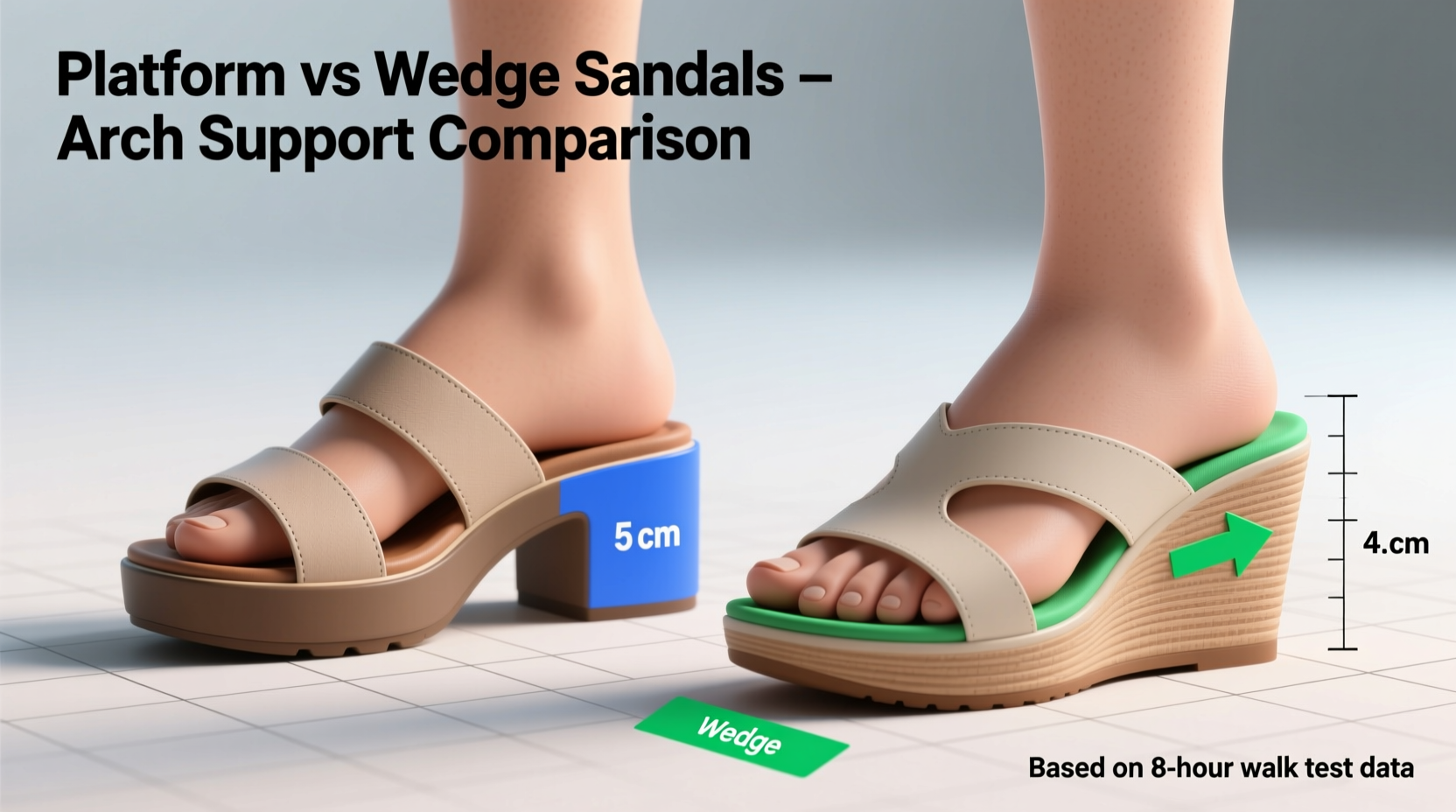
Arch support refers to the degree to which a shoe’s insole or midsole cradles the natural curve of the foot’s arch, preventing excessive flattening (overpronation) or strain. Proper support reduces pressure on the plantar fascia, tendons, and joints, minimizing fatigue and long-term injury risk.
In sandals, arch support is influenced by several factors:
- Insole contouring: A molded footbed that mirrors the arch shape provides passive support.
- Midsole density: Firm yet cushioned materials absorb impact without collapsing.
- Heel-to-toe drop: The height difference between heel and forefoot affects posture and gait efficiency.
- Strap stability: Secure straps prevent foot slippage, reducing muscle strain.
Without adequate support, even short walks can lead to discomfort in the arches, heels, calves, and lower back. For all-day wear, these effects compound significantly.
Platform Sandals: Structure and Support Profile
Platform sandals feature a uniformly thick sole from heel to toe, often with added height at the front. They’re known for fashion-forward designs and elevated silhouettes, especially in chunky or minimalist styles.
From a biomechanical standpoint, platforms offer some advantages:
- Flat, level base promotes even weight distribution.
- Thick soles provide shock absorption, reducing impact on hard surfaces.
- Many modern platforms include contoured footbeds with built-in arch support.
However, not all platforms are engineered for comfort. Cheap versions may have rigid, flat soles with no anatomical shaping, forcing the foot to adapt unnaturally. Additionally, the lack of heel elevation can cause the body’s center of gravity to shift forward, increasing strain on the forefoot during prolonged walking.
Wedge Sandals: Anatomy and Long-Wear Benefits
Wedge sandals rise gradually from the ball of the foot to the heel, creating a continuous sloped sole. This design mimics a low-heeled shoe while maintaining stability across the entire footbase.
Well-designed wedges often outperform flat platforms in terms of arch support due to:
- Natural foot positioning: The incline encourages a more neutral spinal alignment and reduces calf tightness.
- Integrated support systems: Many wedges use layered foam, cork, or EVA midsoles that compress evenly under load.
- Better leverage: The heel elevation reduces strain on the Achilles tendon and plantar fascia during push-off.
Podiatrists frequently recommend wedges for patients needing mild corrective support. Cork wedges, in particular, mold slightly to the foot over time, offering personalized fit and enhanced comfort.
“Wedges, when properly constructed, can offer biomechanical benefits similar to orthopedic shoes—especially if they include a deep heel cup and medial arch contour.” — Dr. Lena Reyes, DPM, Foot Biomechanics Specialist
Comparative Analysis: Platform vs Wedge for All-Day Walking
| Feature | Platform Sandals | Wedge Sandals |
|---|---|---|
| Arch Contouring | Varies widely; often flat unless specifically designed | Frequently includes molded arch support, especially in quality brands |
| Shock Absorption | High (due to thick sole) | Moderate to high (depends on material density) |
| Weight Distribution | Even, but may overload forefoot | Balanced; shifts load toward heel |
| Gait Efficiency | Can disrupt stride if too flat | Promotes natural heel-to-toe motion |
| Stability | Good on flat terrain | Excellent due to continuous sole contact |
| Best For | Short walks, casual wear, fashion-focused use | All-day wear, uneven terrain, standing jobs |
Real-World Example: A Retail Worker’s Experience
Sophie, a 32-year-old sales associate at a lifestyle boutique, stands for 8–10 hours daily. Last summer, she rotated between two pairs: a trendy black platform sandal with a 2-inch flat sole and a tan leather wedge with a 2.5-inch cork base.
After two weeks, she noticed consistent arch fatigue and occasional numbness in her toes with the platforms. Switching to the wedges eliminated the discomfort. “The wedge feels like it lifts me slightly,” she explained. “My calves don’t cramp, and my feet don’t feel ‘stuck’ to the floor.”
Her experience aligns with biomechanical principles: the wedge’s gradual incline improved her posture and reduced strain on the anterior muscles of the foot.
How to Choose the Right Sandal for Extended Walking
Selecting between platform and wedge sandals shouldn’t be based solely on aesthetics. Follow this checklist to ensure lasting comfort:
- Check the footbed: Press your thumb into the arch area. It should resist compression slightly, offering firm support.
- Look for a heel cup: A raised rim around the heel stabilizes the rearfoot and aligns the ankle.
- Assess flexibility: The sole should bend at the ball of the foot, not in the middle or arch.
- Test the strap system: Adjustable straps (especially around the ankle or instep) prevent sliding and reduce muscle effort.
- Walk on varied surfaces: Try the sandals on tile, pavement, and carpet before committing.
- Avoid overly rigid soles: While durability matters, extreme stiffness increases impact transmission.
Frequently Asked Questions
Can platform sandals have good arch support?
Yes, but only if they’re designed with it. Brands like Birkenstock, Teva, and ECCO offer platform styles with anatomically shaped footbeds. Avoid fashion-only platforms made with flat, unstructured soles.
Are wedge sandals suitable for flat feet?
Many are. Look for wedges with medial post support or built-in orthotic-grade insoles. Styles with wide bases also enhance stability for pronated feet.
Do higher wedges compromise support?
Not necessarily. A well-constructed 3-inch wedge with internal shank support can be more stable than a flimsy 1-inch platform. Focus on build quality, not just height.
Final Recommendation: Prioritize Function Over Form
While both platform and wedge sandals can be stylish, **wedge sandals generally provide better arch support for walking all day**. Their ergonomic slope, combined with structured midsoles and heel stabilization, supports natural gait mechanics and reduces fatigue. Platforms can work—but only if they incorporate advanced footbed technology and avoid completely flat profiles.
Ultimately, the best choice depends on your foot type, activity level, and the specific construction of the shoe. Don’t assume a thicker sole equals better support. Instead, evaluate the insole contour, adjustability, and overall biomechanical design.
“The most supportive sandal is the one that fits your foot’s unique shape—not the one with the highest platform or trendiest look.” — Dr. Marcus Tran, Podiatry Today Contributor
Take Action for Healthier Feet
Your feet carry you through every part of your day. Investing in footwear that supports them isn’t a luxury—it’s a necessity. Next time you shop for sandals, bring your orthotics if you use them, go later in the day when feet are slightly swollen, and prioritize models with proven support features. Your arches will thank you after mile one—and mile ten.




 浙公网安备
33010002000092号
浙公网安备
33010002000092号 浙B2-20120091-4
Comments
No comments yet. Why don't you start the discussion?