
Driving under bright sunlight can be more than just uncomfortable—it can be dangerous. Glare from wet roads, car hoods, or other vehicles’ windshields scatters light in unpredictable ways, reducing visibility and increasing reaction times. Many drivers turn to polarised sunglasses as a solution, but are they truly better than non-polarised options? The short answer is yes—polarised lenses offer measurable glare reduction that enhances visual clarity and safety on the road. But understanding how they work, when they’re most effective, and where they might fall short is key to making an informed decision.
How Light and Glare Affect Driving Visibility
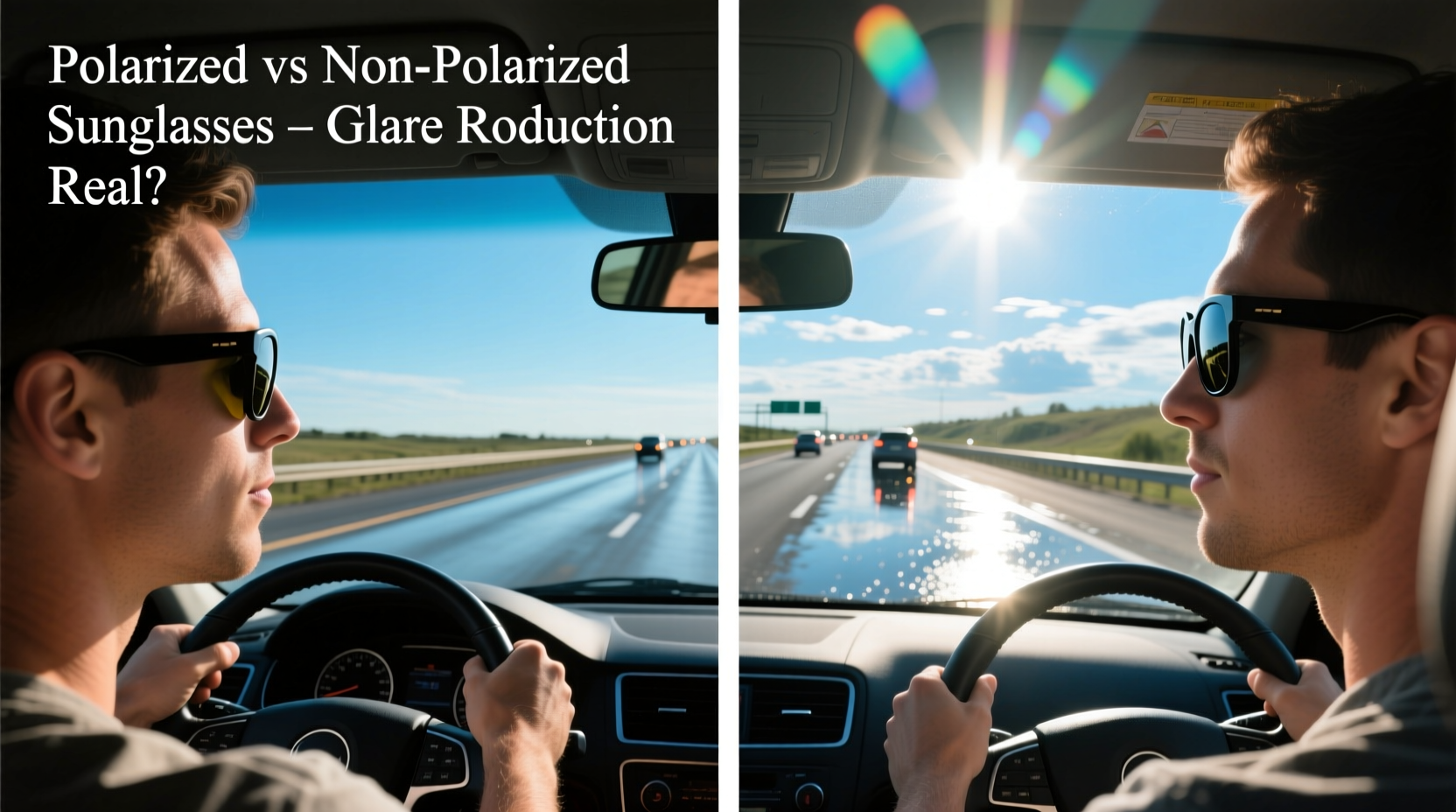
Sunlight reflects off flat, horizontal surfaces like asphalt, water puddles, snow, and even car paint, creating what’s known as \"glare.\" This reflected light becomes horizontally polarised, meaning the light waves vibrate primarily in one direction. When this intense, directional light enters your eyes, it overwhelms your vision, causing squinting, eye strain, and temporary blindness in extreme cases.
Non-polarised sunglasses reduce overall brightness by using tinted lenses, but they don’t selectively filter out horizontally oriented glare. As a result, while your eyes may feel less strained from general brightness, you're still exposed to blinding reflections that compromise depth perception and contrast sensitivity—critical factors when judging distance, speed, and road conditions.
“Glare isn’t just annoying—it’s a legitimate hazard. Studies show that unfiltered glare can delay reaction time by up to 1.5 seconds, which at highway speeds translates to over 100 feet of travel before braking.” — Dr. Lena Torres, Vision Safety Researcher, National Highway Institute
The Science Behind Polarised Lenses
Polarised sunglasses contain a special chemical filter embedded within the lens material. This filter is aligned vertically, acting like microscopic blinds that block horizontally vibrating light waves—the primary component of surface glare—while allowing vertical light waves (which carry useful visual information) to pass through.
This selective filtering dramatically improves contrast and visual clarity. For example, when driving toward a sunlit wet road, a non-polarised lens may make the surface appear washed out and mirror-like, obscuring lane markings and obstacles. A polarised lens cuts through that reflective sheen, revealing texture, depth, and detail beneath.
Key Benefits of Polarised Sunglasses for Drivers
- Reduced eye fatigue: By eliminating harsh glare, your eyes don’t have to work as hard to process visual input.
- Improved contrast sensitivity: Enhances ability to distinguish objects against bright backgrounds, such as spotting a pedestrian near a sunlit curb.
- Better depth perception: Critical for judging distances during lane changes, merging, or stopping suddenly.
- Increased comfort in variable lighting: Especially helpful during sunrise and sunset when the sun sits low on the horizon.
Polarised vs Non-Polarised: A Direct Comparison
| Feature | Polarised Sunglasses | Non-Polarised Sunglasses |
|---|---|---|
| Glare Reduction | High – blocks horizontal glare from reflective surfaces | Low – reduces overall brightness only |
| Visual Clarity | Excellent – enhances contrast and detail | Fair – may still appear hazy under glare |
| Depth Perception | Improved – clearer view of road texture and elevation | Average – limited improvement in reflective conditions |
| Night Driving Suitability | Poor – not recommended due to reduced light transmission | Moderate – lighter tints can be used cautiously |
| Digital Screen Visibility | Potential issues – may cause rainbow patterns on LCDs | No interference – clear viewing of dash displays |
| Cost | Higher – due to specialized manufacturing | Lower – widely available at various price points |
When Polarised Lenses May Not Be Ideal
While polarised sunglasses excel in daylight driving, there are specific scenarios where they can create challenges:
- LCD dashboard screens: Many modern cars use liquid crystal displays for instrument clusters, GPS units, or rearview camera feeds. Because these screens emit polarised light themselves, wearing polarised sunglasses can cause them to appear darkened, distorted, or crisscrossed with color patterns. This varies by screen angle and lens orientation.
- Overcast conditions: On cloudy days, glare is minimal. In such cases, polarisation offers little benefit and may unnecessarily dim your vision.
- Night driving: Polarised lenses are never recommended at night. They reduce already limited light, impairing peripheral vision and increasing risk.
Mini Case Study: Commuter Experiences Reduced Accidents After Switching
Mark T., a delivery driver in Arizona, logs over 50,000 miles annually. For years, he used basic tinted sunglasses but frequently experienced discomfort during late afternoon drives, especially on rain-slicked highways. After a near-miss caused by failing to see a stopped vehicle behind a glare patch, he switched to polarised lenses.
Within two weeks, Mark reported significantly improved visibility on wet roads and fewer instances of squinting or shielding his eyes. Over the next six months, he recorded zero close calls related to visibility—down from an average of two per month previously. While anecdotal, his experience aligns with broader research indicating that polarised lenses contribute to safer driving outcomes in high-glare environments.
Expert Recommendations and Industry Standards
The American Optometric Association (AOA) recommends polarised lenses for daytime outdoor activities involving reflective surfaces, including driving. Their guidelines emphasize that UV protection should always accompany polarisation—since both features serve distinct purposes.
“Polarisation and UV protection are not the same thing. You can have one without the other. Always ensure your sunglasses provide 100% UVA and UVB protection—regardless of whether they’re polarised.” — Dr. Alan Reyes, AOA Spokesperson
Look for labels that confirm:
- UV400 protection (blocks wavelengths up to 400nm)
- Polarisation efficiency of 99–100%
- Optical clarity rated as ANSI Z80.3 (U.S. standard for non-prescription sunglasses)
Step-by-Step Guide: Choosing the Right Sunglasses for Driving
- Assess your driving environment: Do you drive mostly in sunny, open areas? Near bodies of water? In heavy traffic with frequent stop-and-go? High-glare zones favor polarised lenses.
- Check your car’s dashboard type: Sit in your vehicle on a sunny day and observe if digital screens dim or distort when viewed through polarised lenses at normal eye level.
- Select the right lens color:
- Gray lenses: True color perception, ideal for bright, sunny days.
- Brown/amber lenses: Enhance contrast, good for variable light or hazy conditions.
- Green lenses: Balanced color accuracy and glare reduction.
- Avoid overly dark tints: Extremely dark lenses can impair vision in shaded areas like tunnels or tree-lined roads. Medium tints (15–30% VLT) are often safest.
- Try before you buy: Wear potential sunglasses outside your car and drive a short route to evaluate real-world performance.
- Carry a backup pair: Keep a non-polarised, lighter-tinted pair for night or overcast conditions.
Frequently Asked Questions
Do polarised sunglasses really reduce glare while driving?
Yes, they do. Polarised lenses specifically target and block horizontally polarised light—the kind reflected from flat surfaces like roads, water, and car bodies. Independent studies and user reports consistently show improved visual comfort and clarity when driving with polarised sunglasses in sunny, glare-prone conditions.
Can I wear polarised sunglasses at night?
No. Polarised lenses reduce overall light transmission, which compromises visibility in low-light settings. Even high-quality polarised sunglasses are unsafe for night driving. Use clear or lightly tinted non-polarised lenses if needed for light sensitivity at night.
Are all expensive sunglasses polarised?
No. Price does not guarantee polarisation. Some premium brands sell non-polarised models, while effective polarised sunglasses are available at mid-range prices. Always check the product specifications for explicit mention of \"polarised\" and verify UV protection separately.
Final Checklist: What to Look for in Driving Sunglasses
- ✅ 100% UVA/UVB protection (non-negotiable)
- ✅ Polarised filter (for daytime glare reduction)
- ✅ Appropriate lens tint (gray, brown, or green for driving)
- ✅ Minimal distortion (check by looking at straight lines)
- ✅ Compatible with your car’s dashboard displays
- ✅ Durable frame with secure fit (avoids slipping during turns)
- ✅ Side protection (wraparound styles reduce peripheral glare)
Conclusion: Make the Smart Choice for Safer Driving
The glare reduction offered by polarised sunglasses is not marketing hype—it’s grounded in optical science and validated by real-world performance. For daytime driving, especially in sunny or wet conditions, polarised lenses provide a tangible advantage in visual clarity, comfort, and safety. However, they are not a one-size-fits-all solution. Understanding their strengths and limitations allows you to use them effectively and switch to alternatives when necessary.
Your eyes are your primary tool behind the wheel. Equipping them with the right protection isn’t just about comfort—it’s a critical part of defensive driving. Whether you choose polarised or non-polarised sunglasses, prioritize UV protection, optical quality, and situational awareness. Upgrade your eyewear with intention, and you’ll gain more than clearer vision—you’ll gain confidence every time you hit the road.




 浙公网安备
33010002000092号
浙公网安备
33010002000092号 浙B2-20120091-4
Comments
No comments yet. Why don't you start the discussion?