
For individuals with ADHD, the struggle to initiate tasks, maintain attention, and resist distractions is not a matter of discipline—it’s a neurological reality. The brain's executive function network operates differently, making traditional time management strategies ineffective or even counterproductive. In recent years, two popular productivity frameworks—Pomodoro Technique and Deep Work—have gained traction as tools to boost focus. But when it comes to ADHD, one size does not fit all. Understanding how each method aligns (or clashes) with the cognitive patterns of an ADHD brain is essential to choosing what works—not just what’s trending.
The Core Mechanics: How Pomodoro and Deep Work Differ
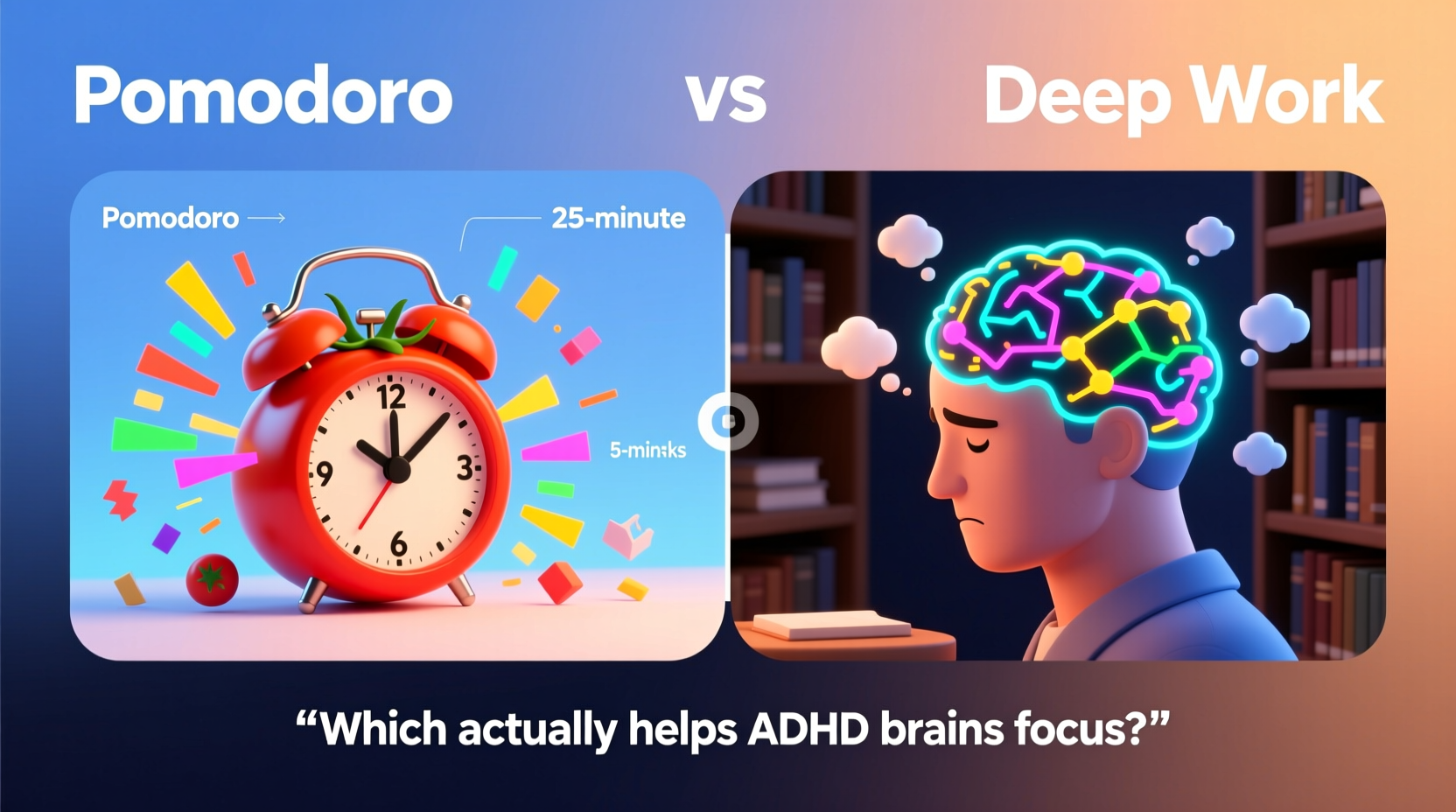
The Pomodoro Technique, developed by Francesco Cirillo in the late 1980s, breaks work into 25-minute intervals called “Pomodoros,” separated by 5-minute breaks. After four cycles, a longer break of 15–30 minutes is taken. The method emphasizes rhythm, structure, and micro-commitments—making starting less intimidating.
Deep Work, a concept popularized by computer science professor Cal Newport, advocates for extended periods—typically 90 minutes to 4 hours—of distraction-free, high-concentration work on cognitively demanding tasks. It requires deliberate environmental control, elimination of interruptions, and mental conditioning to sustain focus.
At first glance, these systems appear to be opposites: one favors fragmentation; the other demands continuity. For neurotypical users, both can be effective depending on context. But for those with ADHD, the difference isn’t just preference—it’s compatibility with brain function.
ADHD and Focus: Why Traditional Productivity Fails
ADHD is not a deficit of attention but a dysregulation of attention. People with ADHD don’t lack focus—they often experience hyperfocus, especially on stimulating or emotionally engaging tasks. The challenge lies in directing that focus intentionally, particularly toward low-stimulation or non-rewarding responsibilities like administrative work, email management, or studying dry material.
Dopamine plays a critical role. ADHD brains have impaired dopamine signaling, meaning they require higher stimulation to achieve motivation and task initiation. This explains why urgent deadlines or last-minute crises often trigger sudden bursts of productivity—a phenomenon known as \"time blindness\" paired with \"crisis mode.\"
Most conventional advice—“just sit down and get started”—ignores this neurochemical reality. Strategies that rely solely on willpower or long stretches of monotony are doomed to fail. What’s needed are systems that work with, not against, the ADHD brain’s wiring.
“The key to managing ADHD isn’t trying harder. It’s designing your environment and routines so that doing the right thing is easier.” — Dr. Russell Barkley, Clinical Neuropsychologist and ADHD Researcher
Pomodoro Technique: Strengths and Pitfalls for ADHD
The Pomodoro Technique offers several advantages for ADHD brains:
- Reduces task initiation resistance: Committing to just 25 minutes feels manageable, lowering the psychological barrier to starting.
- Builds momentum through small wins: Each completed Pomodoro reinforces a sense of progress, triggering modest dopamine release.
- Incorporates structured breaks: Regular pauses help prevent burnout and allow for movement, which supports focus in ADHD.
- Creates external rhythm: The timer acts as an external regulator, compensating for poor internal time perception.
However, the technique has limitations:
- Interruptions disrupt hyperfocus: When someone with ADHD finally enters a productive state, a timer ringing after 25 minutes can feel jarring and counterproductive.
- Rigid structure may increase anxiety: The pressure to perform within strict windows can backfire, especially if a session is interrupted by distraction.
- Breaks can become traps: Five minutes scrolling social media often turns into 30, breaking continuity and making re-entry difficult.
Still, many ADHD individuals report success with modified versions—using visual timers, pairing Pomodoros with body-doubling (working alongside someone else), or combining them with reward systems.
Deep Work: Is It Possible with ADHD?
On paper, Deep Work seems incompatible with ADHD. Sustained, uninterrupted focus for hours contradicts the stereotype of distractibility. Yet, paradoxically, people with ADHD are capable of extraordinary concentration—when the task is inherently interesting or urgent.
The issue isn’t capacity for deep focus—it’s consistency and controllability. Deep Work, as prescribed, assumes the ability to choose focus at will. For ADHD brains, this choice is constrained by interest-based nervous system (IBNS) dynamics. As psychologist Dr. William Dodson explains, “Adults with ADHD do not lack attention. They lack the ability to regulate it on demand unless something makes the task compelling.”
That said, elements of Deep Work can be adapted:
- Time-blocking: Scheduling deep work during peak energy times (e.g., morning for some, night for others) increases odds of success.
- Environmental design: Removing distractions—phone on airplane mode, website blockers, noise-canceling headphones—reduces cognitive load.
- Pre-commitment rituals: Starting with a consistent routine (e.g., coffee + playlist + specific workspace) signals the brain it’s time to shift gears.
But expecting 3-hour blocks of focus without scaffolding sets most ADHD individuals up for failure. Instead, incremental training—starting with 30 minutes and gradually extending—is more realistic.
Comparative Analysis: Pomodoro vs Deep Work for ADHD
| Criteria | Pomodoro Technique | Deep Work |
|---|---|---|
| Task Initiation Support | High – Low barrier to start | Low – Requires strong self-direction |
| Suitability for Low-Stimulus Tasks | Moderate – Breaks help manage boredom | Poor – Hard to sustain without intrinsic interest |
| Flexibility | High – Easy to customize duration | Low – Structured around long blocks |
| Dopamine Reinforcement | High – Frequent feedback loops | Delayed – Reward only after completion |
| Distraction Management | Moderate – Timer encourages staying on task | High – Built-in isolation protocols |
| Best Use Case | Routine tasks, email, admin work | Creative projects, writing, coding |
The table reveals a crucial insight: neither method is universally superior. Their effectiveness depends on the type of task, time of day, energy level, and personal triggers for engagement.
Hybrid Approach: Combining the Best of Both Worlds
Instead of choosing one method, many ADHD individuals benefit from a dynamic, hybrid strategy—using Pomodoro for task initiation and maintenance, then transitioning into Deep Work when momentum builds.
- Start with a Pomodoro sprint on a low-priority or dreaded task. The short commitment lowers resistance.
- Use body-doubling or focus apps (e.g., Focusmate, Flow Club) to increase accountability.
- If flow state emerges, let the timer go. Skip the break and continue until natural fatigue or distraction occurs.
- After disengaging, assess energy. If still alert, begin a scheduled Deep Work block on a high-value project.
- End with reflection: What triggered focus? Was it the task, environment, or timing? Use insights to refine future planning.
Mini Case Study: Maya’s Shift from Burnout to Sustainable Focus
Maya, a freelance graphic designer with diagnosed ADHD, used to work in chaotic bursts—pulling all-nighters before deadlines, then crashing for days. She tried Deep Work after reading Cal Newport’s book but lasted only two days. “Sitting for three hours felt impossible. I’d open my laptop, check email, scroll Instagram, and shut it down in frustration.”
Her breakthrough came when she switched to a modified Pomodoro system: 20-minute work intervals with 10-minute movement breaks. She used a physical timer and worked in a shared co-working space to reduce home distractions.
Over time, she noticed that on certain mornings—after exercise and a protein-rich breakfast—she could extend her focus. She began scheduling creative work during those windows, allowing herself to skip breaks when in flow. Now, she uses Pomodoro for client emails and admin, and Deep Work-style blocks (60–90 minutes) for design sprints.
“I stopped forcing myself to fit a neurotypical mold,” she says. “Now I work with my brain. Some days are short bursts. Others, I disappear into a project for hours. Both are valid.”
Actionable Checklist: Building Your ADHD-Friendly Focus System
Use this checklist to create a personalized focus strategy:
- ✅ Identify your peak focus times (morning, night, post-exercise)
- ✅ Choose a starter method: Pomodoro for low-motivation tasks, Deep Work prep for high-priority projects
- ✅ Modify interval lengths to match your attention span (start small)
- ✅ Eliminate digital distractions using app blockers (Freedom, Cold Turkey)
- ✅ Incorporate movement before and between sessions
- ✅ Use body-doubling for accountability (virtual coworking, study streams)
- ✅ Track what works weekly—adjust based on real data, not guilt
Frequently Asked Questions
Can people with ADHD achieve deep work at all?
Yes—but not through sheer willpower. Deep work is achievable when conditions align: high personal interest, minimized distractions, optimal energy levels, and supportive routines. It’s less about duration and more about intentionality. Many with ADHD enter deep work states naturally; the challenge is making it happen on demand.
Is the Pomodoro Technique too rigid for ADHD?
The original method can be. However, its core principle—breaking work into manageable chunks—is highly compatible with ADHD. Success comes from adapting it: changing timer lengths, skipping breaks when in flow, or using visual timers. Rigidity fails; flexibility sustains.
What if both methods still don’t work?
Some brains need additional support. Consider combining focus techniques with medication (if prescribed), therapy (especially CBT for ADHD), or assistive tools like text-to-speech, dictation software, or task gamification apps. Productivity isn’t one-size-fits-all—experimentation is part of the process.
Conclusion: Focus Is Not a Moral Failing—It’s a Design Challenge
The debate between Pomodoro Technique and Deep Work isn’t about which is better in absolute terms. For ADHD brains, it’s about finding what creates the conditions for attention to emerge. Pomodoro excels at lowering the cost of starting. Deep Work harnesses the power of immersion when conditions are right. The most effective approach is not loyalty to a single system, but strategic fluidity—shifting between methods based on energy, task type, and personal rhythms.
Stop measuring your worth by how long you can sit still. Start measuring progress by how well you understand your mind. Experiment. Adapt. Celebrate small victories. The goal isn’t perfection—it’s sustainable momentum.




 浙公网安备
33010002000092号
浙公网安备
33010002000092号 浙B2-20120091-4
Comments
No comments yet. Why don't you start the discussion?