
For individuals with ADHD, traditional time management strategies often fall short. The brain’s unique wiring—prone to distraction, hyperfocus, and fluctuating energy levels—demands a more adaptive approach to productivity. Two methods have gained traction in recent years: the structured Pomodoro Technique and the fluid Flowtime Method. While both aim to improve focus and task completion, they take opposing philosophies. One relies on rigid intervals; the other embraces natural rhythms. So, which one truly supports sustained productivity for people with ADHD?
The answer isn’t universal. It depends on personal neurotype, current mental state, and the nature of the task. But by understanding how each system works—and where they succeed or fail under ADHD conditions—we can make informed choices that honor our cognitive patterns rather than fight them.
The Pomodoro Technique: Structure as a Scaffold
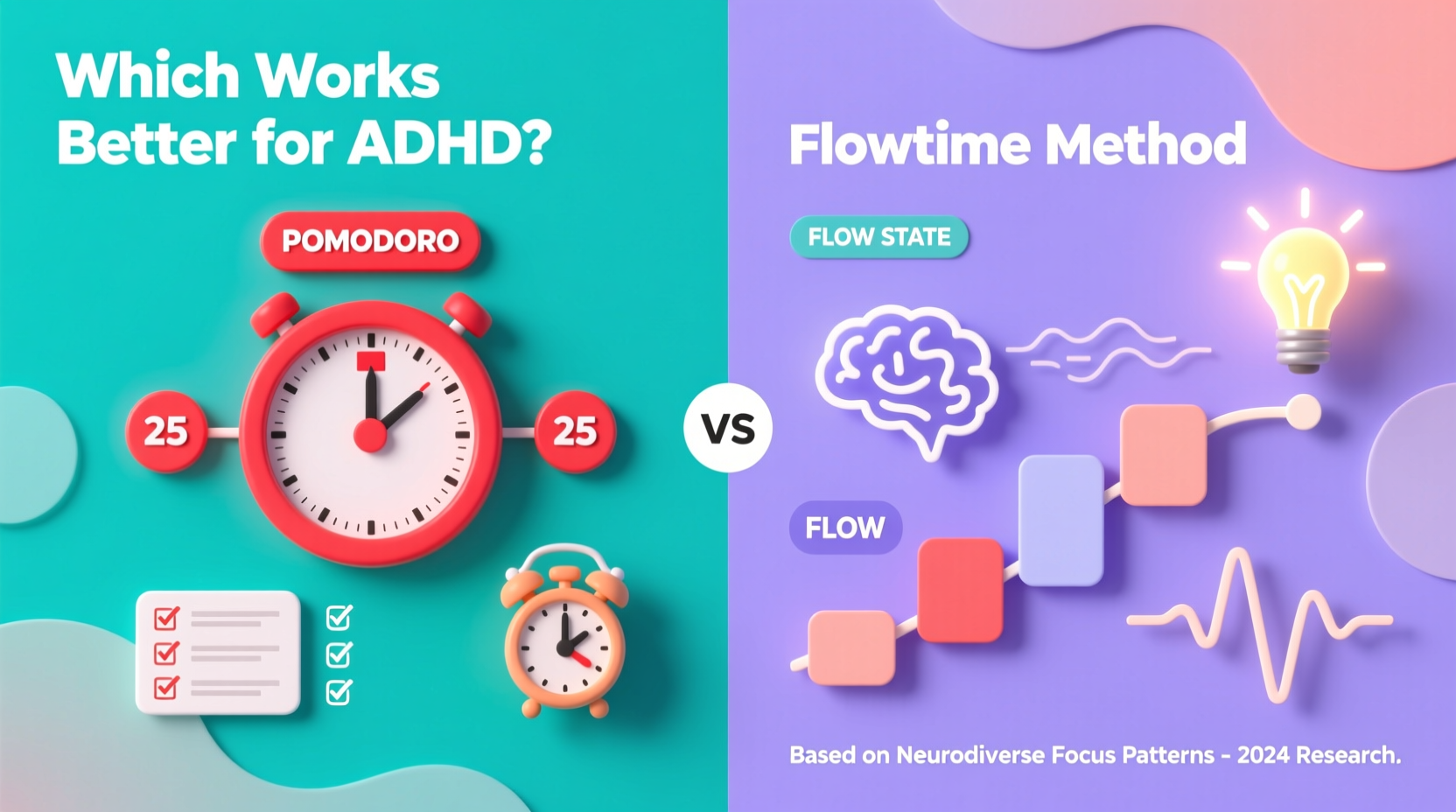
Developed by Francesco Cirillo in the late 1980s, the Pomodoro Technique breaks work into 25-minute blocks called \"Pomodoros,\" followed by a 5-minute break. After four cycles, a longer 15–30 minute break is taken. The method emphasizes consistency, external timing, and interruption logging to reduce distractions.
For many with ADHD, this structure provides a crucial framework. The ticking timer creates urgency, helping overcome procrastination. Knowing a break is just 25 minutes away reduces the anxiety of starting a large task. Additionally, the ritual of tracking completed Pomodoros offers tangible progress feedback—a powerful motivator when dopamine regulation is impaired.
However, the rigidity of Pomodoro can backfire. If deep focus kicks in at minute 20, being forced to stop can disrupt momentum. Conversely, if motivation hasn't engaged by minute 25, ending the session may feel like failure. For those whose attention spans vary hourly, fixed intervals can feel arbitrary or even frustrating.
The Flowtime Method: Flexibility Over Force
In contrast, the Flowtime Method—popularized by programmer and blogger Steve Perry—rejects fixed durations entirely. Instead, you begin working and note the start time. When you naturally feel tired, distracted, or ready for a break, you stop and record the duration. Breaks are also self-determined. The goal is awareness, not enforcement.
This method aligns closely with how ADHD brains often operate: in bursts of intense focus (hyperfocus) interspersed with rest or shifting interests. By removing artificial deadlines within the work session, Flowtime reduces pressure and honors internal cues. It encourages listening to your body and mind, promoting sustainability over short-term output.
Flowtime excels in tasks requiring creativity or problem-solving, where interruptions are costly. It allows someone in hyperfocus to continue uninterrupted, potentially achieving more in one extended session than in several fragmented ones. It also avoids the “just five more minutes” guilt trap common in Pomodoro when a timer ends mid-flow.
“Productivity isn’t about forcing attention—it’s about cultivating conditions where focus can emerge naturally.” — Dr. Ari Tuckman, Psychologist and ADHD Specialist
Comparing Pomodoro and Flowtime for ADHD: A Side-by-Side Analysis
| Criteria | Pomodoro Technique | Flowtime Method |
|---|---|---|
| Structure | Highly structured; fixed intervals | Flexible; self-paced timing |
| Best For | Starting tasks, routine work, overcoming procrastination | Creative work, deep thinking, hyperfocus-prone individuals |
| ADHD Challenge Addressed | Initiation difficulty, time blindness | Hyperfocus crashes, burnout from overwork |
| Risk for ADHD Users | Interrupting flow, feeling trapped by timer | Losing track of time, skipping breaks, burnout |
| Mental Load | Moderate (requires adherence to schedule) | Low (minimal rules, intuitive pacing) |
| Tracking Required | Yes (Pomodoros completed, interruptions) | Yes (start/stop times, reflection notes) |
The table reveals a fundamental trade-off: Pomodoro offers scaffolding at the cost of flexibility; Flowtime grants freedom but demands self-awareness. For ADHD individuals, neither is inherently superior—but context determines effectiveness.
Real-World Application: A Mini Case Study
Meet Jamie, a freelance graphic designer with ADHD. Jamie struggles with inconsistent energy and frequent task-switching. Some days, opening design software feels impossible; other days, hours vanish while perfecting a logo.
On low-motivation days, Jamie uses Pomodoro. Setting a timer for 25 minutes to “just open the file and sketch one idea” lowers the barrier to entry. Often, once started, Jamie continues into a second or third Pomodoro. The structure prevents overwhelm and builds momentum.
On high-energy days, Pomodoro feels restrictive. When inspiration strikes, stopping every 25 minutes disrupts creative flow. Instead, Jamie switches to Flowtime. Starting work at 10:17 a.m., Jamie works until noticing mental fatigue at 11:43 a.m.—a 86-minute stretch. A 20-minute walk follows, then another self-timed session begins.
By using both methods situationally, Jamie maintains consistency without sacrificing creativity. The key insight: productivity isn’t about choosing one system forever, but knowing when to apply each.
Step-by-Step Guide: How to Choose the Right Method for Your ADHD Brain
Selecting between Pomodoro and Flowtime shouldn’t be arbitrary. Follow this decision framework to match the method to your current state and task type.
- Assess your energy and focus level
Are you feeling scattered and avoidant? Pomodoro’s structure may help initiate action. Are you already engaged or in a creative mood? Flowtime will preserve momentum. - Evaluate the task
Routine, repetitive, or boring tasks (email, admin, studying) benefit from Pomodoro’s gamification. Complex, creative, or open-ended tasks (writing, coding, designing) thrive under Flowtime’s uninterrupted focus. - Check your environment
If distractions are high (noisy space, tempting devices), Pomodoro’s defined boundaries create psychological safety. In a calm, controlled environment, Flowtime’s autonomy is safer. - Decide on break strategy
Pomodoro automates breaks—ideal if you forget to rest. Flowtime requires intentional pause recognition. If you tend to hyperfocus to exhaustion, set a soft alarm as a reminder to check in every 60–90 minutes. - Track and reflect weekly
Keep a simple log: method used, task, duration, energy level, outcome. After a week, review what worked. Adjust accordingly.
Expert Recommendations for ADHD-Friendly Productivity
Dr. Melissa Shepard, a psychiatrist specializing in adult ADHD, emphasizes adaptability: “The best productivity system for ADHD is the one you can stick with—and that means it has to be forgiving. Rigid systems fail when life gets messy, and life with ADHD often is.”
She recommends hybrid approaches. For example, using Pomodoro with adjusted intervals—30 minutes on, 10 off—or allowing “overflow Pomodoros” if momentum is strong. She also cautions against over-reliance on timers: “If the timer becomes a source of stress, it’s counterproductive. The tool should serve you, not enslave you.”
Another key insight: external accountability boosts success. Pair either method with a body-doubling session (working alongside someone else, virtually or in person) to increase follow-through. This leverages social motivation, a powerful driver for many with ADHD.
Practical Checklist: Optimizing Either Method for ADHD
- ✅ Start small—don’t expect immediate mastery of either technique
- ✅ Customize interval lengths to fit your natural rhythm (e.g., 20/5 or 50/15)
- ✅ Use a distraction log during work sessions to identify recurring interruptions
- ✅ Pair with body doubling or focus music if solo work is challenging
- ✅ Schedule tasks at times of day when your energy aligns with their demands
- ✅ Reflect weekly: What helped? What felt forced? Adjust accordingly
- ✅ Prioritize task initiation over completion—starting is often the hardest part
Frequently Asked Questions
Can I use both Pomodoro and Flowtime in the same day?
Absolutely. Many ADHD individuals find success by using Pomodoro for low-engagement tasks (like replying to emails) and switching to Flowtime for creative or immersive work. The key is intentionality—choose the method based on the task and your current state, not habit.
What if I keep ignoring my timer or losing track of time?
This is common with ADHD. Try using a visual timer (like a Time Timer) that shows time elapsing. For Flowtime, set a gentle recurring reminder (e.g., hourly) to check in: “Am I still focused? Do I need a break?” These act as cognitive aids without enforcing rigidity.
Is there a risk of burnout with Flowtime?
Yes—if you’re prone to hyperfocus, Flowtime can enable overwork. To prevent this, pair it with environmental cues: stand up and stretch when you notice tension, drink water every time you finish a session, or commit to a 10-minute walk after 90 minutes of continuous work. Build recovery into your rhythm.
Conclusion: Work With Your Brain, Not Against It
The debate between Pomodoro and Flowtime isn’t about finding the single “best” method. It’s about recognizing that ADHD doesn’t need more pressure—it needs smarter support. Pomodoro offers a launchpad for action when inertia is high. Flowtime protects deep work when inspiration flows. The most effective strategy is not choosing one over the other, but learning to pivot between them based on your needs in the moment.
True productivity for ADHD isn’t measured in hours logged or timers completed. It’s measured in reduced stress, consistent progress, and the ability to engage meaningfully with work without self-punishment. Whether you lean toward structure or spontaneity, the goal remains the same: to design a workflow that respects your neurology, not resists it.




 浙公网安备
33010002000092号
浙公网安备
33010002000092号 浙B2-20120091-4
Comments
No comments yet. Why don't you start the discussion?