
For people with ADHD, traditional productivity advice often falls short. The struggle isn’t just about focus—it’s about managing fluctuating energy levels, emotional regulation, and the constant pull of distractions. Two popular time-based systems—Pomodoro and Flowtime—offer different approaches to structuring work. But which one aligns better with the neurodivergent brain?
The Pomodoro Technique relies on rigid intervals: 25 minutes of focused work followed by a 5-minute break. Flowtime, in contrast, is fluid—working in natural bursts of concentration and pausing only when mental fatigue sets in. While both aim to reduce burnout and improve output, their effectiveness varies dramatically depending on individual cognitive rhythms.
This article dives deep into how each method functions, evaluates their strengths and limitations for ADHD brains, and provides actionable guidance to help you choose or adapt the right system.
Understanding the Core Differences
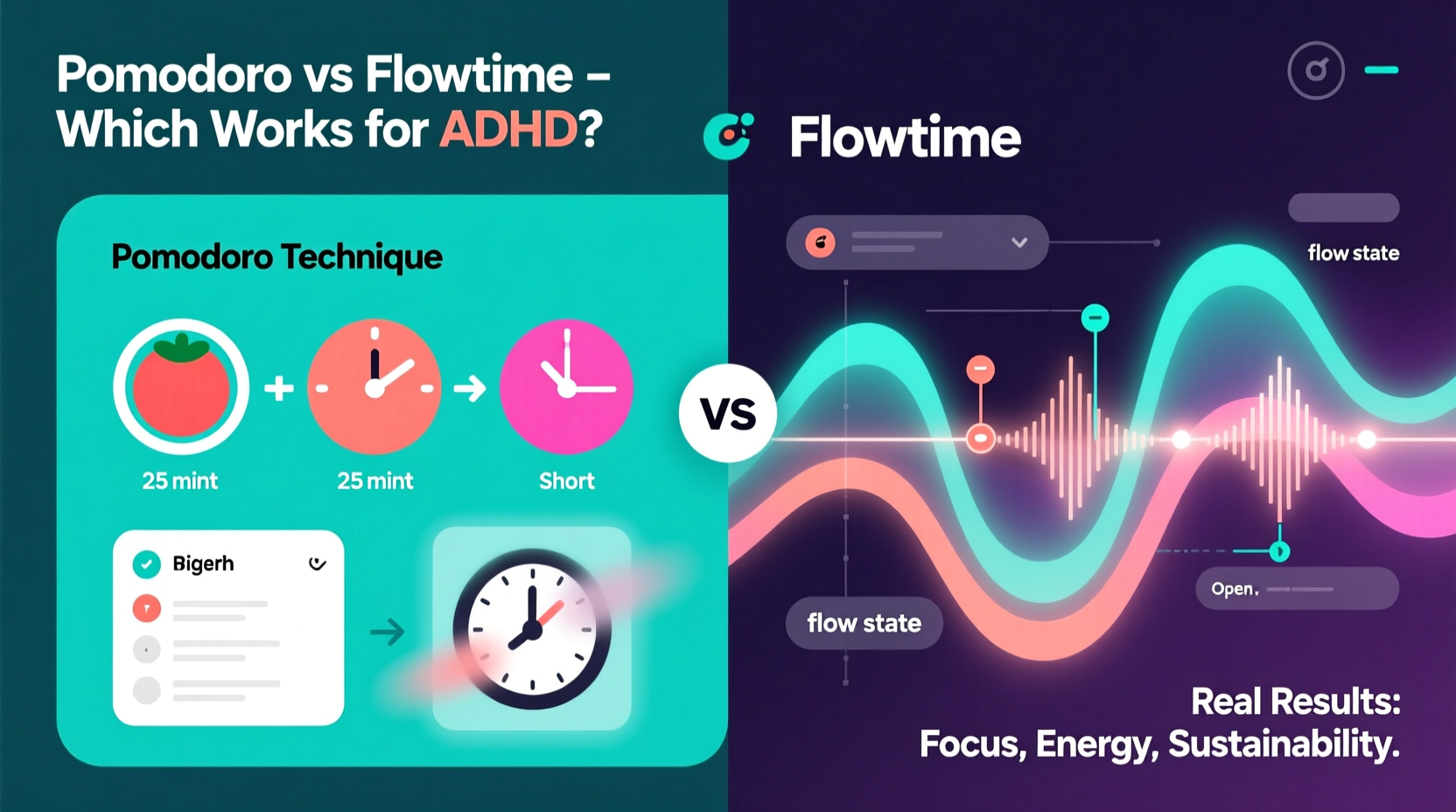
At first glance, Pomodoro and Flowtime seem like variations of the same idea: break work into manageable chunks. But their underlying philosophies diverge significantly.
Pomodoro was developed in the late 1980s by Francesco Cirillo. It emphasizes predictability and structure. Each \"Pomodoro\" is a fixed 25-minute block. After four cycles, a longer 15–30 minute break follows. Tasks are pre-planned, and interruptions are discouraged. If distracted, the timer resets. This rigidity creates external accountability—useful for those who need scaffolding to start tasks.
Flowtime, developed later as a response to Pomodoro’s rigidity, embraces biological rhythms. Instead of forcing focus into boxes, it encourages working until natural fatigue or distraction occurs, then taking a break. There’s no set duration. You might work 40 minutes, pause for 10, then return for another stretch. The goal is to honor your internal state rather than override it.
For neurotypical individuals, either method may work well. But for ADHD brains, where executive dysfunction, rejection sensitivity, and inconsistent attention spans are common, the choice matters deeply.
Why ADHD Brains Struggle with Traditional Time Management
ADHD isn’t just about being “distracted.” It involves impaired executive function—the brain’s ability to plan, initiate, switch tasks, and regulate emotions. Many with ADHD experience:
- Time blindness: Difficulty estimating how long tasks take.
- Motivation lag: Delayed dopamine response makes starting hard, even for desired activities.
- Hyperfocus: Intense immersion in engaging tasks, often at the expense of others.
- Task paralysis: Overwhelm from decision-making or initiation leads to avoidance.
Rigid systems like Pomodoro can feel punishing when time pressure triggers anxiety. Conversely, overly flexible methods may lack enough structure to overcome inertia. The ideal approach must balance flexibility with gentle support.
“People with ADHD don’t lack discipline—they lack systems that respect their neurology.” — Dr. Ari Tuckman, clinical psychologist and ADHD specialist
Comparing Pomodoro and Flowtime for ADHD: A Practical Breakdown
| Feature | Pomodoro Technique | Flowtime Method |
|---|---|---|
| Structure | Fixed intervals (25 min work / 5 min break) | Flexible, self-paced work and rest cycles |
| Initiation Support | High – low barrier to start one “tiny” session | Moderate – requires self-awareness to begin |
| Adaptability to Focus Fluctuations | Low – ignores natural rhythm shifts | High – aligns with attention ebbs and flows |
| Impact on Hyperfocus | Disruptive – forces breaks during productive streaks | Supportive – allows deep work to continue |
| Emotional Load | Can increase stress if timers feel punitive | Lower – less pressure, more autonomy |
| Best For | Task initiation, routine work, deadline-driven projects | Creative work, variable energy days, avoiding burnout |
The table reveals a critical insight: Pomodoro excels at helping someone *start* when motivation is low. Flowtime shines when momentum exists but needs preservation. For ADHD individuals, this means neither method is universally superior—they serve different purposes.
A Real-World Example: Sarah’s Writing Workflow
Sarah, a freelance writer with ADHD, used to dread starting articles. She’d open her laptop, scroll social media, then close it in frustration. When she tried Pomodoro, the first few days were rocky—she resented the timer and felt rushed. But after committing to just one 25-minute session per day, something shifted.
She realized the timer wasn’t a taskmaster but a permission slip: “You only have to do 25 minutes. That’s all.” On good days, she’d finish one Pomodoro and keep writing—sometimes for two hours straight. On rough days, she stopped after one and counted it a win.
Eventually, she blended both methods. She used Pomodoro to begin writing sessions. Once engaged, she turned off the timer and worked in Flowtime mode, pausing only when she noticed her thoughts drifting or energy dipping. This hybrid approach reduced resistance and honored her fluctuating capacity.
“It’s not about forcing myself to work,” she says. “It’s about finding the gentlest way to get started—and the smartest way to keep going.”
How to Adapt These Methods for ADHD Success
Neither Pomodoro nor Flowtime was designed with ADHD in mind. But both can be modified to support neurodivergent cognition. Here’s how:
Step-by-Step: Customizing Your Productivity System
- Start with intention, not timing. Ask: “What’s the smallest step I can take?” Instead of “write report,” try “open document and write one sentence.”
- Adjust Pomodoro intervals. Try 15-minute work blocks with 10-minute breaks. Or extend to 50/10 if 25 feels too short. Call them “focus sprints,” not Pomodoros, to reduce performance pressure.
- Use visual cues. Place a physical timer where you can see it, or use apps like Focus To-Do or Be Focused. Visual progress reduces time blindness.
- Track energy, not just time. In a notebook or app, note when you felt alert, distracted, or drained. Over time, patterns emerge—use them to schedule demanding tasks during peak energy.
- Switch to Flowtime after initiation. Use one modified Pomodoro to begin, then drop the timer and work until natural fatigue. Mark when you paused and why.
- Reflect weekly. Review what helped you start, what kept you going, and what derailed you. Adjust accordingly.
Checklist: Building an ADHD-Friendly Workflow
- ✅ Define micro-tasks (under 5 minutes to start)
- ✅ Choose flexible time blocks (15–50 mins based on energy)
- ✅ Schedule high-focus work during natural energy peaks
- ✅ Allow movement breaks (walking, stretching, doodling)
- ✅ Use body-doubling or focus partners when stuck
- ✅ Celebrate completion of any work block—no minimum output required
- ✅ Review weekly to refine your approach
When to Use Each Method: Decision Framework
Choosing between Pomodoro and Flowtime shouldn’t be arbitrary. Consider these scenarios:
- Use Pomodoro when: You’re avoiding a task, feeling overwhelmed, or need to build consistency. Its structure lowers the activation energy to begin.
- Use Flowtime when: You’re already engaged, working on creative or complex tasks, or experiencing high mental fatigue. It prevents unnecessary interruptions.
- Combine both when: You need to start something challenging but want to preserve momentum once underway.
The key is recognizing that ADHD productivity isn’t about discipline—it’s about designing systems that work *with* your brain, not against it.
Frequently Asked Questions
Can people with ADHD benefit from the Pomodoro Technique?
Yes—but only when adapted. Standard 25-minute blocks may feel too long or too short. Shorter intervals (10–15 minutes), optional breaks, and reframing the timer as a supportive tool (not a judge) make it more sustainable. The main benefit is lowering the barrier to starting.
Does Flowtime encourage procrastination in ADHD?
Not inherently. Flowtime requires self-awareness to recognize when focus drops. For some with ADHD, this awareness is underdeveloped. However, when paired with regular check-ins and environmental cues (like turning off notifications), Flowtime can prevent burnout by honoring natural limits.
Is there research supporting either method for ADHD?
There’s no direct clinical study comparing Pomodoro or Flowtime specifically for ADHD. However, behavioral research supports external structure (Pomodoro’s strength) and minimizing cognitive load (Flowtime’s advantage). Experts recommend individualized approaches over one-size-fits-all systems.
Conclusion: Match the Method to Your Moment
There’s no single “best” productivity method for ADHD brains. The truth is more nuanced: the right tool depends on the task, your energy, and your emotional state in the moment.
Pomodoro offers scaffolding when you’re stuck. Flowtime offers freedom when you’re moving. The most effective strategy isn’t choosing one over the other—it’s learning to fluidly shift between them based on your needs.
Stop trying to force yourself into systems designed for neurotypical minds. Instead, experiment. Modify. Listen to your body and attention. Track what works—not what “should” work.




 浙公网安备
33010002000092号
浙公网安备
33010002000092号 浙B2-20120091-4
Comments
No comments yet. Why don't you start the discussion?