
In the battle for indoor comfort during sweltering summer months, two cooling solutions stand out for renters, urban dwellers, and those without central air: portable air conditioners and window units. Both offer a way to beat the heat without major installation or structural changes. But when comparing them side by side, one question consistently arises—especially among apartment residents and small-space users—is the convenience of rolling a portable AC from room to room really worth the trade-off in noise, efficiency, and overall performance?
This isn’t just about personal preference. It’s about understanding how each system works, where they excel, and what compromises you’re actually making when you choose mobility over power. Let’s break down the realities behind both options and determine whether that easy-to-move feature justifies the downsides.
How Portable ACs and Window Units Work
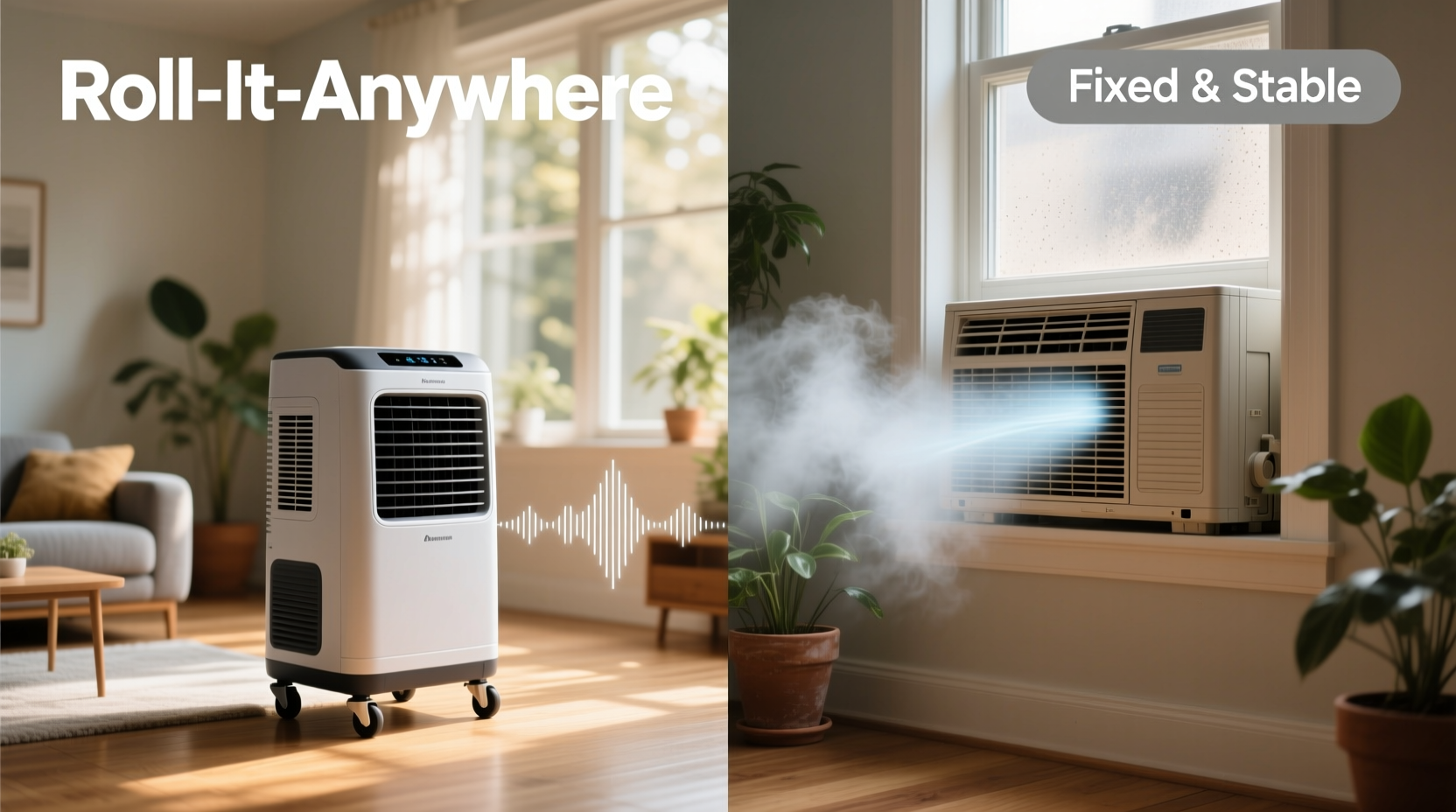
Before diving into the noise debate, it’s essential to understand the fundamental differences in operation between these two types of cooling systems.
Window air conditioners are self-contained units installed directly into a window frame. They pull warm air from inside the room, cool it using refrigerant and an evaporator coil, then expel the hot air outside through the condenser. Because all components are integrated into a single chassis, they operate efficiently with minimal moving parts exposed indoors.
Portable air conditioners, on the other hand, sit entirely inside the room. They still draw in warm air, cool it, and must vent the resulting hot air—but instead of doing so through the unit's back like a window model, they require a hose (or sometimes two) to be routed out a window, door, or wall. This setup allows the unit to remain mobile but introduces inefficiencies due to airflow resistance and imperfect sealing.
The key takeaway? While both systems rely on the same basic refrigeration cycle, their design impacts everything from energy use to noise levels and cooling consistency.
Noise Levels: The Real Trade-Off
Noise is often the most immediate and noticeable difference between portable and window units. Most people expect some level of sound from an AC, but the type, volume, and location of that noise matter significantly.
Window units generate noise too, but because much of the mechanical action—especially the compressor and condenser fan—occurs outside the living space, the indoor experience is generally quieter. Average decibel levels for modern window models range from 45 to 55 dB, comparable to a quiet conversation or background office hum.
Portable ACs, however, house all components—including the compressor and exhaust fan—inside the room. As a result, they typically operate between 50 and 60 dB, with some budget models exceeding 65 dB. That’s equivalent to normal speech at close range or even approaching the volume of a vacuum cleaner. Worse, the noise is continuous and often includes a low-frequency hum that can be more disruptive than higher-pitched sounds.
Moreover, many portable units have dual-hose systems that reduce strain on internal fans, but even those don't eliminate the issue entirely. Single-hose models create negative pressure in the room, forcing the unit to work harder and increasing fan speed—and therefore noise—to compensate.
“From an acoustic engineering standpoint, placing the compressor indoors inherently increases perceived noise. Even with dampening materials, physics limits how quiet a portable AC can get.” — Dr. Alan Zhou, HVAC Acoustics Researcher, MIT Building Technology Group
Cooling Performance and Efficiency Compared
Beyond noise, cooling effectiveness is another critical factor. Here, window units hold a clear advantage.
Window air conditioners are generally more powerful, measured in higher BTUs (British Thermal Units) relative to size, and deliver faster, more consistent cooling. Their sealed installation prevents conditioned air from escaping and hot air from entering, maximizing efficiency. ENERGY STAR-rated window units can achieve seasonal energy efficiency ratios (SEER) of 10–12, making them relatively economical to run.
Portable ACs, by contrast, struggle with efficiency. The flexible exhaust hose restricts airflow, reducing effective cooling capacity by up to 15%. Additionally, the need to vent through a window kit often leaves gaps, allowing hot outdoor air to seep back in. This creates a constant battle between cooling and infiltration, driving up runtime and electricity costs.
Worse, portable units consume more energy per BTU delivered. A typical 10,000 BTU portable AC might draw 1,200 watts, while a comparable window unit uses only 900–1,000 watts. Over a summer season, that difference adds up—not just in noise, but on your electric bill.
| Feature | Portable AC | Window Unit |
|---|---|---|
| Average Noise Level | 55–65 dB | 45–55 dB |
| Energy Use (10,000 BTU) | 1,100–1,300 watts | 900–1,100 watts |
| Cooling Speed | Moderate (slower due to airflow loss) | Fast (direct, sealed cooling) |
| Installation Flexibility | High (no permanent setup) | Low (requires window access) |
| Portability | High (wheels included) | None (fixed location) |
| Dehumidification Effectiveness | Good (but varies with humidity) | Excellent (consistent removal) |
When Portability Actually Matters
Despite their drawbacks, portable ACs aren’t obsolete. There are specific scenarios where their mobility becomes a decisive advantage.
Consider renters who aren’t allowed to install window units, or those living in buildings with non-standard windows (like casement or round-top styles). In such cases, a portable unit may be the only viable option. Similarly, if you frequently switch rooms—using a guest bedroom in summer or working from different areas of a studio apartment—the ability to roll the AC where it’s needed offers real utility.
One user in Chicago, Maria T., shared her experience: “I live in a converted loft with steel-frame windows that can’t support a traditional AC. My landlord won’t approve modifications. The portable unit lets me cool my bedroom at night and move it to the living area during the day. It’s loud, yes, but I use it with a fan and keep the door closed. For me, the flexibility outweighs the noise.”
This highlights a crucial point: value is context-dependent. If you’re choosing between a portable AC and nothing at all, the former wins—even with its flaws.
Step-by-Step: Choosing the Right Option for Your Space
Deciding between a portable and window unit doesn’t have to be guesswork. Follow this practical decision-making process:
- Assess your window compatibility. Can you safely and securely install a window unit? Does your building permit it? If not, a portable may be your only choice.
- Measure your room size. Calculate square footage and match it to the recommended BTU rating. Oversizing wastes energy; undersizing leads to poor performance.
- Evaluate noise sensitivity. Will the unit run in a bedroom, home office, or nursery? If silence is critical, prioritize a window model or look for ultra-quiet portables (some newer models claim sub-50 dB operation).
- Check power and outlet availability. Both types require dedicated circuits. Portable units often need grounded outlets near the floor, which may require extension cords (not recommended for safety).
- Consider long-term use. Are you renting short-term or planning to stay? If temporary, portability has greater value. If permanent, invest in a more efficient, quieter window unit.
- Test ventilation options. For portables, ensure you can route the exhaust hose without blocking egress or creating leaks. Improper venting negates cooling gains.
Expert Tips for Maximizing Any Cooling System
Regardless of which type you choose, these strategies will improve performance and reduce noise impact:
- Seal gaps around the window unit or exhaust hose with foam tape or weatherstripping to prevent air leakage.
- Use ceiling fans or oscillating fans to distribute cooled air more evenly, reducing the load on the AC.
- Clean or replace filters every 2–4 weeks during peak season to maintain airflow and efficiency.
- Close blinds and curtains during daylight hours to minimize solar heat gain.
- Run the unit on a timer or smart plug to avoid unnecessary nighttime operation.
FAQ: Common Questions Answered
Can I use a portable AC without venting it?
No. Unvented portable ACs blow hot air back into the room, effectively acting as heaters. All portable units must be vented to the outdoors to remove heat and moisture. Never operate one in “fan-only” mode with the hose connected indoors—it defeats the purpose.
Do dual-hose portable ACs perform better than single-hose models?
Yes. Dual-hose units draw in fresh air for combustion and expel hot air separately, avoiding the negative pressure created by single-hose designs. This improves efficiency and reduces strain on the compressor, leading to slightly quieter operation and faster cooling.
Are window units dangerous?
When properly installed, window units are safe. However, they must be securely mounted to prevent falling. Use support brackets and follow manufacturer instructions. In high-rise buildings, some fire codes require secondary fasteners or restrict usage altogether.
Final Verdict: Is the Convenience Worth the Noise?
The answer depends on your priorities. If you value quiet operation, energy efficiency, and strong, reliable cooling, a window unit is almost always the superior choice. It delivers better performance at a lower noise level and typically costs less over time in electricity and maintenance.
However, if you need flexibility—because you move frequently, rent under strict rules, or live in a space where window installation isn’t feasible—then a portable AC offers a valuable compromise. Yes, it’s noisier. Yes, it’s less efficient. But it works, and it moves with you.
The convenience of rolling a portable AC from room to room isn’t inherently worth the noise—but it can be worth it when the alternative is enduring uncomfortable temperatures or violating lease terms. In those cases, accepting the hum is part of the deal.
“Every cooling solution involves trade-offs. The best choice isn’t the quietest or the most powerful—it’s the one that fits your life.” — Karen Liu, Residential HVAC Consultant, Northeast Energy Solutions
Take Action Today
Don’t suffer through another summer debating which AC to buy. Assess your space, test your window options, and decide based on real needs—not marketing claims. Whether you go with a window unit for its reliability or a portable for its flexibility, equip yourself with the right knowledge to make it work efficiently and quietly.




 浙公网安备
33010002000092号
浙公网安备
33010002000092号 浙B2-20120091-4
Comments
No comments yet. Why don't you start the discussion?