
When summer heat rolls in, many homeowners and renters look for fast, affordable ways to cool their space without installing central air. Two popular options emerge: portable air conditioners and window units. Both promise relief from rising temperatures, but which one delivers better efficiency, quieter operation, and long-term value? The question isn’t just about convenience—it’s about whether that sleek, mobile unit sitting in your living room is doing more than making noise.
Portable ACs are often marketed as a modern, flexible solution—no permanent installation, easy to move from room to room. Window units, on the other hand, have been around for decades, offering reliable cooling at a lower price point. But with growing concerns over energy costs, indoor comfort, and noise pollution, it’s worth asking: Is a portable air conditioner actually efficient, or is it just loud?
Cooling Performance: How Well Do They Actually Cool?
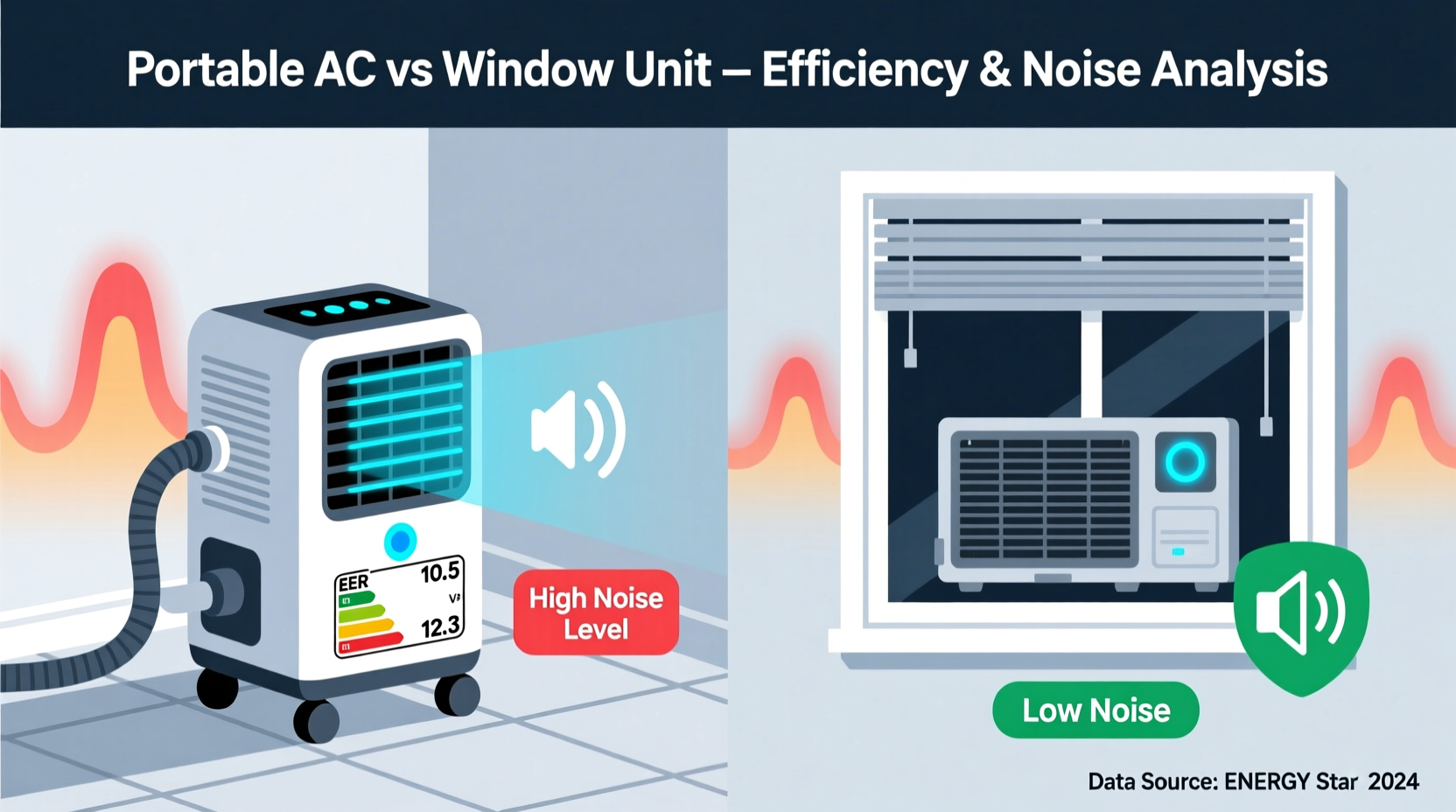
The core purpose of any air conditioner is to remove heat and humidity from indoor air. Both portable and window units use refrigerant-based compression cycles to achieve this, but their design leads to significant differences in effectiveness.
Window air conditioners are typically more powerful because they house all components—including the condenser, evaporator, and compressor—in a single compact unit mounted directly in the window. This setup allows them to expel hot air efficiently outside, minimizing recirculation of warm exhaust into the room.
Portable ACs, by contrast, rely on a single hose (or sometimes two) to vent hot air through a window kit. Single-hose models pull room air into the unit, cool it, and then use part of that same air to cool the internal components before exhausting it outside. This creates a slight negative pressure in the room, pulling in warm air from adjacent spaces or gaps in doors and walls—reducing overall cooling efficiency.
“Single-hose portables can lose up to 20% of their effective cooling capacity due to air infiltration. Dual-hose models improve this, but still lag behind comparably sized window units.” — Dr. Alan Peters, HVAC Efficiency Researcher, National Institute of Building Sciences
Dual-hose portable units separate intake and exhaust airflow, improving efficiency. However, even these models generally underperform window units of the same BTU rating. For example, a 10,000 BTU window unit will cool a 400–450 sq ft room effectively, while a portable unit of the same rating may struggle beyond 350 sq ft due to inefficiencies in heat rejection.
Noise Levels: Are Portable ACs Just Noisy?
Noise is one of the most common complaints about portable air conditioners. Unlike window units, where the noisiest components (compressor and condenser fan) are located outside, portable units operate entirely indoors. All mechanical noise—compressor cycling, fan rotation, refrigerant flow—is emitted directly into the room.
Most portable ACs range between 48 and 55 decibels (dB), comparable to moderate rainfall or a quiet conversation. However, because the unit is inside the living space, the sound feels more intrusive, especially at night. Some users report a constant \"humming\" or \"gurgling\" that disrupts sleep or concentration.
Window units also produce noise—typically between 50 and 60 dB—but since the loudest parts are partially outside, the perceived indoor noise is often less disruptive. Additionally, newer inverter-style window units operate more quietly by adjusting compressor speed rather than cycling on and off.
| Unit Type | Average Noise Level (dB) | Perceived Indoor Experience |
|---|---|---|
| Single-Hose Portable AC | 50–55 dB | Louder, continuous indoor hum; disruptive during sleep |
| Dual-Hose Portable AC | 48–53 dB | Slightly quieter, but still noticeable indoors |
| Standard Window Unit | 50–60 dB | Externalized noise; less intrusive indoors |
| Inverter Window Unit | 45–52 dB | Smooth, low-frequency operation; ideal for bedrooms |
If you're sensitive to noise or plan to use the AC in a bedroom or home office, a high-efficiency window model—especially an inverter type—will likely provide a more comfortable environment.
Energy Efficiency and Operating Costs
Efficiency in air conditioning is measured by EER (Energy Efficiency Ratio)—the cooling output (in BTUs) divided by the power input (in watts). Higher EER means lower electricity consumption for the same cooling effect.
On average, window units have higher EER ratings than portable ACs. A typical 10,000 BTU window unit might have an EER of 10–12, while a comparable portable model averages 8–9. That difference translates into real-world energy costs.
Let’s break it down:
- 10,000 BTU Window Unit (EER 11): Uses ~910 watts per hour
- 10,000 BTU Portable AC (EER 8.5): Uses ~1,176 watts per hour
Assuming 8 hours of daily use over a 90-day summer at $0.15 per kWh:
- Window unit cost: ~$99/year
- Portable AC cost: ~$127/year
That’s nearly $30 more annually for the portable unit—and that gap widens in hotter climates or larger rooms where the portable struggles to keep up and runs longer.
Installation, Portability, and Practical Trade-offs
The main advantage of portable air conditioners is obvious: mobility. With wheels and no permanent fixture, you can roll it from bedroom to living room as needed. Installation is simple—attach the exhaust hose to a window adapter, seal gaps with included panels, and plug it in.
However, this convenience comes with compromises:
- The exhaust hose blocks part of a window and must remain sealed to prevent hot air backflow.
- Units require regular draining (unless self-evaporative), which can mean emptying a reservoir every 8–12 hours in humid conditions.
- Floor space is occupied, and the unit can obstruct foot traffic or furniture layout.
Window units, while less flexible, offer a more permanent and efficient solution. Once installed, they’re out of the way, require minimal maintenance, and don’t take up floor space. Modern designs are slimmer and easier to install than older models, with slide-out brackets and adjustable panels that fit most double-hung windows.
Renters often prefer portables to avoid modifying window frames. But landlords increasingly allow window units with proper installation agreements. If you plan to stay in your space for more than one summer, investing in a window AC may make more sense.
Mini Case Study: Sarah’s Apartment Dilemma
Sarah rents a one-bedroom apartment in Phoenix, where summer highs regularly exceed 105°F. Last year, she bought a 12,000 BTU dual-hose portable AC, attracted by its “easy setup” and mobility. She placed it in her bedroom, routing the hose through a slider window.
By July, she noticed the unit ran almost nonstop, yet the room rarely dropped below 80°F. The constant drone made sleeping difficult, and she had to drain the water tank twice daily. Her electricity bill spiked by $45 that month.
This spring, she switched to a 12,000 BTU ENERGY STAR window unit. Installation took 20 minutes with help from her landlord. The difference was immediate: the room cooled to 74°F within 15 minutes, the unit cycled off regularly, and nighttime noise was barely noticeable. Her next electric bill increased by only $22.
“I thought portability was worth the trade-off,” Sarah said. “But when it’s 110 outside, I’d rather have real cooling than a machine that just makes noise.”
Which One Should You Choose? A Step-by-Step Decision Guide
Picking the right AC depends on your priorities: cooling performance, noise tolerance, budget, and living situation. Follow this decision timeline to find the best fit:
- Assess Your Room Size: Measure square footage and ceiling height. Rooms over 400 sq ft typically need 10,000+ BTUs. Larger or sun-exposed spaces may need 12,000–14,000 BTUs.
- Evaluate Installation Options: Can you install a window unit? Check lease terms and window type. Sliders, casement, and awning windows may not support standard units, making portables the only option.
- Consider Usage Patterns: Will you cool one room consistently, or move the unit frequently? Frequent relocation favors portables, but expect lower efficiency.
- Check Noise Sensitivity: If using in a bedroom or quiet workspace, prioritize low-decibel models. Inverter window units are best; avoid single-hose portables.
- Compare Energy Use: Calculate estimated annual operating cost using EER and local electricity rates. Factor in potential lifespan—window units often last 8–10 years vs. 5–7 for portables.
- Review Budget: Portable ACs start around $300–$500; window units range from $200–$450. Lower upfront cost and proven efficiency often make window units the better long-term investment.
FAQ: Common Questions About Portable vs Window ACs
Can a portable AC cool multiple rooms?
Generally, no. Portable units are designed for single-room cooling. Open floor plans may allow some airflow into adjacent areas, but performance drops significantly with distance and door closures. For whole-apartment cooling, consider multiple window units or a ductless mini-split system.
Why do portable ACs need to be vented?
Like all refrigerant-based ACs, portables generate heat during operation. Without a vent hose, that heat is released back into the room, negating cooling. Never operate a portable AC without proper exhaust—doing so turns it into a space heater.
Are dual-hose portable ACs worth the extra cost?
They are more efficient than single-hose models because they draw outdoor air for condenser cooling instead of room air. However, they still fall short of window units in both performance and noise. Only consider them if window installation is impossible and you need better efficiency than a single-hose model offers.
Final Verdict: Efficiency vs. Convenience
Portable air conditioners offer undeniable convenience—easy setup, no permanent installation, and room-to-room mobility. But that flexibility comes at a cost: lower cooling efficiency, higher energy consumption, and louder indoor operation. In most cases, they are not as effective as window units of the same BTU rating.
Window air conditioners remain the superior choice for reliable, energy-efficient, and quieter cooling. They’ve evolved with better insulation, inverter technology, and sleeker designs that suit modern homes. Unless structural or rental restrictions prevent installation, a window unit delivers better performance and long-term savings.
If you must go portable, choose a dual-hose model with a high EER, place it in a well-sealed room, and manage expectations. It won’t match a window unit’s performance, but it can provide adequate spot cooling when used correctly.




 浙公网安备
33010002000092号
浙公网安备
33010002000092号 浙B2-20120091-4
Comments
No comments yet. Why don't you start the discussion?