
Confidence isn’t just about how you carry yourself in a room—it starts with the quality of your thoughts. When your mind is sharp, organized, and resilient, self-assurance follows naturally. Many people assume that intelligence and confidence are fixed traits, but both can be cultivated through deliberate practice. The key lies not in grand transformations, but in consistent, small improvements to how you process information, make decisions, and respond to challenges.
Smarter thinking leads to better choices, fewer regrets, and a stronger sense of control over your life. As your mental clarity improves, so does your ability to act decisively—even under pressure. This article explores actionable methods to refine your cognitive habits and strengthen your confidence in daily situations, from conversations to career decisions.
1. Reframe Problems with First Principles Thinking
Most people solve problems by relying on assumptions or past experiences. But smarter thinkers break issues down to their most basic truths—a method known as first principles thinking. Pioneered by scientists like Aristotle and used today by innovators such as Elon Musk, this approach strips away inherited beliefs to rebuild understanding from the ground up.
For example, instead of assuming “I’m bad at public speaking,” ask: What actually happens when I speak in front of others? Do I forget my words? Is my voice shaky? Are people reacting negatively—or am I projecting fear onto neutral expressions? By identifying root causes, you replace vague anxiety with targeted solutions.
2. Build Mental Agility with Daily Reflection
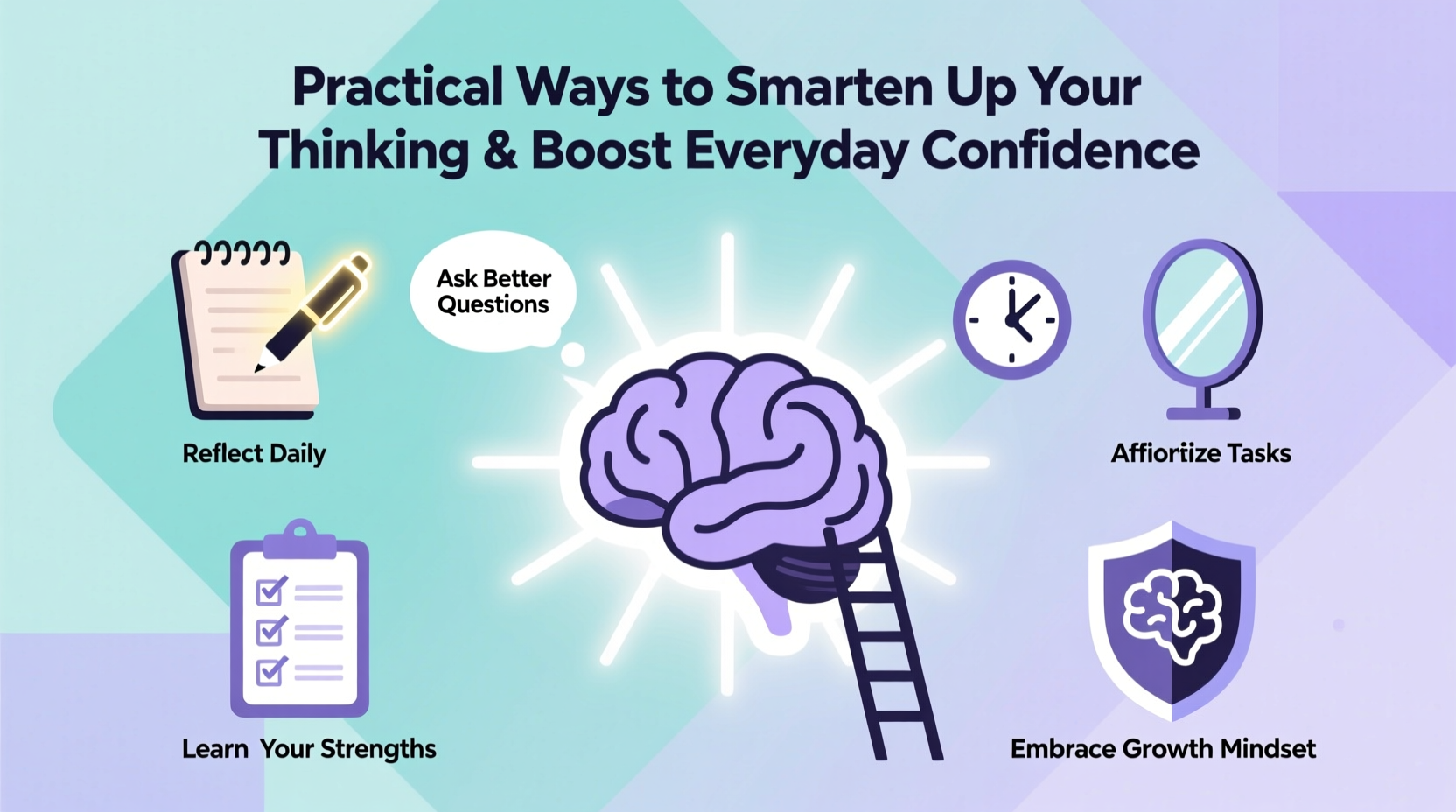
Reflection isn’t just for philosophers. Spending 10 minutes each day reviewing your decisions strengthens self-awareness and improves future judgment. Ask yourself: What went well today? Where did I react emotionally instead of rationally? What could I have said or done differently?
This habit creates a feedback loop for your brain. Over time, you’ll notice patterns—like avoiding difficult conversations or making quick judgments based on limited data. Recognizing these tendencies allows you to interrupt them before they influence your actions.
“Thinking about your thinking is the fastest path to becoming a more capable version of yourself.” — Dr. Sarah Lin, Cognitive Psychologist
A Simple Evening Reflection Routine
- Set a timer for 10 minutes after dinner or before bed.
- List three decisions you made during the day.
- For each, write one sentence on whether it aligned with your goals and values.
- Note one thing you’d adjust if faced with the same situation again.
3. Expand Your Perspective with Diverse Inputs
Your thinking can only be as broad as the information you consume. If you read the same news sources, follow similar people online, or only discuss ideas with those who agree with you, your mental models become narrow. Confidence built on limited perspectives is fragile—it cracks under new evidence or opposing views.
To think smarter, actively seek out voices that challenge your beliefs. Read books outside your field. Listen to podcasts featuring experts in psychology, economics, or history—even if they seem unrelated to your life. You don’t need to adopt every idea, but exposure builds cognitive flexibility.
| Input Type | Recommended Weekly Goal | Benefit |
|---|---|---|
| Non-fiction book (outside your expertise) | 1 chapter | Broadens conceptual thinking |
| Podcast with opposing political view | 1 episode | Reduces confirmation bias |
| Conversation with someone older/younger than you | 1 meaningful exchange | Reveals generational blind spots |
| Article in a scientific journal (summary OK) | 1 summary read | Improves analytical precision |
4. Strengthen Confidence Through Micro-Challenges
Confidence grows not from success alone, but from repeated action despite uncertainty. The most effective way to build it is through micro-challenges—small, slightly uncomfortable tasks that stretch your comfort zone without overwhelming you.
These aren't dramatic leaps; they’re subtle pushes that retrain your brain to see discomfort as safe. Each completed challenge sends a message: *I can handle more than I thought.*
Micro-Challenge Checklist
- Ask a stranger for directions (even if you know them).
- Speak up first in a meeting, even briefly.
- Wear something slightly bolder than usual.
- Send an email requesting feedback from a colleague.
- Say “I don’t know, let me think” instead of guessing.
5. Apply the 70% Rule to Decision-Making
Overthinking paralyzes confidence. Waiting for perfect information or 100% certainty means missing opportunities. Smarter thinkers use the 70% rule: if you have about 70% of the information needed and a reasonable sense of direction, act.
This principle, popularized in military and startup cultures, balances preparation with progress. It acknowledges that some data will only emerge *after* action. Every decision becomes a learning opportunity, not a pass/fail test.
“In high-pressure environments, hesitation is costlier than error. Train yourself to move forward with clarity, not perfection.” — Commander Mark Reyes (Ret.), U.S. Navy Leadership Trainer
Step-by-Step: Using the 70% Rule
- Define the decision you’re facing (e.g., asking for a raise, starting a side project).
- List what information would help you feel fully confident (market rates, approval, resources).
- Identify which 70% of that data you already have.
- Make the move—submit the proposal, send the email, begin the task.
- After acting, record what you learn to improve next time.
Real Example: From Hesitation to Initiative
Julia, a mid-level marketing coordinator, consistently held back in team meetings. She doubted her ideas and feared sounding unprepared. After learning about micro-challenges, she started small: committing to speak at least once per meeting, even if just to agree with someone else’s point.
She paired this with daily reflection, noting when she stayed silent and why. Within three weeks, she asked a clarifying question during a client call—something she’d previously avoided. Her manager later praised her engagement. That single moment shifted her self-perception. Two months later, she pitched a campaign idea that was approved and implemented company-wide.
Her confidence didn’t come from a sudden promotion or external validation. It grew from repeated acts of courage supported by clearer thinking and structured reflection.
FAQ
Can improving thinking skills really boost confidence?
Absolutely. When you trust your ability to analyze situations, make sound judgments, and adapt to new information, you stop doubting yourself in real-time. This internal reliability forms the foundation of authentic confidence.
How long does it take to see results?
Many people notice subtle shifts within two to three weeks of consistent practice—especially with reflection and micro-challenges. Significant changes in behavior and self-perception typically emerge after 6–8 weeks of daily effort.
What if I fail after taking action?
Failure is part of the process. Smarter thinking includes reframing failure as feedback. Ask: What did this teach me? How can I adjust? Each misstep fine-tunes your judgment and builds resilience—the deeper layer of confidence that survives setbacks.
Conclusion
Smarter thinking and lasting confidence aren’t gifts reserved for the naturally gifted—they’re skills forged through daily discipline. By questioning assumptions, reflecting honestly, exposing yourself to new ideas, taking small risks, and acting before you feel ready, you reshape your mental habits and your self-image.
The goal isn’t to eliminate doubt entirely—that’s impossible and unnecessary. It’s to develop a mind sharp enough to navigate uncertainty and a spirit confident enough to move forward anyway. Start tonight: reflect on one decision, challenge one assumption, and plan one small risk for tomorrow.




 浙公网安备
33010002000092号
浙公网安备
33010002000092号 浙B2-20120091-4
Comments
No comments yet. Why don't you start the discussion?