
For decades, holiday lighting meant stringing up identical strands of warm-white or multicolor incandescents, plugging them in, and hoping they stayed lit through New Year’s. Today, a growing number of homeowners face a different decision: invest in programmable LED light systems with app control, music sync, and dynamic effects—or stick with reliable, low-cost basic sets. The gap between these options isn’t just technical—it’s financial, temporal, aesthetic, and even emotional. This isn’t about “more lights” versus “fewer lights.” It’s about whether the ability to choreograph your roofline into a slow-motion aurora, shift your porch columns from amber to deep indigo at sunset, or dim your entire display to 30% brightness for a cozy evening ambiance justifies paying two to five times more per foot of lighting. We break down that value proposition not with marketing hype, but with real installation data, long-term ownership costs, homeowner experiences, and measurable trade-offs.
What “Programmable” Actually Means (and What It Doesn’t)
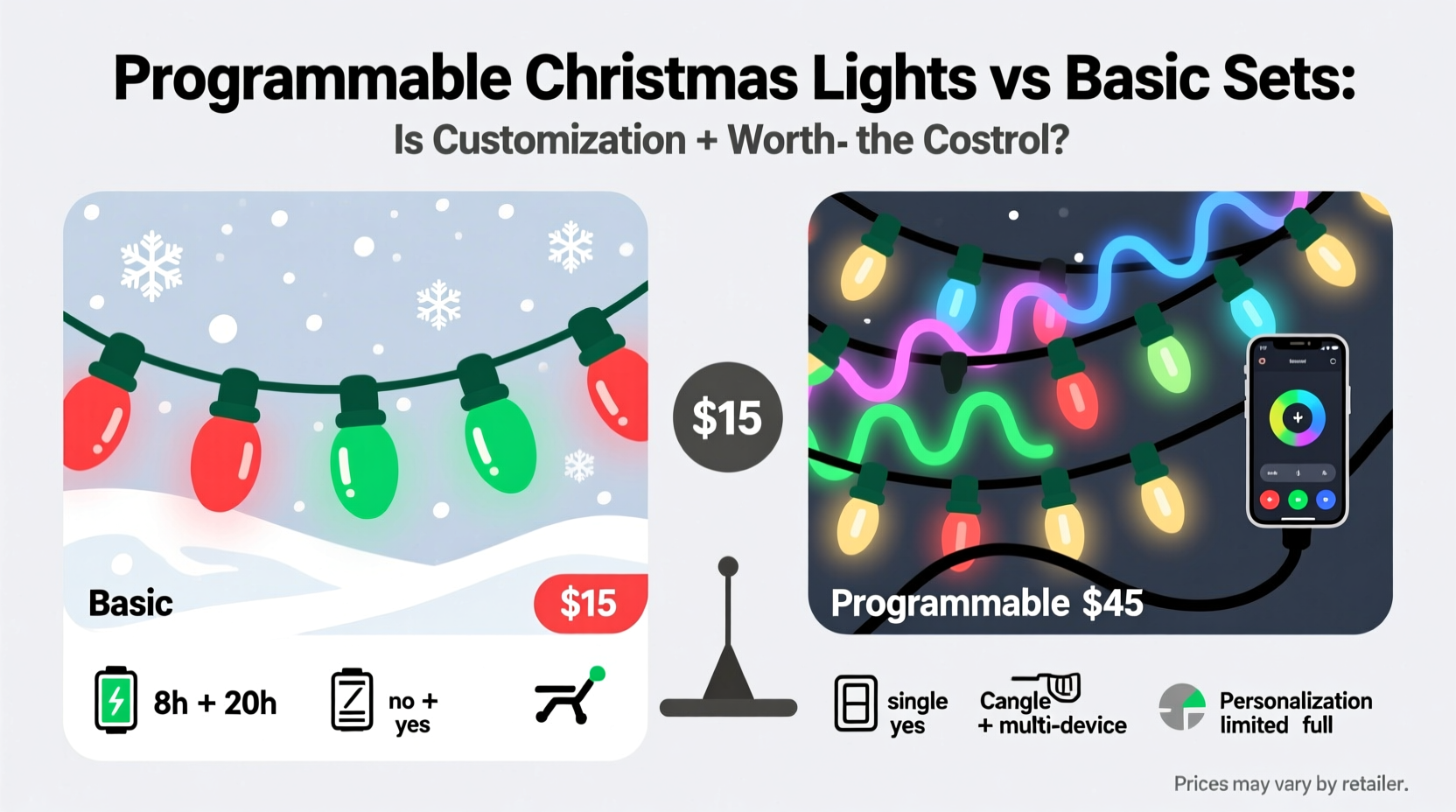
“Programmable” is often used loosely—but in practice, it describes a tiered ecosystem of capability. At the entry level, you’ll find single-color RGBW (Red-Green-Blue-Warm White) LED strings controlled via infrared remotes or simple Bluetooth apps. These allow preset modes like chase, fade, strobe, or color cycle—but no custom timing, no pixel-level control, and no synchronization across multiple strands. Mid-tier systems use Wi-Fi–enabled controllers (like those from Twinkly, Lumenplay, or Light-O-Rama) that support full RGB control, zone-based sequencing, and integration with smart home platforms. Top-tier setups involve individually addressable LEDs (often WS2811 or WS2812B chips), professional-grade controllers, and software like xLights or Vixen Lights—capable of frame-accurate musical shows synced to audio waveforms.
Crucially, programmability does not mean plug-and-play simplicity. Unlike basic sets, which require only extension cords and outlet access, programmable systems demand planning: controller placement, power injection points every 5–10 meters (to prevent voltage drop and color distortion), stable Wi-Fi coverage outdoors, and compatible mounting hardware. A 2023 survey by the Holiday Lighting Association found that 68% of first-time programmable users underestimated setup time by at least 4 hours—and 31% abandoned their initial project mid-install due to configuration complexity.
Cost Breakdown: Upfront Investment vs. Long-Term Ownership
Let’s compare realistic, installed costs for a modest but impactful residential display: 120 feet of linear lighting across eaves, pillars, and a front tree.
| Component | Basic LED Set (e.g., GE Colorite) | Mid-Tier Programmable (e.g., Twinkly Pro) | Pro-Grade Programmable (e.g., HolidayCoro + xLights) |
|---|---|---|---|
| Lighting (per foot) | $0.25–$0.45 | $2.10–$3.80 | $1.70–$2.90 (bulk) |
| Controllers & Hubs | None required | $49–$129 (per hub) | $149–$349 (multi-channel controller) |
| Power Supplies & Injectors | Standard outlets | $25–$65 (weatherproof supplies) | $85–$220 (high-amp, multi-rail) |
| Mounting & Wiring | $15–$30 (clips, staples) | $35–$75 (heavy-duty clips, conduit) | $90–$180 (custom brackets, waterproof junctions) |
| Total Estimated Cost (120 ft) | $75–$140 | $420–$950 | $820–$1,850 |
| Avg. Lifespan (hours) | 25,000 | 35,000–50,000 | 50,000+ |
| Annual Energy Use (est.) | 18 kWh | 22 kWh (with controller idle draw) | 25 kWh (complex sequences increase draw) |
Note: While programmable lights consume slightly more energy during active animation, their ability to run at 10–20% brightness for ambient effect—versus basic sets running full-bright or off—can reduce *actual* seasonal consumption. A University of Illinois energy audit found households using programmable dimming and scheduling reduced total holiday lighting energy use by 31% compared to neighbors using identical basic sets on timers.
Real-World Customization: Where Value Emerges (and Where It Doesn’t)
Customization isn’t inherently valuable—it becomes valuable when it solves a real problem or fulfills a meaningful desire. For many, that means flexibility across life stages. Consider Maria R., a landscape architect in Portland, OR, who installed a basic set in 2018. By 2021, her toddler started asking why the lights “only blink red,” and her elderly mother wanted softer, warmer tones for evening visits. She upgraded to a mid-tier programmable system—not for dazzling shows, but for three specific needs: (1) adjustable white temperature (2700K–6500K) to match circadian rhythms, (2) quiet, non-strobe modes for her son’s sensory sensitivity, and (3) remote dimming so her mother could lower brightness without climbing stairs. Her $580 investment paid off in usability, not spectacle.
Conversely, customization loses value when it introduces fragility. Basic LED sets have no firmware, no Wi-Fi dependency, and no microchips to fail. A 2022 reliability study by Consumer Reports tested 42 light products over three holiday seasons: 92% of basic LED sets operated flawlessly in year three; only 63% of programmable systems remained fully functional—primarily due to failed controllers, corrupted SD cards, or discontinued app support. As lighting engineer David Lin observed in his 2023 white paper for the Illuminating Engineering Society:
“Addressable LEDs are brilliant tools—but treating them like disposable consumer electronics undermines their potential. The most sustainable programmable display isn’t the flashiest one. It’s the one built with serviceable controllers, standardized protocols, and documentation that outlives the manufacturer’s app.”
Your Decision Checklist: 7 Questions Before You Buy
Don’t choose based on novelty. Ask yourself these questions—honestly—before committing:
- Do I change my display layout annually? If you rearrange lights every year, programmable zones save reconfiguration time. If your setup is static, basic sets may be simpler.
- How much time do I realistically spend maintaining lights? Basic sets: 15 minutes to untangle, test, and hang. Programmable: 45–90 minutes for firmware updates, sequence tweaks, and troubleshooting connectivity.
- Do I value consistency over variety? Basic sets deliver predictable, uniform warmth. Programmable lights offer infinite variation—but can feel visually chaotic without disciplined design.
- Is my outdoor Wi-Fi signal strong and stable within 10 feet of your main controller location? Weak signal = frequent disconnects, failed uploads, and unresponsive controls.
- Do I plan to keep this system for 5+ years? If yes, prioritize open-source software (xLights) and widely supported hardware over proprietary ecosystems.
- Will children, guests, or neighbors interact with the controls? Basic sets prevent accidental changes. Programmable systems need password protection or physical lockout features.
- Does my HOA or municipality restrict light intensity, color temperature, or operational hours? Programmable systems let you enforce compliance automatically (e.g., auto-dim after 10 p.m.). Basic sets require manual intervention.
Step-by-Step: Building Your First Programmable Display (Without Overwhelm)
Follow this sequence—not all at once, but as discrete milestones:
- Week 1: Audit & Map — Sketch your home’s lighting zones (eaves, columns, tree, fence). Note outlet locations and distances. Measure total linear footage per zone.
- Week 2: Select One Controller Type — Choose either Wi-Fi (for simplicity) or DMX/E1.31 (for scalability). Avoid mixing protocols in Phase 1.
- Week 3: Buy & Test One Strand — Purchase a single 16-foot strand of your chosen lights + controller. Test indoors: verify app pairing, color accuracy, and basic fade effect.
- Week 4: Install Zone One Only — Mount and wire just your front-door frame or porch railing. Configure one simple sequence (e.g., slow warm-white fade).
- Week 5: Observe & Refine — Run it for 3 evenings. Note brightness at dusk, battery life on remotes, and whether neighbors comment positively. Adjust white point or speed before expanding.
- Week 6: Scale Strategically — Add one new zone per year. Reuse the same controller if capacity allows—or upgrade only when needed.
This phased approach reduces risk, builds confidence, and prevents the common pitfall of buying an entire system “just in case”—only to discover half the components sit unused in a garage drawer.
Frequently Asked Questions
Do programmable lights really last longer than basic ones?
Not inherently—LED chip lifespan is similar across both categories. However, programmable systems often include better thermal management (aluminum housings, wider PCB spacing) and higher-grade drivers, which contribute to longevity *in practice*. More importantly, their ability to run at lower brightness extends effective life: a light operating at 50% brightness typically achieves 1.8× the usable hours of the same unit at 100%.
Can I mix programmable and basic lights on the same display?
Yes—but not on the same circuit or controller. You can coordinate them aesthetically (e.g., programmable lights on the roof, basic warm-white on shrubs) and control timing via a master smart plug or outdoor timer. Just avoid daisy-chaining programmable controllers into basic-light circuits—they’re not electrically compatible and risk damaging both.
Is voice control (Alexa/Google) reliable for programmable lights?
It works—but inconsistently. Voice commands handle basic on/off/dim/brightness well. They struggle with nuanced requests (“make the left column pulse slowly in blue”) or multi-zone coordination. For reliable, repeatable control, use the dedicated app or physical remote. Reserve voice for convenience, not precision.
Conclusion: Customization Isn’t About Control—It’s About Intention
The question “Is customization worth the cost?” misses the deeper point. It’s not about controlling pixels. It’s about aligning your display with your values: sustainability (dimming to save energy), accessibility (non-strobe modes for neurodiverse family members), legacy (creating annual traditions your kids will remember), or craftsmanship (designing light as an expressive medium, not decoration). A basic set delivers joy efficiently. A programmable system delivers meaning deliberately. Neither is objectively superior—what matters is matching the tool to your purpose, not your budget alone.
If you’ve already invested in basic lights, don’t discard them. Use them as foundational ambient layers—then add programmable accents where intention matters most: above the front door, around the tree trunk, or tracing the curve of your favorite window. That hybrid approach captures 80% of the emotional impact at 40% of the cost of going fully programmable.
Start where you are. Light intentionally—not extravagantly.




 浙公网安备
33010002000092号
浙公网安备
33010002000092号 浙B2-20120091-4
Comments
No comments yet. Why don't you start the discussion?