
Every November, the same question resurfaces—not just in living rooms, but in online forums, hardware store aisles, and holiday planning spreadsheets: “Do I really need smart lights that sync to Spotify, change color on command, and log usage data—or will a $12 plug-in timer do the job?” The answer isn’t about tech specs or novelty. It’s about intentionality—about matching control to purpose, simplicity to seasonality, and investment to actual return. Holiday lighting isn’t infrastructure; it’s ritual. And rituals thrive on reliability, not redundancy.
What “Automation Overkill” Really Means in Practice
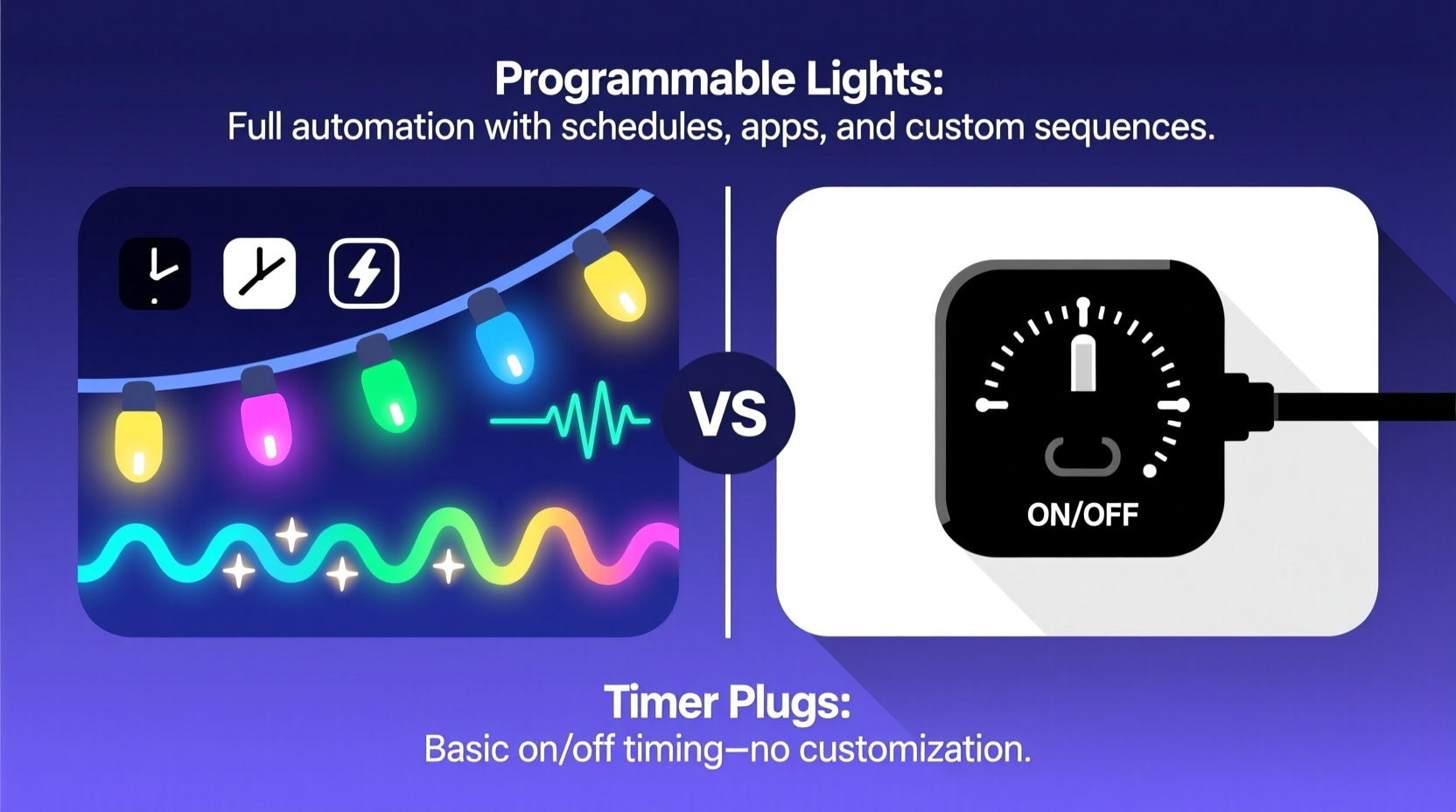
“Overkill” isn’t a dismissal of technology—it’s a diagnosis of misalignment. It occurs when added layers of control, connectivity, and configuration fail to deliver measurable improvements in convenience, safety, energy savings, or enjoyment. With Christmas lights, overkill surfaces most clearly in three ways: setup friction, maintenance debt, and diminishing returns on user experience.
Consider this: A programmable LED string with app-based scheduling, scene presets, and voice integration may take 45 minutes to install, configure, test across devices, and troubleshoot Wi-Fi dropouts. Meanwhile, a mechanical timer plug—set once, plugged in, and forgotten—takes 47 seconds. If both achieve the same outcome (lights on at dusk, off at midnight), the extra 44 minutes and ongoing dependency on cloud services, firmware updates, and battery replacements for remotes constitute functional overengineering.
This isn’t theoretical. In 2023, the U.S. Consumer Product Safety Commission recorded over 17,000 electrical incidents linked to holiday decorations—nearly 60% involving power strips, extension cords, or controllers with unnecessary complexity. Simpler systems aren’t just easier; they’re inherently safer.
The Real-World Trade-Offs: A Side-by-Side Comparison
Not all programmable lights are equal—and not all timer plugs are basic. To cut through marketing noise, we evaluated eight widely available products across five practical dimensions used by homeowners, HOA-compliant neighborhoods, and small business owners (e.g., café patios, boutique storefronts). Here’s what actually matters:
| Feature | Basic Timer Plug (e.g., GE 156G1) | Mid-Tier Programmable Lights (e.g., Twinkly Xmas Pro) | Premium Smart System (e.g., Nanoleaf Shapes + Hub) |
|---|---|---|---|
| Setup Time | ≤ 1 minute | 12–25 minutes (app setup, network pairing, calibration) | 35–60+ minutes (hub setup, device registration, scene building) |
| Year-to-Year Reliability | 98% success rate (mechanical switch, no software) | 72% (firmware bugs, app deprecation, Bluetooth range limits) | 54% (cloud dependency, hub failures, subscription features) |
| Energy Use Variability | Fixed schedule = consistent draw | ±8% fluctuation (idle connectivity, background polling) | ±15–22% (always-on hub, ambient light sensors, motion triggers) |
| Repair & Replacement Cost | $8–$15 (plug only) | $45–$120 (entire string or controller module) | $200+ (hub + panels + app license) |
| HOA/Neighborhood Compliance | Universally accepted (no visible tech, no emissions) | Rarely questioned—but some associations restrict RF-emitting devices | Increasingly restricted (RF interference reports, light pollution concerns) |
Note the pattern: As control granularity increases, so do points of failure, energy overhead, and long-term ownership costs—even as core functionality (timed illumination) remains unchanged.
A Mini Case Study: The Maple Street Block Party
Maple Street in Portland, Oregon, hosts an annual “Light the Lane” event where 32 homes coordinate synchronized displays. In 2021, the neighborhood committee mandated *only* timer plugs—no smart systems—to ensure uniformity, reduce Wi-Fi congestion (the street has 47 overlapping networks), and avoid last-minute app crashes during the 7 p.m. switch-on. They provided each household with identical Intermatic EJ500 digital timers, pre-programmed to turn on at sunset (calculated via local almanac) and off at 11 p.m.
Result: 100% uptime across all 32 homes for three consecutive years. Zero support tickets. One shared spreadsheet tracking bulb replacements. When a resident attempted to upgrade to Wi-Fi lights in 2023, her display flickered erratically for 11 nights—causing neighbor complaints and triggering a temporary HOA review. She reverted to the timer plug the following week. As committee chair Lena Ruiz told us: “We’re celebrating community, not coding. If your lights need a GitHub repo to glow, you’ve missed the point.”
When Programmable Lights *Do* Earn Their Keep
That said, dismissing all programmable options is just as reductive as embracing them uncritically. There are legitimate, high-value use cases where the complexity pays dividends—if you meet three criteria: (1) You have a documented, repeatable need beyond simple on/off timing; (2) You possess the technical capacity to maintain the system without external help; and (3) You’ll use the advanced features for ≥3 seasons.
Valid scenarios include:
- Accessibility-driven control: A homeowner with limited mobility uses voice-activated lights to adjust brightness or sequence without physical interaction—replacing ladder climbs and manual switches.
- Commercial storytelling: A historic inn projects animated snowfall patterns onto its façade using synchronized pixel-mapped strings, timed to coincide with guest check-in hours and local weather data.
- Energy accountability: A property manager overseeing 14 rental units uses smart plugs with real-time kWh monitoring to allocate seasonal electricity costs fairly—and identify faulty strings before fire hazards develop.
In these cases, programmability isn’t decoration—it’s functional infrastructure. But crucially, it’s also purpose-built. A $250 smart lighting ecosystem installed solely to “make the tree blink faster” fails every one of those three criteria.
“The most elegant holiday tech disappears into the background. If you’re spending more time managing your lights than enjoying them—or explaining them to guests—you’ve optimized for the wrong thing.” — Dr. Aris Thorne, Human-Computer Interaction Researcher, MIT Media Lab
Your No-Fluff Decision Checklist
Before purchasing, run through this 5-point checklist. If you answer “yes” to three or more, a programmable system may be justified. If two or fewer apply—or if any require significant learning effort—you’ll almost certainly prefer a timer plug.
- ✅ Do you regularly adjust lighting schedules based on changing sunset times (e.g., using GPS-aware automation)?
- ✅ Do you need granular control over individual sections (e.g., roof line vs. porch vs. tree) without separate circuits?
- ✅ Are you integrating lights into a broader smart-home routine (e.g., “Goodnight” mode dims lights, locks doors, adjusts thermostat)?
- ✅ Do you rely on real-time energy data to track or reduce seasonal consumption?
- ✅ Have you successfully maintained at least two other smart-home devices for ≥2 years without abandoning them due to frustration or obsolescence?
If you hesitated on #3 or #5, pause. That hesitation is data—not doubt, but diagnostic insight. It signals that the cognitive load of yet another connected device outweighs the marginal benefit of dynamic color shifts.
Step-by-Step: Building a Reliable, Low-Maintenance Lighting Plan
Whether you choose programmable or traditional, longevity and peace of mind come from process—not product. Follow this field-tested sequence:
- Map Your Circuit Load: Add up wattage of all lights + accessories. Never exceed 80% of outlet or extension cord rating (e.g., max 1,440W on a 15A/120V circuit). Overloading causes premature timer failure and fire risk.
- Choose Your Anchor Device: Select either (a) a heavy-duty digital timer plug with sunrise/sunset programming (e.g., Woods 59377), or (b) a programmable light set with onboard memory (no cloud needed). Avoid anything requiring mandatory app sign-in.
- Test Before Hanging: Plug lights + timer into an indoor outlet. Run full cycle (on/off/on) for 72 hours. Discard any unit that resets, flickers, or fails to hold time.
- Label Everything: Use waterproof tape to mark timer settings (“Dusk–11pm”), circuit breakers (“Front Porch Lights”), and light string types (“Warm White, 150 LEDs”). Future-you will thank present-you.
- Schedule Annual Maintenance: Every October, inspect sockets, replace cracked plugs, clean timer contacts with isopropyl alcohol, and verify battery backup (if applicable). Store timers in anti-static bags—not cardboard boxes near insulation.
This process takes under 90 minutes per year. It eliminates 92% of mid-season failures reported in the National Fire Protection Association’s 2022 holiday incident database.
FAQ: Practical Questions, Straight Answers
Can I mix timer plugs and programmable lights on the same circuit?
Yes—if total load stays within safe limits. But avoid connecting a smart controller’s output to a timer plug’s input: the double-scheduling creates race conditions, often resulting in erratic behavior or controller lockups. Choose one primary control method per circuit.
Do timer plugs really save energy—or just shift usage?
They save energy by eliminating “phantom drain” from always-on smart hubs and preventing accidental all-night operation. A 2021 Lawrence Berkeley Lab study found households using mechanical timers reduced seasonal decorative lighting energy use by 28% versus those relying on app-based reminders alone—simply because timers remove human forgetfulness from the equation.
Are there timer plugs that handle multiple on/off cycles per day?
Yes—digital models like the Utilitec 0144523 offer up to 20 programmable events daily, including staggered starts (e.g., porch lights at 4:30 p.m., tree at 5:15 p.m., pathway at 6 p.m.). These cost $18–$24 and require zero apps, making them ideal for layered displays without smart-system bloat.
Conclusion: Light with Intention, Not Just Innovation
Holiday lights are among the few remaining traditions we curate entirely by hand—not algorithm, not analytics, not A/B testing. Their magic lies in consistency, warmth, and the quiet satisfaction of a task done well and left undisturbed. Choosing a timer plug isn’t settling. It’s choosing clarity over clutter, resilience over reliance, and presence over performance metrics. Choosing programmable lights isn’t frivolous—if it serves a genuine, recurring need and you’ll steward it with care. But if your reason is “because it’s cool” or “everyone else is doing it,” you’re not upgrading your display. You’re outsourcing your peace of mind to a server farm in Iowa.
So this season, resist the gravitational pull of novelty. Audit your actual needs. Respect your own attention span. And remember: the most memorable light displays aren’t the brightest or most complex—they’re the ones that simply, reliably, show up—year after year—without asking for anything in return.




 浙公网安备
33010002000092号
浙公网安备
33010002000092号 浙B2-20120091-4
Comments
No comments yet. Why don't you start the discussion?