
Lighting does more than illuminate—it sets mood, enhances design, and supports function. As homes and spaces become smarter, the demand for precise lighting control has grown. Two popular options dominate decorative and functional lighting: programmable LED strips and standard string lights. While both serve aesthetic purposes, their capabilities in control, adaptability, and integration vary significantly. Understanding these differences is essential for making informed decisions that align with your project goals, whether it's ambient bedroom lighting or a dynamic outdoor display.
Understanding the Core Differences
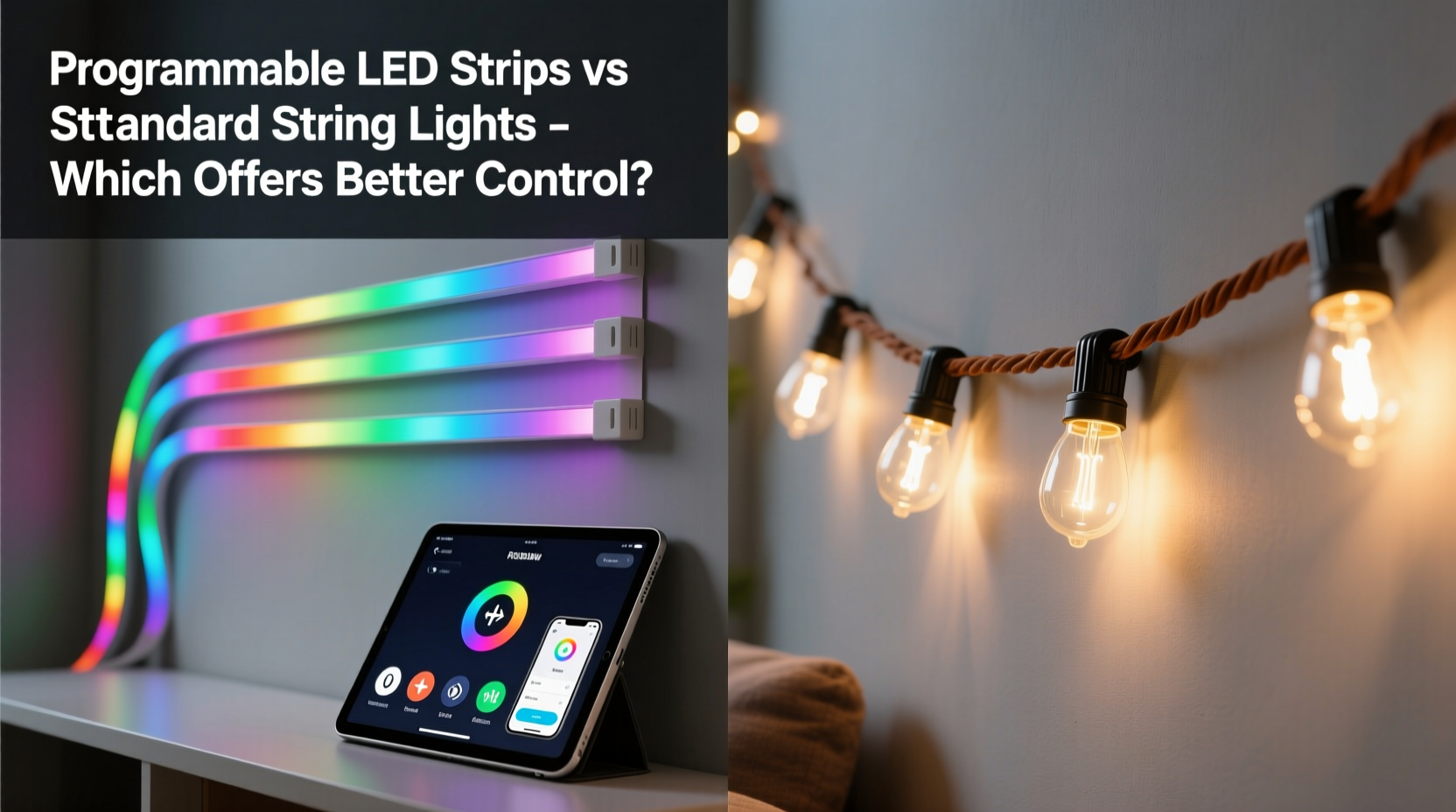
The fundamental distinction between programmable LED strips and standard string lights lies in their architecture and responsiveness. Standard string lights—often seen during holidays or in café patios—are typically a series of bulbs connected by a wire, powered directly from an outlet. They offer limited functionality: on/off switching, perhaps a few preset modes like twinkling or fading, and sometimes a timer. Their simplicity makes them accessible, but also restrictive.
In contrast, programmable LED strips consist of densely packed surface-mounted LEDs mounted on a flexible circuit board. These are often addressable, meaning each LED—or group—can be controlled individually via microcontrollers like Arduino, ESP32, or Raspberry Pi, using protocols such as WS2812B (NeoPixel) or APA102. This allows for complex animations, color gradients, synchronization with music, and integration into smart home ecosystems.
The key differentiator? Control. Programmable LED strips don’t just light up—they respond, react, and evolve based on user input or environmental triggers. This level of interactivity opens possibilities far beyond what standard string lights can achieve.
Control Capabilities Compared
When evaluating “better control,” consider factors like precision, flexibility, automation, and personalization. Here’s how the two options stack up:
1. Individual Light Management
Standard string lights operate as a single unit. Flip the switch, and every bulb turns on with the same color and brightness. There's no way to adjust one section without affecting the whole strand.
Programmable LED strips allow per-LED control. You can set the first third to pulse blue, the middle to glow warm white, and the end to fade through reds—all simultaneously. This granularity enables creative designs, such as simulating sunrise effects across a ceiling or highlighting architectural features selectively.
2. Color Range and Mixing
Most standard string lights come in fixed colors—either monochromatic (e.g., warm white) or multicolor sets where all bulbs cycle together. True RGB mixing isn't possible; you get pre-set combinations at best.
Programmable strips use RGB (or RGBW) LEDs capable of producing over 16 million colors through digital blending. With software control, you can dial in exact hues, saturations, and brightness levels, matching brand colors, seasonal themes, or even syncing to screen content.
3. Dynamic Effects and Timing
Basic string lights may include rudimentary effects like chasing, slow fade, or twinkle—but these are hardcoded and non-adjustable. You cannot modify speed, direction, or pattern sequence.
With programmable strips, effects are software-defined. You can create custom chases, breath effects, sound-reactive pulses, or meteor simulations. Libraries like FastLED or WLED make it easy to code or configure advanced behaviors without deep programming knowledge.
4. Integration and Automation
Standard string lights rarely support smart home platforms unless they’re part of a Wi-Fi-enabled product line (like some Philips Hue strings). Even then, control is usually limited to app-based on/off and color changes.
Programmable LED strips can connect to MQTT brokers, Home Assistant, Alexa, or Google Home via compatible controllers. This means you can trigger lighting scenes based on time of day, motion detection, weather conditions, or media playback. For example, lights could turn red when a doorbell rings or dim automatically at sunset.
“Addressable LEDs transformed how we approach ambient lighting. It’s no longer about illumination—it’s about interaction.” — Daniel Park, Smart Lighting Engineer at Lumen Dynamics
Practical Comparison: Features at a Glance
| Feature | Programmable LED Strips | Standard String Lights |
|---|---|---|
| Individual LED Control | Yes (addressable) | No |
| Color Customization | Full RGB/RGBW spectrum | Fixed or limited presets |
| Effect Flexibility | Customizable via code/apps | Pre-programmed only |
| Smart Home Integration | Yes (via WLED, Tasmota, etc.) | Rarely, unless branded smart |
| Installation Complexity | Moderate (requires power & data wiring) | Low (plug-and-play) |
| Long-Term Adaptability | High (reprogrammable anytime) | None |
| Cost (per meter/foot) | Higher upfront | Lower |
Real-World Application: A Home Theater Upgrade
Consider Mark, a DIY enthusiast who wanted to enhance his basement home theater. His initial setup used standard string lights behind the screen for ambiance. While pleasant, the effect was static—always the same soft white glow regardless of the movie genre.
Dissatisfied with the lack of immersion, he replaced them with WS2812B programmable LED strips connected to a NodeMCU running WLED firmware. Using a simple configuration, he programmed the lights to:
- Shift to deep red during horror films
- Pulse gently with bass tones in action scenes
- Display rainbow chase effects during kids’ movie nights
- Automatically dim when the projector starts
He integrated the system with his Home Assistant dashboard, allowing voice commands and scene triggers. The result wasn’t just better lighting—it was responsive environment design. Where standard string lights offered decoration, programmable strips delivered experience.
Step-by-Step: Setting Up a Programmable LED System
Transitioning from passive lighting to active control requires planning. Follow this guide to deploy a functional, customizable setup:
- Define Your Layout: Measure where you want lights installed—under cabinets, around ceilings, behind TVs. Note total length needed.
- Select Components: Choose addressable strips (e.g., WS2812B), a compatible microcontroller (ESP8266 recommended), a power supply (5V or 12V depending on strip), and connectors.
- Plan Power Distribution: Long runs require supplemental power injection every 3–5 meters to prevent voltage drop and color distortion.
- Install Hardware: Mount strips using adhesive backing or clips. Connect data lines and power, ensuring polarity is correct.
- Flash Firmware: Upload WLED or FastLED-based code to your controller. WLED is ideal for beginners due to its web interface.
- Connect to Network: Configure Wi-Fi settings so the device appears on your local network.
- Configure Effects: Access the WLED dashboard via browser to choose colors, effects, speeds, and palettes.
- Integrate with Smart Systems: Add the device to Home Assistant or use IFTTT for automations like \"turn on rainbow mode when I start gaming.\"
This process takes a few hours for a beginner but results in a highly adaptable system that evolves with your needs.
When Standard String Lights Still Make Sense
Despite their limitations, standard string lights have enduring appeal. They excel in scenarios where simplicity, portability, and cost matter most:
- Temporary Decorations: Holiday trees, wedding venues, or patio setups where lights are used seasonally.
- Rental Properties: Tenants who need removable, non-permanent installations without drilling or soldering.
- Budget Constraints: For users who only want basic ambiance without investing in controllers or learning new tools.
However, even in these cases, hybrid solutions exist. Some plug-and-play smart string lights now offer app control and limited color tuning. But they still fall short of the granular, real-time control provided by true programmable systems.
FAQ: Common Questions Answered
Can I cut and reconnect programmable LED strips?
Yes, most strips have designated cut points (usually every 3 or 6 LEDs). After cutting, you can solder wires or use clip connectors to rejoin segments. Just ensure data flow direction is maintained.
Do programmable LED strips use more power?
Power consumption depends on brightness and number of lit LEDs. At full white, they can draw more than standard incandescent strings, but modern LEDs are efficient. A 5V, 60-LED/meter strip uses about 18W per meter at maximum. Dimming and selective activation reduce usage significantly.
Are programmable LED strips difficult to maintain?
Maintenance is minimal. The electronics are solid-state with no moving parts. Avoid moisture unless using waterproof-rated versions. Clean dust with a dry cloth. Firmware updates may be needed occasionally for security or feature improvements.
Final Verdict: Which Offers Better Control?
The answer is unequivocal: programmable LED strips provide vastly superior control. They transform lighting from a static backdrop into an interactive element of your environment. While standard string lights serve well for simple, temporary applications, they lack the responsiveness, precision, and scalability required for modern lighting demands.
For anyone seeking dynamic color shifts, synchronized effects, automation, or future-proof adaptability, programmable LED strips are not just better—they are essential. The initial learning curve and higher cost are offset by long-term versatility and performance. Once you’ve experienced lights that respond to music, shift with the time of day, or highlight specific moments in your space, returning to fixed-function string lights feels limiting.
“The difference between standard and programmable lighting is like comparing a flip phone to a smartphone. One makes calls. The other connects, adapts, and transforms.” — Lena Torres, IoT Lighting Consultant
Take Action: Start Your Lighting Evolution
If you're ready to move beyond basic illumination, start small. Purchase a 1-meter roll of addressable LED strip, an ESP8266 module, and a 5V power supply. Flash WLED firmware, connect via Wi-Fi, and experiment with effects. Within an hour, you’ll see firsthand how much more expressive lighting can be.
Share your first project online, join communities like r/WLED or r/DIYLighting, and build from there. Whether enhancing a workspace, creating mood lighting, or building a full-home ambient system, the control is literally in your hands—and your code.




 浙公网安备
33010002000092号
浙公网安备
33010002000092号 浙B2-20120091-4
Comments
No comments yet. Why don't you start the discussion?