
Lighting is no longer just about illumination—it’s a design language. Whether you’re outlining a bookshelf, animating a gallery wall, or setting mood in your living room, the choice between programmable LED strips and standard light strings shapes not only aesthetics but functionality, longevity, and user experience. Programmable strips—often addressable RGBW models controlled via apps, DMX, or microcontrollers—offer pixel-level control, dynamic effects, and integration with smart ecosystems. Standard light strings (incandescent, warm-white LED, or basic multicolor sets) deliver simplicity, affordability, and nostalgic charm—but with fixed patterns and limited adaptability. This article cuts through marketing hype to compare real-world performance, installation realities, and, most importantly, twelve inventive, tested applications where each type shines—not as competitors, but as complementary tools in a thoughtful lighting toolkit.
Core Differences: Beyond Brightness and Color
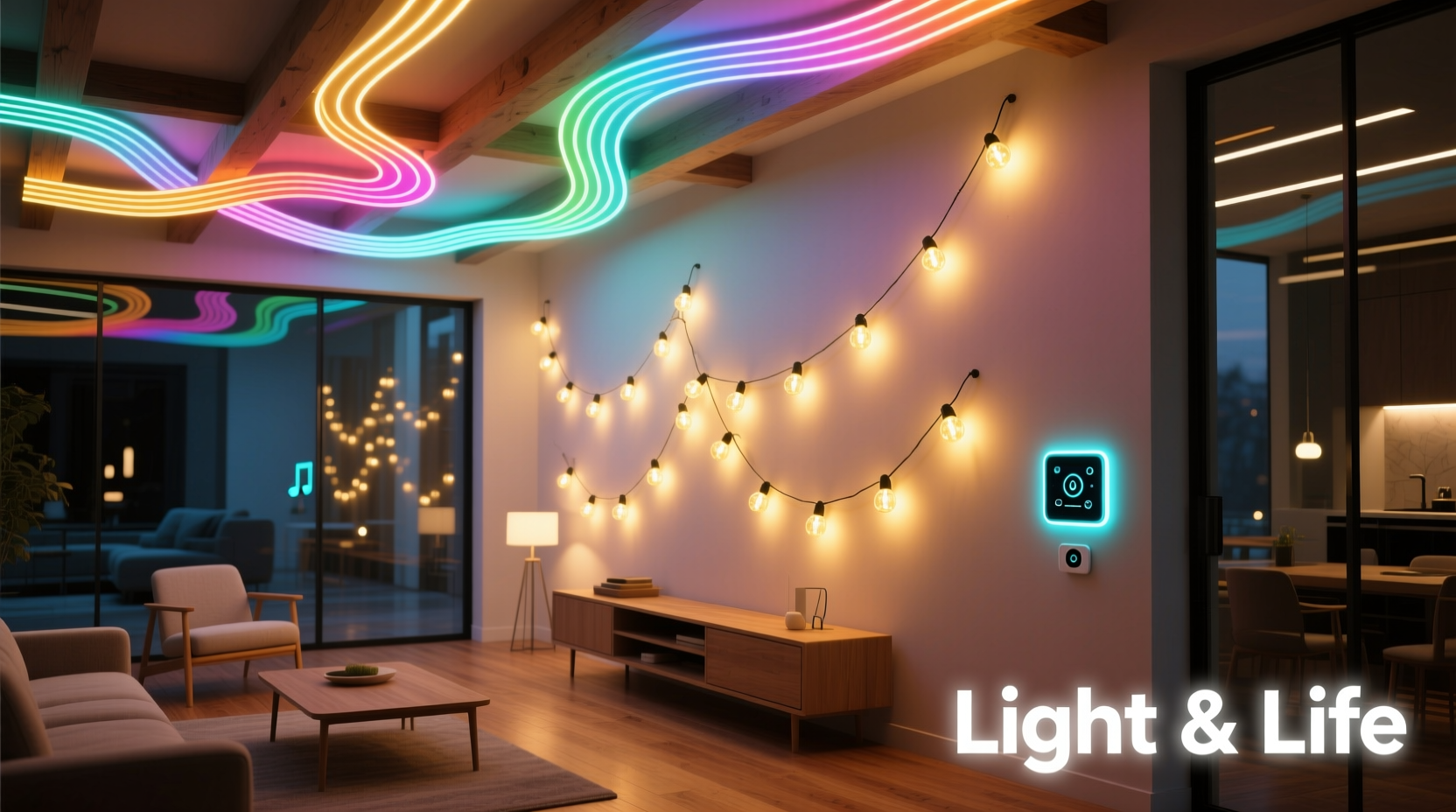
Understanding the technical and experiential divide helps avoid costly missteps. Programmable LED strips (e.g., WS2812B, SK6812, or APA102 models) consist of individually addressable LEDs mounted on flexible PCBs. Each diode can be assigned unique hue, saturation, brightness, and timing—enabling smooth gradients, reactive motion, and synchronized scenes. They require a controller (like an Arduino, Raspberry Pi, or commercial hub), power supply matching voltage and amperage, and often custom mounting (adhesive backing, aluminum channels, or silicone casing). Standard light strings are pre-wired, plug-and-play units—typically 20–100 bulbs per strand—with fixed wiring, non-addressable circuits, and limited control (on/off, static color, or basic chase modes via built-in timers).
The distinction isn’t merely “smart vs. dumb.” It’s about intentionality. A programmable strip invites iteration: tweaking fade durations at 2 a.m., syncing to Spotify audio analysis, or fading from amber to deep indigo over 90 minutes to mimic sunset. A standard string offers reliability: it works the moment you unbox it, survives outdoor rain without sealed connectors, and rarely needs firmware updates or troubleshooting Wi-Fi dropouts.
| Feature | Programmable LED Strips | Standard Light Strings |
|---|---|---|
| Control Precision | Pixels adjustable individually; supports complex animations, sound reactivity, time-based schedules | Entire string or section only; typically 3–5 preset modes (steady, twinkle, fade, chase) |
| Installation Flexibility | Cuttable every 1–3 LEDs; bendable around curves; requires power injection for runs >5m | Fixed length; bulbs spaced evenly; minimal customization beyond daisy-chaining compatible sets |
| Durability & Environment | IP65+ common for outdoor use; sensitive to voltage spikes and improper grounding | Robust plastic housings; many rated IP44–IP67; less prone to cascade failure if one bulb burns out |
| Energy Use (per meter) | 6–18W/m depending on density and brightness (e.g., 60 LEDs/m @ 50% brightness = ~9W) | 2–8W/m (incandescent: 4–10W/m; modern LED strings: 2–4W/m) |
| Lifespan | 25,000–50,000 hours (with proper heat dissipation and stable power) | 15,000–30,000 hours (LED); incandescent: 1,000–2,000 hours |
Creative Use #1: Architectural Accenting—Subtlety vs. Statement
Under-cabinet lighting in kitchens demonstrates how both types serve distinct roles. Programmable strips excel when layered intention matters: install a 3000K white strip for task lighting, then mount a second RGBW strip *above* the cabinet valance, aimed upward to wash the ceiling with soft, adjustable ambient light. With a scheduler, it shifts from cool daylight (5000K) during meal prep to warm amber (2200K) at 8 p.m., reducing blue light exposure before sleep. Standard strings? Perfect for open shelving with glass backs. Drape a warm-white micro-string (2mm diameter, 100 bulbs) along the rear edge—its gentle, uniform glow highlights objects without glare or shadows, and its low profile remains invisible from the front. No app needed. Just plug in and appreciate the quiet elegance.
Creative Use #2: Art Installation & Gallery Lighting
A local mixed-media artist, Lena Rostova, recently transformed her studio gallery using both technologies in tandem. For her kinetic sculpture “Tide Cycle,” she embedded 2m of programmable strip behind translucent acrylic panels. Using a Raspberry Pi and custom Python script, the LEDs pulse in slow, wave-like sequences—brightness rising and falling across the strip to simulate water movement, synced to a subtle audio loop of ocean recordings. Meanwhile, above the entrance archway, she hung three parallel strands of vintage-style Edison bulb strings (standard, non-dimmable). Their warm, filament-based glow creates a welcoming threshold—consistent, human-scale, and emotionally resonant. “The programmable strip tells the story,” she explains. “The standard strings set the tone. One is narrative; the other is atmosphere.”
“The most compelling installations don’t rely on technology alone—they use the right tool to serve the human experience first.” — Diego Mendoza, Lighting Designer, Studio Lumina Collective
Creative Use #3: Functional Wayfinding & Safety
In stairwells, basements, or narrow hallways, lighting must balance visibility and calm. Programmable strips offer precision: mount a low-profile 5V strip under each tread (cut to exact depth), set to emit only 5% brightness in warm white (2700K) when motion is detected—enough to see step edges without disrupting night vision. Pair with a PIR sensor and timer to auto-off after 30 seconds. Standard strings shine in broader safety contexts: wrap a 20-foot warm-white string around the perimeter of a garage workbench. Its even, diffuse output eliminates harsh shadows where tools are handled, and its plug-and-play nature means it’s operational within 90 seconds—no coding, no drivers, no risk of misconfiguring voltage. For rental apartments or temporary setups, this reliability is non-negotiable.
Creative Use #4: Seasonal & Thematic Transformation
Seasonal decor demands flexibility and speed. Programmable strips enable rapid thematic pivots: a single 5m strip behind a mantelpiece can shift from crisp red/green gradients (Christmas), to pulsing orange/amber (Halloween), to pastel pink/lavender swirls (Spring), all via app presets—no physical restringing. But standard strings retain irreplaceable charm for tradition-driven displays. Think of a porch railing draped with C7 bulbs in classic red-and-green alternating pattern, or a child’s bedroom ceiling strung with battery-operated fairy lights shaped like stars and moons. Their tactile familiarity—the slight warmth of incandescent bulbs, the gentle hum of older transformers—carries emotional weight that algorithms can’t replicate. Use programmable strips for the dynamic centerpiece (e.g., animated snowfall on a window), and standard strings for the comforting frame (e.g., steady white outlines on window frames).
Creative Use #5: Interactive Learning & Maker Spaces
In classrooms or makerspaces, programmable strips are pedagogical gold. Students wire them to micro:bits or Circuit Playground boards to learn sequencing, loops, and conditional logic—creating a “traffic light” simulator or a plant-moisture indicator (green = hydrated, red = dry). The immediate visual feedback reinforces abstract concepts. Standard strings, meanwhile, teach foundational electrical principles safely: students connect multiple strands in series/parallel, measure voltage drop across 10m runs, or test insulation integrity with a multimeter—all without risking damage from incorrect data signals or ground loops. One middle school STEM lab uses both: programmable strips for final project demos, standard strings for hands-on circuit labs. The contrast makes theory tangible.
Step-by-Step: Installing a Hybrid Shelf Lighting System
Here’s how to combine both types in a single, cohesive application—floating shelves in a home office:
- Measure & Plan: Determine shelf depth (e.g., 25cm) and total linear meters needed. Allocate 70% for programmable strip (under-front lip for task lighting), 30% for standard string (rear valance for ambient fill).
- Mount Programmable Strip: Clean shelf underside, peel adhesive backing, press strip firmly into place. Cut only at marked points. Connect to controller and 12V power supply (ensure 20% headroom on wattage).
- Install Aluminum Channel (Critical): Snap extruded aluminum channel over strip—this dissipates heat and diffuses light evenly. Secure channel with screws or double-sided tape.
- Position Standard String: Use small clear hooks to suspend a 2m warm-white micro-string 5cm behind the shelf back edge. Ensure bulbs face upward toward ceiling.
- Power & Sync: Plug both into separate outlets—or use a smart plug for the standard string to turn on/off with the programmable system’s main schedule. No need for sync; let the standard string provide constant baseline light while the programmable strip adds adaptive layers.
Checklist: Choosing the Right Type for Your Project
- ✅ Need precise color control or animation? → Choose programmable strips.
- ✅ Installing outdoors in freezing or high-humidity conditions? → Prioritize standard strings with IP67 rating or programmable strips in fully sealed aluminum channels.
- ✅ Working in a rental or temporary space? → Standard strings win—no permanent adhesive, no controller setup, no risk of voiding insurance with DIY electronics.
- ✅ Designing for accessibility (e.g., dementia care)? → Standard strings with consistent, non-flickering output reduce cognitive load better than dynamic effects.
- ✅ Building a long-term smart home ecosystem? → Programmable strips integrate with Matter, Home Assistant, or Apple HomeKit—enabling voice, automation, and cross-device triggers.
FAQ
Can I cut and reconnect a standard light string?
Most modern LED strings are not designed for user cutting. Cutting interrupts the series circuit—often rendering the entire strand inoperable. Some higher-end commercial strings have designated cut marks and include solderless connectors, but these are exceptions. Programmable strips, by contrast, are engineered for cutting (at copper pads) and reconnection via soldering or JST connectors.
Do programmable strips cause more eye strain than standard strings?
Not inherently—but poor implementation does. Flicker-free PWM drivers and avoiding rapid strobes or high-contrast animations reduce fatigue. Standard strings using quality constant-current drivers also minimize flicker. Always select products certified to IEEE 1789-2015 for low-risk flicker, regardless of type.
How do I prevent color shift over time?
Heat is the primary culprit. Programmable strips degrade faster if mounted directly to wood or enclosed without ventilation. Use aluminum channels and limit sustained brightness to ≤70%. Standard strings with quality phosphor-coated LEDs (look for CRI >90) maintain color fidelity longer than budget sets with inconsistent binning.
Conclusion
Choosing between programmable LED strips and standard light strings isn’t about picking a winner—it’s about recognizing that lighting, at its best, serves dual masters: human emotion and functional intelligence. The warm, unwavering glow of a standard string evokes memory, comfort, and simplicity. The responsive, evolving presence of a programmable strip enables expression, adaptation, and interactivity. In practice, the most compelling spaces use both: the programmable strip as the conductor, shaping light’s rhythm and tone; the standard string as the foundation, offering stability and soul. Whether you’re illuminating a child’s reading nook, highlighting architectural details in a loft, or designing immersive retail environments, start by asking not “Which is better?” but “What feeling do I want this light to carry—and what task must it perform?” Then reach for the tool that answers both questions. Your space—and your peace of mind—will reflect that clarity.




 浙公网安备
33010002000092号
浙公网安备
33010002000092号 浙B2-20120091-4
Comments
No comments yet. Why don't you start the discussion?